![Do extra threads or longer thread cost more? | The attachment and service determine the fee [OK Prostate Chip]](/img/a/T0296/eyecatch.svg)
This page is based on entries from "ok-lab's diary" (https://ok-lab.hatenablog.com/), the Japanese development diary written by Mr. Okada, founder of OK Lab, a small company in Japan (Okada Comfortable Life Laboratory). Only the entries about "extra thread and extension costs" are summarized here, in order of publication. Past prices and sizes are as written at the time. Current prices come from the official product list (retrieved September 4, 2026). Quotations are translated from Japanese.
Note: This page is a personal reading log by someone with no connection to the maker or the seller. It reflects the source entries as of their publication dates and makes no guarantee of accuracy or safety. The product is not a medical device; talk to a doctor about any health decision. Check the official site for current information. This page contains advertising.
In short
- Extra thread costs depend on attachment points, length, material, and accessories.
- The maker distinguished ordinary paired threads from separately attached threads, extensions, and four-thread builds.
- The current list includes additional nylon thread and loop-ended extension thread, but does not confirm every historical custom option.
If you see blood in your urine, even a small amount or for the first time, do not wait and see. See a urologist right away.
If you suddenly cannot urinate, or the device cannot be removed, do not try to fix it yourself. Go to a medical facility, including emergency care, immediately.
About this product

The OK Prostate Chip is a small device that is placed in the urethra (the urine passage) so that it acts on the prostate; the maker sells it in several shapes, sizes and materials. It is made and sold by OK Lab (Okada Comfortable Life Laboratory), a small company in Japan, through its own online store, and prices are in Japanese yen (JPY). The maker's development diary, "ok-lab's diary", is written in Japanese. This page is an English summary of it, and every quotation is translated. OK Lab ships internationally, so readers outside Japan can order (see "Buying from outside Japan" below). Product names on this page are plain-English descriptions. The official Japanese product name is shown once in the product table so you can find the same item in the store.
Before you read: key terms
| Term | Plain-English meaning |
|---|---|
| Urethra | The urine passage, where the device is placed. |
| Retrieval thread | Thread attached to the chip, intended for removal. |
| Safety chip | An end fitting used to bring the thread lengths together. |
| Thread extension | Additional thread supplied to lengthen an existing thread system. |
| Stopper | An accessory intended to help hold the system in place. |
| Nitinol thread | Thin shape-memory wire proposed as an alternative to nylon thread. |
What happens: extra thread costs
The OK Prostate Chip is a small device placed in the urethra (urine passage) to act on the prostate. Nylon retrieval thread (thread intended for removal) connects to the chip and can extend outside the body. The entries discuss its number, length, attachment points, and end fittings, because these details affected quoted work and compatible accessories. Some later designs replaced nylon with wire or omitted the thread.
Two threads kept the embedding fee unchanged, but accessories cost extra
In an entry published in April 2019, the embedding charge was unchanged for 1 or 2 threads. However, the paired version omitted the normally supplied safety chip (an end fitting that brings thread lengths together).
Six-hole accessories cost ¥500 (about $3 at ¥156 = $1, rate as of 2026-09-04) excluding tax more than three-hole versions. Mr. Okada recommended the separately sold six-hole safety chip for bringing the two thread lengths together.
(Source: ok-lab's diary, published April 2019)
https://ok-lab.hatenablog.com/entry/2019/04/27/153239
A trapped ceramic chip prompted development of an extra retrieval thread
In an entry published in September 2020, a customer reported being unable to remove a sea-slug ceramic Ver.4 chip. The customer wanted help and also reported some bleeding. Mr. Okada identified the attachment point, offset toward one end from the chip’s center of gravity, as one possible reason.
The customer subsequently reported successful removal the following day; that outcome does not establish safety for another case. Mr. Okada’s reply included seeking a urologist’s help when removal was unsuccessful.
(Source: ok-lab's diary, published September 2020)
https://ok-lab.hatenablog.com/entry/2020/09/05/095734
A loop-ended thread extension received its own price and dimensions
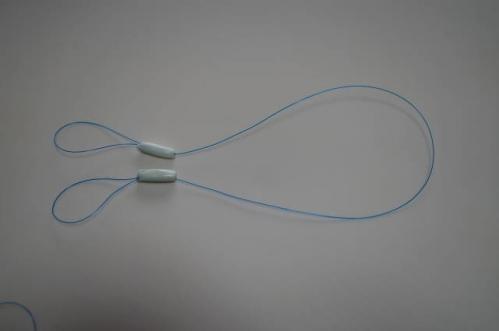
In an entry published in January 2021, Mr. Okada introduced an extension specifically for thread systems ending in a loop. It comprised 20cm of nylon thread plus loops approximately 2cm in diameter at both ends.
The published price was ¥500 (about $3 at ¥156 = $1, rate as of 2026-09-04) excluding tax. Mr. Okada proposed it as a temporary extension for customers uncertain about using a shorter, loop-ended system.
(Source: ok-lab's diary, published January 2021)
https://ok-lab.hatenablog.com/entry/2021/01/16/124800
Buying without thread brought a stated discount on a ceramic order
In an entry published in January 2022, a customer requested a ceramic custom model without its thread. Mr. Okada explained that thread-free sales received a ¥1,100 (about $7 at ¥156 = $1, rate as of 2026-09-04) discount for customers arranging their own thread attachment. The diary does not record that customer’s experience with the completed product.
(Source: ok-lab's diary, published January 2022)
https://ok-lab.hatenablog.com/entry/2022/01/01/124134
A later build without thread reduced its quoted price by ¥1,000 (about $6 at ¥156 = $1, rate as of 2026-09-04)
In an entry published in March 2025, Mr. Okada described a wire-based build with a loop-ended extension replacing the usual nylon thread. His example fell from ¥10,000 (about $64 at ¥156 = $1, rate as of 2026-09-04) to ¥9,000 (about $58 at ¥156 = $1, rate as of 2026-09-04), reflecting the stated ¥1,000 (about $6 at ¥156 = $1, rate as of 2026-09-04) deduction; these prices excluded tax.
For customers awaiting safety confirmation, he offered a temporary 20cm nylon thread without charge. Mr. Okada cautioned that this temporary thread lacked resin fixation.
(Source: ok-lab's diary, published March 2025)
https://ok-lab.hatenablog.com/entry/2025/03/29/122912
Nitinol thread costs separated attachment work from the wire itself
In an entry published in August 2025, Mr. Okada discussed nitinol thread (thin shape-memory wire) for ceramic chips. Attachment cost ¥1,000 (about $6 at ¥156 = $1, rate as of 2026-09-04) excluding tax, with materials charged separately at ¥500 (about $3 at ¥156 = $1, rate as of 2026-09-04) excluding tax per strand up to 35cm.
For separately attached threads, he quoted an additional ¥1,000 (about $6 at ¥156 = $1, rate as of 2026-09-04) excluding tax for nylon or ¥1,500 (about $10 at ¥156 = $1, rate as of 2026-09-04) excluding tax for nitinol. Mr. Okada proposed mixed thread materials as a precaution because he believed their weaknesses differed.
(Source: ok-lab's diary, published August 2025)
https://ok-lab.hatenablog.com/entry/2025/08/30/122943
A missed two-thread specification resulted in a remake being required
In an entry published in August 2026, Mr. Okada acknowledged overlooking a 2-thread specification on an earlier custom order. He stated that the affected item would be remade. The diary does not record when that remake was completed.
(Source: ok-lab's diary, published August 2026)
https://ok-lab.hatenablog.com/entry/2026/08/15/122912
The maker's answer to extra thread costs
The maker offered different services for additional length, more strands, separate attachment points, and changes of material.
Thread extension became a service with different charges for used items
In an entry published in April 2020, Mr. Okada introduced a service for changing thread length after manufacture. Unshipped or unused items cost ¥500 (about $3 at ¥156 = $1, rate as of 2026-09-04) excluding tax; previously used items cost ¥1,000 (about $6 at ¥156 = $1, rate as of 2026-09-04) excluding tax. He explained that replacing already shortened thread could also require remaking attached auxiliary parts.
The ordinary maximum length was 35cm, and each extension could add up to 35cm. Mr. Okada offered repeated extensions without an overall length limit.
(Source: ok-lab's diary, published April 2020)
https://ok-lab.hatenablog.com/entry/2020/04/04/152310
Four threads required a paid assembly and restricted replacement eligibility
In an entry published in May 2023, Mr. Okada proposed four threads in response to concerns about heavier chips loading the thread. He quoted ¥2,500 (about $16 at ¥156 = $1, rate as of 2026-09-04) excluding tax, comprising ¥1,500 (about $10 at ¥156 = $1, rate as of 2026-09-04) for the blue resin safety chip and ¥1,000 (about $6 at ¥156 = $1, rate as of 2026-09-04) for additional threads and bundling. At that time, only the blue safety chip supported the arrangement.
Other stoppers (accessories intended to help hold the system in place) were incompatible, and the additional two threads were intended solely for retrieval. Mr. Okada accepted 4-thread replacements only for products originally sold with 4 threads, refusing upgrades from 1 or 2 threads.
(Source: ok-lab's diary, published May 2023)
https://ok-lab.hatenablog.com/entry/2023/05/13/123004
Four-thread accessories expanded when twelve-hole stopper versions became possible
In an entry published in July 2023, the diary announced 12-hole internal and external stopper versions compatible with four threads. This expanded the accessory choices beyond the earlier restriction. Mr. Okada invited customers to specify these accessories when requesting a reservation.
(Source: ok-lab's diary, published July 2023)
https://ok-lab.hatenablog.com/entry/2023/07/15/123004
Three threads addressed a conflict between independent attachments and accessories
In an entry published in March 2025, a customer wanted separate attachment points together with auxiliary chips. Staff warned that accessories bringing the threads together immediately could reduce the intended benefit. The customer then proposed two ordinary threads plus an independent retrieval thread on the opposite side.
The diary showed the resulting three-thread ceramic build. Staff’s advice had been to resolve the accessory arrangement before confirming the specification.
(Source: ok-lab's diary, published March 2025)
https://ok-lab.hatenablog.com/entry/2025/03/01/122825
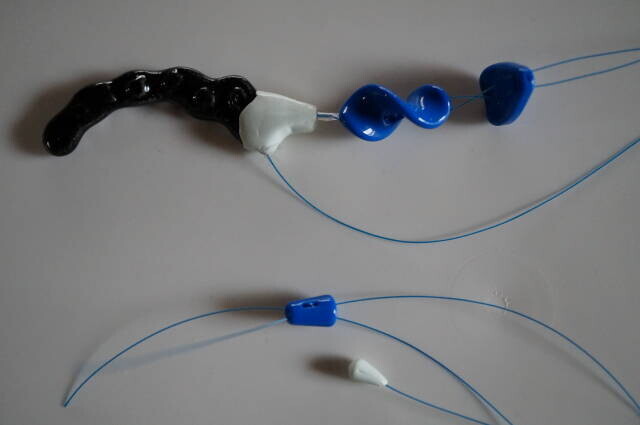
Mixed-material thread costs depended on nitinol length and strand count
In an entry published in September 2025, the diary priced nitinol sections between the chip and nylon thread. Up to 10cm cost ¥1,500 (about $10 at ¥156 = $1, rate as of 2026-09-04) for two strands or ¥2,000 (about $13 at ¥156 = $1, rate as of 2026-09-04) for four, excluding tax. Up to 20cm cost ¥2,000 (about $13 at ¥156 = $1, rate as of 2026-09-04) for two or ¥2,500 (about $16 at ¥156 = $1, rate as of 2026-09-04) for four, excluding tax.
Up to 30cm cost ¥2,500 (about $16 at ¥156 = $1, rate as of 2026-09-04) for two or ¥3,000 (about $19 at ¥156 = $1, rate as of 2026-09-04) for four, excluding tax. Auxiliary-chip prices were unchanged whether attached to nylon or nitinol. Mr. Okada favored nitinol internally and nylon externally for their different handling qualities.
(Source: ok-lab's diary, published September 2025)
https://ok-lab.hatenablog.com/entry/2025/09/13/122925
If you see blood in your urine, even a small amount or for the first time, do not wait and see. See a urologist right away.
If you suddenly cannot urinate, or the device cannot be removed, do not try to fix it yourself. Go to a medical facility, including emergency care, immediately.
How extra thread costs changed over time
| Published | What the diary said then |
|---|---|
| Mar 2019 | Provisional ¥6,000 (about $38 at ¥156 = $1, rate as of 2026-09-04) long-chip pricing ended; glass long vibrating models were ¥8,000, (about $51 at ¥156 = $1, rate as of 2026-09-04) excluding tax. |
| Apr 2019 | Mr. Okada selected 3-0 nylon after finding thicker 2-0 irritating. |
| May 2021 | A four-thread looped extension was quoted at ¥2,000 (about $13 at ¥156 = $1, rate as of 2026-09-04) excluding tax. |
| Jul 2023 | Stainless-steel reservations offered four threads for an additional ¥2,750 (about $18 at ¥156 = $1, rate as of 2026-09-04). |
| Aug 2025 | A stainless-steel custom build quoted ¥2,850 (about $18 at ¥156 = $1, rate as of 2026-09-04) for four threads. |
| Sep 2025 | Silicone-coated nitinol supported two strands; uncoated wire could support four. |
| Nov 2025 | Jointed builds offered terminal thread up to 35cm for ¥1,000 (about $6 at ¥156 = $1, rate as of 2026-09-04) excluding tax. |
| Apr 2026 | A custom build with two 600mm threads quoted ¥1,100 (about $7 at ¥156 = $1, rate as of 2026-09-04) including tax for extension. |
The diary does not say what the current state is.
OK Prostate Chip products related to extra thread costs
The current list contains the nylon addition option and the separate loop-ended nylon extension.
Products that appear in these entries
| Product (official name) | Price incl. tax | Relation to this topic |
|---|---|---|
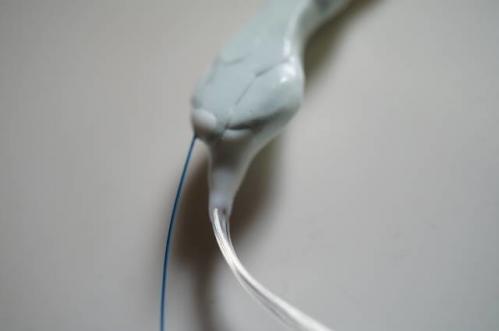
| Additional nylon thread option (ナイロン糸追加(オプション)) | ¥1,100 (about $7 at ¥156 = $1, rate as of 2026-09-04) | In September 2020, Mr. Okada named this option for a ceramic order requiring separately attached threads. |
| Nylon extension with loops at both ends (両端ループナイロン糸) | ¥550 (about $4 at ¥156 = $1, rate as of 2026-09-04) | In January 2021, the diary introduced this item for extending thread systems with a terminal loop. |
The additional nylon thread option is listed in the company’s own online store.
The loop-ended nylon extension is also listed in the company’s own online store.
(Source: ok-lab's diary, published September 2020)
https://ok-lab.hatenablog.com/entry/2020/09/19/123115
(Source: ok-lab's diary, published January 2021)
https://ok-lab.hatenablog.com/entry/2021/01/16/124800
Products the diary mentioned as alternatives
The diary names no alternative.
Custom ceramic builds without thread, sea-slug ceramic Ver.4 builds, loop-ended wire builds, and mixed-material thread modifications:
No matching product can be confirmed on the current list.
Common worries about extra thread costs
The reader questions distinguish removing thread from an order, adding it, and changing its arrangement.
"Does buying without thread reduce a resin chip’s price?"
In an entry published in June 2019, a customer asked about ordering a resin screw chip without thread. Mr. Okada quoted ¥3,000 (about $19 at ¥156 = $1, rate as of 2026-09-04) excluding tax, because the ¥1,000 (about $6 at ¥156 = $1, rate as of 2026-09-04) excluding tax embedding charge would not apply. The diary does not record whether this particular order was completed.
(Source: ok-lab's diary, published June 2019)
https://ok-lab.hatenablog.com/entry/2019/06/01/155432
"What does adding thread to a vibrating chip cost?"
In an entry published in June 2020, a customer requested finer electrical cable and two 35cm nylon threads on a glass vibrating chip. Mr. Okada quoted ¥7,700 (about $49 at ¥156 = $1, rate as of 2026-09-04) plus ¥1,100 (about $7 at ¥156 = $1, rate as of 2026-09-04) for thread. Cable acceptance depended on whether a sufficiently strong connection could be made.
After receiving the cable, he reported testing its bond, with completion still pending. Mr. Okada warned that repeated sharp bending could break the fine cable.
(Source: ok-lab's diary, published June 2020)
https://ok-lab.hatenablog.com/entry/2020/06/27/120614
"Do two threads attached separately cost extra?"
In an entry published in September 2020, a customer asked whether separate threads were available for the sea-slug ceramic Ver.4 chip. Mr. Okada accepted the request with an additional ¥1,100 (about $7 at ¥156 = $1, rate as of 2026-09-04); the same entry described the separate-attachment charge as ¥1,000 (about $6 at ¥156 = $1, rate as of 2026-09-04) excluding tax.
The diary says different end-fitting sizes distinguished the threads, but gives no customer use report. Mr. Okada directed future buyers to the additional nylon thread option for this arrangement.
(Source: ok-lab's diary, published September 2020)
https://ok-lab.hatenablog.com/entry/2020/09/19/123115
"Can thread extension loops also use two strands?"
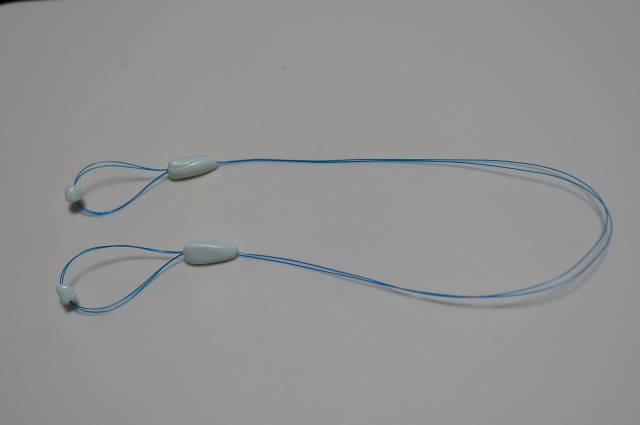
In an entry published in February 2021, a customer requested doubled loops and a doubled extension. Mr. Okada initially said he needed to investigate, then produced a prototype. He retained free terminal-loop work, including doubled loops, but charged ¥500 (about $3 at ¥156 = $1, rate as of 2026-09-04) excluding tax extra for doubling the separate loop-ended extension product.
He reported that the prototype’s strands were not exactly equal in length. Mr. Okada cautioned that differing bends and stretching could leave the finished pair uneven.
(Source: ok-lab's diary, published February 2021)
https://ok-lab.hatenablog.com/entry/2021/02/27/130152
Buying from outside Japan

OK Lab ships internationally to countries covered by Japan Post's EMS courier service. Overseas orders are paid in advance by PayPal. Each order carries a ¥400 (about $3 at ¥156 = $1, rate as of 2026-09-04) handling fee, and EMS shipping is charged on top. These terms come from OK Lab's official sales-terms page (written here as plain text, not a link: ok-lab.net/docs/law), checked on September 7, 2026; confirm them on the official store before you order, because they can change.
Summary of this article
| What you wanted to know | The answer |
|---|---|
| What is the short answer? | Thread arrangement and the work involved determine the charge. |
| What is the product? | A device made by OK Lab in Japan for placement in the urethra. |
| What do the thread terms mean? | Retrieval threads, extensions, safety fittings, and stoppers have different roles. |
| What happened in the diary? | Charges covered different attachment arrangements, materials, and thread-free builds; one missed specification required a remake. |
| What did the maker offer? | Extension services, additional strands, compatible accessories, and mixed-material arrangements, subject to stated limitations. |
| What changed over time? | New thread configurations and accessories appeared, with separately dated prices and specifications. |
| What is listed currently? | The nylon addition option and loop-ended extension have current product-list prices. |
| What did customers ask? | Whether omitted thread reduced prices, and whether added or doubled thread cost more. |
| How do overseas purchases work? | Advance PayPal payment, a handling fee, and additional EMS shipping charges. |
Source: ok-lab's diary (Okada Comfortable Life Laboratory). The original entries are in Japanese; quotations on this page are translated. Photos and videos are on the original entries.
This article is a summary of the maker's development diary. The product is not a medical device and no result is guaranteed. If anything feels wrong or worries you, see a doctor. Prices, specifications and cautions change, so confirm the latest information on the official blog and the official site. Questions about ordering and shipping go to the seller.