![Is the retrieval loop hard to catch? | Chip removal tools have limits [OK Prostate Chip]](/img/a/T0269/eyecatch.svg)
This page is based on entries from "ok-lab's diary" (https://ok-lab.hatenablog.com/), the Japanese development diary written by Mr. Okada, founder of OK Lab, a small company in Japan (Okada Comfortable Life Laboratory). Only the entries about "chip removal tools and retrieval loops" are summarized here, in order of publication. Past prices and sizes are as written at the time. Current prices come from the official product list (retrieved September 4, 2026). Quotations are translated from Japanese.
Note: This page is a personal reading log by someone with no connection to the maker or the seller. It reflects the source entries as of their publication dates and makes no guarantee of accuracy or safety. The product is not a medical device; talk to a doctor about any health decision. Check the official site for current information. This page contains advertising.
In short
- Internal retrieval loops can be difficult to catch, and a broken thread creates a different removal problem.
- Mr. Okada changed hooks and loops after tests revealed missed catches, poor fit, and unwanted chip movement.
- The current product list includes the multipurpose stainless-steel wire; several specialized retrieval designs have no confirmed match.
If you see blood in your urine, even a small amount or for the first time, do not wait and see. See a urologist right away. If you suddenly cannot urinate, or the device cannot be removed, do not try to fix it yourself. Go to a medical facility, including emergency care, immediately.
About this product
The OK Prostate Chip is a small device that is placed in the urethra (the urine passage) so that it acts on the prostate; the maker sells it in several shapes, sizes and materials. It is made and sold by OK Lab (Okada Comfortable Life Laboratory), a small company in Japan, through its own online store, and prices are in Japanese yen (JPY). The maker's development diary, "ok-lab's diary", is written in Japanese. This page is an English summary of it, and every quotation is translated. OK Lab ships internationally, so readers outside Japan can order (see "Buying from outside Japan" below). Product names on this page are plain-English descriptions. The official Japanese product name is shown once in the product table so you can find the same item in the store.
Before you read: key terms
| Term | Plain-English meaning |
|---|---|
| Retrieval loop | A closed thread or wire loop attached to the device, intended as a removal attachment. |
| J-hook | A J-shaped wire end intended to catch a retrieval attachment. |
| Resin connector | A small resin part joining thread into a loop. |
| Shape-memory wire | Wire that recovers its shape after bending, used to make extensions and loops. |
| Single-loop retrieval tool | An angled wire loop inside a flexible tube, intended to hold a device for retrieval or positioning. |
| Double-loop retrieval tool | A tool with crossing wire loops, intended to catch the device's attachment. |
| Dedicated retrieval wire | A smaller-ended hook wire designed for the fine-wire extension's end loops. |
| Retrieval net | A net-shaped prototype intended to capture a displaced chip. |
What happens: chip removal tools
The OK Prostate Chip is a small device placed in the urethra to act on the prostate. The entries describe a retrieval loop (a closed end section intended as a removal attachment) connected to the device by thread or wire. Some versions keep that loop inside the urethra, with no thread extending outside the penis. The maker's chip removal tools include hooks and looped wires intended to engage those internal attachments.
A customer's retrieval loop request became an offered customization
In an entry published in August 2019, a customer requested a loop after the thread's end fitting, partly for easier handling. Mr. Okada made the requested design and began accepting similar requests. The maximum thread length was 27cm, excluding the loop, which measured about 3cm when extended. Mr. Okada asked customers to specify the length without including the loop.
(Source: ok-lab's diary, published August 2019)
https://ok-lab.hatenablog.com/entry/2019/08/17/132641
A J-hook caught the thread loop in only about 10% of tests
In an entry published in January 2021, a custom request prompted Mr. Okada to test his previously untested J-hook (J-shaped retrieval wire) idea. He reported catching the thread loop in only about 10% of attempts. Catches on the resin connector (the part joining the thread into a loop) outnumbered thread catches by about 2:1, he reported. He warned that the wire could push the connector and thread deeper into the urethra.
(Source: ok-lab's diary, published January 2021)
https://ok-lab.hatenablog.com/entry/2021/01/09/130022
Hospital removal difficulties prompted plans for a custom retrieval net
In an entry published in July 2021, Mr. Okada described reports of hospital instruments slipping off retained chips. One account involved repeated attempts, another appointment, and discussion of bladder surgery if removal still failed. The diary says that customer eventually removed the device outside hospital.
Mr. Okada developed a retrieval net (a net-shaped device intended to capture a displaced chip), but had not tested it inside the bladder. He ruled out regular retail sales, offering custom manufacture in response to requests instead. He suggested taking the proposed tool to a doctor for removal under camera observation.
(Source: ok-lab's diary, published July 2021)
https://ok-lab.hatenablog.com/entry/2021/07/31/125702
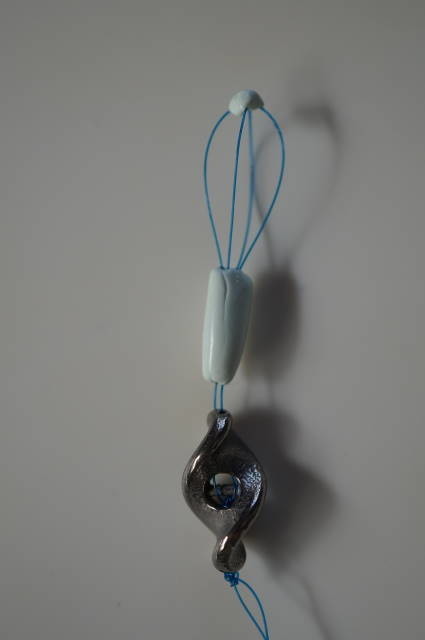
Birdcage retrieval loops were designed to stay open inside the urethra
An entry published in August 2021 described a birdcage-shaped nylon end loop that opened in three dimensions within the available urethral space. Mr. Okada claimed this shape could be caught even farther inside, where a flat thread loop could lie against the wall. The modification was priced at ¥2,000 (about $13 at ¥156 = $1, rate as of 2026-09-04) excluding tax. Mr. Okada limited the option to assemblies with two threads.
(Source: ok-lab's diary, published August 2021)
https://ok-lab.hatenablog.com/entry/2021/08/07/125807
A firmer retrieval loop did not make straw alignment straightforward
In an entry published in March 2025, Mr. Okada described an extension made from shape-memory wire (wire that recovers its shape after bending). Its end loop was intended to provide a retrieval attachment without an exposed thread. His 6mm straw holder could miss the loop and pass alongside the extension. When speed mattered, Mr. Okada favored the ¥500 (about $3 at ¥156 = $1, rate as of 2026-09-04) multipurpose wire over that holder.
(Source: ok-lab's diary, published March 2025)
https://ok-lab.hatenablog.com/entry/2025/03/29/122912
Larger retrieval prototypes pushed the chip deeper during testing
In an entry published in April 2026, Mr. Okada reported successful retrieval with two prototypes. The larger prototype pushed the chip inward, so that test required the chip to be restrained by its thread. The slimmer prototype passed alongside without that restraint.
His test devices still had external threads, allowing him to observe unwanted movement. He wrote that this feedback would be unavailable with a broken thread. Mr. Okada emphasized that the prototypes could not guarantee passage without pushing the chip toward the bladder.
(Source: ok-lab's diary, published April 2026)
https://ok-lab.hatenablog.com/entry/2026/04/11/122913
The maker's answer to chip removal tools
Mr. Okada changed wire thickness, loop shape, and tool size as tests exposed different limitations.
The multipurpose retrieval wire balanced strength against stiffness in early tests
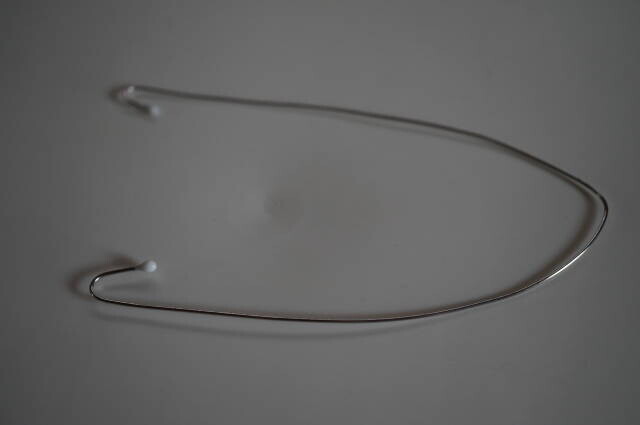
In an entry published in January 2021, Mr. Okada reported that 0.5mm wire straightened under a strong pull. He judged 1mm wire too harsh for the urethra and preferred 0.7mm.
The published 25cm design had a J-hook with a resin-covered tip and a resin-covered rounded head at the opposite end. Its price was ¥500 (about $3 at ¥156 = $1, rate as of 2026-09-04) excluding tax. Mr. Okada also cautioned that beginners could push a device too far with the rounded end.
(Source: ok-lab's diary, published January 2021)
https://ok-lab.hatenablog.com/entry/2021/01/09/130022
Single-loop retrieval tools combined flexible parts with a length limitation
An entry published in April 2025 introduced a single-loop retrieval tool (an angled wire loop inside a flexible tube). Its 0.3mm wire and 4mm tube were intended for both retrieval and positioning. The price was ¥3,000 (about $19 at ¥156 = $1, rate as of 2026-09-04) excluding tax up to 20cm, with ¥1,000 (about $6 at ¥156 = $1, rate as of 2026-09-04) excluding tax extra up to 30cm. Mr. Okada discouraged longer versions because he expected greater friction inside the tube.
(Source: ok-lab's diary, published April 2025)
https://ok-lab.hatenablog.com/entry/2025/04/05/122932
Double-loop retrieval tools offered broader capture but added bulk
The same entry published in April 2025 described a double-loop retrieval tool (a tube-based tool with crossing wire loops). Mr. Okada thought its shape would catch an attachment more readily, but found it bulky for positioning. It cost ¥5,000 (about $32 at ¥156 = $1, rate as of 2026-09-04) excluding tax up to 20cm, with ¥1,000 (about $6 at ¥156 = $1, rate as of 2026-09-04) excluding tax extra up to 30cm. He favored the single-loop design when compactness mattered for positioning.
(Source: ok-lab's diary, published April 2025)
https://ok-lab.hatenablog.com/entry/2025/04/05/122932
Fine-wire retrieval loops needed a smaller hook than the multipurpose version
In an entry published in April 2025, Mr. Okada reported that the multipurpose hook's tip was too large for the 0.2mm extension's double end loop. He made a dedicated retrieval wire (a smaller-ended hook wire for those fine-wire loops). It used 0.7mm stainless steel, measured 20cm, and had small rubber-covered J-shaped ends.
The published price was ¥500 (about $3 at ¥156 = $1, rate as of 2026-09-04) excluding tax. Mr. Okada offered it free to existing buyers of the affected loop products. He encouraged future buyers of those products to purchase the dedicated wire.
(Source: ok-lab's diary, published April 2025)
https://ok-lab.hatenablog.com/entry/2025/04/19/122913
If you see blood in your urine, even a small amount or for the first time, do not wait and see. See a urologist right away. If you suddenly cannot urinate, or the device cannot be removed, do not try to fix it yourself. Go to a medical facility, including emergency care, immediately.
How chip removal tools changed over time
| Published | What the diary said then |
|---|---|
| Aug 2019 | Two rough-finish complaints prompted a caution about the new loop fitting. |
| Dec 2020 | A six-hole thread fitting was proposed for adjustable internal loops. |
| Jan 2021 | A multipurpose wire version up to 30cm was planned. |
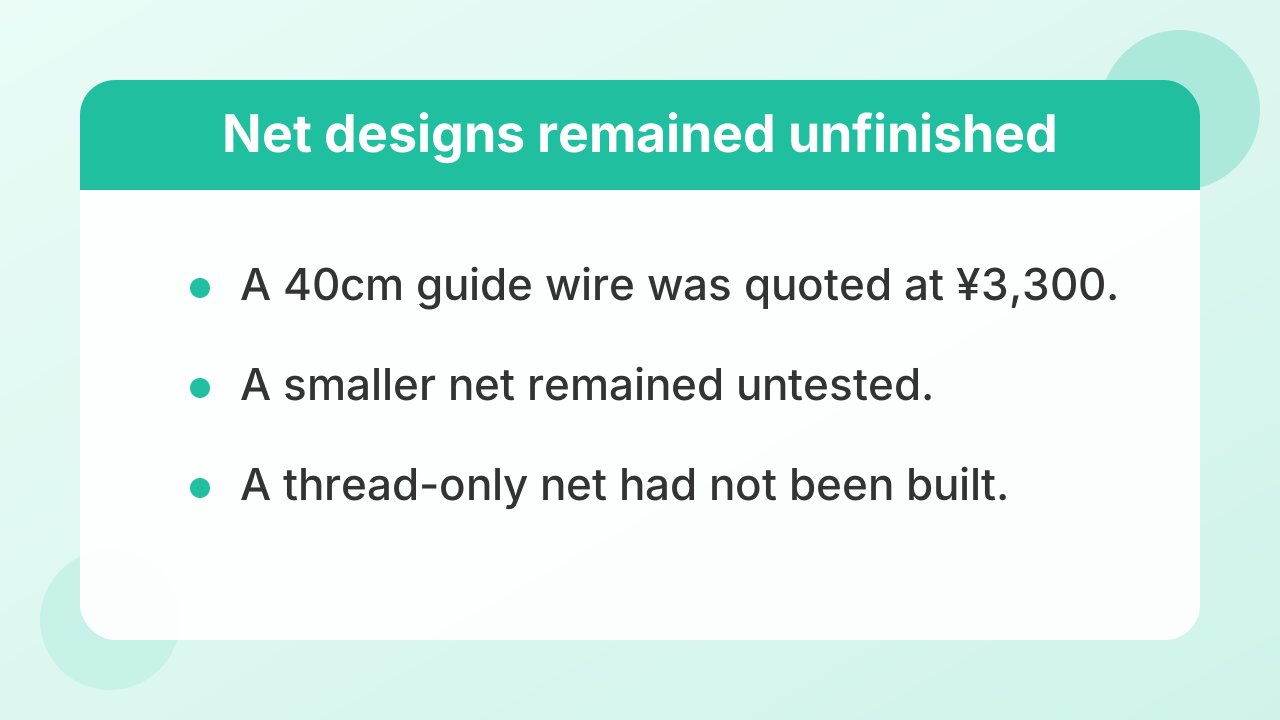
| Jan 2025 | A 40cm guide wire with an added retrieval hook was quoted at ¥3,300 (about $21 at ¥156 = $1, rate as of 2026-09-04). |
| Apr 2025 | A double end-loop modification became available for an additional ¥1,000 (about $6 at ¥156 = $1, rate as of 2026-09-04) excluding tax. |
| Apr 2026 | A smaller net remained untested; a thread-only net had not been built. |
The diary does not record later testing of those net designs.
OK Prostate Chip products related to chip removal tools
The current list includes the multipurpose stainless-steel wire at ¥550 (about $4 at ¥156 = $1, rate as of 2026-09-04) including tax.
Products that appear in these entries
| Product (official name) | Price incl. tax | Relation to this topic |
|---|---|---|
| Multipurpose stainless-steel wire (多目的ステンレスワイヤー) | ¥550 (about $4 at ¥156 = $1, rate as of 2026-09-04) | In April 2026, staff warned that its hook could slip when a customer's retrieval thread had broken. |
(Source: ok-lab's diary, published April 2026)
https://ok-lab.hatenablog.com/entry/2026/04/04/122916
Products the diary mentioned as alternatives
| Product (official name) | Price incl. tax | Relation to this topic |
|---|---|---|
| Multipurpose stainless-steel wire | ¥550 (about $4 at ¥156 = $1, rate as of 2026-09-04) | In March 2025, Mr. Okada favored it over the straw holder for quicker retrieval from the extension's end loop. |
(Source: ok-lab's diary, published March 2025)
https://ok-lab.hatenablog.com/entry/2025/03/29/122912
Separate diary designs include single-loop and double-loop tools, the dedicated wire, birdcage modification, hooked guide wire, and retrieval-net prototypes. No matching product can be confirmed on the current list.
Common worries about chip removal tools
Customer requests document historical quotes, while the broken-thread consultation records warnings without a confirmed removal outcome.
"How much was a 20cm single-loop retrieval tool?"
In an entry published in April 2025, a customer requested a 20cm single-loop retrieval tool alongside a custom loop-based device. The quote listed the tool separately at ¥3,300 (about $21 at ¥156 = $1, rate as of 2026-09-04). The diary does not record whether the order was completed or how the tool performed for that customer.
(Source: ok-lab's diary, published April 2025)
https://ok-lab.hatenablog.com/entry/2025/04/26/122909
"Was a dedicated retrieval wire quoted for the thin extension?"
In an entry published in June 2025, a customer requested a dedicated retrieval wire for an extension containing 0.2mm shape-memory wire. The reply quoted ¥550 (about $4 at ¥156 = $1, rate as of 2026-09-04) for that wire as part of the requested custom assembly. The diary does not record how this customer's retrieval wire performed.
(Source: ok-lab's diary, published June 2025)
https://ok-lab.hatenablog.com/entry/2025/06/14/122936
"Can a J-hook help after the retrieval thread breaks?"
In an entry published in April 2026, a customer reported a broken thread, no natural release after about 1 week, and painful urination. Asked about the multipurpose wire, staff warned that its hook could slip and that pushing could displace the chip into the bladder. The customer acknowledged those risks and asked about a developing chip holder.
Mr. Okada replied that the proposed holder could not grasp the back of an already retained chip. The diary does not record whether this customer's device was eventually removed. Mr. Okada stressed that his suggested thin-wire alternative was not a certain removal method.
(Source: ok-lab's diary, published April 2026)
https://ok-lab.hatenablog.com/entry/2026/04/04/122916
Buying from outside Japan
OK Lab ships internationally to countries covered by Japan Post's EMS courier service. Overseas orders are paid in advance by PayPal. Each order carries a ¥400 (about $3 at ¥156 = $1, rate as of 2026-09-04) handling fee, and EMS shipping is charged on top. These terms come from OK Lab's official sales-terms page (written here as plain text, not a link: ok-lab.net/docs/law), checked on September 7, 2026; confirm them on the official store before you order, because they can change.
Summary of this article
| What you wanted to know | The answer |
|---|---|
| What is the short answer? | Loop access and hook fit matter; broken threads present a separate problem. |
| What is this product? | A urethral device made by OK Lab in Japan, priced in JPY. |
| What do the key terms mean? | Hooks, loops, and nets describe different attachments or tools intended for retrieval. |
| What happened in the diary? | Tests found missed loops, oversized hooks, and prototypes that pushed chips deeper. |
| What did the maker change? | Wire thickness, capture-loop design, tool dimensions, and guidance on compatible attachments. |
| What changed over time? | Simple end loops led to specialized tools and unfinished retrieval-net designs. |
| What current product is listed? | The multipurpose stainless-steel wire, ¥550 (about $4 at ¥156 = $1, rate as of 2026-09-04) including tax. |
| What did customers ask? | Tool quotes and possible help after a broken retrieval thread. |
| How does overseas buying work? | Advance PayPal payment, a ¥400 (about $3 at ¥156 = $1, rate as of 2026-09-04) handling fee, and additional EMS shipping. |
Source: ok-lab's diary (Okada Comfortable Life Laboratory). The original entries are in Japanese; quotations on this page are translated. Photos and videos are on the original entries.
This article is a summary of the maker's development diary. The product is not a medical device and no result is guaranteed. If anything feels wrong or worries you, see a doctor. Prices, specifications and cautions change, so confirm the latest information on the official blog and the official site. Questions about ordering and shipping go to the seller.