![Separate or built-in Apple Stopper? | More movement or firmer fixation [OK Prostate Chip]](/img/a/T0266/eyecatch.svg)
This page is based on entries from "ok-lab's diary" (https://ok-lab.hatenablog.com/), the Japanese development diary written by Mr. Okada, founder of OK Lab, a small company in Japan (Okada Comfortable Life Laboratory). Only the entries about "Apple Stopper: separate and built-in versions" are summarized here, in order of publication. Past prices and sizes are as written at the time. Current prices come from the official product list (retrieved September 4, 2026). Quotations are translated from Japanese.
Note: This page is a personal reading log by someone with no connection to the maker or the seller. It reflects the source entries as of their publication dates and makes no guarantee of accuracy or safety. The product is not a medical device; talk to a doctor about any health decision. Check the official site for current information. This page contains advertising.
In short
The maker reports firmer fixation with a built-in Apple Stopper, but more freedom of movement with a separate one.
His replies link Apple Stopper fit to chip material, cable thickness, and tool compatibility.
The current list includes related chips, but no Apple Stopper listing can be confirmed.
About this product

The OK Prostate Chip is a small device that is placed in the urethra (the urine passage) so that it acts on the prostate; the maker sells it in several shapes, sizes and materials. It is made and sold by OK Lab (Okada Comfortable Life Laboratory), a small company in Japan, through its own online store, and prices are in Japanese yen (JPY). The maker's development diary, "ok-lab's diary", is written in Japanese. This page is an English summary of it, and every quotation is translated. OK Lab ships internationally, so readers outside Japan can order (see "Buying from outside Japan" below). Product names on this page are plain-English descriptions. The official Japanese product name is shown once in the product table so you can find the same item in the store.
Before you read: key terms
| Term | Plain-English meaning |
|---|---|
| Urethra | The urine passage; the diary describes the chip and stopper as staying inside it. |
| Apple Stopper | An apple-shaped loop attachment intended to limit inward and outward chip movement. |
| Separate version | A stopper linked to the chip by thread, allowing their relative positions and angles to change. |
| Built-in version | A stopper fixed to the chip body, intended to hold the assembly more firmly in position. |
| Retrieval thread | Thread used for retrieval; nylon thread also forms the connection between a separate stopper and its chip. |
| Apple pushing tool | A tool intended to advance the stopper; the versions discussed have different contact surfaces. |
| External urethral sphincter | The diary does not explain this. A customer names this anatomical structure when describing pressure from the stopper. |
What happens: Apple Stopper fit
The OK Prostate Chip is a small device placed in the urethra, the urine passage, to act on the prostate. An Apple Stopper is an apple-shaped attachment intended to limit movement toward the bladder and outward from the body. The diary describes it as sitting inside the urine passage, where it is intended to hold the chip in position. It can be separate from the chip or built into it, changing how freely the pieces move relative to each other.
Separate Apple Stopper prototypes allowed movement, while built-in versions held firmer
In an entry published in December 2025, Mr. Okada compared the designs through his own prototype tests. He reported less strain with the separate version because the chip and stopper had freedom to change their relative positions and angles.
Both versions were difficult to remove in his account, although he considered the separate design easier. Mr. Okada described the built-in version as almost completely fixed, but cautioned that its position could place strain on the urine passage.
(Source: ok-lab's diary, published December 2025)
https://ok-lab.hatenablog.com/entry/2025/12/20/123000
Early Apple Stopper quotes charged extra for both attachment styles
In an entry published in December 2025, a customer requested a built-in Apple Stopper on the double-twist ceramic chip. The requested stopper width was 20 mm, and OK Lab quoted an additional ¥4,400 (about $28 at ¥156 = $1, rate as of 2026-09-04) for the stopper work.
A separate-version quote in the same entry also listed ¥4,400 (about $28 at ¥156 = $1, rate as of 2026-09-04) for the attachment. The diary does not record how either customer's combination felt in use.
(Source: ok-lab's diary, published December 2025)
https://ok-lab.hatenablog.com/entry/2025/12/27/122915
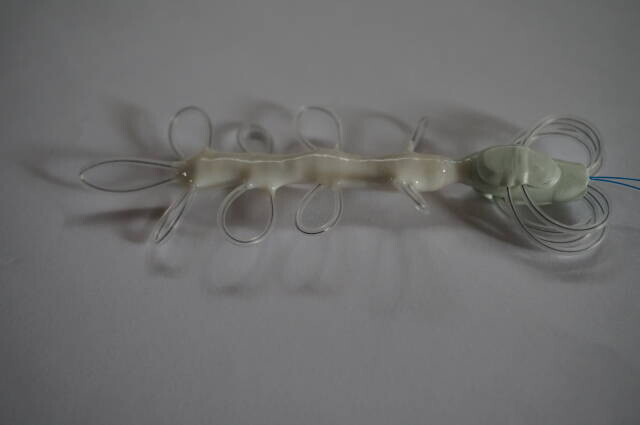
A jointed Apple Stopper prototype introduced four bending connections
An entry published in January 2026 records a customer's request for an assembly with a 20 mm Apple Stopper and four joints. Mr. Okada described this as the first request using that bending-joint construction. He presented the resulting assembly, but the diary does not record the customer's experience with it.
(Source: ok-lab's diary, published January 2026)
https://ok-lab.hatenablog.com/entry/2026/01/10/122922
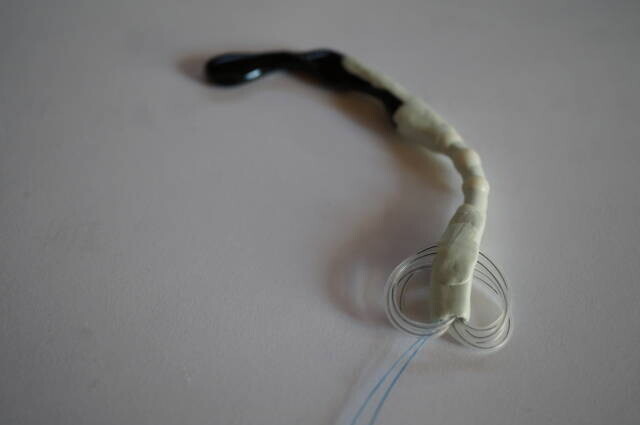
A resin-chip Apple Stopper request changed to the separate version
In an entry published in February 2026, a customer requested a built-in Apple Stopper on a second-generation resin chip. OK Lab explained that this resin chip supported only the separate attachment, and the customer accepted that change. The diary records the revised specification, but does not record the customer's experience after delivery.
(Source: ok-lab's diary, published February 2026)
https://ok-lab.hatenablog.com/entry/2026/02/28/122912
A customer reported substantial strain with the short chip's Apple Stopper
An entry published in July 2026 describes a customer who liked a short looped-wire chip but reported extremely high strain. The complaint concerned the external urethral sphincter, the anatomical structure identified in the customer's message.
The customer requested a much wider gap between the chip and Apple Stopper, plus changes to the wire section. Mr. Okada showed a redesigned assembly; the diary does not record whether it reduced the reported strain.
(Source: ok-lab's diary, published July 2026)
https://ok-lab.hatenablog.com/entry/2026/07/25/123012
Cable thickness led one Apple Stopper order to a different attachment
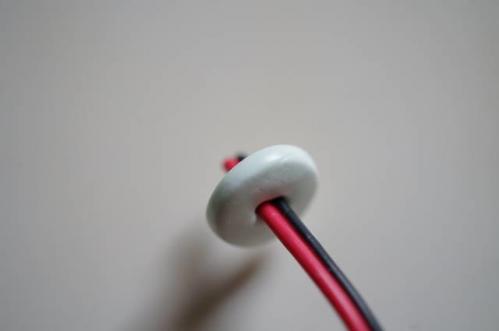
In an entry published in August 2026, a customer requested a built-in Apple Stopper on a vibrating ceramic chip. They wanted its width and thickness close to the standard stopper. OK Lab replied that the parallel cable would make the attachment 9 mm or thicker, far beyond the standard thickness.
The customer accepted a normal parallel-cable stopper instead, quoted at ¥1,100 (about $7 at ¥156 = $1, rate as of 2026-09-04), replacing the ¥4,400 (about $28 at ¥156 = $1, rate as of 2026-09-04) Apple Stopper request. The diary does not record how the replacement performed.
(Source: ok-lab's diary, published August 2026)
https://ok-lab.hatenablog.com/entry/2026/08/01/122916
The maker's answer to Apple Stopper fit
The maker's replies distinguish material compatibility, connection dimensions, and the limits of the proposed pushing tools.
Apple Stopper material choices determined which attachment could be made
In an entry published in December 2025, ceramic chips were described as compatible with either a separate or built-in Apple Stopper. The maker's blue-chip range and stainless steel chips were limited to separate attachments.
The published Apple Stopper price was ¥4,000 (about $26 at ¥156 = $1, rate as of 2026-09-04) excluding tax for either design. Mr. Okada explained that a reliable method of fixing a built-in stopper to those other materials had not yet been established.
(Source: ok-lab's diary, published December 2025)
https://ok-lab.hatenablog.com/entry/2025/12/20/123000
Apple Stopper spacing and loop width had specific design limits
In an entry published in December 2025, Mr. Okada specified a gap of about 2 mm for the separate design. He said a smaller gap could not be made with that construction process, while a longer gap made advancement unstable.
The listed loop widths were 15 mm, 18 mm, 20 mm, and 25 mm, with 20 mm described as standard. Mr. Okada cautioned that 15 mm had not been tested, leaving its effectiveness as a stopper unknown.
(Source: ok-lab's diary, published December 2025)
https://ok-lab.hatenablog.com/entry/2025/12/20/123000
Apple Stopper tool compatibility remained uncertain on a cable
In an entry published in March 2026, a customer asked whether the Version 2 Apple pushing tool suited a built-in Apple Stopper. Staff said the stopper lacked the rubber contact needed for that tool, and quoted ¥550 (about $4 at ¥156 = $1, rate as of 2026-09-04) for an added rubber end section.
Staff also proposed Version 3, with rubber on the tool itself, and the customer requested a revised quote. Mr. Okada subsequently warned that its grip would add thickness, while the central cable would require angled contact.
He wrote that the proposed combination might not work; the requested assembly had not yet been made. Mr. Okada advised considering the higher cost and said he could not identify a reliably better option.
(Source: ok-lab's diary, published March 2026)
https://ok-lab.hatenablog.com/entry/2026/03/21/122906
How Apple Stopper fit changed over time
| Published | What the diary said then |
|---|---|
| Dec 2025 | Four apple-shaped loops used covered 0.15 mm wire. |
| Dec 2025 | Core targets: width and thickness within 7 mm, length about 20 mm. |
| Feb 2026 | A 30 cm covered-thread option was quoted at ¥2,200 (about $14 at ¥156 = $1, rate as of 2026-09-04). |
| Mar 2026 | A jointed build combined five units, six loop attachments, and a separate stopper. |
| Jun 2026 | Manufacturing constraints led to rubber coating instead of silicone tubing over the connection. |
| Jul 2026 | A shortened looped-wire prototype combined four pairs of loops with an Apple Stopper. |
| Aug 2026 | A cable-thickness warning led to a conventional cable stopper replacing the requested attachment. |
The diary does not say what the current state is.
OK Prostate Chip products related to Apple Stopper fit
The current list confirms prices for related base chips and a cable-stopper option.
Products that appear in these entries
| Product (official name) | Price incl. tax | Relation to this topic |
|---|---|---|
| Double-twist ceramic chip (OKプロステートチップ 陶器素材覚醒タイプ ダブルツイスト(ラブカチップ)) | ¥6,600 (about $42 at ¥156 = $1, rate as of 2026-09-04) | December 2025: this chip was the base for a built-in Apple Stopper quote. |
| Second-generation resin chip (OKプロステートチップ 凶悪ゾロ(第二世代生体適合樹脂)) | ¥6,600 (about $42 at ¥156 = $1, rate as of 2026-09-04) | February 2026: its incompatible built-in Apple Stopper request changed to the separate version. |
| Plain vibrating chip (OKプロステート核振チップ プレーン(胎児チップ)) | ¥3,300 (about $21 at ¥156 = $1, rate as of 2026-09-04) | May 2026: a customer asked about adding an Apple Stopper to its cable. |
| Medium-length vibrating ceramic chip (OKプロステート核振チップ 陶器素材セミロングタイプ) | ¥6,600 (about $42 at ¥156 = $1, rate as of 2026-09-04) | August 2026: its Apple Stopper request changed after a warning about cable thickness. |
(Source: ok-lab's diary, published December 2025)
https://ok-lab.hatenablog.com/entry/2025/12/27/122915
(Source: ok-lab's diary, published February 2026)
https://ok-lab.hatenablog.com/entry/2026/02/28/122912
(Source: ok-lab's diary, published May 2026)
https://ok-lab.hatenablog.com/entry/2026/05/02/122917
(Source: ok-lab's diary, published August 2026)
https://ok-lab.hatenablog.com/entry/2026/08/01/122916
Products the diary mentioned as alternatives
| Product (official name) | Price incl. tax | Relation to this topic |
|---|---|---|
| Parallel-cable stopper option (平行ケーブル用ストッパー追加(オプション)) | ¥1,100 (about $7 at ¥156 = $1, rate as of 2026-09-04) | August 2026: accepted instead of the Apple Stopper after a cable-thickness warning; performance was not reported. |
The parallel-cable stopper option is listed in OK Lab's own online store.
(Source: ok-lab's diary, published August 2026)
https://ok-lab.hatenablog.com/entry/2026/08/01/122916
Custom Apple Stopper assemblies, jointed prototypes, shortened looped-wire builds, and the Apple pushing tools:
No matching product can be confirmed on the current list.
Common worries about Apple Stopper fit
Customer questions concern thread durability, cable compatibility, and whether peeling rubber affects the connection.
"Can an Apple Stopper use a covered retrieval thread?"
An entry published in February 2026 records a customer requesting silicone-covered retrieval thread because ordinary thread had shrunk after contact with cookware. Staff said the replacement could probably be made, and Mr. Okada reported making the custom assembly.
The diary does not record the customer's later experience with heat damage. Mr. Okada thought the covering might withstand light cookware contact, but warned that overheating could still shrink the nylon inside.
(Source: ok-lab's diary, published February 2026)
https://ok-lab.hatenablog.com/entry/2026/02/21/122935
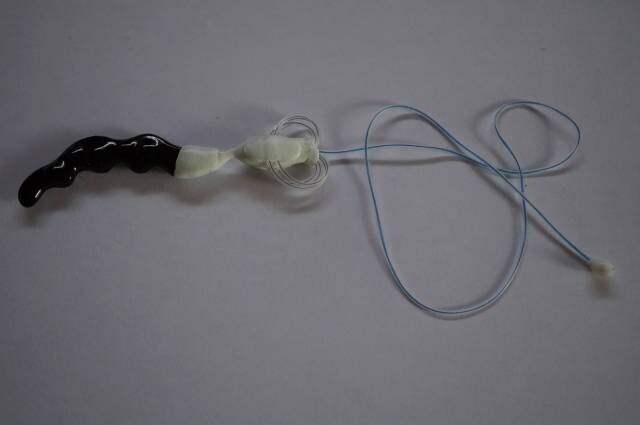
"Can an Apple Stopper fit a vibrating chip's cable?"
In an entry published in May 2026, a customer asked whether an Apple Stopper could hold a plain vibrating chip at a chosen position. Staff said a cable-mounted version could be made, but expected its core to become substantially thicker than the usual thread-mounted design.
The diary does not record whether that inquiry became a completed order. Staff's warning was that the extra thickness would make insertion more difficult.
(Source: ok-lab's diary, published May 2026)
https://ok-lab.hatenablog.com/entry/2026/05/02/122917
"Does peeling rubber weaken a separate Apple Stopper?"
In an entry published in June 2026, a customer asked about continued use after rubber peeled from a four-point-twist chip's Apple Stopper connection. The nylon retrieval thread remained attached, but the entry contains no follow-up about continued use. Staff explained that early separate versions had only exposed nylon between the parts, while later versions added rubber coating.
Staff believed peeling did not reduce strength because the nylon formed the connection. Mr. Okada described the coating as cushioning and said thin rubber on this flexible connection could peel under strong force. Staff cautioned against damage to the nylon thread from sharp objects.
(Source: ok-lab's diary, published June 2026)
https://ok-lab.hatenablog.com/entry/2026/06/13/122909
Buying from outside Japan

OK Lab ships internationally to countries covered by Japan Post's EMS courier service. Overseas orders are paid in advance by PayPal. Each order carries a ¥400 (about $3 at ¥156 = $1, rate as of 2026-09-04) handling fee, and EMS shipping is charged on top. These terms come from OK Lab's official sales-terms page (written here as plain text, not a link: ok-lab.net/docs/law), checked on September 7, 2026; confirm them on the official store before you order, because they can change.
Summary of this article
| What you wanted to know | The answer |
|---|---|
| What is the basic tradeoff? | The maker describes freer movement versus firmer fixation. |
| What is the base product? | A urethral device made by OK Lab in Japan. |
| What distinguishes the designs? | Thread-linked parts can move relative to each other; built-in parts cannot. |
| What happened in the cases? | Requests changed because of material limits, strain, and cable thickness. |
| What did the maker address? | Attachment compatibility, dimensions, and uncertain tool suitability. |
| What changed over time? | Jointed builds, covered connections, and shorter prototypes appeared. |
| What can current prices confirm? | Listed base chips and the conventional cable-stopper option. |
| What worried customers? | Heat damage, cable fit, and peeling connection rubber. |
| How do overseas orders work? | Advance PayPal payment, a handling fee, and additional EMS shipping. |
| What remains unresolved? | Several custom builds lack recorded customer outcomes. |
Source: ok-lab's diary (Okada Comfortable Life Laboratory). The original entries are in Japanese; quotations on this page are translated. Photos and videos are on the original entries.
This article is a summary of the maker's development diary. The product is not a medical device and no result is guaranteed. If anything feels wrong or worries you, see a doctor. Prices, specifications and cautions change, so confirm the latest information on the official blog and the official site. Questions about ordering and shipping go to the seller.