![How do Apple Bougie versions differ? | Grip and release have different limits [OK Prostate Chip]](/img/a/T0265/eyecatch.svg)
This page is based on entries from "ok-lab's diary" (https://ok-lab.hatenablog.com/), the Japanese development diary written by Mr. Okada, founder of OK Lab, a small company in Japan (Okada Comfortable Life Laboratory). Only the entries about "Apple Bougie Versions 1–3" are summarized here, in order of publication. Past prices and sizes are as written at the time. Current prices come from the official product list (retrieved September 4, 2026). Quotations are translated from Japanese.
Note: This page is a personal reading log by someone with no connection to the maker or the seller. It reflects the source entries as of their publication dates and makes no guarantee of accuracy or safety. The product is not a medical device; talk to a doctor about any health decision. Check the official site for current information. This page contains advertising.
In short
- The original tool pushes; later versions grip, with limits involving material, thickness, and release.
- Mr. Okada describes rubber additions and a release-wire prototype, while warning that the tools cannot grasp an already-placed chip.
- No matching product can be confirmed on the current list.
If you see blood in your urine, even a small amount or for the first time, do not wait and see. See a urologist right away. If you suddenly cannot urinate, or the device cannot be removed, do not try to fix it yourself. Go to a medical facility, including emergency care, immediately.
About this product
The OK Prostate Chip is a small device that is placed in the urethra (the urine passage) so that it acts on the prostate; the maker sells it in several shapes, sizes and materials. It is made and sold by OK Lab (Okada Comfortable Life Laboratory), a small company in Japan, through its own online store, and prices are in Japanese yen (JPY). The maker's development diary, "ok-lab's diary", is written in Japanese. This page is an English summary of it, and every quotation is translated. OK Lab ships internationally, so readers outside Japan can order (see "Buying from outside Japan" below). Product names on this page are plain-English descriptions. The official Japanese product name is shown once in the product table so you can find the same item in the store.
Before you read: key terms
| Term | Plain-English meaning |
|---|---|
| Placement tool (Apple Bougie) | A separate flexible wire instrument intended to help position a chip or its stopper. |
| Apple-shaped stopper (Apple Stopper) | A looped attachment intended to limit chip movement toward the bladder and toward the outside. |
| Nitinol | The springy wire material used for the tool's shaft and gripping loops. |
| Rubber membrane | A thin rubber sheet across a wire loop, added to grip surfaces that bare wire could not hold. |
| Release wire | An extra sliding wire intended to disengage the grip of the Version 3 prototype. |
| Retrieval thread | A thread attached to a chip for taking it out. |
What happens: Apple Bougie versions
The OK Prostate Chip is a device placed in the urethra (the urine passage), where the diary describes it acting on the prostate. The flexible placement tool (Apple Bougie) is a separate wire instrument developed for the apple-shaped stopper (Apple Stopper). The stopper is intended to limit chip movement in either direction within the urethra. The tool enters the same passage; later versions grip suitable parts of the chip or stopper during placement.
The original Apple Bougie addressed the stopper's easily deformed end
In an entry published in December 2025, Mr. Okada introduced the original tool because the stopper's flexible end was awkward to push. Its shaft used doubled 0.4mm nitinol (the springy wire material), with a length of 20cm. Resin covered both ends for approximately 50mm, at approximately 4mm wide.
One end included a small loop intended for an attached thread. The launch price was ¥2,000 (about $13 at ¥156 = $1, rate as of 2026-09-04) tax excluded, as published in December 2025. Mr. Okada presented this version as a dedicated placement aid for the stopper's flexible end.
(Source: ok-lab's diary, published December 2025)
https://ok-lab.hatenablog.com/entry/2025/12/20/123000
Longer Apple Bougie options received a published price schedule
In an entry published in January 2026, Mr. Okada set out length-based prices for the original placement tool. The published prices were ¥2,000 (about $13 at ¥156 = $1, rate as of 2026-09-04) tax excluded for lengths up to 20cm and ¥3,000 (about $19 at ¥156 = $1, rate as of 2026-09-04) tax excluded up to 30cm. The band up to 35cm cost ¥4,000 (about $26 at ¥156 = $1, rate as of 2026-09-04) tax excluded.
These were the January 2026 length bands, rather than prices from the current product list. Mr. Okada offered those lengths after completing the longer build.
(Source: ok-lab's diary, published January 2026)
https://ok-lab.hatenablog.com/entry/2026/01/10/122922
Apple Bougie Version 2 gained grip only on suitable surfaces
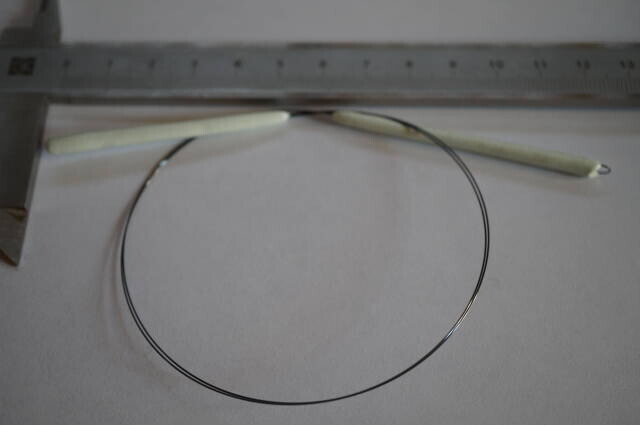
In an entry published in March 2026, Mr. Okada introduced Version 2 with springy wire loops that held a chip's rubber or tubing. He described a connected grip capable of supporting both pushing and pulling during placement. Bare ceramic and resin surfaces slipped out because, in his account, the wire lacked enough friction against them.
The published price was ¥3,000 (about $19 at ¥156 = $1, rate as of 2026-09-04) tax excluded up to 20cm, or ¥4,000 (about $26 at ¥156 = $1, rate as of 2026-09-04) tax excluded up to 30cm. Mr. Okada restricted the gripping function to rubber or tubing that the loops could hold.
(Source: ok-lab's diary, published March 2026)
https://ok-lab.hatenablog.com/entry/2026/03/14/122910
Apple Bougie Version 3 gained grip but introduced release problems
In an entry published in March 2026, Mr. Okada moved the rubber onto the tool itself as rubber membranes (thin gripping sheets). He warned that the added grip made the held section slightly thicker, so a chip without sufficient room might not fit. He also considered the design unsuitable for people who have difficulty with rubber.
He reported that adhesion could draw the chip back with the tool instead of allowing them to separate. A retrieval thread (the chip's attached removal thread) could also become tangled with the tool and be pulled unintentionally. Mr. Okada favored Version 3 for placement, but Version 2 for easier separation because it lacked the rubber friction.
(Source: ok-lab's diary, published March 2026)
https://ok-lab.hatenablog.com/entry/2026/03/21/122906
A cable-mounted stopper raised another Apple Bougie compatibility concern
In an entry published in August 2026, a customer requested a ceramic vibrating chip, an integrated apple-shaped stopper, and a 20cm original tool. The customer wanted the stopper as close as possible to standard width and thickness. Staff replied that attaching the stopper to the parallel cable would make it 9mm or more thick.
The diary does not record how the revised arrangement felt in use. Staff proposed the usual cable stopper at ¥1,100 (about $7 at ¥156 = $1, rate as of 2026-09-04) instead of the ¥4,400 (about $28 at ¥156 = $1, rate as of 2026-09-04) apple-shaped stopper, and the customer accepted that change.
(Source: ok-lab's diary, published August 2026)
https://ok-lab.hatenablog.com/entry/2026/08/01/122916
The maker's answer to Apple Bougie compatibility
The maker's changes addressed grip and release separately, with limits remaining for each design.
Added rubber gave Apple Bougie Version 2 a suitable contact point
In an entry published in March 2026, Mr. Okada explained that ordinary ceramic and blue chips needed a rubber contact area for Version 2. His proposed location was the rear thread connection, rather than the hard chip surface. The published charge for the maker's rubber addition was ¥500 (about $3 at ¥156 = $1, rate as of 2026-09-04).
He attributed the charge to extra production work needed to retain the rubber's shape while it hardened. Mr. Okada proposed this addition for threaded ceramic, blue, glass, and white resin chips that lacked a suitable gripping point.
(Source: ok-lab's diary, published March 2026)
https://ok-lab.hatenablog.com/entry/2026/03/14/122910
Apple Bougie Version 3 added membranes whose production raised the price
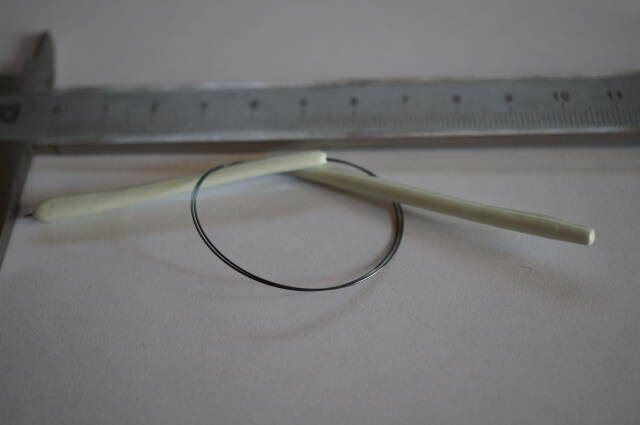
In an entry published in March 2026, Mr. Okada specified two overlapping membrane loops, each made from two 0.4mm wires. The resulting shaft contained four 0.4mm wires, and he described this version as intended for pushing during placement. He attributed its higher price to the difficulty of producing even rubber membranes.
The published totals were ¥7,000 (about $45 at ¥156 = $1, rate as of 2026-09-04) tax excluded up to 20cm and ¥9,000 (about $58 at ¥156 = $1, rate as of 2026-09-04) tax excluded up to 30cm. Those totals included a ¥1,000 (about $6 at ¥156 = $1, rate as of 2026-09-04) tax-excluded shaft-assembly charge. Mr. Okada also asked prospective buyers to consider Version 3's substantially higher price.
(Source: ok-lab's diary, published March 2026)
https://ok-lab.hatenablog.com/entry/2026/03/21/122906
The Apple Bougie release-wire prototype still needed further testing
In an entry published in March 2026, staff suggested an opening hinge to address Version 3's tendency to cling. Mr. Okada initially said a spring hinge would be difficult, then developed a release wire (an extra sliding part intended to disengage the grip). After rebuilding the 20cm prototype, he reported smooth wire movement.
He still found difficulty with a pointed screw-shaped component and suspected rubber-ended chips could stick to the rubber membranes. Whether a 30cm version would release as smoothly remained untested. Mr. Okada described the prototype as unfinished and called for further trials before considering the design complete.
(Source: ok-lab's diary, published March 2026)
https://ok-lab.hatenablog.com/entry/2026/03/28/122908
If you see blood in your urine, even a small amount or for the first time, do not wait and see. See a urologist right away. If you suddenly cannot urinate, or the device cannot be removed, do not try to fix it yourself. Go to a medical facility, including emergency care, immediately.
How Apple Bougie versions changed over time
| Published | What the diary said then |
|---|---|
| Dec 2025 | Original tool introduced for the stopper's flexible end. |
| Jan 2026 | Workshop space made lengths beyond roughly 30cm substantially more laborious. |
| Jan 2026 | A completed 35cm tool established a longer published price band. |
| Mar 2026 | Version 2 added a spring grip for rubber and tubing. |
| Mar 2026 | Version 3 added rubber gripping sheets, with thickness and release drawbacks. |
| Mar 2026 | Release-wire prototype remained unfinished; longer-version performance was untested. |
| Apr 2026 | Maker clarified that existing tools could not grasp a chip already inside. |
| Jun 2026 | A 28cm Version 2 received a ¥3,300 (about $21 at ¥156 = $1, rate as of 2026-09-04) quote; no general price revision was stated. |
| Aug 2026 | Cable-mounted stopper thickness prompted a change to the customer's requested configuration. |
| Aug 2026 | An unversioned 30cm tool received a ¥2,200 (about $14 at ¥156 = $1, rate as of 2026-09-04) quote; no general price revision was stated. |
OK Prostate Chip products related to Apple Bougie compatibility
A current ceramic vibrating chip appears as the base product in a custom-build compatibility question.
Products that appear in these entries
| Product (official name) | Price incl. tax | Relation to this topic |
|---|---|---|
| Semi-long ceramic vibrating chip (OKプロステート核振チップ 陶器素材セミロングタイプ) | ¥6,600 (about $42 at ¥156 = $1, rate as of 2026-09-04) | In March 2026, this base chip appeared in a custom stopper request that exposed Version 2 compatibility limits. |
(Source: ok-lab's diary, published March 2026)
https://ok-lab.hatenablog.com/entry/2026/03/21/122906
Products the diary mentioned as alternatives
The diary names no alternative.
Original placement tool, Versions 2 and 3, release-wire prototype, and custom stopper arrangements: No matching product can be confirmed on the current list.
Common worries about Apple Bougie compatibility
The reader questions concern custom length, stopper compatibility, and whether the gripping design can retrieve a lodged chip.
"Can an Apple Bougie be longer than the original?"
In an entry published in January 2026, a customer praised the original tool's usefulness with other chips but requested 35cm. The original length felt insufficient for their anatomy; staff replied that workshop space became a serious production constraint beyond roughly 30cm. The customer initially accepted 30cm, then asked about longer work, which Mr. Okada provisionally priced at ¥4,000 (about $26 at ¥156 = $1, rate as of 2026-09-04) tax excluded up to 35cm.
A subsequent entry published in January 2026 confirms the 35cm tool was completed. Before production, Mr. Okada had cautioned that he might decline longer requests if making them proved too difficult.
(Source: ok-lab's diary, published January 2026)
https://ok-lab.hatenablog.com/entry/2026/01/03/122924
(Source: ok-lab's diary, published January 2026)
https://ok-lab.hatenablog.com/entry/2026/01/10/122922
"Will Apple Bougie Version 2 grip an integrated stopper?"
In an entry published in March 2026, a customer changed a vibrating-chip request to an integrated apple-shaped stopper and asked about Version 2. Staff said this stopper had no rubber for Version 2 to grip, then quoted ¥550 (about $4 at ¥156 = $1, rate as of 2026-09-04) for added rubber at its rear. They also offered Version 3, whose rubber could grip the stopper, and the customer requested a revised quote.
Mr. Okada then questioned that recommendation: the cable could obstruct the original tool, while Version 3 would add thickness and apply pressure off-center. The requested combination was untested, and the diary does not record whether the order was completed. Mr. Okada suggested Version 2 with rubber on the cable as another possibility, while cautioning that he could not confirm the best arrangement.
(Source: ok-lab's diary, published March 2026)
https://ok-lab.hatenablog.com/entry/2026/03/21/122906
"Can an Apple Bougie retrieve a chip already inside?"
In an entry published in April 2026, a customer whose chip remained inside after its thread broke asked whether the gripping tool could help. The customer reported pain during urination and had already discussed a different wire tool with staff. Mr. Okada replied that the existing placement tools could not reach inside and grasp the rear of an already-placed chip.
He warned that a proposed opening-grip arrangement could instead push the chip toward the bladder. The diary does not record successful removal in this entry. Mr. Okada described a separate retrieval-tool proposal as untested and cautioned that it was not a dependable removal method.
(Source: ok-lab's diary, published April 2026)
https://ok-lab.hatenablog.com/entry/2026/04/04/122916
Buying from outside Japan
OK Lab ships internationally to countries covered by Japan Post's EMS courier service. Overseas orders are paid in advance by PayPal. Each order carries a ¥400 (about $3 at ¥156 = $1, rate as of 2026-09-04) handling fee, and EMS shipping is charged on top. These terms come from OK Lab's official sales-terms page (written here as plain text, not a link: ok-lab.net/docs/law), checked on September 7, 2026; confirm them on the official store before you order, because they can change.
Summary of this article
| What you wanted to know | The answer |
|---|---|
| What is the short answer? | Grip, material compatibility, thickness, and release differ between versions. |
| What is the base product? | The OK Prostate Chip is a urethral device made by OK Lab in Japan. |
| What do the terms mean? | The placement tool, stopper, gripping membranes, release wire, and retrieval thread have separate roles. |
| What changed between versions? | The original pushed; Version 2 gripped rubber; Version 3 added rubber to its own grip. |
| How did the maker respond? | Rubber contact areas and a release-wire prototype addressed different limitations. |
| What does the timeline establish? | Length options and gripping designs developed over time; individual later quotes did not explain general pricing. |
| What is on the current list? | The ceramic vibrating base chip is listed; no matching placement-tool product can be confirmed. |
| What did customers ask? | Questions covered extra length, integrated stoppers, and a chip that remained inside after thread breakage. |
| How do overseas orders work? | The stated terms use PayPal, EMS shipping, and a ¥400 (about $3 at ¥156 = $1, rate as of 2026-09-04) handling fee. |
Source: ok-lab's diary (Okada Comfortable Life Laboratory). The original entries are in Japanese; quotations on this page are translated. Photos and videos are on the original entries.
This article is a summary of the maker's development diary. The product is not a medical device and no result is guaranteed. If anything feels wrong or worries you, see a doctor. Prices, specifications and cautions change, so confirm the latest information on the official blog and the official site. Questions about ordering and shipping go to the seller.