![Will a jointed urethral sound bend and stay in place? | Flexibility has limits [OK Prostate Chip]](/img/a/T0264/eyecatch.svg)
This page is based on entries from "ok-lab's diary" (https://ok-lab.hatenablog.com/), the Japanese development diary written by Mr. Okada, founder of OK Lab, a small company in Japan (Okada Comfortable Life Laboratory). Only the entries about "jointed urethral sounds, urine collection, and rigid-flexible designs" are summarized here, in order of publication. Past prices and sizes are as written at the time. Current prices come from the official product list (retrieved September 4, 2026). Quotations are translated from Japanese.
Note: This page is a personal reading log by someone with no connection to the maker or the seller. It reflects the source entries as of their publication dates and makes no guarantee of accuracy or safety. The product is not a medical device; talk to a doctor about any health decision. Check the official site for current information. This page contains advertising.
In short
- The two-cord sound bends, but later customers reported difficult insertion and movement during use.
- Mr. Okada developed cushioned joints and rigid-flexible designs, while abandoning the urine-collection design.
- Related ceramic and resin chips remain listed, with current prices distinct from historical custom-assembly quotes.
About this product

The OK Prostate Chip is a small device that is placed in the urethra (the urine passage) so that it acts on the prostate; the maker sells it in several shapes, sizes and materials. It is made and sold by OK Lab (Okada Comfortable Life Laboratory), a small company in Japan, through its own online store, and prices are in Japanese yen (JPY).
The maker's development diary, "ok-lab's diary", is written in Japanese. This page is an English summary of it, and every quotation is translated. OK Lab ships internationally, so readers outside Japan can order (see "Buying from outside Japan" below).
Product names on this page are plain-English descriptions. The official Japanese product name is shown once in the product table so you can find the same item in the store.
Before you read: key terms
| Term | Plain-English meaning |
|---|---|
| Urethra | The urine passage, where the chip and sound are positioned. |
| Jointed urethral sound / two-cord sound | A supporting rod with resin segments on parallel cords, intended to support a tip while allowing limited bending. |
| Epoxy | The resin forming the sound’s firm segments, with gaps allowing the joints to bend. |
| Cushioned joints | Silicone padding between resin segments, intended by Mr. Okada to prevent tissue from becoming caught. |
| USB connection | The motor’s power connector, priced separately in the January 2023 design. |
| Urine-collection sound | An experimental sound combined with an external condom-and-tube collector to control urine flow. |
| Support plate | A plate used to hold the penis retracted, with an opening near the urine outlet. |
| Rigid-flexible sound | A sound combining firm and flexible lengths, intended to hold an internal shape while allowing movement near the penis. |
| Perineal rod | An external support rod used with the plate; the diary describes its pressure moving the sound inward. |
| Side-entry holder | An external support intended to keep the sound or chip in place. |
| Tail | A flexible cord-and-tube extension with resin segments, intended to provide support while remaining bendable. |
| Electrode chip | A chip with electrical contacts, intended to provide electrical stimulation. |
What happens: jointed urethral sounds
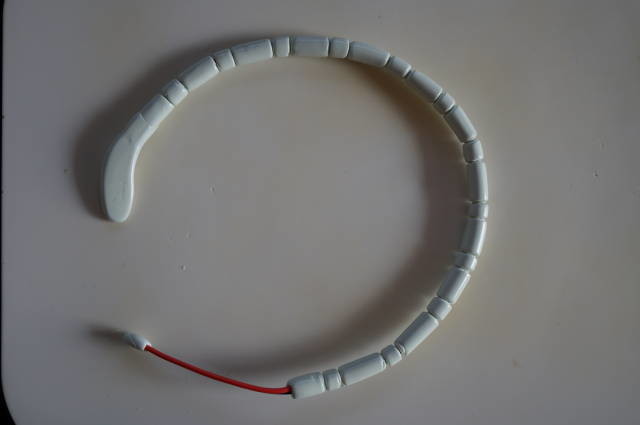
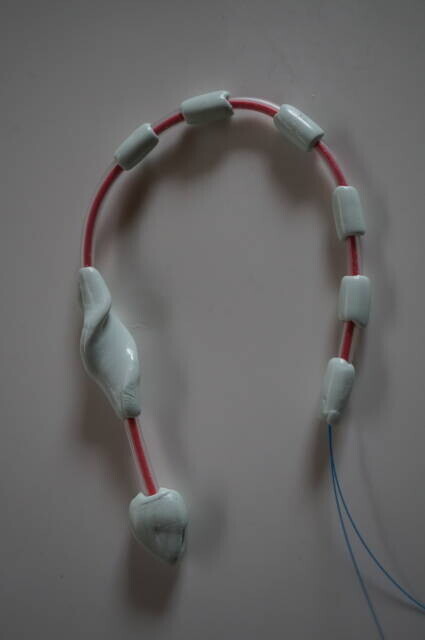
The OK Prostate Chip is a small device placed in the urethra to act on the prostate. A jointed urethral sound (a supporting rod with bendable joints) connects a tip to parallel cords covered with firm resin segments. Its joints allow limited bending along the urethra, and its tip may be a chip or a motor. Related experiments combined sounds with external urine collectors or flexible sections near the penis.
Wire breakage prompted the two-cord sound, whose joints bend one way
In an entry published in January 2023, a customer reported that an approximately 6mm four-wire sound broke after about 3 weeks. The wire failed beside a rigid 5cm section, and the customer requested a replacement with a shorter rigid section. Mr. Okada instead proposed eliminating the wire and made a cord-and-epoxy prototype (epoxy is the resin forming its firm segments).
He reported that 2 strands worked adequately instead of 4, but the new design bent in only one direction. In an entry published in February 2023, that customer reported comfort with a larger custom version after initial difficulty. Mr. Okada’s January 2023 caution was that this one-direction bending made orientation important.
(Source: ok-lab's diary, published January 2023)
https://ok-lab.hatenablog.com/entry/2023/01/21/122941
(Source: ok-lab's diary, published February 2023)
https://ok-lab.hatenablog.com/entry/2023/02/11/123054
A motor-tipped jointed urethral sound received separate component charges
In an entry published in January 2023, a customer requested a motorized model with 3 stimulation points. Mr. Okada replied that versions with 2 or 3 motors could use the jointed design. He then described a motor-tipped variant with a USB connection (the motor’s power connector) at the opposite end.
The motor charge was ¥2,000 (about $13 at ¥156 = $1, rate as of 2026-09-04) tax excluded, and the USB charge was ¥500 (about $3 at ¥156 = $1, rate as of 2026-09-04) tax excluded, both added to the sound’s price. The diary does not record whether that customer’s requested model was completed. Mr. Okada suggested a 6mm motor or 8mm thin motor as a way to make the design slimmer.
(Source: ok-lab's diary, published January 2023)
https://ok-lab.hatenablog.com/entry/2023/01/28/122843
Cushioned joints added cost to the two-cord sound’s protective redesign
In an entry published in February 2023, Mr. Okada introduced cushioned joints (silicone padding between the resin segments). Although he believed the existing gaps did not pinch tissue, he wanted a more protective joint. He described 1mm tubing in a double layer as a cartilage-like cushion.
The surcharge was ¥1,000 (about $6 at ¥156 = $1, rate as of 2026-09-04) tax excluded per 10cm, or ¥2,000 (about $13 at ¥156 = $1, rate as of 2026-09-04) tax excluded for the maximum 18cm. His claim that the padding improved safety came from his own assessment. Mr. Okada recommended the cushioned version on that basis.
(Source: ok-lab's diary, published February 2023)
https://ok-lab.hatenablog.com/entry/2023/02/11/123054
The urine-collection sound was difficult to fit and could leak
In an entry published in April 2023, Mr. Okada reported needing about 10 minutes to fit his urine-collection sound, even as its developer. His prototype combined a sound with a condom-and-tube collector outside the body. He claimed better urine control, but warned that a capped outlet could cause the condom to overfill and leak inward during substantial urination.
For possible heavy leakage, he suggested an absorbent diaper as an additional precaution. He offered the experimental version to people seeking prolonged placement and controlled collection. However, Mr. Okada recommended the ordinary sound without urine collection because the collecting version was difficult to manage.
(Source: ok-lab's diary, published April 2023)
https://ok-lab.hatenablog.com/entry/2023/04/15/123038
Wider support-plate openings ended development of the urine-collection sound
In an entry published in April 2023, Mr. Okada described a wider opening in the support plate (a device that holds the penis retracted). The revised plate exposed the urine outlet on its outer face, changing the arrangement used in the previous collection prototype. He explicitly stopped development of the condom-and-tube urine-collection structure.
His preference for the retracted arrangement also changed from the rigid flat sound to the two-cord sound. Mr. Okada recommended the jointed design because he believed it followed the altered passage more readily.
(Source: ok-lab's diary, published April 2023)
https://ok-lab.hatenablog.com/entry/2023/04/22/123057
The rigid-flexible sound had distinct charges for each section’s length
In an entry published in June 2023, Mr. Okada introduced a rigid-flexible sound (a firm inner section joined to a flexible outer length). The rigid section was limited to 10cm, costing ¥2,500 (about $16 at ¥156 = $1, rate as of 2026-09-04) tax excluded, with ¥3,000 (about $19 at ¥156 = $1, rate as of 2026-09-04) stated for the twisted form. The flexible section cost ¥500 (about $3 at ¥156 = $1, rate as of 2026-09-04) tax excluded per 1.5cm, and combined length could not exceed 22cm.
Mr. Okada intended the firmer part to hold its shape internally while the softer section accommodated movement near the penis. He said the earlier all-rigid form could still be used. Mr. Okada nevertheless recommended the rigid-flexible design for the S-shaped arrangement.
(Source: ok-lab's diary, published June 2023)
https://ok-lab.hatenablog.com/entry/2023/06/03/121955
The maker's answer to jointed urethral sounds
Mr. Okada proposed different tips, joints, and supports, while reporting limits tied to shape, depth, and positioning.
A flat resin tip was the maker’s preferred two-cord sound option
In an entry published in January 2023, Mr. Okada set out options for the newly offered two-cord sound. A resin tip with cord cost ¥2,000 (about $13 at ¥156 = $1, rate as of 2026-09-04) tax excluded, while the jointed section cost ¥500 (about $3 at ¥156 = $1, rate as of 2026-09-04) tax excluded per 15mm. The published example priced an assembly with 18cm of joints at ¥8,000 (about $51 at ¥156 = $1, rate as of 2026-09-04).
An 8-hole version added ¥1,000 (about $6 at ¥156 = $1, rate as of 2026-09-04) tax excluded for 4 front holes and 4 rear holes. The design could also connect to ordinary chips, with ceramic tips priced according to the chosen chip. Mr. Okada recommended a slender, curved resin tip with a flat end for sound use.
(Source: ok-lab's diary, published January 2023)
https://ok-lab.hatenablog.com/entry/2023/01/21/122941
Deeper movement complicated support with an S-shaped rigid-flexible sound
In another part of an entry published in June 2023, Mr. Okada compared S-shaped sounds used with a perineal rod (an external support rod). He reported that pressure from the rod had already been pushing the assembly inward. With a stronger S-shaped curve, the sound itself reached the prostate, while its attached chip moved into the bladder.
He attributed the unexpectedly deep position to the rod’s pressure and his own anatomy. He emphasized that the same curve would not reach the same depth in every person. Mr. Okada therefore cautioned that the curve needed individual consideration.
(Source: ok-lab's diary, published June 2023)
https://ok-lab.hatenablog.com/entry/2023/06/03/121955

Downward fixation of the rigid-flexible sound remained a limited personal test
In an entry published in October 2023, Mr. Okada tested a side-entry holder (an external support) with the rigid-flexible sound. The nearly 8mm-wide sound reportedly fitted closely into the holder. He also tested downward positioning with the 2017 downward-support garment.
According to Mr. Okada, the firm inner section and flexible area near the penis worked well together in that arrangement. He stressed that downward positioning involved different angles from upward positioning, and his placement tests had lasted only a few days. Mr. Okada cautioned that he did not recommend this combination for everyone.
(Source: ok-lab's diary, published October 2023)
https://ok-lab.hatenablog.com/entry/2023/10/21/123054
How jointed urethral sounds changed over time
| Published | What the diary said then |
|---|---|
| Jan 2023 | Joint sections alternated 10mm and 5mm, with a maximum of 12 units. |
| Feb 2023 | Standard diameter was 5–6mm; one custom version measured 7–8mm. |
| Mar 2023 | Mr. Okada preferred the jointed sound over the standalone rigid flat model. |
| Apr 2023 | The collector combined a reinforced tube and sound beneath an elastic outer coating. |
| May 2023 | A 20mm plate opening was Mr. Okada’s reported limit for his jointed vibrator test. |
| Oct 2023 | An 18cm jointed addition was quoted at ¥6,600 (about $42 at ¥156 = $1, rate as of 2026-09-04) for a ceramic-chip build. |
| Feb 2024 | A tail prototype (flexible extension) adapted the jointed design with wider gaps between resin segments. |
The diary does not say what the current state is.
OK Prostate Chip products related to jointed urethral sounds
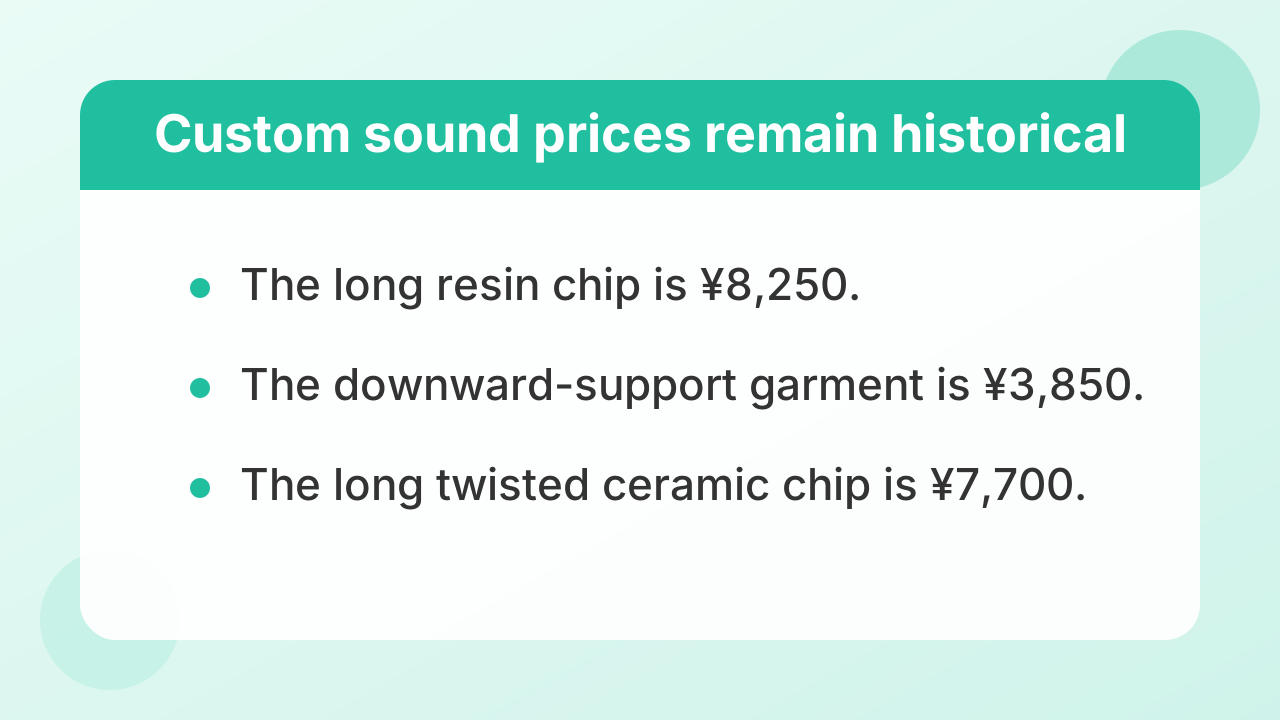
Related chips and a support garment are listed today; the diary’s custom sound prices remain historical.
Products that appear in these entries
| Product (official name) | Price incl. tax | Relation to this topic |
|---|---|---|
| Long resin chip (OKプロステートチップ ロング凶悪ゾロ(生体適合樹脂)) | ¥8,250 (about $53 at ¥156 = $1, rate as of 2026-09-04) | In October 2023, a quote paired this chip with a rigid-flexible sound; the current listing covers the chip. |
| Downward-support garment (ペニストッキング2017) | ¥3,850 (about $25 at ¥156 = $1, rate as of 2026-09-04) | In October 2023, Mr. Okada tested this garment with the side-entry holder and rigid-flexible sound. |
(Source: ok-lab's diary, published October 2023)
https://ok-lab.hatenablog.com/entry/2023/10/21/123054
Products the diary mentioned as alternatives
| Product (official name) | Price incl. tax | Relation to this topic |
|---|---|---|
| Long twisted ceramic chip (OKプロステートチップ 陶器素材ロングタイプ 4点ツイスト) | ¥7,700 (about $49 at ¥156 = $1, rate as of 2026-09-04) | In April 2023, Mr. Okada suggested this longer chip instead of shorter tips that might not reach the prostate in his arrangement. |
(Source: ok-lab's diary, published April 2023)
https://ok-lab.hatenablog.com/entry/2023/04/15/123038
Historical custom sounds, experimental tail, side-entry holder, and thin cable option: No matching product can be confirmed on the current list.
Common worries about jointed urethral sounds
The diary’s questions distinguish comfort after placement, slipping during use, and difficulty getting the jointed section through.
"Is a jointed urethral sound comfortable once in place?"
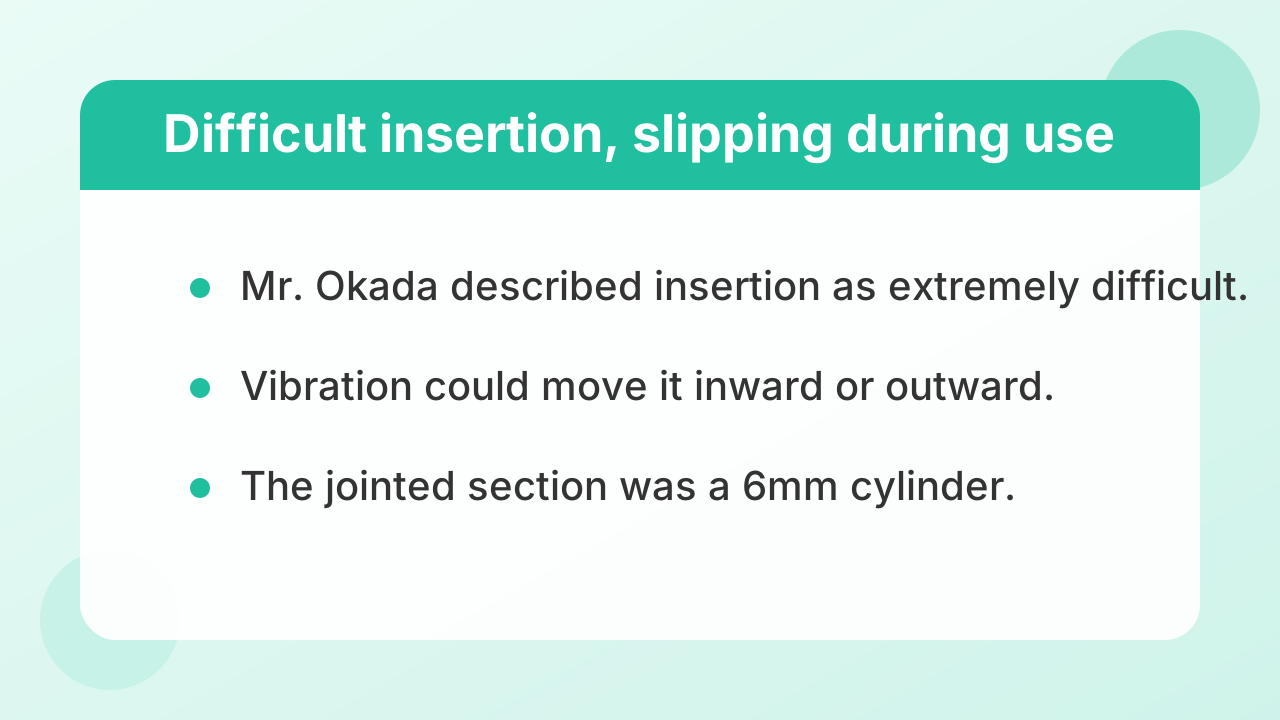
In an entry published in May 2023, a customer asked whether the sound added strain and whether an ordinary thread-connected chip could work. Mr. Okada said the two-cord model might cause relatively little strain once positioned. He also described insertion as extremely difficult because the urethra curved and the plate opening reduced the available space.
The diary does not record how the customer’s sound felt in use. Mr. Okada also suggested an ordinary thread-connected chip as an option.
(Source: ok-lab's diary, published May 2023)
https://ok-lab.hatenablog.com/entry/2023/05/13/123004
"Can a jointed urethral sound slide out during use?"
In an entry published in May 2023, a customer said a motorized two-cord sound kept slipping out and asked about alterations. The previous quote listed a 12cm jointed section at ¥4,400 (about $28 at ¥156 = $1, rate as of 2026-09-04), a ¥3,300 (about $21 at ¥156 = $1, rate as of 2026-09-04) tip motor, and a ¥1,100 (about $7 at ¥156 = $1, rate as of 2026-09-04) waterproof USB modification. Mr. Okada replied that the design had no built-in feature preventing outward movement.
He said vibration could move it inward or outward. The diary does not record whether his proposed solution stopped the customer’s problem. Mr. Okada suggested external support, including a ring-based arrangement.
(Source: ok-lab's diary, published May 2023)
https://ok-lab.hatenablog.com/entry/2023/05/27/122912
"Will a jointed urethral sound make smaller chips easier?"
In an entry published in August 2023, a customer sought thinner electrode chips (chips carrying electrical contacts) and smaller vibrating models. Earlier chips had been difficult to insert; OK Lab replied that electrical contacts limited how much smaller the electrode chip could be. It warned that the jointed section itself was a 6mm cylinder and could make insertion harder.
The reply mentioned several earlier purchasers who could not insert their jointed models. The diary does not record whether a thinner version was completed for this customer. Mr. Okada suggested a thinner nylon-reinforced cable instead, while warning that it could not support the jointed design.
(Source: ok-lab's diary, published August 2023)
https://ok-lab.hatenablog.com/entry/2023/08/19/123214
Buying from outside Japan

OK Lab ships internationally to countries covered by Japan Post's EMS courier service. Overseas orders are paid in advance by PayPal. Each order carries a ¥400 (about $3 at ¥156 = $1, rate as of 2026-09-04) handling fee, and EMS shipping is charged on top. These terms come from OK Lab's official sales-terms page (written here as plain text, not a link: ok-lab.net/docs/law), checked on September 7, 2026; confirm them on the official store before you order, because they can change.
Summary of this article
| What you wanted to know | The answer |
|---|---|
| What is the short answer? | Flexibility did not prevent insertion problems or movement during use. |
| What is the base product? | A urethral device made and sold by OK Lab in Japan, with prices in Japanese yen. |
| What do the design terms mean? | Joints, padding, and mixed rigid-flexible lengths describe different approaches to bending and support. |
| What happened during development? | A broken wire prompted redesign; urine collection was later abandoned. |
| What did the maker propose? | Different tips and supports, with cautions about depth and individual fit. |
| How did the design evolve? | Jointed segments led to padding, mixed stiffness, and later tail experiments. |
| What is listed today? | Current prices cover the listed chips and garment, separately from historical custom-build quotes. |
| What did customers ask? | Whether the sound would feel comfortable, stay put, or make insertion easier. |
| Can someone outside Japan order? | The stated terms specify EMS shipping, advance PayPal payment, and handling and shipping charges. |
Source: ok-lab's diary (Okada Comfortable Life Laboratory). The original entries are in Japanese; quotations on this page are translated. Photos and videos are on the original entries.
This article is a summary of the maker's development diary. The product is not a medical device and no result is guaranteed. If anything feels wrong or worries you, see a doctor. Prices, specifications and cautions change, so confirm the latest information on the official blog and the official site. Questions about ordering and shipping go to the seller.