![Chip lost inside or gone too far? | Seek immediate care if it cannot be removed [OK Prostate Chip]](/img/a/T0017/eyecatch.svg)
This page is based on entries from "ok-lab's diary" (https://ok-lab.hatenablog.com/), the Japanese development diary written by Mr. Okada, founder of OK Lab, a small company in Japan (Okada Comfortable Life Laboratory). Only the entries about "a chip lost inside or gone too far" are summarized here, in order of publication. Past prices and sizes are as written at the time. Current prices come from the official product list (retrieved September 4, 2026). Quotations are translated from Japanese.
Note: This page is a personal reading log by someone with no connection to the maker or the seller. It reflects the source entries as of their publication dates and makes no guarantee of accuracy or safety. The product is not a medical device; talk to a doctor about any health decision. Check the official site for current information. This page contains advertising.
In short
- The diary records chips becoming impossible to locate, including cases requiring hospital removal from the bladder.
- Mr. Okada favors an attached cord that remains connected outside the body.
- By April 2026, new retrieval tools remained experimental, with no guarantee of successful recovery.
If you see blood in your urine, even a small amount or for the first time, do not wait and see. See a urologist right away. If you suddenly cannot urinate, or the device cannot be removed, do not try to fix it yourself. Go to a medical facility, including emergency care, immediately.
About this product
The OK Prostate Chip is a small device that is placed in the urethra (the urine passage) so that it acts on the prostate; the maker sells it in several shapes, sizes and materials. It is made and sold by OK Lab (Okada Comfortable Life Laboratory), a small company in Japan, through its own online store, and prices are in Japanese yen (JPY). The maker's development diary, "ok-lab's diary", is written in Japanese.
This page is an English summary of it, and every quotation is translated. OK Lab ships internationally, so readers outside Japan can order (see "Buying from outside Japan" below). Product names on this page are plain-English descriptions. The official Japanese product name is shown once in the product table so you can find the same item in the store.
Before you read: key terms
| Term | Plain-English meaning |
|---|---|
| Urethra | The urine passage, where the maker intends the chip to sit near the prostate. |
| Retrieval thread | A cord attached to the device, intended to provide a means of recovery. |
| Fully internal design | A configuration intended to keep both the chip and its retrieval parts inside the body. |
| Retrieval loop | A loop on the device or thread, intended as a catching point for a retrieval tool. |
| Birdcage loop | A three-dimensional thread structure intended to remain open as a catching point. |
| J-hook | A curved wire end intended to catch a retrieval loop. |
| Sphincter | The muscle boundary used in the diary to describe whether a device has advanced beyond its intended position. |
| Stopper | An added part intended to limit inward movement; the diary describes conditions where it can fail. |
| Cystoscopy | Examination with a bladder camera, used during the reported hospital removals. |
What happens: a chip lost inside
The OK Prostate Chip is a small device placed in the urethra to act on the prostate. The diary's lost-chip cases concern devices people could no longer locate, including some that had moved into the bladder. A retrieval thread (an attached cord) provides a recovery connection, with some designs leaving the cord outside the body. Other entries describe internal loops intended as catching points for a separate tool.
A chip lost inside prompted requests for help in January 2018
In a January 2018 entry, a beginner described severe pain and losing track of the chip near the penis base. The customer wanted help, but the diary does not record how this case ended.
Mr. Okada treated retrieval thread movement as a clue to depth. He emphasized the attached cord because his own earlier experiments had involved devices he could no longer locate.
(Source: ok-lab's diary, published January 2018)
https://ok-lab.hatenablog.com/entry/20180127/1517054930
A retrieval loop became available for thread drawn inside in August 2019
In an August 2019 entry, a customer requested a retrieval loop (a catching point) beyond the thread's safety attachment. Mr. Okada initially considered redirecting the request to an existing part, but made the requested version. He found it useful and opened orders.
The stated maximum thread length was 27cm, excluding a loop measuring about 3cm when extended. He thought the loop could provide a catching point if the thread disappeared inside. Mr. Okada advised customers ordering this modification to specify thread length without including the loop.
(Source: ok-lab's diary, published August 2019)
https://ok-lab.hatenablog.com/entry/2019/08/17/132641
A birdcage retrieval loop addressed flattened thread loops in August 2021
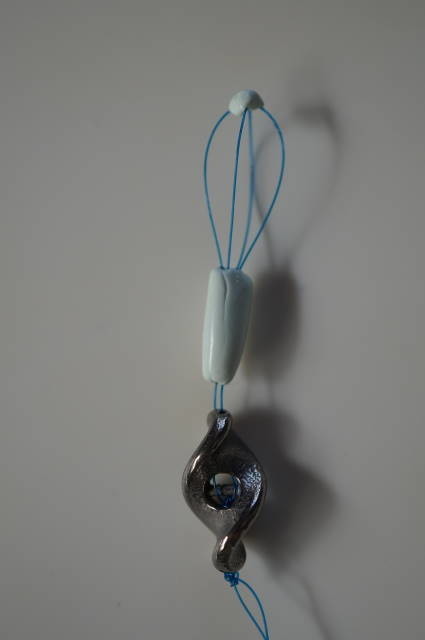
An August 2021 entry described a birdcage loop (a three-dimensional thread structure) intended to remain open inside the urine passage. Mr. Okada presented it as easier to catch than an ordinary flattened loop.
The modification supported two threads only and cost ¥2,000 (about $13 at ¥156 = $1, rate as of 2026-09-04) excluding tax, as published in August 2021. Mr. Okada proposed this design for internal loops that were difficult to catch.
(Source: ok-lab's diary, published August 2021)
https://ok-lab.hatenablog.com/entry/2021/08/07/125807
A chip lost inside required hospital removal in December 2021
December 2021 entries followed a customer who lost a fully internal chip (with its retrieval parts also inside) after sleeping. Staff initially thought its rear loop remained reachable, but Mr. Okada warned against searching inside the bladder with a wire. After noticing pus, the customer sought care; the entire assembly was in the bladder.
Hospital cystoscopy (examination with a bladder camera) removed it in about 10 minutes, with a reported charge of more than ¥30,000 (about $192 at ¥156 = $1, rate as of 2026-09-04). Staff had advised medical assessment when the customer lacked confidence in resolving the problem.
(Source: ok-lab's diary, published December 2021)
https://ok-lab.hatenablog.com/entry/2021/12/18/123756
(Source: ok-lab's diary, published December 2021)
https://ok-lab.hatenablog.com/entry/2021/12/25/123556
Chip retrieval experiments compared inexpensive hooks with loop tools in April 2025
In an entry published in April 2025, Mr. Okada compared straws, a multipurpose wire, and single-loop and double-loop prototypes. The historical prices were ¥10 (about $0 at ¥156 = $1, rate as of 2026-09-04) or less for straws and ¥500 (about $3 at ¥156 = $1, rate as of 2026-09-04) excluding tax for the multipurpose wire. The single-loop and double-loop prototypes were ¥3,000 (about $19 at ¥156 = $1, rate as of 2026-09-04) excluding tax and ¥5,000 (about $32 at ¥156 = $1, rate as of 2026-09-04) excluding tax, respectively.
Mr. Okada reported success in all three of his J-hook (curved wire tip) tests. For retrieval alone, he favored the simpler multipurpose wire over the loop tools.
(Source: ok-lab's diary, published April 2025)
https://ok-lab.hatenablog.com/entry/2025/04/05/122932
A chip lost inside with its thread required hospital care in May 2025
In a May 2025 entry, a customer reported that a wire could not catch a custom device made from wire and tubing. Mr. Okada initially answered on the assumption that its retrieval loops remained outside the sphincter (the muscle boundary discussed in these entries). A follow-up revealed that the attached thread had disappeared too.
The customer later confirmed that the device and thread had entered the bladder. Hospital tests, waiting, and cystoscopy took about 5 hours, with a reported cost of ¥34,000 (about $218 at ¥156 = $1, rate as of 2026-09-04). Once the deeper position became apparent, Mr. Okada advised a urology visit because he could not suggest a straightforward recovery.
(Source: ok-lab's diary, published May 2025)
https://ok-lab.hatenablog.com/entry/2025/05/03/122907
A broken retrieval thread remained unresolved after one week in April 2026
In an April 2026 entry, a customer reported a chip still inside after about 1 week following thread failure. The customer described pain during urination and asked about the multipurpose wire. Staff warned that its hook could slip and that mechanical movement might send the chip into the bladder.
Their reply favored lubrication over mechanical manipulation, but the diary does not record whether this customer's chip was eventually removed. Mr. Okada cautioned that the alternative tool he proposed was not a reliable retrieval method.
(Source: ok-lab's diary, published April 2026)
https://ok-lab.hatenablog.com/entry/2026/04/04/122916
The maker's answer to a chip lost inside
Mr. Okada emphasized an external retrieval thread, while acknowledging limits in the proposed recovery tools.
The chip retrieval manual offered explanations without proving reliable recovery
A July 2021 entry reproduced Mr. Okada's troubleshooting manual. It linked failed thread retrieval to dryness or sticking semen and proposed urine-assisted recovery. These were the maker's explanations, without an individual diagnosis.
The manual expected most bladder cases to pass with urine, and discussed a custom catcher or hospital cystoscopy for failures. Mr. Okada also warned that blind retrieval could fail and pointed to hospitals equipped with a bladder camera.
(Source: ok-lab's diary, published July 2021)
https://ok-lab.hatenablog.com/entry/2021/07/24/125923
A retrieval hook did not justify removing the external thread in December 2024
In a December 2024 entry, a customer requested a wire that also supported retrieval. Mr. Okada responded with separate functions at its opposite ends. He nevertheless warned that a wire could fail to recover a device once its entire length crossed the sphincter.
He allowed that catching a device inside the bladder might happen by chance, without promising success. Mr. Okada regarded an external thread as the safest choice and advised against eliminating it.
(Source: ok-lab's diary, published December 2024)
https://ok-lab.hatenablog.com/entry/2024/12/14/122948
A smaller retrieval hook addressed tiny wire loops in April 2025
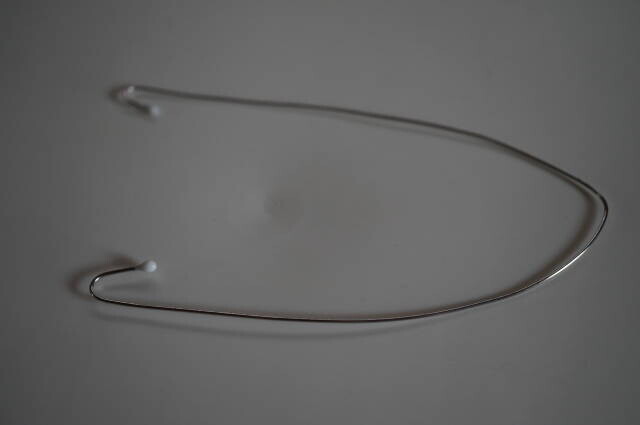
In an April 2025 entry, Mr. Okada said the multipurpose hook was too large for certain 0.2mm wire loops. He made a dedicated tool from 0.7mm stainless steel wire, with small J-shaped ends.
It measured 20cm and cost ¥500 (about $3 at ¥156 = $1, rate as of 2026-09-04) excluding tax, as published in April 2025. Mr. Okada offered it without charge to existing buyers of the relevant loops and recommended it with future purchases of those products.
(Source: ok-lab's diary, published April 2025)
https://ok-lab.hatenablog.com/entry/2025/04/19/122913
A softer chip retrieval net still lacked guaranteed success in April 2026
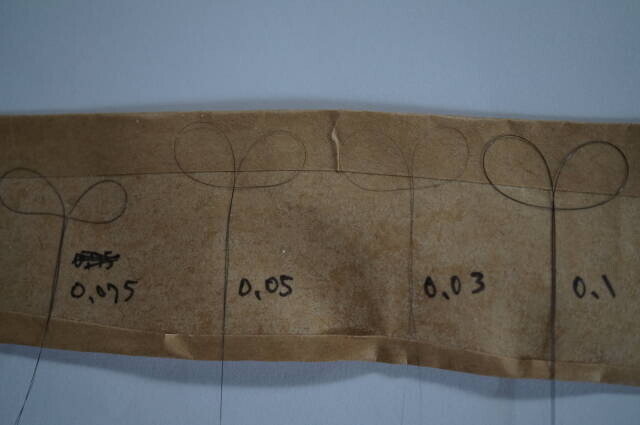
An April 2026 entry described Mr. Okada's softer net made from 0.05mm wire. He replaced a single 0.4mm shaft wire with doubled 0.15mm wire and restored a looped tip. He suspected an earlier sharp tip had penetrated its rubber covering and caused bleeding during testing.
Mr. Okada judged the softer shaft unable to push a chip into the bladder, but did not guarantee successful retrieval. He reported net breakage when strands tangled, while expecting broken strands to remain attached to the shaft. Mr. Okada named medical help as the fallback if the experimental tool failed.
(Source: ok-lab's diary, published April 2026)
https://ok-lab.hatenablog.com/entry/2026/04/25/122914
If you see blood in your urine, even a small amount or for the first time, do not wait and see. See a urologist right away. If you suddenly cannot urinate, or the device cannot be removed, do not try to fix it yourself. Go to a medical facility, including emergency care, immediately.
How chip retrieval changed over time
| Published | What the diary said then |
|---|---|
| Jan 2018 | Customers reported difficulty locating chips inside the urine passage. |
| Aug 2019 | A custom thread-end retrieval loop became available. |
| Jul 2021 | A bladder catcher prototype existed, but bladder testing had not occurred. |
| Aug 2021 | Birdcage loops added an open structure to internal retrieval attachments. |
| Dec 2021 | Mr. Okada warned against searching inside the bladder with a wire. |
| Dec 2024 | An added retrieval hook did not replace the maker's preference for an external thread. |
| Apr 2025 | A smaller dedicated hook addressed incompatibility with fine wire loops. |
| May 2025 | A custom device made from wire and tubing entered the bladder with its thread. |
| Apr 2026 | A larger net prototype pushed the chip inward unless its thread restrained it. |
| Apr 2026 | A softer shaft and looped tip replaced the earlier retrieval design. |
The diary does not say what the current state is.
OK Prostate Chip products related to chip retrieval
The current list includes the multipurpose stainless steel wire discussed in a case that required hospital removal.
Products that appear in these entries
| Product (official name) | Price incl. tax | Relation to this topic |
|---|---|---|
| Multipurpose stainless steel wire (多目的ステンレスワイヤー) | ¥550 (about $4 at ¥156 = $1, rate as of 2026-09-04) | In December 2021, staff suggested this wire during a lost-chip case that ultimately required hospital removal. |
(Source: ok-lab's diary, published December 2021)
https://ok-lab.hatenablog.com/entry/2021/12/25/123556
Products the diary mentioned as alternatives
The diary names no alternative.
Historical custom chips, thread-loop modifications, the dedicated small hook, and retrieval prototypes:
No matching product can be confirmed on the current list.
Common worries about a chip lost inside
Mr. Okada did not treat stoppers or proposed recovery tools as guaranteed protection.
"Could a magnet solve chip retrieval problems?"
In a February 2021 entry, a customer proposed a magnet inside the chip to support retrieval. Mr. Okada worried about leaving a magnet powerful enough for that purpose inside the body for long periods. He explicitly acknowledged having no expertise to substantiate that health concern.
The diary does not record a completed device. Mr. Okada's response cautioned against prolonged internal exposure to a powerful magnet.
(Source: ok-lab's diary, published February 2021)
https://ok-lab.hatenablog.com/entry/2021/02/27/130152
"Can stoppers prevent a chip from going too far?"
A December 2021 follow-up from the hospital patient asked whether a stopper (an added movement-limiting part) could also move too far inward. Mr. Okada's explanation assumed the stopper remained free in the penile section of the urine passage, outside the sphincter. He thought a stopper too close to the main chip could follow it across that boundary.
He also warned that lengthwise pressure could move it across, even with more separation. He did not know whether a customer had experienced bladder migration with a stopper fitted. Mr. Okada cautioned that a stopper beyond that boundary would no longer serve its intended purpose.
(Source: ok-lab's diary, published December 2021)
https://ok-lab.hatenablog.com/entry/2021/12/25/123556
"Can a chip go too far despite difficult insertion?"
In a December 2021 entry, the customer asked how a chip could enter the bladder when placement had previously been difficult. The hospital account confirmed that it had happened.
The customer later linked vigorous vibrating massage to inward movement. The customer warned against vibrator-driven movement with fully internal designs and called a thread connected outside the body a minimum condition.
(Source: ok-lab's diary, published December 2021)
https://ok-lab.hatenablog.com/entry/2021/12/25/123556
Buying from outside Japan
OK Lab ships internationally to countries covered by Japan Post's EMS courier service. Overseas orders are paid in advance by PayPal.
Each order carries a ¥400 (about $3 at ¥156 = $1, rate as of 2026-09-04) handling fee, and EMS shipping is charged on top. These terms come from OK Lab's official sales-terms page (written here as plain text, not a link: ok-lab.net/docs/law), checked on September 7, 2026; confirm them on the official store before you order, because they can change.
Summary of this article
| What you wanted to know | The answer |
|---|---|
| What is the immediate concern? | The diary includes devices that could not be located or removed. |
| What is the product? | A urethral device made and sold by OK Lab in Japan. |
| What do the retrieval terms mean? | Threads and loops provide recovery connections; stoppers aim to limit movement. |
| What happened to customers? | Reported outcomes include hospital removals; some outcomes remain unrecorded. |
| What did the maker favor? | An external retrieval thread, with acknowledged limits to experimental tools. |
| What changed over time? | Retrieval designs evolved from thread loops to hooks and softer nets. |
| What current product appears here? | The multipurpose stainless steel wire is listed at ¥550 (about $4 at ¥156 = $1, rate as of 2026-09-04) including tax. |
| What do the reader questions reveal? | Stopper protection depends on position; the customer warned against vibration with fully internal designs. |
| How do overseas orders work? | Advance PayPal payment, a ¥400 (about $3 at ¥156 = $1, rate as of 2026-09-04) handling fee, and additional EMS shipping charges. |
Source: ok-lab's diary (Okada Comfortable Life Laboratory). The original entries are in Japanese; quotations on this page are translated. Photos and videos are on the original entries.
This article is a summary of the maker's development diary. The product is not a medical device and no result is guaranteed. If anything feels wrong or worries you, see a doctor. Prices, specifications and cautions change, so confirm the latest information on the official blog and the official site. Questions about ordering and shipping go to the seller.