![Can a prostate chip widen the urethra? | A design aim with unproven medical benefits [OK Prostate Chip]](/img/a/T0013/eyecatch.svg)
This page is based on entries from "ok-lab's diary" (https://ok-lab.hatenablog.com/), the Japanese development diary written by Mr. Okada, founder of OK Lab, a small company in Japan (Okada Comfortable Life Laboratory). Only the entries about "urethral stretching" are summarized here, in order of publication. Past prices and sizes are as written at the time. Current prices come from the official product list (retrieved September 4, 2026). Quotations are translated from Japanese.
Note: This page is a personal reading log by someone with no connection to the maker or the seller. It reflects the source entries as of their publication dates and makes no guarantee of accuracy or safety. The product is not a medical device; talk to a doctor about any health decision. Check the official site for current information. This page contains advertising.
In short
- Mr. Okada describes outward pressure, but relief of complete blockage remained theoretical.
- His proposals balance widening, urine flow and resistance to unwanted movement.
- The current list includes the external holder; several widening designs lack confirmed matches.
If you see blood in your urine, even a small amount or for the first time, do not wait and see. See a urologist right away. If you suddenly cannot urinate, or the device cannot be removed, do not try to fix it yourself. Go to a medical facility, including emergency care, immediately.
About this product

The OK Prostate Chip is a small device that is placed in the urethra (the urine passage) so that it acts on the prostate; the maker sells it in several shapes, sizes and materials. It is made and sold by OK Lab (Okada Comfortable Life Laboratory), a small company in Japan, through its own online store, and prices are in Japanese yen (JPY). The maker's development diary, "ok-lab's diary", is written in Japanese. This page is an English summary of it, and every quotation is translated. OK Lab ships internationally, so readers outside Japan can order (see "Buying from outside Japan" below). Product names on this page are plain-English descriptions. The official Japanese product name is shown once in the product table so you can find the same item in the store.
Before you read: key terms
| Term | Plain-English meaning |
|---|---|
| Prostatic urethra | The urine-passage section within the prostate; the maker's chip designs target this section for widening. |
| Bulbar urethra | The wider urine-passage section near the penis base; some loops and stoppers are intended to expand there. |
| Sphincter | The closing muscle before the prostate; the diary uses it as a boundary for chip and stopper positioning. |
| Medical dilator | A device intended to widen a passage; Mr. Okada described this as the chip's original development category. |
| Urethral expander, or bougie | A device intended to widen the urine passage; the gourd-shaped version uses flexible tubing. |
| Tube tail | Nylon thread covered by silicone tubing, providing a connection for supporting parts. |
| Mesh stopper | A perforated plate intended to limit movement while leaving openings for urine. |
| Screw attachment | A twisted plate connected behind a chip, intended to help it stay in position. |
| External slide-lock holder | A holder at the urethral opening, used to secure tubing and limit unwanted inward movement. |
| Nitinol wire | Wire used to form springy loops intended to expand or help stabilize the device. |
What happens: urethral stretching
The OK Prostate Chip is a small device placed in the urethra, intended to press outward within the prostate's urine passage. Urethral stretching here means the maker's proposed widening through a device's shape or outward spring pressure. Some designs target the prostatic urethra (the passage through the prostate), while others expand farther outward in the wider bulbar area. The diary's accounts include personal tests, design explanations and limits on where particular shapes could reach.
Urethral stretching for complete blockage remained theoretical in October 2017
In an entry published in October 2017, Mr. Okada proposed widening a narrowed urine passage with a chip. He described testing the device himself, but had no experience of someone with complete blockage trying it. He explicitly presented that application as theoretical. Mr. Okada advised discussing further use with a doctor.
(Source: ok-lab's diary, published October 2017)
https://ok-lab.hatenablog.com/entry/20171013/1507858434
Medical claims for urethral stretching lacked an application in July 2021
In an entry published in July 2021, Mr. Okada described developing the chip as a medical dilator (a device for widening a passage). He wrote that clinical trial evidence and other requirements were incomplete, so no approval application had been made. He therefore described its legal sales category in Japan as a novelty product, with no guaranteed effects. The draft advised consultation with a doctor for people already receiving treatment or experiencing health problems.
(Source: ok-lab's diary, published July 2021)
https://ok-lab.hatenablog.com/entry/2021/07/24/125923
November 2023 urethral stretching design probably could not reach the prostate
In an entry published in November 2023, Mr. Okada introduced standard sizes for the gourd-shaped urethral expander (bougie). Total lengths were SS 14cm, S 16cm, M 18cm and L 20cm, all ¥8,000 (about $51 at ¥156 = $1, rate as of 2026-09-04) excluding tax. Custom pricing was length in centimeters × ¥500 (about $3 at ¥156 = $1, rate as of 2026-09-04) excluding tax, with a ¥8,000 (about $51 at ¥156 = $1, rate as of 2026-09-04) excluding tax minimum and an approximate 12-25cm manufacturing range.
These standards reflected his own preferred fit; he said they lacked an objective basis. He thought pressure would spread the tip, preventing passage beyond the bulbar urethra (the wider section near the penis base). Mr. Okada advised treating the sphincter (the closing muscle before the prostate) as the design's limit when considering size.
(Source: ok-lab's diary, published November 2023)
https://ok-lab.hatenablog.com/entry/2023/11/04/122744
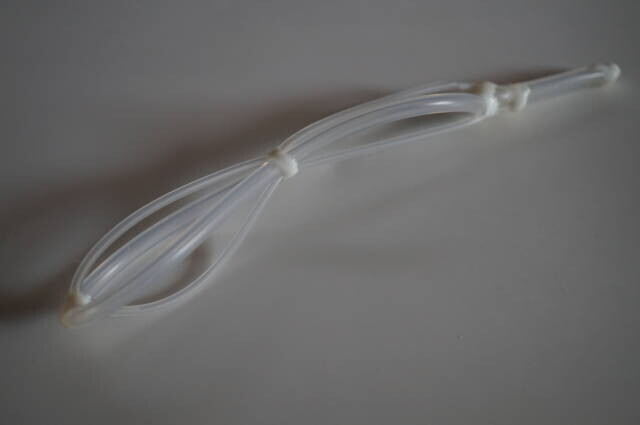
November 2023 urethral stretching tests exposed urine-flow problems with solid stoppers
In an entry published in November 2023, Mr. Okada reported that urine pressure threatened to dislodge plate stoppers on 2.5mm tubing. The plates stood across the flow; a mesh stopper (a perforated plate) improved passage while allowing widening, he reported. The permanently fitted version cost ¥2,000 (about $13 at ¥156 = $1, rate as of 2026-09-04) excluding tax; the removable version cost ¥2,500 (about $16 at ¥156 = $1, rate as of 2026-09-04) excluding tax.
The tube tail (a covered thread carrying attachments) cost ¥2,000 (about $13 at ¥156 = $1, rate as of 2026-09-04) excluding tax for lengths up to 10cm. Its shortest feasible length was about 3cm, because its ends needed fastening. Mr. Okada favored permanent fitting for the stopper nearest the main chip, where it contacts the sphincter.
(Source: ok-lab's diary, published November 2023)
https://ok-lab.hatenablog.com/entry/2023/11/25/122934
December 2023 urethral stretching attachments needed smaller holes to resist slipping
In an entry published in December 2023, a prototype screw attachment (a twisted supporting plate) had a 2.5mm central hole. Mr. Okada found that wet tubing slipped too easily inside it. He warned that the gap from the main chip could change from 10mm to 20mm.
His revised 2mm hole gripped the 2.5mm tube more effectively in his test while retaining adjustability. The dedicated tube-tail screw attachment was then announced at ¥3,000 (about $19 at ¥156 = $1, rate as of 2026-09-04) excluding tax. Mr. Okada considered the screw-only configuration sufficient for customers seeking the earlier screw attachment's function.
(Source: ok-lab's diary, published December 2023)
https://ok-lab.hatenablog.com/entry/2023/12/02/122648
July 2025 urethral stretching tests showed crown-shaped loops resisted passage
In an entry published in July 2025, Mr. Okada reported strong resistance during his crown-shaped loop test. The whole loop did not pass beyond the sphincter. He explained that a crown-shaped loop could resist passage more strongly than an ordinary loop of the same 30mm width.
Crown shaping carried no additional charge, but he said exact dimensions were difficult to reproduce. Mr. Okada asked customers to specify a maximum acceptable size and accept manufacturing variation.
(Source: ok-lab's diary, published July 2025)
https://ok-lab.hatenablog.com/entry/2025/07/26/122909
August 2025 urethral stretching prototypes awaited decisions about sales
In an entry published in August 2025, Mr. Okada described experimental bladder loops using 0.2mm nitinol wire (wire forming springy loops). These accompanied paired blue chips or a white resin screw, with the loop intended to improve stability. He withheld specifications and prices pending a patent professional's advice; a longer sales hold depended on whether protection seemed possible. The diary does not say what the current state is.
(Source: ok-lab's diary, published August 2025)
https://ok-lab.hatenablog.com/entry/2025/08/16/122934
The maker's answer to urethral stretching
Mr. Okada's proposals address outward pressure, urine passage and unwanted movement, alongside warnings about symptoms.
Urethral stretching designs sought outward pressure while leaving urine paths open
In an entry published in July 2021, a titanium fabricator proposed a chip resembling a cross-head screwdriver. Mr. Okada thought the shape could press outward in 4 directions while leaving room for urine. He considered it functionally promising, although less visually appealing than some ceramic designs. The diary does not record a customer trial of this proposal.
(Source: ok-lab's diary, published July 2021)
https://ok-lab.hatenablog.com/entry/2021/07/03/125851
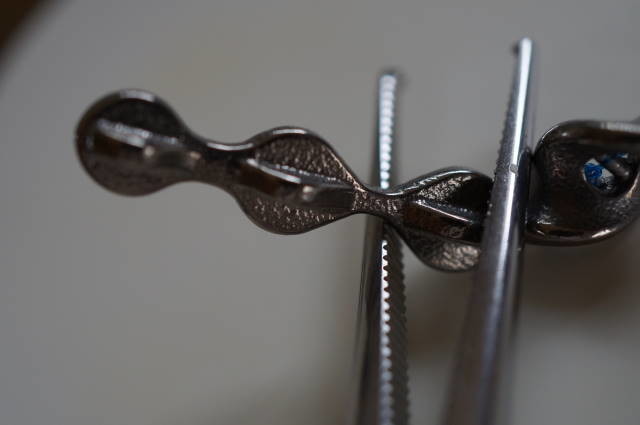
An external holder addressed unwanted inward movement during urethral stretching
In an entry published in October 2023, Mr. Okada tested plain 4mm tubing with an external slide-lock holder (Gatekeeper). He described the holder as securing tubing at the urethral opening to prevent unintended inward travel. He also announced ceramic-chip thread covering: nylon sealed inside tubing up to 25cm long, for ¥2,000 (about $13 at ¥156 = $1, rate as of 2026-09-04) excluding tax.
Blue chips and stainless steel versions required separate consideration; he gave no prices for that work. Mr. Okada cautioned against extending the plain-tube experiment into the bladder.
(Source: ok-lab's diary, published October 2023)
https://ok-lab.hatenablog.com/entry/2023/10/28/122832
The urethral stretching draft acknowledged symptoms requiring medical attention
An entry published in July 2021 reproduced draft warnings about unusual discomfort and bleeding. It also discussed broken retrieval threads and devices that could not be removed, including chips inside the bladder. Mr. Okada's draft advised medical consultation for abnormal symptoms and discouraged customers from making their own repairs or alterations.
(Source: ok-lab's diary, published July 2021)
https://ok-lab.hatenablog.com/entry/2021/07/24/125923
If you see blood in your urine, even a small amount or for the first time, do not wait and see. See a urologist right away. If you suddenly cannot urinate, or the device cannot be removed, do not try to fix it yourself. Go to a medical facility, including emergency care, immediately.
How urethral stretching changed over time
| Published | What the diary said then |
|---|---|
| Oct 2017 | Complete-blockage use remained theoretical despite the maker's personal testing. |
| Jul 2021 | Medical approval had not been sought; the maker described a novelty-product sales category. |
| Oct 2023 | Ceramic-chip thread covering received a length limit and separate price. |
| Nov 2023 | The gourd-shaped expander gained standard sizes and custom pricing. |
| Nov 2023 | Perforated stoppers addressed urine pressure against solid plates. |
| Dec 2023 | A smaller screw opening improved grip on wet tubing in the maker's test. |
| Aug 2025 | Bladder-loop pricing awaited patent advice; any longer sales hold remained conditional. |
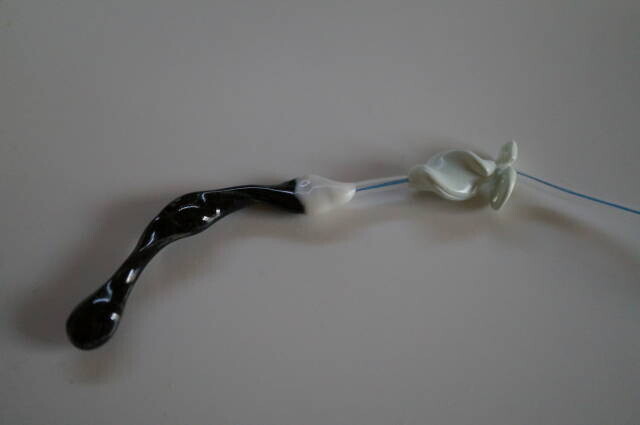
OK Prostate Chip products related to urethral stretching
The current list confirms the external slide-lock holder, without confirming the historical widening assemblies.
Products that appear in these entries
| Product (official name) | Price incl. tax | Relation to this topic |
|---|---|---|
| External slide-lock holder (スライドロック式尿道ゲートキーパー) | ¥6,600 (about $42 at ¥156 = $1, rate as of 2026-09-04) | In October 2023, Mr. Okada tested this holder with plain tubing and described its role in preventing inward movement. |
The external slide-lock holder is sold through OK Lab's own online store.

(Source: ok-lab's diary, published October 2023)
https://ok-lab.hatenablog.com/entry/2023/10/28/122832

Products the diary mentioned as alternatives
The diary names no alternative.
Historical builds: gourd-shaped expander; ceramic thread covering; titanium proposal; mesh stoppers; tube tails; dedicated screws; crown-shaped loops; bladder-loop prototypes; petal-shaped stopper; specially curved wire. No matching product can be confirmed on the current list.
Common worries about urethral stretching
The questions concern how flexible loops widen the passage, allow urine through and resist drifting.
"How does urethral stretching work with flexible tube loops?"
In an entry published in November 2023, a patent professional asked how the expander's thicker and thinner tube loops worked together. Mr. Okada explained that their different lengths created opposing tension, intended to keep the device expanded without rigid pressure. He said hollow silicone tubes bent more softly than solid rods; their hollow centers were not urine channels. Mr. Okada cautioned that the urethra was delicate and should not be forcibly widened.
(Source: ok-lab's diary, published November 2023)
https://ok-lab.hatenablog.com/entry/2023/11/11/122638
"Can urine pass during urethral stretching with this expander?"
In the entry published in November 2023, the patent professional also asked whether tubing filling the passage would obstruct urine. Mr. Okada replied that urine could pass through gaps between the tubes. He claimed urination remained almost as fast with the expander present, describing his assessment rather than a measured clinical result. Mr. Okada cautioned that, without the external holder, urine pressure could push the expander out.
(Source: ok-lab's diary, published November 2023)
https://ok-lab.hatenablog.com/entry/2023/11/11/122638
"Why can urethral stretching loops drift toward the bladder?"
In an entry published in August 2025, a customer asked why their loop device shifted inward, seeking guidance for future sizing. Mr. Okada thought compressed loops tended to move toward roomier areas, while the following loop resisted entering the prostate. He suggested this could leave the narrow joining sections in a stable position, instead of the intended loop.
He also wrote that bladder loops could change shape, so total length did not guarantee a stopping point. The diary does not record whether a revised device was ordered or tested. Mr. Okada suggested a petal-shaped stopper or a wire with a 120-degree curve as possible ways to resist inward movement.
(Source: ok-lab's diary, published August 2025)
https://ok-lab.hatenablog.com/entry/2025/08/16/122934
Buying from outside Japan

OK Lab ships internationally to countries covered by Japan Post's EMS courier service. Overseas orders are paid in advance by PayPal. Each order carries a ¥400 (about $3 at ¥156 = $1, rate as of 2026-09-04) handling fee, and EMS shipping is charged on top. These terms come from OK Lab's official sales-terms page (written here as plain text, not a link: ok-lab.net/docs/law), checked on September 7, 2026; confirm them on the official store before you order, because they can change.
Summary of this article
| What you wanted to know | The answer |
|---|---|
| What is the short answer? | Outward pressure is the maker's design aim; complete-blockage relief remained theoretical. |
| What is this product? | A urethral device made by OK Lab in Japan, with prices in Japanese yen. |
| Which terms matter? | The prostate passage, wider bulbar area, sphincter and supporting parts describe different targets and boundaries. |
| What happened in testing? | Different shapes showed limits involving reach, urine flow, resistance and slipping. |
| What did the maker propose? | Open flow paths, supporting holders and revised attachments, alongside symptom warnings. |
| What changed over time? | Early chip claims expanded into flexible tubing, perforated stoppers, adjustable screws and experimental loops. |
| What is listed today? | The external slide-lock holder is ¥6,600 (about $42 at ¥156 = $1, rate as of 2026-09-04) including tax. |
| What did readers ask? | How loops expand, where urine passes and why devices drift. |
| How do overseas orders work? | Advance PayPal payment, a ¥400 (about $3 at ¥156 = $1, rate as of 2026-09-04) handling fee and additional EMS shipping under the stated terms. |
| What does this account establish? | Dated maker reports and design limits; the entries do not establish medical effectiveness. |
Source: ok-lab's diary (Okada Comfortable Life Laboratory). The original entries are in Japanese; quotations on this page are translated. Photos and videos are on the original entries.
This article is a summary of the maker's development diary. The product is not a medical device and no result is guaranteed. If anything feels wrong or worries you, see a doctor. Prices, specifications and cautions change, so confirm the latest information on the official blog and the official site. Questions about ordering and shipping go to the seller.