![Are spiral prostate chips easier to insert? | Large prototypes bent and cracked [OK Prostate Chip]](/img/a/T0011/eyecatch.svg)
This page is based on entries from "ok-lab's diary" (https://ok-lab.hatenablog.com/), the Japanese development diary written by Mr. Okada, founder of OK Lab, a small company in Japan (Okada Comfortable Life Laboratory). Only the entries about "spiral chips and water floating" are summarized here, in order of publication. Past prices and sizes are as written at the time. Current prices come from the official product list (retrieved September 4, 2026). Quotations are translated from Japanese.
Note: This page is a personal reading log by someone with no connection to the maker or the seller. It reflects the source entries as of their publication dates and makes no guarantee of accuracy or safety. The product is not a medical device; talk to a doctor about any health decision. Check the official site for current information. This page contains advertising.
In short
Large spiral prototypes were difficult to insert and could deform or crack.
Mr. Okada proposed smaller spirals, longer drying, and a water floating approach.
The current list includes a resin spiral model and a positioning belt.
If you see blood in your urine, even a small amount or for the first time, do not wait and see. See a urologist right away.
If you suddenly cannot urinate, or the device cannot be removed, do not try to fix it yourself. Go to a medical facility, including emergency care, immediately.
About this product

The OK Prostate Chip is a small device that is placed in the urethra (the urine passage) so that it acts on the prostate; the maker sells it in several shapes, sizes and materials. It is made and sold by OK Lab (Okada Comfortable Life Laboratory), a small company in Japan, through its own online store, and prices are in Japanese yen (JPY).
The maker's development diary, "ok-lab's diary", is written in Japanese. This page is an English summary of it, and every quotation is translated. OK Lab ships internationally, so readers outside Japan can order (see "Buying from outside Japan" below).
Product names on this page are plain-English descriptions. The official Japanese product name is shown once in the product table so you can find the same item in the store.
Before you read: key terms
| Term | Plain-English meaning |
|---|---|
| Urethra | The urine passage; the base prostate chip is placed here for the maker's intended prostate stimulation. |
| Spiral chip | A hollow, coiled rectal device that Mr. Okada described for prostate stimulation and assistance with stool removal. |
| Water floating | Mr. Okada's name for a chip enclosed with water inside a condom, intended to separate fullness from chip pressure. |
| Epoxy resin | The material covering the tested spiral; Mr. Okada discussed its hardening, bending, and cracking. |
| Sigmoid colon | A body part the tester associated with pain. The diary does not explain this. |
| Control belt | An external strap intended to influence the rectal chip's position. |
| Support device | An external support intended to resist the water enclosure moving outward. |
What happens: spiral chip problems
The OK Prostate Chip is a device placed in the urethra (the urine passage) for prostate stimulation. The spiral chips discussed here are separate rectal devices, described as prostate massagers and aids for removing stool. Mr. Okada's water floating concept places a rectal chip inside a water-filled condom, intended to separate bowel fullness from pressure produced by the chip itself.
A hollow spiral chip could miss small amounts of stool
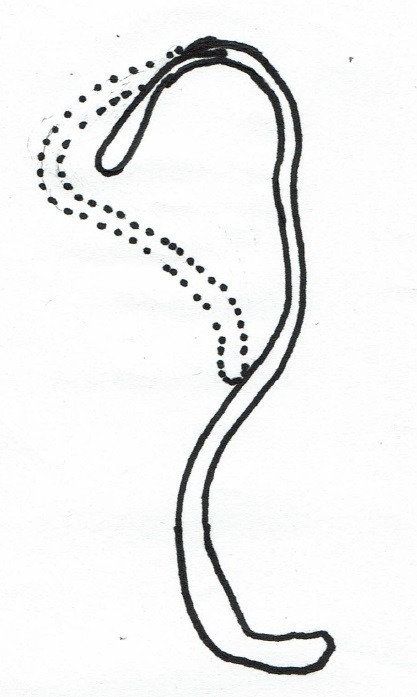
In an entry published in October 2018, Mr. Okada described the spiral as a hollow device intended to capture stool. A proposed version measured about 3cm in diameter and 7cm long, with stool removal and prostate massage as its stated purposes. He also identified a limitation: the hollow spiral could leave small amounts of stool behind.
The same entry described a smaller chip with a U-shaped tip for that remaining stool. His proposed alternative for this specific limitation was the U-shaped design.
(Source: ok-lab's diary, published October 2018)
https://ok-lab.hatenablog.com/entry/20181005/1538740535
An XL enclosure deformed the spiral chip before the test succeeded
In an entry published in October 2018, Mr. Okada reported testing an 8cm spiral prototype inside an XL condom containing water. He said the condom's contracting pressure distorted the spiral, and the water floating test did not work.
He described the XL condom as about 45mm in diameter and thought a spiral around 5cm might fit this approach. For the recipient of a 9cm prototype, his answer was that this condom-based water floating arrangement would not work.
(Source: ok-lab's diary, published October 2018)
https://ok-lab.hatenablog.com/entry/20181023/1540283887
A large spiral chip produced pink secretions, pain, deformation, and cracking
In an entry published in October 2018, a tester reported difficult insertion and pink secretions with a 90mm spiral prototype. On reuse, the tester associated dull pain with the sigmoid colon (unexplained in the diary); the spiral's diameter became 80mm.
After effectively 1 session lasting several minutes, reshaping produced a crack across the epoxy resin (the coating material), 2.5cm from the tip. Mr. Okada blamed incomplete hardening, saying full hardening needed at least 1 month; older prototypes could crack under strong bending.
He judged large, unsupported spirals impractical, considering sales limited to 4cm or less, with at least 1 month of drying. His proposed answer was water floating, intended to shield the spiral from direct bowel pressure.
(Source: ok-lab's diary, published October 2018)
https://ok-lab.hatenablog.com/entry/20181027/1540618195
The published spiral chip price described a smaller standard model
An entry published in October 2018 listed the spiral rectal chip at ¥8,000 (about $51 at ¥156 = $1, rate as of 2026-09-04) excluding tax. Its stated chip length was 11cm, with an internal length of 8cm and maximum width of 35mm.
The entry discussed both ordinary and water floating arrangements for this model. Mr. Okada cautioned that the water enclosure could move outward when the user strained.
(Source: ok-lab's diary, published October 2018)
https://ok-lab.hatenablog.com/entry/20181031/1540960147
Water floating brought belt discomfort and inward movement in one report
In an entry published in November 2018, a tester described a spiral chip with water floating and a control belt (an external positioning strap). They reported better positioning with the belt and less sensation when the enclosure contained too much water.
Friction near the anus became painful, and the tester removed the belt after 5 hours. Around 12 hours, the entire chip moved inside; the report described subsequent removal without bleeding or chip deformation.
Mr. Okada attributed the inward movement to the enclosure's fastening position. He referred the tester back to his earlier enclosure-design advice.
(Source: ok-lab's diary, published November 2018)
https://ok-lab.hatenablog.com/entry/20181123/1542963370
The maker's answer to spiral chip problems
Mr. Okada proposed changes to the enclosure, external support, and chip positioning.
Water floating separated the enclosure's role from spiral chip pressure

In an entry published in October 2018, Mr. Okada described water floating as his response to bleeding problems. In his account, the water enclosure provided bowel fullness, while the chip's shape and size determined the intended prostate stimulation.
He reported personal experience with the concept and considered it gentler than direct contact. Mr. Okada favored a condom enclosure, citing its smoothness and his experience handling that material.
(Source: ok-lab's diary, published October 2018)
https://ok-lab.hatenablog.com/entry/20181020/1540018080
External support addressed outward movement during water floating with spiral chips
In an entry published in October 2018, Mr. Okada explained why water floating required a support device (an external retaining support). He wrote that straining could create an outward force on the water enclosure, including during urination.
He considered external support necessary to counter that movement. He named a tight girdle or a hernia support belt as possible alternatives to the dedicated support.
(Source: ok-lab's diary, published October 2018)
https://ok-lab.hatenablog.com/entry/20181031/1540960147
A control belt addressed positioning problems with water floating spiral chips
In an entry published in October 2018, Mr. Okada warned that excess water could leave the chip without contact at the intended location. His explanation distinguished the enclosure's fullness from the chip actually pressing on the prostate.
The control belt was intended to influence the chip's position from outside the body. He proposed the belt for that positioning problem and described the expected sensation as mild.
(Source: ok-lab's diary, published October 2018)
https://ok-lab.hatenablog.com/entry/20181031/1540960147
If you see blood in your urine, even a small amount or for the first time, do not wait and see. See a urologist right away.
If you suddenly cannot urinate, or the device cannot be removed, do not try to fix it yourself. Go to a medical facility, including emergency care, immediately.
How spiral chip problems changed over time
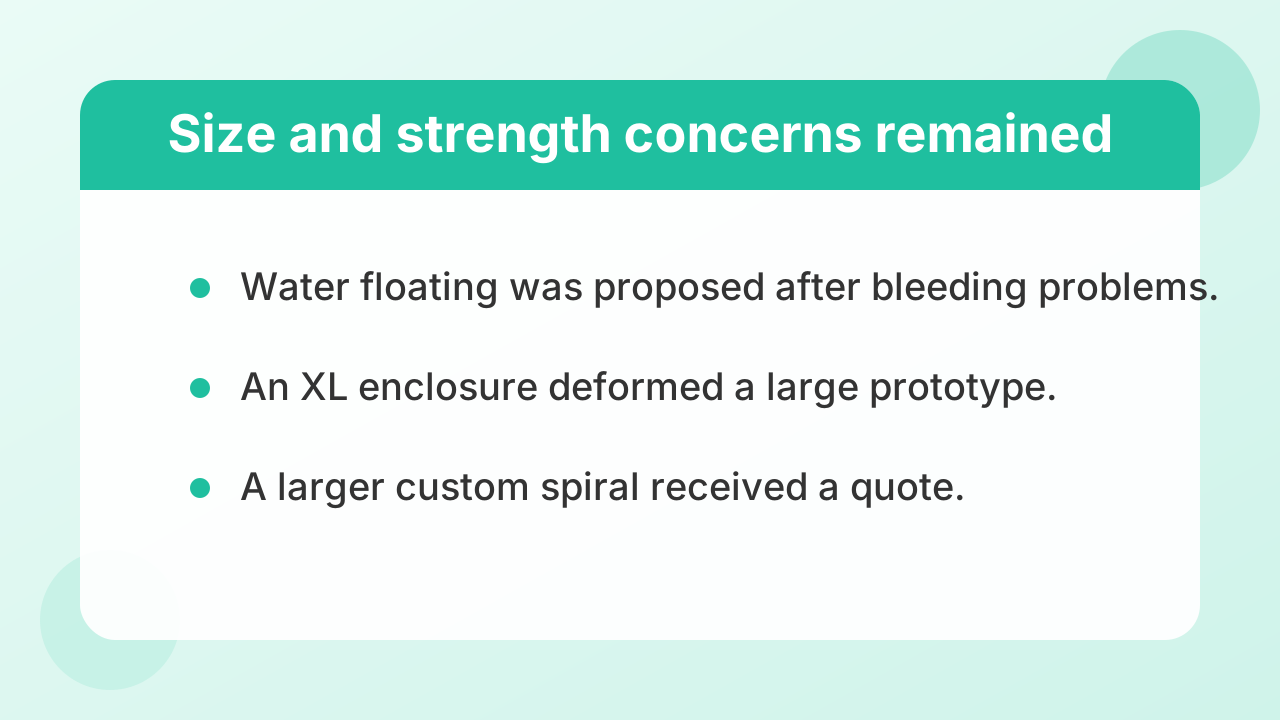
| Published | What the diary said then |
|---|---|
| Oct 2018 | The hollow spiral's stool-capture limitation prompted a U-shaped alternative. |
| Oct 2018 | Water floating was proposed after bleeding problems. |
| Oct 2018 | An XL enclosure deformed a large prototype during testing. |
| Oct 2018 | A damaging test prompted proposed limits on diameter and drying time. |
| Oct 2018 | The diary published the smaller spiral's price and dimensions. |
| Nov 2018 | A tester reported painful belt friction and inward chip movement. |
| Feb 2019 | A larger custom spiral received a quote despite unresolved strength limits. |
The diary does not say what the current state is.
OK Prostate Chip products related to spiral chip problems
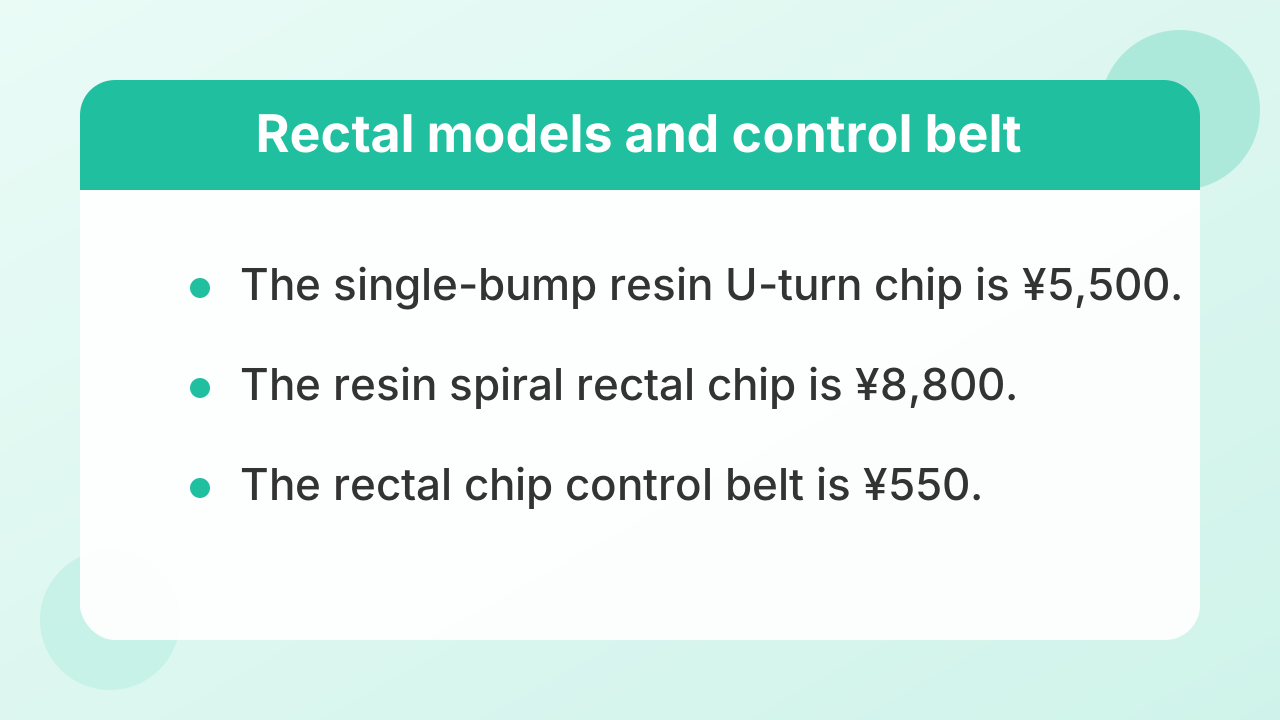
The current list includes standard rectal models and a control belt discussed in these entries.
Products that appear in these entries
| Product (official name) | Price incl. tax | Relation to this topic |
|---|---|---|
| Single-bump resin U-turn rectal chip (OKプロステートお尻チップ 樹脂素材1コブUターン型) | ¥5,500 (about $35 at ¥156 = $1, rate as of 2026-09-04) | The October 2018 entry described this model's ordinary and water floating arrangements. |
| Resin spiral rectal chip (OKプロステートお尻チップ 樹脂素材螺旋型) | ¥8,800 (about $56 at ¥156 = $1, rate as of 2026-09-04) | The October 2018 product entry described the standard spiral's dimensions, historical price, and enclosure concerns. |
| Rectal chip control belt (お尻チップ用コントロールベルト) | ¥550 (about $4 at ¥156 = $1, rate as of 2026-09-04) | The November 2018 tester reported improved positioning followed by painful friction with the belt. |
(Source: ok-lab's diary, published October 2018)
https://ok-lab.hatenablog.com/entry/20181031/1540960147
(Source: ok-lab's diary, published November 2018)
https://ok-lab.hatenablog.com/entry/20181123/1542963370
Products the diary mentioned as alternatives
The diary names no alternative.
Historical prototypes, the small U-shaped stool-removal design, and the enlarged custom build:
No matching product can be confirmed on the current list.
Common worries about spiral chip problems
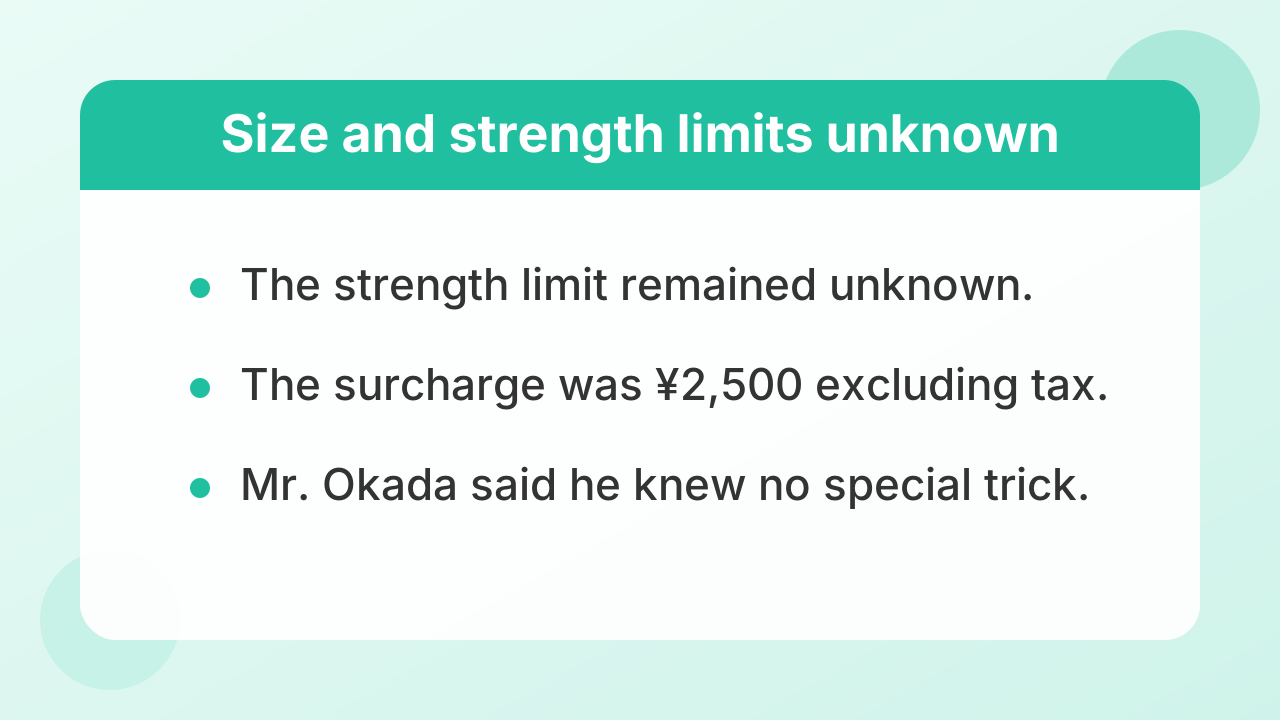
Reader messages raised concerns about size limits, custom prices, and whether stronger sensations were achievable.
"Does water floating establish a safe spiral chip size?"
In an entry published in October 2018, a customer raised the question of finding a maximum diameter and proposed a water-balloon concept. The published message warned that an air-containing water balloon could tear the rectum if it burst internally.
The diary does not record a maximum diameter established by this proposal. Mr. Okada acknowledged possible bursting with very large enclosures. For spirals around 10cm, he thought a stronger enclosure material might be necessary.
(Source: ok-lab's diary, published October 2018)
https://ok-lab.hatenablog.com/entry/20181020/1540018080
"What did a larger custom spiral chip cost?"
In an entry published in February 2019, a customer wanted a larger spiral after worrying that the standard size would feel insufficient. Mr. Okada said he had experienced no particular problem around 5cm, but could not establish a maximum diameter with adequate strength.
The follow-up requested 35mm → 50mm and asked about payment; Mr. Okada described the base strip increasing from about 23cm to 30cm. His quoted rate was ¥350 (about $2 at ¥156 = $1, rate as of 2026-09-04) excluding tax per 1cm, with an overall surcharge of ¥2,500 (about $16 at ¥156 = $1, rate as of 2026-09-04) excluding tax.
The diary does not record a payment arrangement, delivery date, or the customer's experience with the enlarged chip. Mr. Okada's qualification was that the strength limit remained unknown.
(Source: ok-lab's diary, published February 2019)
https://ok-lab.hatenablog.com/entry/2019/02/16/171153
"Can a screw chip guarantee the desired orgasm?"
In an entry published in February 2019, a customer using a screw chip wanted help progressing beyond an almost-orgasm sensation. The diary does not record which screw-chip model the customer meant.
The customer also asked for a discussion board; Mr. Okada declined because the company's staffing could not support timely replies. He said he knew no special trick, and the diary does not record whether the customer later achieved the desired result. His advice centered on paying attention to personal bodily sensations and mental responses.
(Source: ok-lab's diary, published February 2019)
https://ok-lab.hatenablog.com/entry/2019/02/16/171153
Buying from outside Japan

OK Lab ships internationally to countries covered by Japan Post's EMS courier service. Overseas orders are paid in advance by PayPal. Each order carries a ¥400 (about $3 at ¥156 = $1, rate as of 2026-09-04) handling fee, and EMS shipping is charged on top. These terms come from OK Lab's official sales-terms page (written here as plain text, not a link: ok-lab.net/docs/law), checked on September 7, 2026; confirm them on the official store before you order, because they can change.
Summary of this article
| What you wanted to know | The answer |
|---|---|
| What is the short answer? | Large spiral prototypes caused difficulties; Mr. Okada revised his proposals after test reports. |
| What is the base product? | A Japanese urethral device; the spiral rectal devices discussed here are a separate design. |
| What does water floating mean? | A chip enclosed with water inside a condom, intended to separate fullness from chip pressure. |
| What happened in testing? | Reports included deformation, cracking, pink secretions, pain, belt friction, and inward movement. |
| What did the maker propose? | Changes to the enclosure, external support, and control of chip position. |
| What changed over time? | Early proposals gave way to size and strength concerns, followed by a later custom quote. |
| Which related products appear on the current list? | Single-bump and spiral resin rectal models, plus a control belt. |
| What remained unanswered? | A maximum diameter with adequate strength and the enlarged custom chip's outcome. |
| How does ordering outside Japan work? | Advance PayPal payment, a ¥400 (about $3 at ¥156 = $1, rate as of 2026-09-04) handling fee, and additional Japan Post EMS shipping. |
Source: ok-lab's diary (Okada Comfortable Life Laboratory). The original entries are in Japanese; quotations on this page are translated. Photos and videos are on the original entries.
This article is a summary of the maker's development diary. The product is not a medical device and no result is guaranteed. If anything feels wrong or worries you, see a doctor. Prices, specifications and cautions change, so confirm the latest information on the official blog and the official site. Questions about ordering and shipping go to the seller.