![Why does the chip bend instead of advancing? | Jointed supports add stiffness, with limits [OK Prostate Chip]](/img/a/T0014/eyecatch.svg)
This page is based on entries from "ok-lab's diary" (https://ok-lab.hatenablog.com/), the Japanese development diary written by Mr. Okada, founder of OK Lab, a small company in Japan (Okada Comfortable Life Laboratory). Only the entries about "jointed supports that provide stiffness for advancing the chip" are summarized here, in order of publication. Past prices and sizes are as written at the time. Current prices come from the official product list (retrieved September 4, 2026). Quotations are translated from Japanese.
Note: This page is a personal reading log by someone with no connection to the maker or the seller. It reflects the source entries as of their publication dates and makes no guarantee of accuracy or safety. The product is not a medical device; talk to a doctor about any health decision. Check the official site for current information. This page contains advertising.
In short
- The diary describes flexible supports that bend instead of transmitting enough pushing force.
- Mr. Okada developed reinforced tubing and jointed shafts, while reporting limits involving friction, fit, and discomfort.
- No matching product can be confirmed on the current list.
About this product

The OK Prostate Chip is a small device that is placed in the urethra (the urine passage) so that it acts on the prostate; the maker sells it in several shapes, sizes and materials. It is made and sold by OK Lab (Okada Comfortable Life Laboratory), a small company in Japan, through its own online store, and prices are in Japanese yen (JPY). The maker's development diary, "ok-lab's diary", is written in Japanese. This page is an English summary of it, and every quotation is translated. OK Lab ships internationally, so readers outside Japan can order (see "Buying from outside Japan" below). Product names on this page are plain-English descriptions. The official Japanese product name is shown once in the product table so you can find the same item in the store.
Before you read: key terms
| Term | Plain-English meaning |
|---|---|
| Articulated shaft | A support with firm sections and flexible joints, intended to transmit pushing force while allowing bends. |
| Double-tube support | Reinforcement using nested or paired tubes; its arrangement differs between the tail and loop-connection designs. |
| Tail | An extension behind a loop-shaped device, discussed here as a possible support for advancing it. |
| Nitinol | The metal wire used as a flexible core in these designs; the diary does not explain its composition. |
| Nylon thread | A thread incorporated alongside the wire, intended to keep parts connected if the wire breaks. |
| Resin segment | A firm coated section of the support, intended to restrict bending between joints. |
| Milking | An insertion method mentioned for flexible devices. The diary does not explain this. |
| Straw stop | A fitting associated with a straw used as an insertion aid; it appears as an optional component. |
What happens: prostate chip insertion difficulty
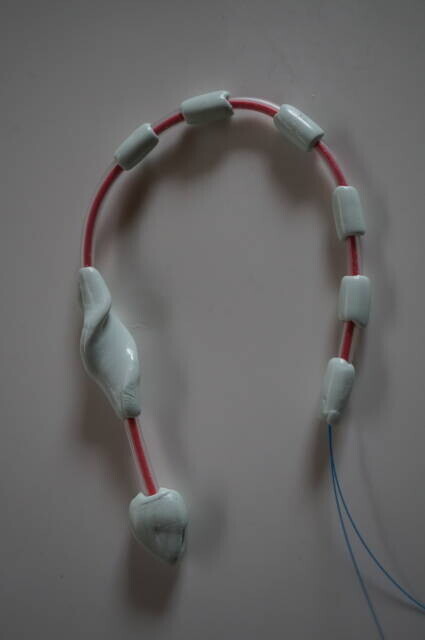
The OK Prostate Chip is a small device placed in the urethra, the urine passage, to act on the prostate. The entries describe supports attached to the chip, plus related loop designs, intended to make advancement easier. An articulated shaft (firm sections separated by flexible joints) is intended to control where the support bends. Double-tube supports (paired or nested tubes) reinforce selected parts of the assembly inside the urethra.
A cable addressing chip stiffness could bend in only one direction
An entry published in June 2022 describes a reinforced 6-line cable, nicknamed Super 4. Its supplementary cables were intended to cover the wire even if it bent or broke. Mr. Okada reports that their resistance to stretching also restricted bending to one direction.
He expected that controlled bending would improve comfort compared with less predictable movement. However, he presents that benefit as an expectation: he had not yet tested the prototype in place.
(Source: ok-lab's diary, published June 2022)
https://ok-lab.hatenablog.com/entry/2022/06/04/123036
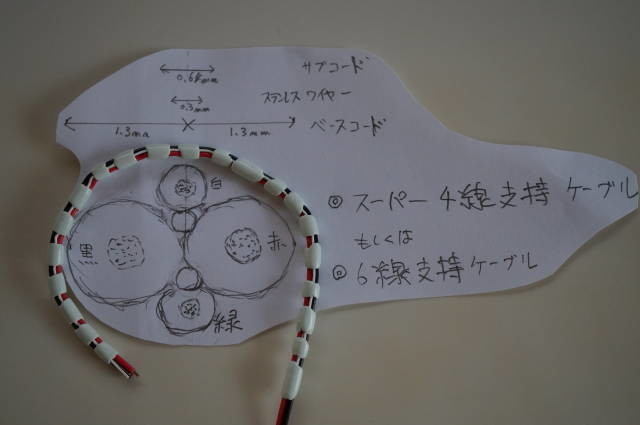
Chip stiffness varied along the June 2023 rigid-and-flexible shaft
An entry published in June 2023 describes a shaft combining a rigid internal section with a flexible section through the penis. The rigid section followed the earlier flat-shaft specification, with freely specified lengths up to 10 cm costing ¥2,500 (about $16 at ¥156 = $1, rate as of 2026-09-04) excluding tax. The twisted version cost ¥3,000 (about $19 at ¥156 = $1, rate as of 2026-09-04) excluding tax.
The flexible section used 1.5 cm length increments, each priced at ¥500 (about $3 at ¥156 = $1, rate as of 2026-09-04) excluding tax. These were separate component charges published at that time. Mr. Okada proposed the flexible section to accommodate movement of the penis while retaining a firmer internal shape.
(Source: ok-lab's diary, published June 2023)
https://ok-lab.hatenablog.com/entry/2023/06/03/121955
A jointed tail addressed the earlier extension's lack of stiffness
An entry published in February 2024 identifies the original tail's problem: it was too soft to provide useful pushing support. Mr. Okada describes a prototype containing an internal cord and external resin segments (firm coated sections). The design borrowed its principle from an existing support with parallel cords and joints.
He reports that wider gaps between the resin sections preserved flexibility while adding support. Mr. Okada says further work on the spacing was needed before releasing the reinforced tail.
(Source: ok-lab's diary, published February 2024)
https://ok-lab.hatenablog.com/entry/2024/02/24/122947
A loop prototype showed why chip stiffness alone was insufficient
An entry published in November 2025 describes a loop prototype whose insertion took Mr. Okada about 20 minutes. He reports that it reached the intended prostate region, but the resulting sensations were too intense. That trial lasted less than 30 minutes, and he included the design among his failed prototypes.
His wider conclusion was that the loop designs needed both covered wire and additional pushing support. Mr. Okada argues for those structural changes rather than relying on the unsupported loops.
(Source: ok-lab's diary, published November 2025)
https://ok-lab.hatenablog.com/entry/2025/11/22/122910
The articulated shaft became thinner, but easier movement reduced retention
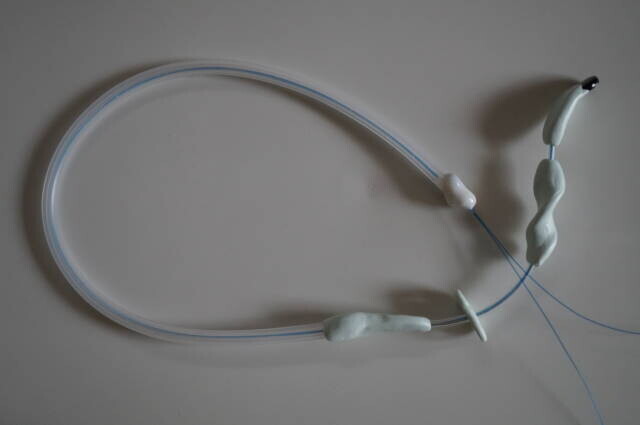
An entry published in November 2025 describes an articulated shaft about 4 mm across, compared with approximately 6 mm for the earlier two-cord jointed support. Its core used nitinol (the metal wire providing flexibility) alongside nylon thread. Mr. Okada calls it the lowest-friction design among the pushable products he had made.
He also reports that easier movement meant the assembly could slip out without features providing additional resistance. Mr. Okada suggests a separate retaining device might be needed to hold it firmly.
(Source: ok-lab's diary, published November 2025)
https://ok-lab.hatenablog.com/entry/2025/11/29/122908
Removing joints from the articulated shaft connection caused substantial discomfort
An entry published in December 2025 describes Mr. Okada testing a chip connected directly to a straight shaft without a joint. He reports discomfort strong enough to prevent extended use.
The proposed chip-side unit instead had joints about 10 mm long, behind a fixed connection. Its historical surcharge was ¥2,000 (about $13 at ¥156 = $1, rate as of 2026-09-04) plus ¥500 (about $3 at ¥156 = $1, rate as of 2026-09-04) per joint, excluding tax, in addition to the chip price. Mr. Okada suggests approximately 2–3 joints for that unit.
(Source: ok-lab's diary, published December 2025)
https://ok-lab.hatenablog.com/entry/2025/12/13/122917
The maker's answer to prostate chip insertion difficulty
Mr. Okada's approach combined firmer support with selected flexible sections, while acknowledging that added stiffness could introduce other problems.
Double-tube support felt firmer than two wires inside one tube
An entry published in May 2025 describes Mr. Okada's own trial of a loop prototype with a paired-tube connection. He reports that its increased stiffness made advancement slightly easier.
In his comparison, separate tubes containing one wire each felt firmer than a single tube containing two wires. This was his assessment from the prototype trial, rather than a customer follow-up. He also cautions that the paired connection produced somewhat stronger sensations where the body gripped it.
(Source: ok-lab's diary, published May 2025)
https://ok-lab.hatenablog.com/entry/2025/05/03/122907
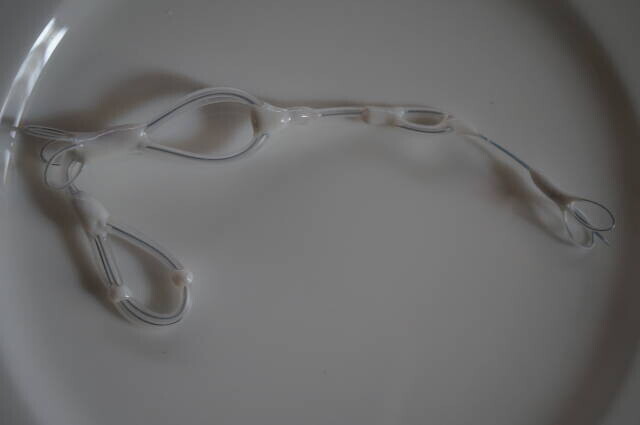
Short gaps let the articulated shaft retain a flexible core
An entry published in November 2025 proposes joint gaps of about 1 mm or less between resin sections. Mr. Okada explains that these short gaps keep the nitinol and nylon threads alongside each other. The nylon was intended to maintain a connection if the metal wire broke.
He describes exposed wire as confined to the valleys between resin sections, with the resin forming the contact surface. These were his reasons for pursuing the structure. Mr. Okada explicitly says the articulated nitinol design still needed further testing.
(Source: ok-lab's diary, published November 2025)
https://ok-lab.hatenablog.com/entry/2025/11/22/122910
Articulated shaft pricing separated the core from its added components
An entry published in November 2025 lists component prices, all excluding tax. The core cost ¥1,000 (about $6 at ¥156 = $1, rate as of 2026-09-04) for up to 6 units, or ¥1,500 (about $10 at ¥156 = $1, rate as of 2026-09-04) for up to 12 units. Each resin-coated unit cost ¥500 (about $3 at ¥156 = $1, rate as of 2026-09-04) separately.
A straw stop (a fitting for an insertion aid) added ¥500 (about $3 at ¥156 = $1, rate as of 2026-09-04). The diary also allowed combinations with different chip materials and additional retaining features. Mr. Okada presents these as configurable arrangements, while warning that an assembly without enough resistance could slip out.
(Source: ok-lab's diary, published November 2025)
https://ok-lab.hatenablog.com/entry/2025/11/29/122908
The articulated shaft assembly gained separate parts and additional thread attachments
An entry published in December 2025 proposed separate chip, straight-shaft, and heart-shaped retaining sections. The straight shaft contained 0.3 mm nitinol wire, measured about 4 mm across, and offered lengths in 10 mm increments. Lengths up to 100 mm cost ¥2,000 (about $13 at ¥156 = $1, rate as of 2026-09-04) excluding tax.
Following staff concerns about separation, the revised assembly used 4 tubes, including additional attachments securing the shaft and stopper to the thread. The extra attachments did not change the quoted prices. Mr. Okada cautions that supplying a suitable overall size would be difficult because customers' dimensions vary.
(Source: ok-lab's diary, published December 2025)
https://ok-lab.hatenablog.com/entry/2025/12/13/122917
How prostate chip insertion difficulty changed over time
| Published | What the diary said then |
|---|---|
| Jun 2022 | Supplementary cable material passed Mr. Okada's preliminary heat tests. |
| Jun 2023 | Combined rigid and flexible sections were limited to 22 cm. |
| Feb 2024 | The experimental urethral loop device was considered unlikely to launch. |
| Jun 2024 | Reinforced tail: 4 mm outside, 1 mm bore, two 0.24 mm nylon threads. |
| May 2025 | A separate double-wire specification was corrected to 3 supporting wires. |
| Nov 2025 | Mr. Okada found 0.1 mm wire gentler than 0.15 mm in brief tests. |
| Nov 2025 | Base segments measured 20 mm long and 4 mm wide. |
| Dec 2025 | The penile section's joints were fixed; moving joints remained nearer the chip. |
OK Prostate Chip products related to prostate chip insertion difficulty
No current product is directly tied to this topic.
Common worries about prostate chip insertion difficulty
The recorded customer questions concern pushing strength, connection design, and the price of a custom assembly.
"Can a double-tube tail help when pushing seems difficult?"
An entry published in June 2024 records a customer's concern that the loop-shaped device's tail might be too flexible. Staff replied that its 2.5 mm tube lacked pushing strength and depended on milking (an insertion method not explained in this material). The customer then asked about a cable option, and Mr. Okada developed a double-tube tail instead.
His prototype used a 2 mm inner tube inside a 4 mm outer tube, with nylon threads inside. The historical surcharge, excluding tax, was ¥3,000 (about $19 at ¥156 = $1, rate as of 2026-09-04) up to 15 cm or ¥4,500 (about $29 at ¥156 = $1, rate as of 2026-09-04) up to 25 cm. Mr. Okada cautions that dryness could still prevent advancement; the diary does not record how the customer's proposed version felt in use.
(Source: ok-lab's diary, published June 2024)
https://ok-lab.hatenablog.com/entry/2024/06/01/123036
"Can a double-tube connection replace the requested double-wire section?"
An entry published in May 2025 describes a customer requesting different wire arrangements between connected loops. Staff initially refused because the loops and their connection shared one continuous wire. After making a prototype, the production reply offered a double-tube connection using single wire, which the customer approved.
The diary shows the completed build but does not record the customer's experience with it. For eligible designs with paired loops at both locations, this connection change carried no extra charge. Mr. Okada cautions that the bulkier connection could increase discomfort where the body grips it.
(Source: ok-lab's diary, published May 2025)
https://ok-lab.hatenablog.com/entry/2025/05/03/122907
"How much did an articulated shaft cost in August 2026?"
An entry published in August 2026 quotes a custom articulated shaft with 9 units. The quoted base was ¥1,650 (about $11 at ¥156 = $1, rate as of 2026-09-04), with ¥550 (about $4 at ¥156 = $1, rate as of 2026-09-04) × 9 for the units and ¥2,200 (about $14 at ¥156 = $1, rate as of 2026-09-04) × 4 for loop options. The request specified 0.15 mm wire and approximately 195 mm from end to end.
The customer requested 5 loop options, but the quotation priced 4; the diary does not explain the difference. The diary does not record whether the quoted order was completed or how it felt in use.
(Source: ok-lab's diary, published August 2026)
https://ok-lab.hatenablog.com/entry/2026/08/15/122912
Buying from outside Japan

OK Lab ships internationally to countries covered by Japan Post's EMS courier service. Overseas orders are paid in advance by PayPal. Each order carries a ¥400 (about $3 at ¥156 = $1, rate as of 2026-09-04) handling fee, and EMS shipping is charged on top. These terms come from OK Lab's official sales-terms page (written here as plain text, not a link: ok-lab.net/docs/law), checked on September 7, 2026; confirm them on the official store before you order, because they can change.
Summary of this article
| What you wanted to know | The answer |
|---|---|
| What is the short answer? | Flexible supports could buckle; the maker explored reinforcement and controlled bending. |
| What is the product? | A urethral device made and sold by OK Lab in Japan, with prices in JPY. |
| What do the technical terms mean? | Articulated shafts use joints; double-tube designs reinforce tubing; nylon threads connect parts. |
| What happened in the development entries? | Stiffer designs improved advancement in the maker's trials, but introduced fit and retention trade-offs. |
| What was the maker's response? | Selected flexible sections, resin-coated supports, configurable components, and additional thread attachments. |
| What changed over time? | Cable reinforcement developed into tubing and articulated designs, followed by revised specifications. |
| Which current product matches? | No current product is directly tied to this topic. |
| What did customers ask? | Whether a flexible tail could transmit force, whether a connection was feasible, and what customization cost. |
| Can someone outside Japan order? | The stated terms use EMS shipping and advance PayPal payment, with handling and shipping charges. |
Source: ok-lab's diary (Okada Comfortable Life Laboratory). The original entries are in Japanese; quotations on this page are translated. Photos and videos are on the original entries.
This article is a summary of the maker's development diary. The product is not a medical device and no result is guaranteed. If anything feels wrong or worries you, see a doctor. Prices, specifications and cautions change, so confirm the latest information on the official blog and the official site. Questions about ordering and shipping go to the seller.