![What do chipless and core frame devices cost? | Prices depend on the design [OK Prostate Chip]](/img/a/T0295/eyecatch.svg)
This page is based on entries from "ok-lab's diary" (https://ok-lab.hatenablog.com/), the Japanese development diary written by Mr. Okada, founder of OK Lab, a small company in Japan (Okada Comfortable Life Laboratory). Only the entries about "chipless and core frame prices" are summarized here, in order of publication. Past prices and sizes are as written at the time. Current prices come from the official product list (retrieved September 4, 2026). Quotations are translated from Japanese.
Note: This page is a personal reading log by someone with no connection to the maker or the seller. It reflects the source entries as of their publication dates and makes no guarantee of accuracy or safety. The product is not a medical device; talk to a doctor about any health decision. Check the official site for current information. This page contains advertising.
In short
- Historical prices vary by frame design, loop configuration, and added parts.
- Mr. Okada quotes changes separately and sometimes advises waiting for a new design.
- Current prices below cover related accessories; device prices are dated diary quotations.
About this product

The OK Prostate Chip is a small device that is placed in the urethra (the urine passage) so that it acts on the prostate; the maker sells it in several shapes, sizes and materials. It is made and sold by OK Lab (Okada Comfortable Life Laboratory), a small company in Japan, through its own online store, and prices are in Japanese yen (JPY). The maker's development diary, "ok-lab's diary", is written in Japanese. This page is an English summary of it, and every quotation is translated. OK Lab ships internationally, so readers outside Japan can order (see "Buying from outside Japan" below). Product names on this page are plain-English descriptions. The official Japanese product name is shown once in the product table so you can find the same item in the store.
Before you read: key terms
| Term | Plain-English meaning |
|---|---|
| Core frame | A frame around the genital area, intended by the maker to apply pressure around the prostate. |
| Chipless device | A wire-and-tube device using loops instead of a solid prostate chip, intended for stimulation and staying in position. |
| Shape-memory wire | The flexible metal core forming the device's loops; the diary describes using its spring force for pressure. |
| Bladder loop | An additional front loop intended to sit inside the bladder and help prevent outward movement. |
| Seminal vesicles | The diary does not explain this. |
| Guide wire | The diary does not explain this. |
| Retrieval thread | A thread intended for taking the device out; the diary mentions supplied thread and a separate nylon option. |
What happens: chipless and core frame prices
The OK Prostate Chip is a device placed in the urethra, the urine passage, to act on the prostate. Chipless devices replace a solid prostate chip with covered wire loops, intended to provide stimulation and hold the device in place. The diary describes one loop at the prostate and another elsewhere along the urine passage. The core frames described in the earlier entries instead surround the genital area, with pressure and vibration as their intended functions.
The core frame price included a battery box in April 2020
In an entry published in April 2020, core frame version 1 cost ¥7,000 (about $45 at ¥156 = $1, rate as of 2026-09-04) excluding tax, with a USB-equipped 3V battery box included. It had a vibration motor and a stocking cover over the frame. Mr. Okada explained that washing requirements were the reason for offering only a USB connection. He invited inquiries by email because it was initially a custom-order product.
(Source: ok-lab's diary, published April 2020)
https://ok-lab.hatenablog.com/entry/2020/04/11/151453
The second core frame price excluded its controller and pulling cord
In another entry published in April 2020, the simpler core frame version 2 cost ¥5,000 (about $32 at ¥156 = $1, rate as of 2026-09-04) excluding tax. The motor and a USB lead about 5 cm long were included, while the controller and pulling cord were sold separately. Mr. Okada developed this version because handling and washing the covered first version were inconvenient.
The new design used a stainless-steel frame with resin accents and omitted the stocking cover. Mr. Okada suggested the company's separately sold control belt as a pulling-cord option.
(Source: ok-lab's diary, published April 2020)
https://ok-lab.hatenablog.com/entry/2020/04/18/133904
The third core frame price included an added dinosaur design charge
In an entry published in May 2020, core frame version 3 cost ¥10,000 (about $64 at ¥156 = $1, rate as of 2026-09-04) excluding tax. About ¥2,000 (about $13 at ¥156 = $1, rate as of 2026-09-04) of that price was an added charge for its dinosaur-skeleton design. Its thickness was about 8 mm, and the frame had several flexible sections for shape adjustment. Mr. Okada again invited email inquiries for custom orders.
(Source: ok-lab's diary, published May 2020)
https://ok-lab.hatenablog.com/entry/2020/05/02/131505
The air-loop chipless price depended on specified wire length
In an entry published in October 2024, a customer proposed replacing the solid chip with loops and asked about thread and stoppers. Mr. Okada responded with a simple prototype having a loop at each end. Its published prices were ¥4,000 (about $26 at ¥156 = $1, rate as of 2026-09-04) up to 30 cm and ¥5,000 (about $32 at ¥156 = $1, rate as of 2026-09-04) up to 40 cm, excluding tax.
The wire length included material used in the loops, so it was not necessarily the finished device length. Standard tubing was 2 mm, with 2.5 mm tubing available at the same price. Mr. Okada advised choosing the tube thickness according to how firmly the added parts should stay in position.
(Source: ok-lab's diary, published October 2024)
https://ok-lab.hatenablog.com/entry/2024/10/26/122649
The standard chipless price accompanied a report of mild discomfort
In an entry published in November 2024, the standard chipless device was priced at ¥6,000 (about $38 at ¥156 = $1, rate as of 2026-09-04) excluding tax. Its construction used 0.3 mm shape-memory wire (the flexible metal core) inside silicone tubing with an outside diameter of 2.5 mm. Mr. Okada reported mild pain, prickling, or tingling around the prostate loop.
He says these sensations eased when the wire's position changed. For custom dimensions, a requested 20 mm distance could come out around 15–25 mm, with angle errors of about 10 degrees. Mr. Okada cautioned that specified dimensions and angles would be approximate.
(Source: ok-lab's diary, published November 2024)
https://ok-lab.hatenablog.com/entry/2024/11/23/123015
Adding a bladder loop raised the published chipless price
In a later entry published in November 2024, the bladder-loop chipless device cost ¥10,000 (about $64 at ¥156 = $1, rate as of 2026-09-04) excluding tax. Mr. Okada had delayed announcing it until repeated prototypes gave him confidence that he could manufacture it consistently. The added bladder loop was intended to help prevent the device from moving outward.
Published bladder-loop lengths were 40 mm, 45 mm, or 50 mm, with gaps of 5 mm, 10 mm, or 15 mm. Those gaps ran from the bladder loop to the prostate loop. Mr. Okada asked customers to specify both dimensions when requesting this version.
(Source: ok-lab's diary, published November 2024)
https://ok-lab.hatenablog.com/entry/2024/11/30/122919
Double-wire chipless prices followed prototype testing with a serious reported problem
In an entry published in March 2025, a customer requested 0.4 mm double wire for a stronger hold. Staff initially asked them to wait for supplies, but Mr. Okada proceeded with prototype testing before the full shipment arrived. He reported excessive stimulation and what he described as heart failure after about 2 hours, then removed the prototype.
Planned prices were ¥8,000 (about $51 at ¥156 = $1, rate as of 2026-09-04) excluding tax for the standard version and ¥12,000 (about $77 at ¥156 = $1, rate as of 2026-09-04) excluding tax with a single-wire bladder loop. Doubling the bladder-loop wire too was expected to cost ¥13,000 (about $83 at ¥156 = $1, rate as of 2026-09-04) excluding tax; he attributed the increases to materials and processing. Mr. Okada suggested 0.3 mm double wire might suit him better, but had not yet tested that prototype internally.
(Source: ok-lab's diary, published March 2025)
https://ok-lab.hatenablog.com/entry/2025/03/08/123016
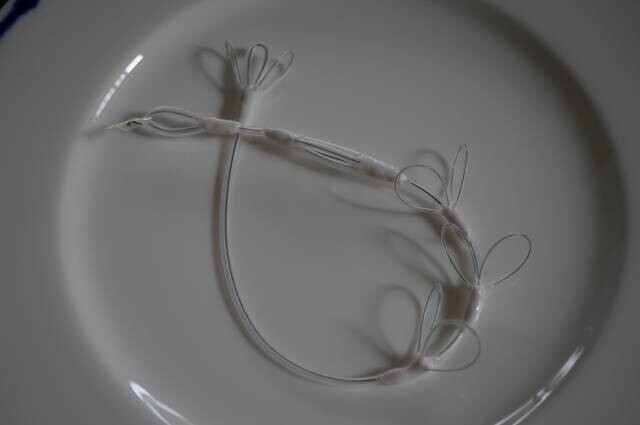
The petal-loop chipless price came with a warning about movement
In an entry published in May 2025, the petal-loop chipless device cost ¥7,000 (about $45 at ¥156 = $1, rate as of 2026-09-04) excluding tax, compared with ¥6,000 (about $38 at ¥156 = $1, rate as of 2026-09-04) excluding tax for the standard design. Paired flexible side loops replaced the wider urethral loop, leaving a straight central axis. Mr. Okada warned that this shape could travel bladderward past the closing muscle in people prone to device migration.
His 25 mm petal prototype felt too intense, and he ended that test after about three hours. He reported less discomfort with approximately 18 mm petals. Based on his own trials, Mr. Okada suggested petals around 20 mm or smaller for this location.
(Source: ok-lab's diary, published May 2025)
https://ok-lab.hatenablog.com/entry/2025/05/24/122958
Larger rectal chipless prices separated the base from an extra massage loop
In an entry published in August 2025, Mr. Okada described a larger chipless device intended for rectal use. Its base price was ¥9,000 (about $58 at ¥156 = $1, rate as of 2026-09-04) excluding tax; an added crossed loop for massage of the seminal vesicles cost ¥6,000 (about $38 at ¥156 = $1, rate as of 2026-09-04) excluding tax. The prototype was about 25 cm long.
He reported that its light construction did not provide the pressure he wanted for expressing semen. Mr. Okada specified a crossed arrangement for the added massage loop.
(Source: ok-lab's diary, published August 2025)
https://ok-lab.hatenablog.com/entry/2025/08/02/123058
The maker's answer to chipless and core frame prices
The diary prices changes by the part or construction requested, with limits on what can be made.
Parallel chipless loops added a separate charge for each location

In an entry published in January 2025, a customer proposed a doubled loop with fewer fixed points. Mr. Okada said he could not make that proposed shape with his available techniques, then offered offset parallel loops instead. The smaller loop was about 2 mm shorter, with its tip left unattached to the main loop.
The additional charge was ¥2,000 (about $13 at ¥156 = $1, rate as of 2026-09-04) excluding tax per location. Published combinations were ¥6,000 (about $38 at ¥156 = $1, rate as of 2026-09-04) + ¥2,000 (about $13 at ¥156 = $1, rate as of 2026-09-04) for the standard device and ¥10,000 (about $64 at ¥156 = $1, rate as of 2026-09-04) + ¥2,000 (about $13 at ¥156 = $1, rate as of 2026-09-04) for the bladder-loop device, excluding tax. Mr. Okada asked customers to identify which loops they wanted doubled and specify any unusual offset.
(Source: ok-lab's diary, published January 2025)
https://ok-lab.hatenablog.com/entry/2025/01/18/123007
An unspecified chipless order received a proposed milder configuration
In an entry published in April 2025, a customer wanted a bladder-loop device but asked OK Lab to choose the dimensions. Mr. Okada proposed single 0.3 mm wire, with 30 mm bladder and prostate loops and a 40 mm lower urethral loop. The quote separated the ¥11,000 (about $70 at ¥156 = $1, rate as of 2026-09-04) device from a ¥3,300 (about $21 at ¥156 = $1, rate as of 2026-09-04) loop-ended extension.
The diary does not record how this configuration felt for that customer. Mr. Okada offered these dimensions as what he considered a standard configuration toward the milder end.
(Source: ok-lab's diary, published April 2025)
https://ok-lab.hatenablog.com/entry/2025/04/26/122909
Chipless resin covering added thickness and carried a separate fee
In an entry published in June 2026, a customer asked whether resin could replace rubber-covered sections and what that would cost. OK Lab replied that the rubber served a waterproofing purpose, so resin could not simply replace it. The proposed resin covering would add about 1–2 mm of thickness.
The quoted charge was ¥1,100 (about $7 at ¥156 = $1, rate as of 2026-09-04) per location, with ¥2,200 (about $14 at ¥156 = $1, rate as of 2026-09-04) stated for the example's two locations. The diary does not record whether the customer accepted the added thickness. OK Lab offered resin over the existing rubber as the possible alternative.
(Source: ok-lab's diary, published June 2026)
https://ok-lab.hatenablog.com/entry/2026/06/13/122909
How chipless and core frame prices changed over time

| Published | What the diary said then |
|---|---|
| Apr 2020 | The first core frame included a battery box. |
| Apr 2020 | The simpler frame left the controller and pulling cord outside its base price. |
| May 2020 | The dinosaur design carried an additional design charge. |
| Oct 2024 | Air-loop pricing varied by wire length; tube thickness did not change the price. |
| Nov 2024 | A forthcoming compact design prompted advice to delay an air-loop order. |
| Dec 2024 | A standard chipless device was quoted at ¥6,600 (about $42 at ¥156 = $1, rate as of 2026-09-04). |
| Jan 2025 | Parallel-loop modifications introduced a charge per location. |
| Mar 2025 | Double-wire prices distinguished whether the bladder loop also used doubled wire. |
| May 2025 | Petal-loop pricing exceeded the standard design's price, alongside a movement warning. |
| Jun 2026 | Resin covering was quoted per location and added thickness. |
The diary does not say what the current state is.
OK Prostate Chip products related to chipless and core frame prices

The current product list confirms related accessories, separately from the historical device quotes.
Products that appear in these entries
| Product (official name) | Price incl. tax | Relation to this topic |
|---|---|---|
| Six-hole safety accessory (六穴方式オプションチップ(セーフティチップ)) | ¥1,100 (about $7 at ¥156 = $1, rate as of 2026-09-04) | In December 2024, this accessory was quoted separately with a bladder-loop chipless device. |
(Source: ok-lab's diary, published December 2024)
https://ok-lab.hatenablog.com/entry/2024/12/21/122903
Products the diary mentioned as alternatives
| Product (official name) | Price incl. tax | Relation to this topic |
|---|---|---|
| Double-loop nylon thread (両端ループナイロン糸) | ¥550 (about $4 at ¥156 = $1, rate as of 2026-09-04) | In October 2024, Mr. Okada suggested this as an alternative to the loose retrieval thread supplied for shorter air-loop devices. |
(Source: ok-lab's diary, published October 2024)
https://ok-lab.hatenablog.com/entry/2024/10/26/122649
Historical core frames, air-loop devices, and custom chipless builds discussed above:
No matching product can be confirmed on the current list.
Common worries about chipless and core frame prices

The recorded questions concern availability, separately priced accessories, and wire selection.
"Could the air-loop chipless device be ordered immediately?"
In an entry published in November 2024, a customer asked to buy an air-loop device, then requested a detailed quote. Staff confirmed it could be made and provided an itemized quote.
Mr. Okada then described a forthcoming compact design intended to remain only around the prostate, with a patent application underway. The customer said they would compare the new design before ordering again. Mr. Okada advised waiting until its details could be published.
(Source: ok-lab's diary, published November 2024)
https://ok-lab.hatenablog.com/entry/2024/11/02/122858
"Did bladder-loop chipless prices include requested accessories?"
In an entry published in December 2024, a customer requested a bladder-loop device and accessories. The quote listed ¥11,000 (about $70 at ¥156 = $1, rate as of 2026-09-04) for the device and ¥3,300 (about $21 at ¥156 = $1, rate as of 2026-09-04) for a 30 cm guide wire. The safety accessory cost ¥1,100 (about $7 at ¥156 = $1, rate as of 2026-09-04).
The diary does not record whether this order was completed. OK Lab's reply offered the requested accessories as separately priced additions.
(Source: ok-lab's diary, published December 2024)
https://ok-lab.hatenablog.com/entry/2024/12/21/122903
"Which chipless wire thickness did Mr. Okada recommend?"
In an entry published in April 2025, a customer asked whether 0.3 mm or 0.4 mm double wire would suit them. OK Lab replied that people experienced the spring force differently and that Mr. Okada could not tolerate the thicker pair for extended use. The quote was unchanged by thickness: ¥13,200 (about $84 at ¥156 = $1, rate as of 2026-09-04) for the specified bladder-loop configuration and ¥2,200 (about $14 at ¥156 = $1, rate as of 2026-09-04) for doubled wire.
The customer chose 0.3 mm because they were considering longer wear, but no use result is recorded. OK Lab declined to recommend either thickness as universally better.
(Source: ok-lab's diary, published April 2025)
https://ok-lab.hatenablog.com/entry/2025/04/12/122910
Buying from outside Japan

OK Lab ships internationally to countries covered by Japan Post's EMS courier service. Overseas orders are paid in advance by PayPal. Each order carries a ¥400 (about $3 at ¥156 = $1, rate as of 2026-09-04) handling fee, and EMS shipping is charged on top. These terms come from OK Lab's official sales-terms page (written here as plain text, not a link: ok-lab.net/docs/law), checked on September 7, 2026; confirm them on the official store before you order, because they can change.
Summary of this article
| What you wanted to know | The answer |
|---|---|
| The short answer | Design and separately quoted additions determine the historical prices. |
| What the product is | A Japanese device intended to act on the prostate. |
| What the terms mean | Frames, wire loops, and retrieval threads have different roles. |
| What the diary prices covered | Frame packages, standard loops, bladder loops, doubled wire, petals, and larger rectal designs. |
| How the maker handled requests | He proposed alternatives, itemized changes, and described manufacturing limits. |
| What changed over time | New designs added separate charges and different specifications. |
| What the current list confirms | Related safety and thread accessories; no confirmed matching device listing. |
| What customers asked | Availability, accessory charges, and wire selection. |
| How overseas buying works | Advance PayPal payment, a handling fee, and additional EMS shipping. |
Source: ok-lab's diary (Okada Comfortable Life Laboratory). The original entries are in Japanese; quotations on this page are translated. Photos and videos are on the original entries.
This article is a summary of the maker's development diary. The product is not a medical device and no result is guaranteed. If anything feels wrong or worries you, see a doctor. Prices, specifications and cautions change, so confirm the latest information on the official blog and the official site. Questions about ordering and shipping go to the seller.