![Does a longer chip cost more? | The model and custom work determine the price [OK Prostate Chip]](/img/a/T0292/eyecatch.svg)
This page is based on entries from "ok-lab's diary" (https://ok-lab.hatenablog.com/), the Japanese development diary written by Mr. Okada, founder of OK Lab, a small company in Japan (Okada Comfortable Life Laboratory). Only the entries about "prices by size and length" are summarized here, in order of publication. Past prices and sizes are as written at the time. Current prices come from the official product list (retrieved September 4, 2026). Quotations are translated from Japanese.
Note: This page is a personal reading log by someone with no connection to the maker or the seller. It reflects the source entries as of their publication dates and makes no guarantee of accuracy or safety. The product is not a medical device; talk to a doctor about any health decision. Check the official site for current information. This page contains advertising.
In short
Longer chips can cost more, but some size options share one price.
Mr. Okada bases charges on the product category, material, shape, and custom work.
Current medium-length ceramic chips cost ¥4,400 (about $28 at ¥156 = $1, rate as of 2026-09-04) and long ceramic chips cost ¥6,600, (about $42 at ¥156 = $1, rate as of 2026-09-04) including tax.
About this product

The OK Prostate Chip is a small device that is placed in the urethra (the urine passage) so that it acts on the prostate; the maker sells it in several shapes, sizes and materials. It is made and sold by OK Lab (Okada Comfortable Life Laboratory), a small company in Japan, through its own online store, and prices are in Japanese yen (JPY). The maker's development diary, "ok-lab's diary", is written in Japanese. This page is an English summary of it, and every quotation is translated. OK Lab ships internationally, so readers outside Japan can order (see "Buying from outside Japan" below). Product names on this page are plain-English descriptions. The official Japanese product name is shown once in the product table so you can find the same item in the store.
Before you read: key terms
| Term | Plain-English meaning |
|---|---|
| Urethra | The urine passage, where the maker describes placing the chip to act on the prostate. |
| Semi-long | The maker’s medium-length category, used to classify chip bodies and assign prices. |
| Awakening | A named chip category used for pricing; its June 2018 definition included one prostate-area bulge. |
| Twist | A chip shape with rotated sections, treated as a separate design when setting prices. |
| Parallel cable | Paired electrical wires used to connect parts of an electrically powered chip assembly. |
| Gourd-shaped accessory | A shaped device with separate lengths intended for different parts of the urine passage. |
What happens: chip prices by size
The OK Prostate Chip is a small device placed in the urethra (the urine passage) to act on the prostate. The price differences concern the chip body, combinations of linked chips, and paid work on connecting cables or accessories. The body sits in the urine passage; some quoted measurements instead describe connections extending from it. Across these entries, Mr. Okada assigns charges using length categories, material, shape, and the work needed for a custom request.
Chip prices by size gained a length boundary in June 2018
In an entry published in June 2018, Mr. Okada defined categories for chips measuring 50mm or more. A chip with 1 prostate-area bulge belonged to the awakening category; 2 or more meant the long category.
The announced awakening chip measured 60mm ±2mm, with a planned ¥4,000 (about $26 at ¥156 = $1, rate as of 2026-09-04) body price plus ¥1,000 (about $6 at ¥156 = $1, rate as of 2026-09-04) for thread connection, excluding tax. Mr. Okada presented these definitions as guidance for pricing custom requests.
(Source: ok-lab's diary, published June 2018)
https://ok-lab.hatenablog.com/entry/20180616/1529136608
Vibrating chip prices separated material costs from length categories
An entry published in March 2019 announced regular vibrating-chip models, with all listed prices excluding tax. The resin short and medium-length models were ¥4,000 (about $26 at ¥156 = $1, rate as of 2026-09-04) and ¥5,000, (about $32 at ¥156 = $1, rate as of 2026-09-04) respectively.
Glass short and medium-length models were ¥5,000 (about $32 at ¥156 = $1, rate as of 2026-09-04) and ¥6,000 (about $38 at ¥156 = $1, rate as of 2026-09-04); glass awakening and long models were ¥7,000 (about $45 at ¥156 = $1, rate as of 2026-09-04) and ¥8,000 (about $51 at ¥156 = $1, rate as of 2026-09-04). The earlier provisional ¥6,000 (about $38 at ¥156 = $1, rate as of 2026-09-04) long-model price had ended. Mr. Okada scheduled regular sales for early April.
(Source: ok-lab's diary, published March 2019)
https://ok-lab.hatenablog.com/entry/2019/03/23/173222
Custom chip prices included separate bodies and a joining charge
An entry published in December 2020 introduced a linked ceramic design, the sea-slug version 5. Its front body carried the medium-length price, while its second body carried the short-chip price.
The diary said bumps were standard and that no smooth version was offered. For the complete set, Mr. Okada specified separate body charges, two bump options, and a joining charge of ¥1,000 (about $6 at ¥156 = $1, rate as of 2026-09-04) excluding tax.
(Source: ok-lab's diary, published December 2020)
https://ok-lab.hatenablog.com/entry/2020/12/19/132929
Custom chip prices put larger rings into a higher bracket
In an entry published in May 2021, Mr. Okada described checking a large linked custom assembly before shipment. Its price breakdown listed 6 stainless-steel rings measuring up to 39mm, at ¥3,000 (about $19 at ¥156 = $1, rate as of 2026-09-04) each excluding tax.
The assembly also contained 1 ring measuring 40mm or more, priced at ¥4,000 (about $26 at ¥156 = $1, rate as of 2026-09-04) excluding tax. The diary does not record how this assembly felt in use.
(Source: ok-lab's diary, published May 2021)
https://ok-lab.hatenablog.com/entry/2021/05/22/125847
Custom chip prices followed three existing categories for curved ceramic designs
An entry published in December 2021 assigned the curved ceramic designs, called Apocalypse A, B, and C, to existing price categories. A matched the long ceramic twist, B matched the awakening ceramic twist, and C matched the medium-length ceramic twist.
Mr. Okada said their approximate sizes also matched those respective models. He directed buyers to identify the requested design in their order comments.
(Source: ok-lab's diary, published December 2021)
https://ok-lab.hatenablog.com/entry/2021/12/25/123556

Longer chip prices placed both sculpted designs in the awakening category
An entry published in January 2022 introduced the sculpted ceramic pair called Angel and Devil. Mr. Okada assigned both the ceramic awakening price because their lengths exceeded 50mm.
He reported that hand corrections during ceramic production could leave differences between individual pieces. For ordering, he directed buyers to the awakening category and asked them to name their preferred design.
(Source: ok-lab's diary, published January 2022)
https://ok-lab.hatenablog.com/entry/2022/01/29/123455
Aluminum chip prices changed when either body crossed a length threshold
In an entry published in August 2024, Mr. Okada revisited requests for thin, long chips. He recalled initially declining because he considered that shape dangerous for beginners. An earlier linked prototype used only 1 conductor between 2 chips; a customer reported an early break, and he judged it impractical.
His new proposal connected the bodies with reinforced parallel cable (paired electrical wires). For each body, 40mm or more meant medium-length pricing; 50mm or more meant long pricing. Mr. Okada suggested shorter bodies for beginners.
(Source: ok-lab's diary, published August 2024)
https://ok-lab.hatenablog.com/entry/2024/08/10/122913
Vibrating chip prices gained connection-length surcharges by February 2026
An entry published in February 2026 described a long-connection vibrating modification, called the twin-whip version. The measured connection ran between a ceramic chip and its motor.
The surcharges were ¥5,000 (about $32 at ¥156 = $1, rate as of 2026-09-04) up to 10cm, ¥6,000 (about $38 at ¥156 = $1, rate as of 2026-09-04) up to 15cm, and ¥8,000 (about $51 at ¥156 = $1, rate as of 2026-09-04) up to 20cm, excluding tax. These amounts were added to the ordinary vibrating-chip price. Mr. Okada warned that the exposed metal design was unsuitable for people with metal allergies.
(Source: ok-lab's diary, published February 2026)
https://ok-lab.hatenablog.com/entry/2026/02/21/122935
The maker's answer to chip prices by size
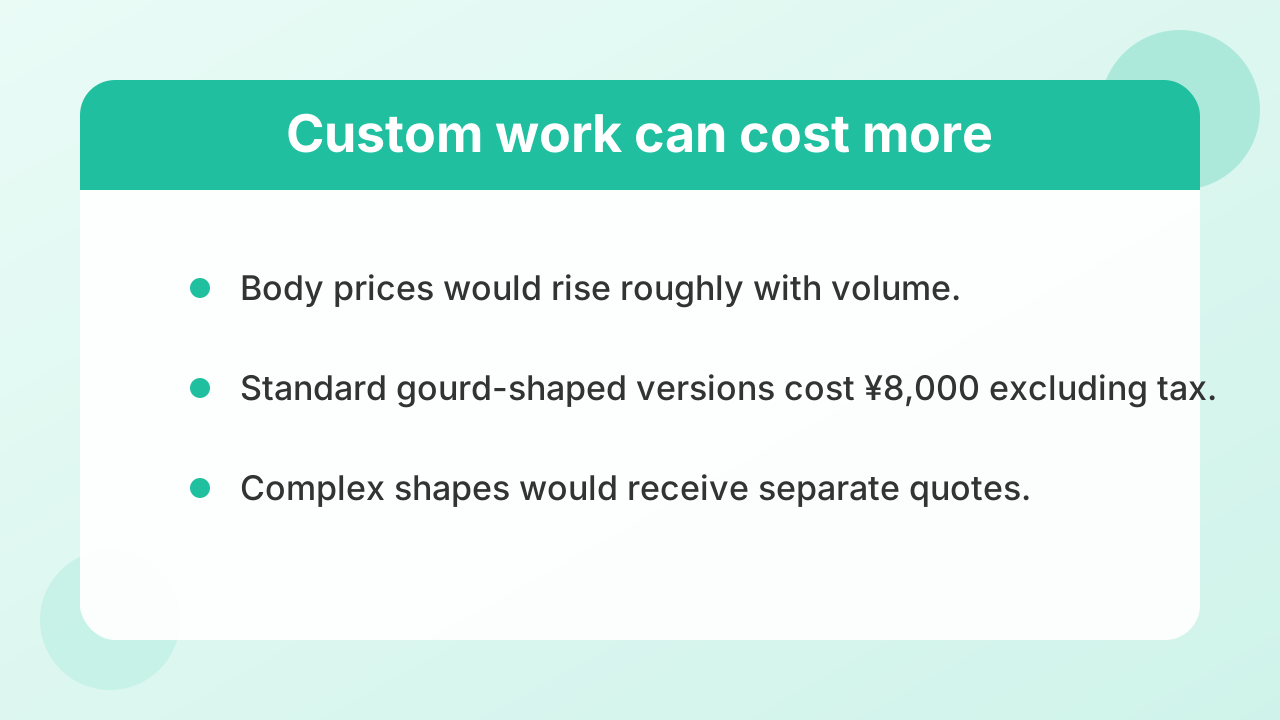
The maker’s pricing rules distinguish standard categories from custom dimensions, production costs, and separately charged work.
Longer chip prices once stayed unchanged for custom resin bodies
In an entry published in March 2018, Mr. Okada said resin designs could have any shape and retain the price of 1 resin chip, regardless of length. Glass requests were limited to changes such as length and width, rather than more unusual shapes.
He reserved the right to refuse resin designs he considered too weak or impossible to place. Within those limits, he invited custom requests and described long resin bodies as good value.
(Source: ok-lab's diary, published March 2018)
https://ok-lab.hatenablog.com/entry/20180331/1522485734
Chip prices by size later reflected volume and production space
An entry published in July 2021 explained pricing for products made by an outside manufacturing collaborator. Mr. Okada said body prices would rise roughly with volume, using the short chip as the starting point.
He explained that twists cost more than flat designs of equal volume because they occupied more production space. Initial short-body plans were ¥3,500 (about $22 at ¥156 = $1, rate as of 2026-09-04) for resin and ¥8,000 (about $51 at ¥156 = $1, rate as of 2026-09-04) for titanium, each with a ¥500 (about $3 at ¥156 = $1, rate as of 2026-09-04) thread-connection charge, excluding tax.
(Source: ok-lab's diary, published July 2021)
https://ok-lab.hatenablog.com/entry/2021/07/10/125840
Custom accessory prices depended on standard dimensions as well as length
In an entry published in November 2023, Mr. Okada described pricing for a gourd-shaped accessory (a device spanning parts of the urine passage). Standard SS, S, M, and L versions measured 14cm, 16cm, 18cm, and 20cm, respectively, all at ¥8,000 (about $51 at ¥156 = $1, rate as of 2026-09-04) excluding tax.
Custom dimensions cost ¥500 (about $3 at ¥156 = $1, rate as of 2026-09-04) per centimeter of total length, excluding tax, with a minimum charge of ¥8,000 (about $51 at ¥156 = $1, rate as of 2026-09-04) excluding tax. He attributed the difference to the extra work of measuring and making each request separately. He asked that custom requests stay within approximately 12–25cm.
(Source: ok-lab's diary, published November 2023)
https://ok-lab.hatenablog.com/entry/2023/11/04/122744
Custom chip prices gained an explicit nonstandard accessory surcharge
An entry published in July 2026 added ¥1,000 (about $6 at ¥156 = $1, rate as of 2026-09-04) excluding tax per item for nonstandard epoxy-resin stoppers and screw-shaped auxiliary chips. Mr. Okada said these custom sizes had previously carried no extra charge.
He described the change as bringing prices into line with production costs. He advised that difficult work and unusually complex shapes would receive separate quotes, even when a request repeated an earlier example.
(Source: ok-lab's diary, published July 2026)
https://ok-lab.hatenablog.com/entry/2026/07/25/123012
How chip prices by size changed over time
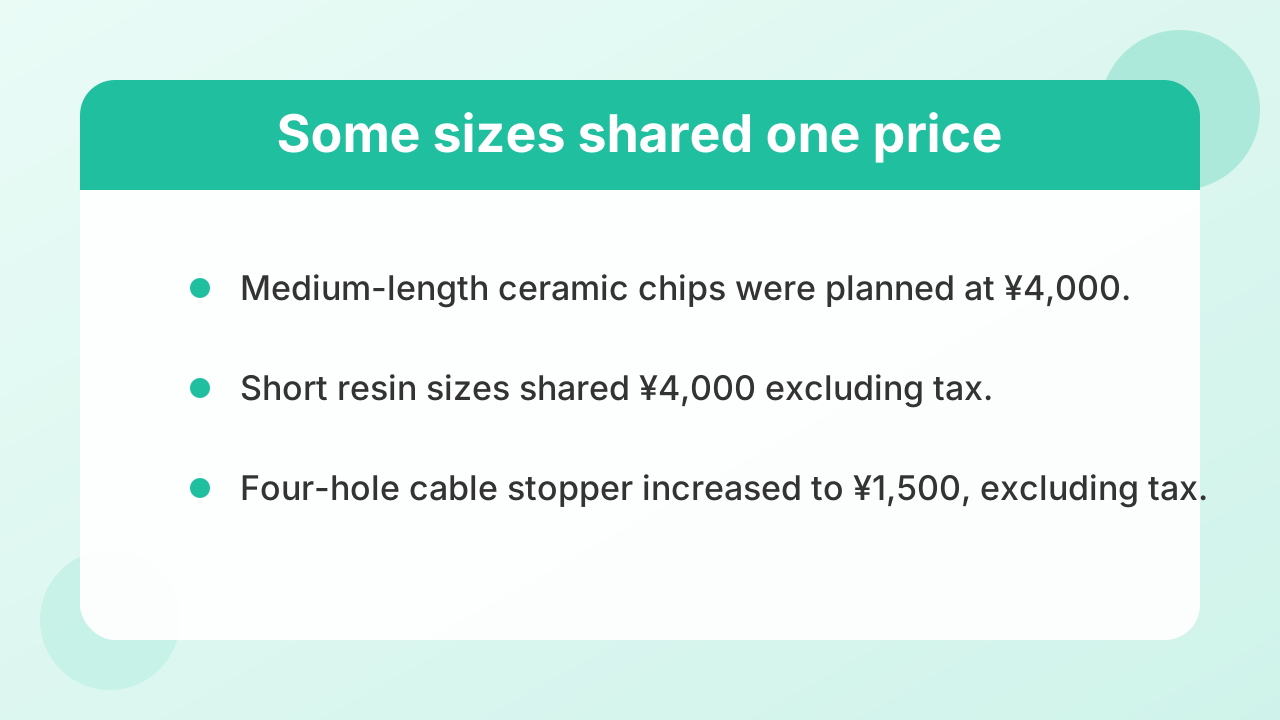
| Published | What the diary said then |
|---|---|
| Jan 2018 | Linked glass pairs were planned at ¥6,000 (about $38 at ¥156 = $1, rate as of 2026-09-04) excluding tax across different spacing options. |
| Jun 2019 | Planned ceramic prices: short ¥3,000, (about $19 at ¥156 = $1, rate as of 2026-09-04) medium-length ¥4,000, (about $26 at ¥156 = $1, rate as of 2026-09-04) awakening ¥5,000 (about $32 at ¥156 = $1, rate as of 2026-09-04). |
| Jul 2020 | Planned double-twist price matched the awakening twist: ¥6,000 (about $38 at ¥156 = $1, rate as of 2026-09-04) excluding tax. |
| Sep 2021 | Short resin sizes 27mm, 30mm, and 33mm shared a ¥4,000 (about $26 at ¥156 = $1, rate as of 2026-09-04) price, excluding tax. |
| Sep 2021 | Long resin category: ¥7,500 (about $48 at ¥156 = $1, rate as of 2026-09-04) excluding tax; awakening: ¥8,000 (about $51 at ¥156 = $1, rate as of 2026-09-04) excluding tax. |
| Jul 2026 | Four-hole cable stopper increased from ¥1,000 (about $6 at ¥156 = $1, rate as of 2026-09-04) to ¥1,500, (about $10 at ¥156 = $1, rate as of 2026-09-04) excluding tax. |
The diary does not say what the current state is.
OK Prostate Chip products related to chip prices by size
The current list confirms standard products, but it does not establish availability of the historical custom builds.
Products that appear in these entries
| Product (official name) | Price incl. tax | Relation to this topic |
|---|---|---|
| Long vibrating glass chip (OKプロステート核振チップ ガラス素材ロングタイプ) | ¥8,800 (about $56 at ¥156 = $1, rate as of 2026-09-04) | The March 2019 announcement assigned this model a regular price and ended its provisional price. |
| Medium-length ceramic chip (OKプロステートチップ 陶器素材セミロングタイプ) | ¥4,400 (about $28 at ¥156 = $1, rate as of 2026-09-04) | A September 2020 customer selected this product while requesting a custom design charged in the long category. |
| Long ceramic chip (OKプロステートチップ 陶器素材ロングタイプ) | ¥6,600 (about $42 at ¥156 = $1, rate as of 2026-09-04) | A December 2019 customer selected this product for a custom request that Mr. Okada reassigned to medium-length pricing. |
(Source: ok-lab's diary, published March 2019)
https://ok-lab.hatenablog.com/entry/2019/03/23/173222
(Source: ok-lab's diary, published December 2019)
https://ok-lab.hatenablog.com/entry/2019/12/14/151232
(Source: ok-lab's diary, published September 2020)
https://ok-lab.hatenablog.com/entry/2020/09/26/124400
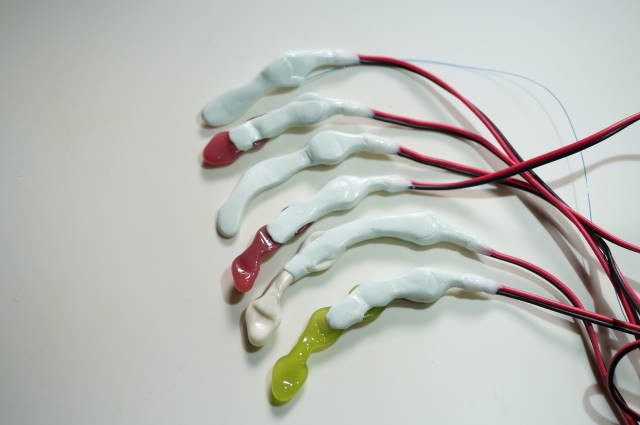
Products the diary mentioned as alternatives
The diary names no alternative.
| Historical custom item | Current-list status |
|---|---|
| Sea-slug custom versions | No matching product can be confirmed on the current list. |
| Large linked ring assembly | No matching product can be confirmed on the current list. |
| Apocalypse, Angel, and Devil ceramic designs | No matching product can be confirmed on the current list. |
| Gourd-shaped accessory | No matching product can be confirmed on the current list. |
| Paired aluminum-electrode assembly | No matching product can be confirmed on the current list. |
| Twin-whip vibrating modification | No matching product can be confirmed on the current list. |
Common worries about chip prices by size
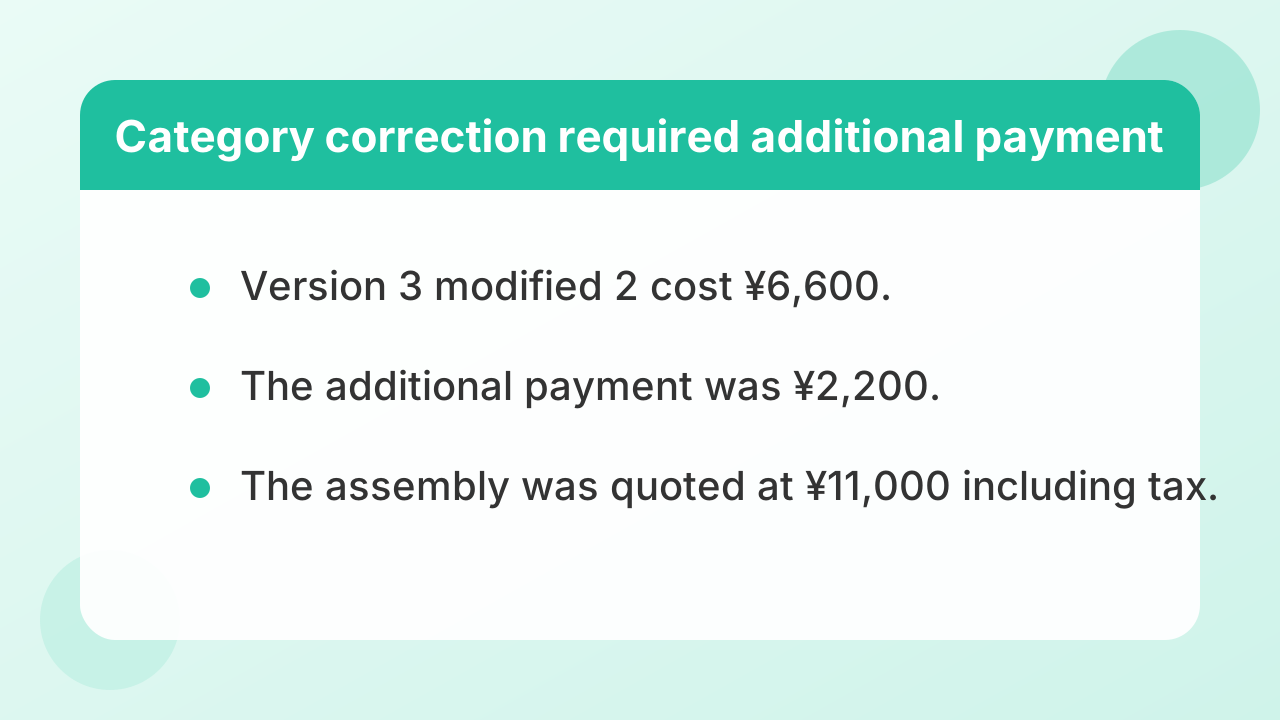
The recorded questions concern choosing the correct category and understanding what a custom quote includes.
"Which chip price applied to sea-slug version 3 modified 1?"
In an entry published in December 2019, a customer wanted sea-slug version 3 modified 1 but did not know which product to select. They chose the long ceramic product; Mr. Okada assigned the request to the medium-length category at ¥4,400 (about $28 at ¥156 = $1, rate as of 2026-09-04).
The diary does not record whether this order was completed. Mr. Okada directed requests for that version through the medium-length ceramic category.
(Source: ok-lab's diary, published December 2019)
https://ok-lab.hatenablog.com/entry/2019/12/14/151232
"Why did a custom chip price require another payment?"
In an entry published in September 2020, a customer requested customized sea-slug designs after selecting medium-length ceramic products. Mr. Okada explained that version 3 modified 2 cost ¥6,600 (about $42 at ¥156 = $1, rate as of 2026-09-04), rather than the medium-length ¥4,400 (about $28 at ¥156 = $1, rate as of 2026-09-04).
He reported explaining the classification and receiving the additional ¥2,200 (about $14 at ¥156 = $1, rate as of 2026-09-04). He identified the long ceramic category as the correct one for that version.
(Source: ok-lab's diary, published September 2020)
https://ok-lab.hatenablog.com/entry/2020/09/26/124400
"What did the aluminum chip price include?"
In an entry published in October 2025, a customer requested a quote for the aluminum-electrode assembly described in August 2024. The reply quoted ¥10,000 (about $64 at ¥156 = $1, rate as of 2026-09-04) excluding tax, or ¥11,000 (about $70 at ¥156 = $1, rate as of 2026-09-04) including tax, for that assembly. The diary does not record whether this quote became an order.
The August 2024 entry separately priced cable stitching at ¥500 (about $3 at ¥156 = $1, rate as of 2026-09-04) per 5cm, up to 25cm, excluding tax. It explicitly quoted ¥2,000 (about $13 at ¥156 = $1, rate as of 2026-09-04) extra for 20cm, excluding tax. Mr. Okada also offered a ¥1,000 (about $6 at ¥156 = $1, rate as of 2026-09-04) resin cover between the bodies, excluding tax, limited to a 10mm connecting section.
(Source: ok-lab's diary, published August 2024)
https://ok-lab.hatenablog.com/entry/2024/08/10/122913
(Source: ok-lab's diary, published October 2025)
https://ok-lab.hatenablog.com/entry/2025/10/04/122910
Buying from outside Japan

OK Lab ships internationally to countries covered by Japan Post's EMS courier service. Overseas orders are paid in advance by PayPal. Each order carries a ¥400 (about $3 at ¥156 = $1, rate as of 2026-09-04) handling fee, and EMS shipping is charged on top. These terms come from OK Lab's official sales-terms page (written here as plain text, not a link: ok-lab.net/docs/law), checked on September 7, 2026; confirm them on the official store before you order, because they can change.
Summary of this article
| What you wanted to know | The answer |
|---|---|
| In short: does length determine price? | Sometimes; category, material, shape, and custom work also matter. |
| About the product: who makes it? | OK Lab, a small company in Japan, makes the urethral device. |
| Key terms: what do category names mean? | They identify designs and pricing groups; published definitions belong to their dates. |
| What happens: where do prices change? | Changes affect bodies, linked assemblies, connections, and accessories. |
| The maker’s answer: how are custom prices set? | Standard categories, manufacturing costs, dimensions, and extra work determine charges. |
| Changes over time: is every longer size dearer? | No; some standard size ranges shared one price. |
| Related products: what prices are current? | The product table uses the September 2026 list, including tax. |
| Common worries: can an order require another payment? | Yes; the recorded category correction required an additional payment. |
| Overseas buying: how are orders paid and shipped? | Advance PayPal payment, a ¥400 (about $3 at ¥156 = $1, rate as of 2026-09-04) handling fee, and additional EMS shipping. |
Source: ok-lab's diary (Okada Comfortable Life Laboratory). The original entries are in Japanese; quotations on this page are translated. Photos and videos are on the original entries.
This article is a summary of the maker's development diary. The product is not a medical device and no result is guaranteed. If anything feels wrong or worries you, see a doctor. Prices, specifications and cautions change, so confirm the latest information on the official blog and the official site. Questions about ordering and shipping go to the seller.