![How do electrode chips work? | Designs changed, and safety remains uncertain [OK Prostate Chip]](/img/a/T0190/eyecatch.svg)
This page is based on entries from "ok-lab's diary" (https://ok-lab.hatenablog.com/), the Japanese development diary written by Mr. Okada, founder of OK Lab, a small company in Japan (Okada Comfortable Life Laboratory). Only the entries about "electrode chip use" are summarized here, in order of publication. Past prices and sizes are as written at the time. Current prices come from the official product list (retrieved September 4, 2026). Quotations are translated from Japanese.
Note: This page is a personal reading log by someone with no connection to the maker or the seller. It reflects the source entries as of their publication dates and makes no guarantee of accuracy or safety. The product is not a medical device; talk to a doctor about any health decision. Check the official site for current information. This page contains advertising.
In short
Electrode chip use has produced uneven stimulation, electrical reactions, and mechanical faults in the diary.
Mr. Okada urged caution, sometimes requested stopping, and changed cables, connections, and edge coatings.
The current list includes an anal base chip; the electrical builds discussed here were custom or experimental.
If you see blood in your urine, even a small amount or for the first time, do not wait and see. See a urologist right away.
If you suddenly cannot urinate, or the device cannot be removed, do not try to fix it yourself. Go to a medical facility, including emergency care, immediately.
About this product
The OK Prostate Chip is a small device that is placed in the urethra (the urine passage) so that it acts on the prostate; the maker sells it in several shapes, sizes and materials. It is made and sold by OK Lab (Okada Comfortable Life Laboratory), a small company in Japan, through its own online store, and prices are in Japanese yen (JPY). The maker's development diary, "ok-lab's diary", is written in Japanese. This page is an English summary of it, and every quotation is translated. OK Lab ships internationally, so readers outside Japan can order (see "Buying from outside Japan" below). Product names on this page are plain-English descriptions. The official Japanese product name is shown once in the product table so you can find the same item in the store.
Before you read: key terms
| Term | Plain-English meaning |
|---|---|
| Electrode | An electrical contact, made here from aluminum or stainless steel, that carries the stimulator's output. |
| Pole | One side of the electrical connection; one pole can include several linked chips. |
| Stimulator or controller | The external unit that supplies and controls electrical stimulation. |
| Internal electrical resistance | Opposition to current within body tissue; Mr. Okada used it as a design consideration between electrodes. |
| Nylon-thread cable | Electrical wire twisted with nylon thread, providing a connection to the chip. |
| Snap connector | A press-stud connection joining the chip's cable to the stimulator's cable. |
| Capacitor | An electrical component Mr. Okada associated with protection against shocks during controller faults. |
| Parallel cable | Paired wires running together, used for electrical connections and sometimes structural support. |
| Positioning loop (Lock-on) | A support structure discussed for keeping a chip in position. |
| External retainer (Gatekeeper) | A support accessory with retaining pins, discussed alongside chip-positioning arrangements. |
What happens: electrode chip use
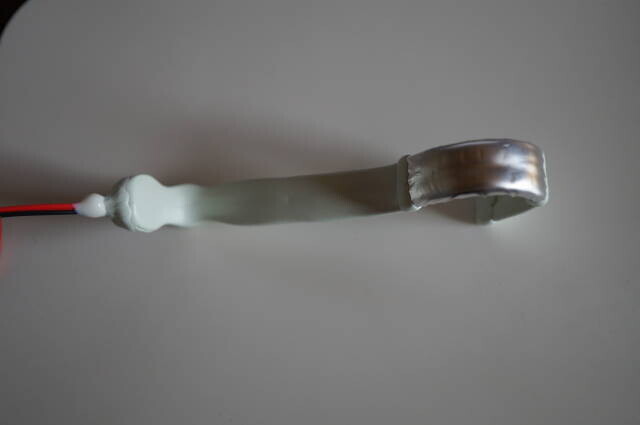
The OK Prostate Chip is a small device placed in the urethra, the urine passage, to stimulate the prostate. An electrode chip adds a conductive contact (an electrode) linked to an external stimulator (the unit supplying electrical pulses). The diary describes aluminum contacts on resin chips and stainless steel chips that themselves serve as electrodes. The diary also discusses anal chips and adhesive electrode pads on the skin as other parts of these electrical designs.
Electrode chip use raised early concerns about moisture and compatibility
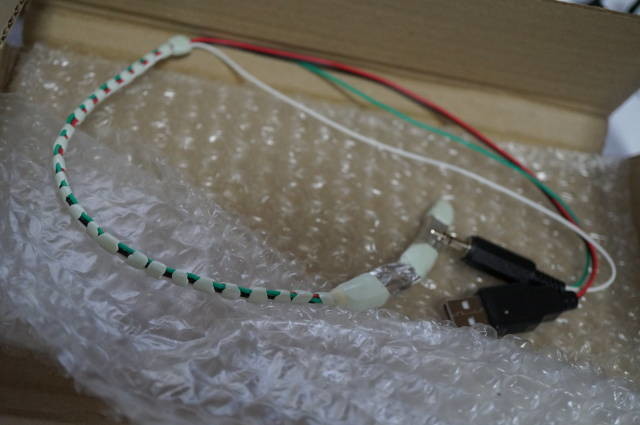
In an entry published in December 2018, a customer requested an anal chip containing two electrodes. Mr. Okada feared changing rectal moisture could alter current and that enema fluid might electrically bridge the electrodes.
OK Lab could supply electrode chips but could not judge compatibility with customers' stimulators. The diary does not record how this requested device performed. Mr. Okada warned that electrical output could be life-threatening and declined requests from people without stimulator experience.
(Source: ok-lab's diary, published December 2018)
https://ok-lab.hatenablog.com/entry/20181208/1544250742
A production change reduced the initial cost of electrode chip use
In an entry published in March 2019, Mr. Okada reduced the charge for adding electrodes to a chip. The 1-pole charge per chip fell from ¥5,000 (about $32 at ¥156 = $1, rate as of 2026-09-04) to ¥3,000 (about $19 at ¥156 = $1, rate as of 2026-09-04); the 2-pole charge fell from ¥8,000 (about $51 at ¥156 = $1, rate as of 2026-09-04) to ¥5,000 (about $32 at ¥156 = $1, rate as of 2026-09-04). These were tax-excluded prices.
This reflected easier fabrication, although Mr. Okada said appearance would be less tidy. Mr. Okada said customers needed to buy the external stimulator separately.
(Source: ok-lab's diary, published March 2019)
https://ok-lab.hatenablog.com/entry/2019/03/16/165528
Electrode chip use gained a stricter design principle in April 2019
In an entry published in April 2019, Mr. Okada adopted a principle limiting each body opening to one electrode. He wanted at least 500Ω of internal electrical resistance (opposition to current) between electrodes if the controller failed.
Snap-connected electrode additions cost ¥4,000 (about $26 at ¥156 = $1, rate as of 2026-09-04) excluding tax beyond the applicable chip price. Published cable choices were 20cm, 25cm, and 30cm. Mr. Okada recommended semi-long or longer chips because he wanted more contact with the urethral lining.
(Source: ok-lab's diary, published April 2019)
https://ok-lab.hatenablog.com/entry/2019/04/13/150233
Electrode chip use left Mr. Okada unable to work
In an entry published in May 2019, Mr. Okada reported an irregular heartbeat during his own electrode test near setting 2. He wrote that the effects left him unable to work for about 2 hours.
He said he would abandon electrical self-testing and reconsider selling devices he could not test personally. Mr. Okada offered order cancellation to anyone worried by that entry's reports.
(Source: ok-lab's diary, published May 2019)
https://ok-lab.hatenablog.com/entry/2019/05/04/162111
Electrode chip use prompted a stop request despite positive feedback
In an entry published in April 2022, a customer reported overpowering stimulation from the ZEUS 6 Mode Palm Power Box. Even setting 1 limited sessions to 3 minutes, with lingering sensations afterward despite feeling normal the next day. Mr. Okada considered the report dangerously intense and asked the customer to stop using that controller.
A follow-up published in April 2022 described plans to abandon ZEUS and a trial with an Omron HV-F125. The customer generally used 1, stopped immediately at 3, and reported no unusual symptoms 2 days later. Mr. Okada warned that individual reactions differed and the products were not necessarily safe.
(Source: ok-lab's diary, published April 2022)
https://ok-lab.hatenablog.com/entry/2022/04/02/123050
(Source: ok-lab's diary, published April 2022)
https://ok-lab.hatenablog.com/entry/2022/04/09/123458
Electrode chip use exposed a cable fault during the second session
An entry published in July 2022 described a custom electrode chip containing motors and a 6-wire support cable. The customer liked its steadier position, but the motors stopped during the 2nd use. Inspection after return confirmed a fault midway along the cable, rather than at the motor connections.
Mr. Okada's suggestion of a factory joining defect remained speculation; no completed repair was recorded. Mr. Okada proposed paid repair while he considered how to carry it out.
(Source: ok-lab's diary, published July 2022)
https://ok-lab.hatenablog.com/entry/2022/07/30/122933
Electrode chip use expanded to stainless steel through trial sales
In an entry published in August 2023, Mr. Okada announced trial sales of stainless steel electrode chips. The design used a nylon-thread cable (electrical wire twisted with nylon) and a snap connector (a press-stud connection).
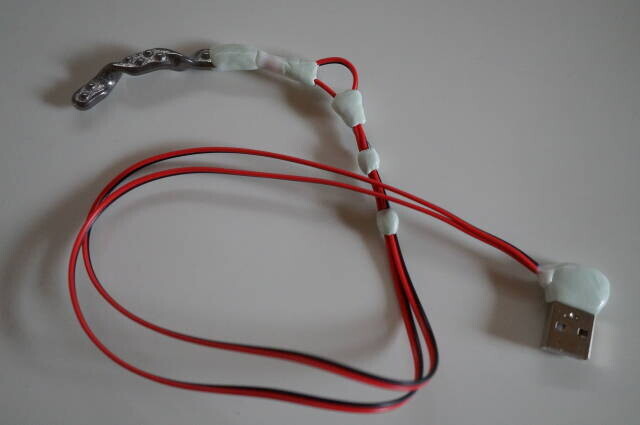
The trial addition cost ¥4,000 (about $26 at ¥156 = $1, rate as of 2026-09-04) excluding tax beyond the normal stainless steel chip price. The specification included a 25cm cable and 10cm of double thread beyond the connector. Mr. Okada favored the snap connector because he considered it better suited to the thin cable.
(Source: ok-lab's diary, published August 2023)
https://ok-lab.hatenablog.com/entry/2023/08/26/122534
Electrode chip use gained stronger stainless steel connections in December 2024
In an entry published in December 2024, a customer requested a stainless steel electrode with a positioning loop (Lock-on). Staff initially had no experience making that combination but agreed to attempt it.
Mr. Okada reported a strong connection incorporating a wire, allowing electrical connections through parallel cables (paired wires running together). The diary does not record how this customer's finished device felt in use. Mr. Okada advised requesting an individual quotation because electrical connection work cost extra.
(Source: ok-lab's diary, published December 2024)
https://ok-lab.hatenablog.com/entry/2024/12/07/122832
Electrode chip use reports led to thicker protection around aluminum edges
In an entry published in November 2025, a customer reported a prickly area where aluminum met resin. Staff said exposed cut edges would be a manufacturing defect and requested return if that was the problem. The customer later reported 2 uses without pain or bleeding, while remaining unsure whether an edge had been exposed.
Mr. Okada cited 2 previous exposed-edge reports and said coating thinner than the aluminum's 0.1mm thickness could expose its cut face. He said the edge coating was now thicker, while acknowledging possible missed defects in handmade products. The diary asks customers to contact OK Lab about suspected exposed edges.
(Source: ok-lab's diary, published November 2025)
https://ok-lab.hatenablog.com/entry/2025/11/15/122921
The maker's answer to electrode chip use
Mr. Okada's measures focused on electrical risk, stronger connections, and assessment of custom builds.
Electrode chip use without pads brought a specific shock warning
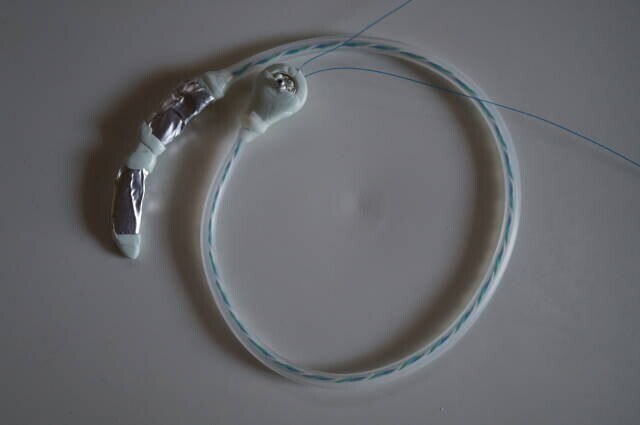
In an entry published in August 2023, Mr. Okada compared pad-containing designs with designs having chips for both electrodes. He warned that the latter lacked a capacitor (an electrical component he associated with protection during controller failure). He said a controller fault could therefore cause a strong shock.
In the same entry, he reported heart failure during a demonstration at 2–3, with recovery taking about 1 hour. Mr. Okada favored a pad-and-stainless-chip combination for newcomers, based on the gentler response he and a staff member described.
(Source: ok-lab's diary, published August 2023)
https://ok-lab.hatenablog.com/entry/2023/08/26/122534
Electrode chip use with anal models required reconsidering cable strength
In an entry published in February 2024, a customer asked for a single-pole version of the single-lobe U-shaped resin anal chip. Mr. Okada had not made this type before, citing concerns about a single wire's strength.
He accepted this request after identifying a design using paired wires and a snap connector. The diary does not record the customer's experience with the finished conversion. Mr. Okada cautioned that he could not test this arrangement himself and urged caution.
(Source: ok-lab's diary, published February 2024)
https://ok-lab.hatenablog.com/entry/2024/02/10/123023
Electrode chip use with thin cables raised concerns about breakage
In an entry published in July 2024, a customer requested nylon-thread cables and snap connectors on a resin two-pole electrode chip. Staff warned that the thinner cable carried a higher breakage risk and that separate end connectors raised strength concerns.
The customer agreed to added tube protection and joined connectors; Mr. Okada then reported a successful electrical tester check. The diary does not record its long-term durability. The staff recommended protective tubing as reinforcement for this custom cable.
(Source: ok-lab's diary, published July 2024)
https://ok-lab.hatenablog.com/entry/2024/07/20/123059
If you see blood in your urine, even a small amount or for the first time, do not wait and see. See a urologist right away.
If you suddenly cannot urinate, or the device cannot be removed, do not try to fix it yourself. Go to a medical facility, including emergency care, immediately.
How electrode chip use changed over time
| Published | What the diary said then |
|---|---|
| Mar 2019 | A training prototype used approximately 40mm urethral and 60mm anal components. |
| Apr 2019 | Separate chips allowed variable electrode spacing and an anchoring role. |
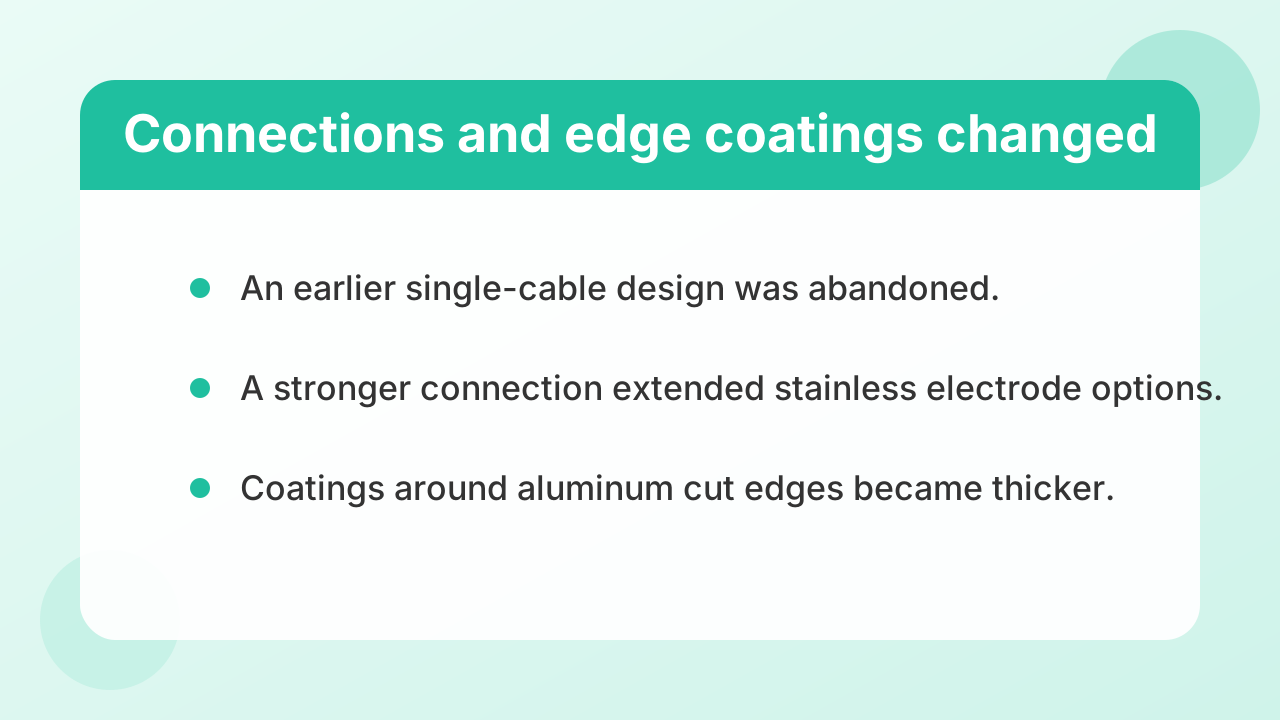
| May 2022 | An earlier single-cable design was abandoned because of strength concerns. |
| Sep 2023 | Twin stainless electrodes were about 7–8mm thick; joining cost ¥1,000 (about $6 at ¥156 = $1, rate as of 2026-09-04) excluding tax. |
| Feb 2024 | Single-pole anal builds became feasible with paired wires and snap connectors. |
| Dec 2024 | A stronger connection extended stainless electrode options to parallel cables. |
| Nov 2025 | Mr. Okada reported thicker coatings around aluminum cut edges. |
The diary does not say what the current state is.
OK Prostate Chip products related to electrode chip use
The single-lobe resin anal chip costs ¥5,500 (about $35 at ¥156 = $1, rate as of 2026-09-04) incl. tax on the September 2026 product list.
Products that appear in these entries
| Product (official name) | Price incl. tax | Relation to this topic |
|---|---|---|
| Single-lobe U-shaped resin anal chip (OKプロステートお尻チップ 樹脂素材1コブUターン型) | ¥5,500 (about $35 at ¥156 = $1, rate as of 2026-09-04) | In February 2024, this base model was requested for a custom single-pole electrode build. |
(Source: ok-lab's diary, published February 2024)
https://ok-lab.hatenablog.com/entry/2024/02/10/123023
Products the diary mentioned as alternatives
The diary names no alternative.
Historical custom electrode builds and assemblies:
No matching product can be confirmed on the current list.
Common worries about electrode chip use
The diary records questions about controller shutdowns, loose retaining pins, and larger custom electrodes.
"Why does the controller switch off during electrode chip use?"
In an entry published in March 2024, a customer said an Omron HV-F128 worked with its pads but shut down with the electrode chip. The customer later reported that the problem resolved after position changes. Staff said their own checks sometimes required 2–3 restarts before current was detected.
They did not establish whether controller age or a protective function explained this. Mr. Okada said he had wanted the unit returned for investigation before the customer reported resolution.
(Source: ok-lab's diary, published March 2024)
https://ok-lab.hatenablog.com/entry/2024/03/23/122837
"What if a retaining pin loosens during electrode chip use?"
In an entry published in December 2024, a customer asked about adhesive after a retaining pin came loose from the external retainer (Gatekeeper). It happened after about the 8th or 9th use, and the customer also reported loosening on the opposite side.
Mr. Okada apologized and acknowledged that the existing glued fastening might not be secure. The diary does not record a result for the proposed revision. Mr. Okada proposed U-shaped pins for future production.
(Source: ok-lab's diary, published December 2024)
https://ok-lab.hatenablog.com/entry/2024/12/07/122832
"Are longer devices possible for electrode chip use?"
In an entry published in March 2025, a customer asked about a 15cm electrode modeled on another company's product. Staff initially needed time to consider the request; Mr. Okada later said OK Lab could not reproduce that construction. He thought a linked 5-chip design might be possible, with either one shared pole or separate 4-chip and 1-chip groups.
The proposal left the connecting sections without electrodes. The diary does not record whether this proposed build was completed. Mr. Okada requested a detailed drawing before considering the custom work further.
(Source: ok-lab's diary, published March 2025)
https://ok-lab.hatenablog.com/entry/2025/03/15/122925
Buying from outside Japan
OK Lab ships internationally to countries covered by Japan Post's EMS courier service. Overseas orders are paid in advance by PayPal. Each order carries a ¥400 (about $3 at ¥156 = $1, rate as of 2026-09-04) handling fee, and EMS shipping is charged on top. These terms come from OK Lab's official sales-terms page (written here as plain text, not a link: ok-lab.net/docs/law), checked on September 7, 2026; confirm them on the official store before you order, because they can change.
Summary of this article
| What you wanted to know | The answer |
|---|---|
| What is the main concern? | Electrical reactions and physical faults appear alongside favorable reports. |
| What is the product? | A urethral device made by OK Lab in Japan. |
| What do the terms mean? | Chips provide contacts; an external stimulator supplies electrical pulses. |
| What happened in use? | Reports prompted changes to prices, electrical designs, cables, and coatings. |
| What did the maker advise? | He urged caution, requested stopping in one case, and proposed stronger parts. |
| What changed over time? | Designs progressed from prototypes to revised connections and thicker edge coatings. |
| What is currently listed? | The single-lobe resin anal base chip is ¥5,500 (about $35 at ¥156 = $1, rate as of 2026-09-04) incl. tax. |
| What remains uncertain? | Controller shutdown causes and several custom-build outcomes were not established. |
| How are overseas orders handled? | Advance PayPal payment, a ¥400 (about $3 at ¥156 = $1, rate as of 2026-09-04) handling fee, and separate EMS shipping. |
Source: ok-lab's diary (Okada Comfortable Life Laboratory). The original entries are in Japanese; quotations on this page are translated. Photos and videos are on the original entries.
This article is a summary of the maker's development diary. The product is not a medical device and no result is guaranteed. If anything feels wrong or worries you, see a doctor. Prices, specifications and cautions change, so confirm the latest information on the official blog and the official site. Questions about ordering and shipping go to the seller.