![Can you go out, drive, or visit a doctor with it in? | Comfort varies, and problems are recorded [OK Prostate Chip]](/img/a/T0176/eyecatch.svg)
This page is based on entries from "ok-lab's diary" (https://ok-lab.hatenablog.com/), the Japanese development diary written by Mr. Okada, founder of OK Lab, a small company in Japan (Okada Comfortable Life Laboratory). Only the entries about "going out, driving, and visiting a doctor with the device in place" are summarized here, in order of publication. Past prices and sizes are as written at the time. Current prices come from the official product list (retrieved September 4, 2026). Quotations are translated from Japanese.
Note: This page is a personal reading log by someone with no connection to the maker or the seller. It reflects the source entries as of their publication dates and makes no guarantee of accuracy or safety. The product is not a medical device; talk to a doctor about any health decision. Check the official site for current information. This page contains advertising.
In short
Reports include comfortable outings, distracted driving, sudden urine loss, and a chip requiring hospital treatment.
Mr. Okada cautioned against keeping long chips in the bladder (the urine-storage organ) for extended periods.
The current list includes related accessories; several outing reports concern unmatched custom devices or prototypes.
If you see blood in your urine, even a small amount or for the first time, do not wait and see. See a urologist right away. If you suddenly cannot urinate, or the device cannot be removed, do not try to fix it yourself. Go to a medical facility, including emergency care, immediately.
About this product

The OK Prostate Chip is a small device that is placed in the urethra (the urine passage) so that it acts on the prostate; the maker sells it in several shapes, sizes and materials. It is made and sold by OK Lab (Okada Comfortable Life Laboratory), a small company in Japan, through its own online store, and prices are in Japanese yen (JPY). The maker's development diary, "ok-lab's diary", is written in Japanese. This page is an English summary of it, and every quotation is translated. OK Lab ships internationally, so readers outside Japan can order (see "Buying from outside Japan" below). Product names on this page are plain-English descriptions. The official Japanese product name is shown once in the product table so you can find the same item in the store.
Before you read: key terms
| Term | Plain-English meaning |
|---|---|
| Urethra | The urine passage, where these devices are placed for stimulation. |
| Bladder | The organ that holds urine; several entries discuss chips moving into it. |
| Sphincter | A urine-control muscle; the diary also discusses its role in keeping chips positioned. |
| Chipless design | A device using loops instead of a solid chip, intended to provide stimulation. |
| Screw aid | An additional chip connected behind the main device to help it remain positioned. |
| Perineal bar | A support bar against the area beneath the pelvis, used with the flattening device. |
| Urethral rod | A rod worn in the urine passage; its intended purpose: The diary does not explain this. |
What happens: wearing a prostate chip outside
The OK Prostate Chip is a device placed in the urethra (the urine passage) for prostate stimulation. This topic concerns leaving it there during shopping, driving, and medical appointments, with continuing stimulation as the aim. The diary includes solid chips, vibrating models, and later loop-based designs without a solid chip. It records both comfortable outings and problems with concentration, urine control, pain, and a trapped device.
Doctor visits with a vibrating chip included one disclosed heart test
In an entry published in February 2019, the diary described a wearer attending a heart appointment with a vibrating chip operating. The wearer reported disclosing the internal motor beforehand. According to the account, the nurse agreed before the test, while the doctor agreed afterward.
The wearer reported a slightly faster pulse, with the remaining results unchanged. The doctor reportedly could not feel vibration through the wearer's waist.
(Source: ok-lab's diary, published February 2019)
https://ok-lab.hatenablog.com/entry/2019/02/09/152257
Driving with a chip left one customer distracted and dissatisfied
In an entry published in January 2020, a customer described wanting to limit use to home because of concerns about accidents outside. A single attempt at driving with a chip had left the customer unable to concentrate on driving. The customer found it unenjoyable.
Mr. Okada replied that he personally went out with a chip retained and noticed dental-drill vibration during appointments. His reply offered no solution to the concentration problem.
(Source: ok-lab's diary, published January 2020)
https://ok-lab.hatenablog.com/entry/2020/01/04/155235
Driving with a urethral rod felt comfortable to Mr. Okada
In an entry published in December 2022, Mr. Okada described attending a regular heart appointment wearing his complete wedge-and-restraint assembly. He reported no problems driving or walking with the urethral rod (a rod in the urine passage) in place. He also reported urinating at the hospital. He wrote that initial discomfort gradually settled.
(Source: ok-lab's diary, published December 2022)
https://ok-lab.hatenablog.com/entry/2022/12/03/122846
A chip stuck in the bladder required university hospital treatment
In an entry published in October 2023, a customer reported that a curved, flat-faced blue chip, size M, had entered the bladder. The customer could not get it out. A private clinic referred the customer to a university hospital.
The customer subsequently reported that treatment there had resolved the problem. The diary does not record what treatment was performed. Mr. Okada urged caution after reporting this incident.
(Source: ok-lab's diary, published October 2023)
https://ok-lab.hatenablog.com/entry/2023/10/14/122718
Chipless driving felt less burdensome during Mr. Okada's first reported trip
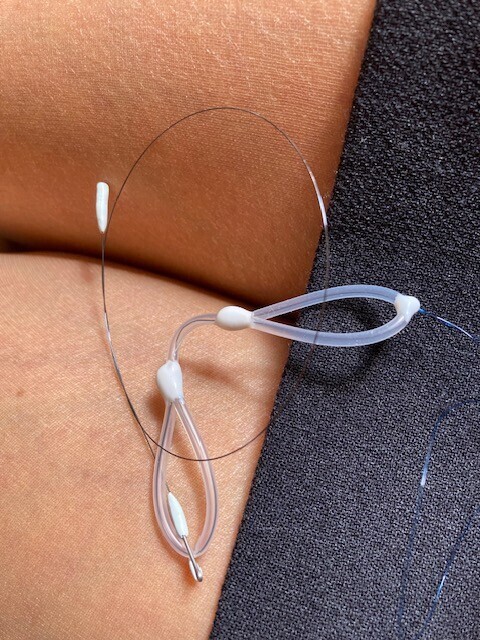
In an entry published in December 2024, Mr. Okada reported his first drive with a chipless design (a stimulating device without a solid chip). He described continued pleasure and attributed the lower burden during activity to the absence of a solid chip.
He also reported a separate prototype test with a 50mm bladder loop, which he said settled after about half a day. Whether he drove or went out with that prototype: Not recorded in the material. He reported barely noticing that loop when urine accumulated in his bladder. Mr. Okada suggested longer bladder use might become possible; the diary records no completed long-term result.
(Source: ok-lab's diary, published December 2024)
https://ok-lab.hatenablog.com/entry/2024/12/07/122832
The maker's answer to wearing a prostate chip outside
The maker's replies include warnings about inward movement, prolonged bladder use, and parts that need a different fit.
Walking with a long chip did not remove the maker's warning
In an entry published in November 2022, a customer reported testing a custom joined device, version 5, for prolonged wear. The customer described 22h of wear, including two walking outings and several trips to urinate, with the device remaining positioned.
Mr. Okada replied that he had already discouraged keeping a long chip in the bladder for extended periods. The customer had nevertheless expressed confidence in proceeding. His response retained that warning and described the account as frightening to read.
(Source: ok-lab's diary, published November 2022)
https://ok-lab.hatenablog.com/entry/2022/11/05/122757
A separate development update announced a wide-hole front plate
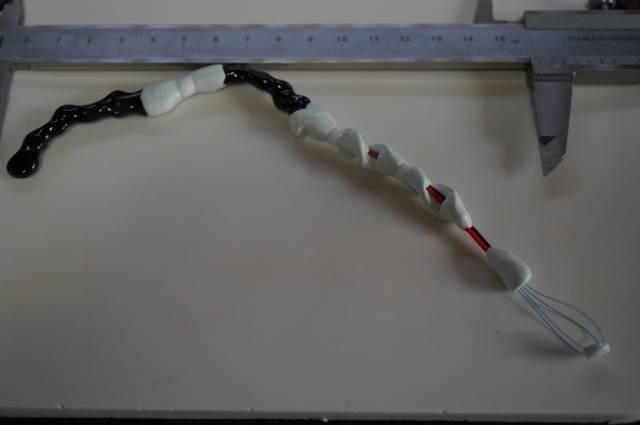
In an entry published in April 2023, Mr. Okada announced a change to future releases of the flattening device. He planned a wide-hole front plate for all future releases, leaving the penis tip visible. He also said support for the previous design would be limited.
Exchanges would take priority over new sales. He stated that owners satisfied with the older design could continue with it. For those wanting the new wide-hole version, he offered a free exchange, with some waiting time.
(Source: ok-lab's diary, published April 2023)
https://ok-lab.hatenablog.com/entry/2023/04/22/123057
A custom vibrating assembly request involved a discontinued cable specification
In an entry published in April 2023, a customer requested a three-motor custom assembly with a 6-wire support cable. Mr. Okada replied that the 6-wire version had been discontinued. The diary does not record whether this order was completed.
No outing result is recorded for that proposed assembly. He proposed a 2-wire version instead and supplied a revised quotation.
(Source: ok-lab's diary, published April 2023)
https://ok-lab.hatenablog.com/entry/2023/04/22/123057
Wearing chipless petals outside still raised concerns about inward movement
In an entry published in May 2025, Mr. Okada compared loop-based and petal-shaped chipless designs. He warned that its straight shaft could favor travel past the sphincter (a urine-control muscle), especially in people prone to inward chip movement. His own test had not crossed the sphincter.
With 25mm petals near the sphincter, he reported excessive stimulation and ended that test after about 3 hours. In the other configuration, he reported about 24 hours of wear, including a hospital visit, without a large burden. He later preferred 18mm petals himself and suggested about 20mm as an upper size around the sphincter.
(Source: ok-lab's diary, published May 2025)
https://ok-lab.hatenablog.com/entry/2025/05/24/122958
If you see blood in your urine, even a small amount or for the first time, do not wait and see. See a urologist right away. If you suddenly cannot urinate, or the device cannot be removed, do not try to fix it yourself. Go to a medical facility, including emergency care, immediately.
How wearing a prostate chip outside changed over time
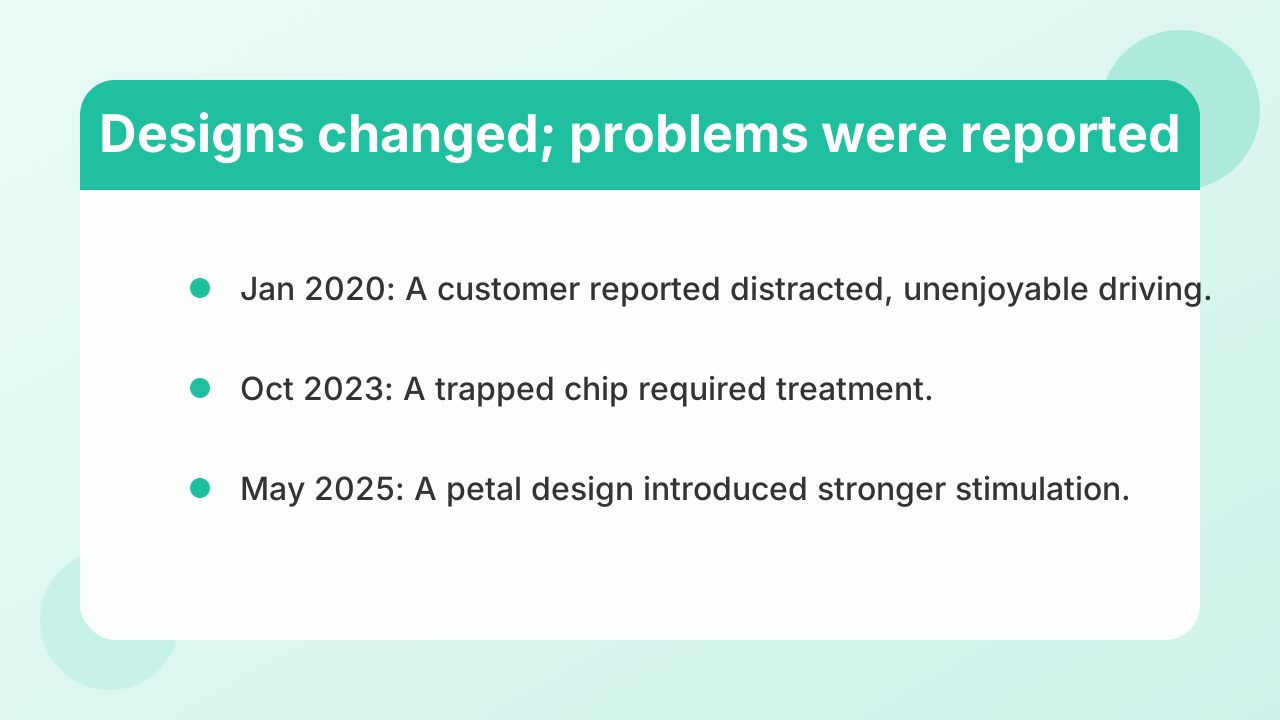
| Published | What the diary said then |
|---|---|
| Jul 2018 | A customer reported no stopper deterioration after nearly a month of continuous wear. |
| Jan 2020 | A customer reported distracted, unenjoyable driving. |
| Jun 2021 | Sudden urine loss during shopping prompted concern about injury or inflammation. |
| Nov 2022 | Mr. Okada reiterated his warning against prolonged bladder placement of long chips. |
| Apr 2023 | A wide-hole flattening design and free exchanges were announced. |
| Oct 2023 | A trapped chip required treatment following referral to a university hospital. |
| Dec 2024 | Mr. Okada reported less burden during his first chipless drive. |
| May 2025 | A petal design introduced stronger stimulation and renewed concerns about inward movement. |
The diary does not say what the current state is.
OK Prostate Chip products related to wearing a prostate chip outside
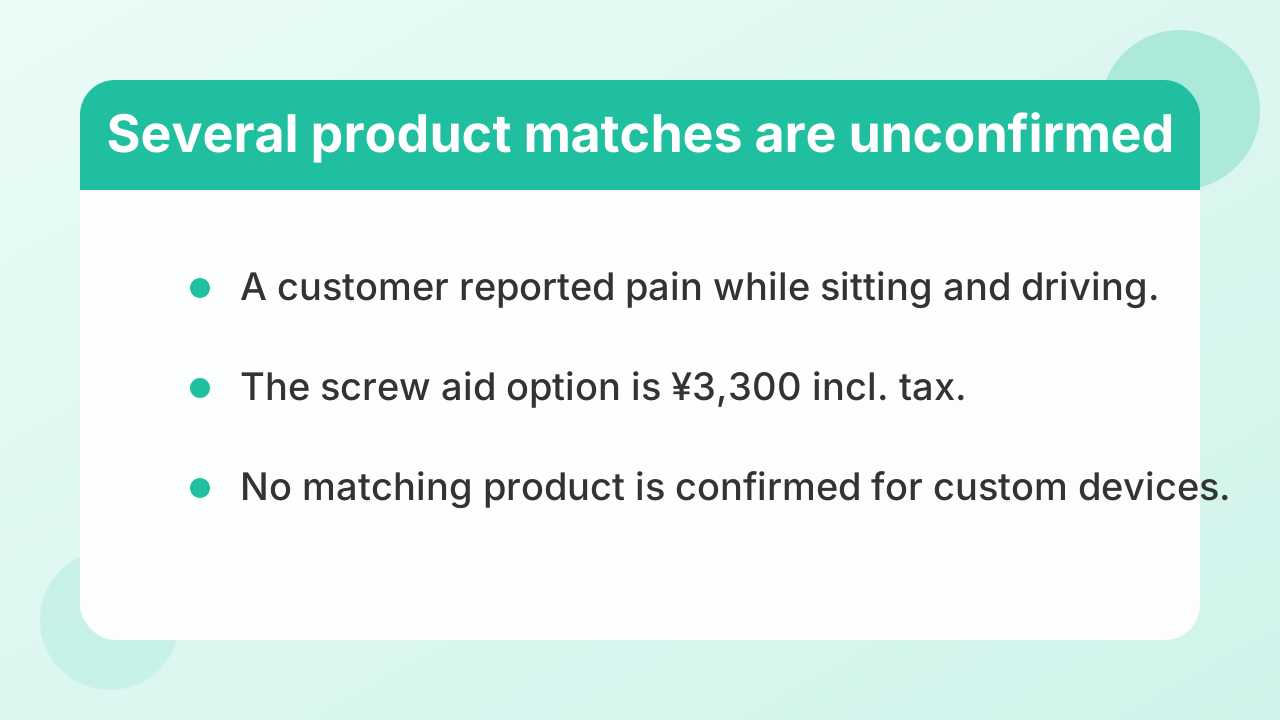
A customer reported perineal-bar pain while sitting and driving.
Products that appear in these entries
| Product (official name) | Price incl. tax | Relation to this topic |
|---|---|---|
| Long ceramic four-point twist chip (OKプロステートチップ 陶器素材ロングタイプ 4点ツイスト) | ¥7,700 (about $49 at ¥156 = $1, rate as of 2026-09-04) | A January 2020 customer considered this with a screw aid because other chips moved. |
| Screw aid option (スクリュー型補助チップ追加オプション) | ¥3,300 (about $21 at ¥156 = $1, rate as of 2026-09-04) | A January 2020 reply explained this aid's limits when combined with a long chip. |
| Perineal support bar (エイン・デ・フラット用会陰棒(単体)) | ¥3,300 (about $21 at ¥156 = $1, rate as of 2026-09-04) | An April 2023 customer reported pain from this bar while sitting and driving. |
(Source: ok-lab's diary, published January 2020)
https://ok-lab.hatenablog.com/entry/2020/01/04/155235
(Source: ok-lab's diary, published April 2023)
https://ok-lab.hatenablog.com/entry/2023/04/22/123057
Products the diary mentioned as alternatives
The diary names no alternative.
Custom joined and vibrating devices, the wedge assembly, curved blue chip, and chipless prototypes: No matching product can be confirmed on the current list.
The petal chipless design was priced at ¥7,000 (about $45 at ¥156 = $1, rate as of 2026-09-04) excluding tax in May 2025. The same entry gave ¥6,000 (about $38 at ¥156 = $1, rate as of 2026-09-04) excluding tax for the standard chipless design.
(Source: ok-lab's diary, published May 2025)
https://ok-lab.hatenablog.com/entry/2025/05/24/122958
Common worries about wearing a prostate chip outside
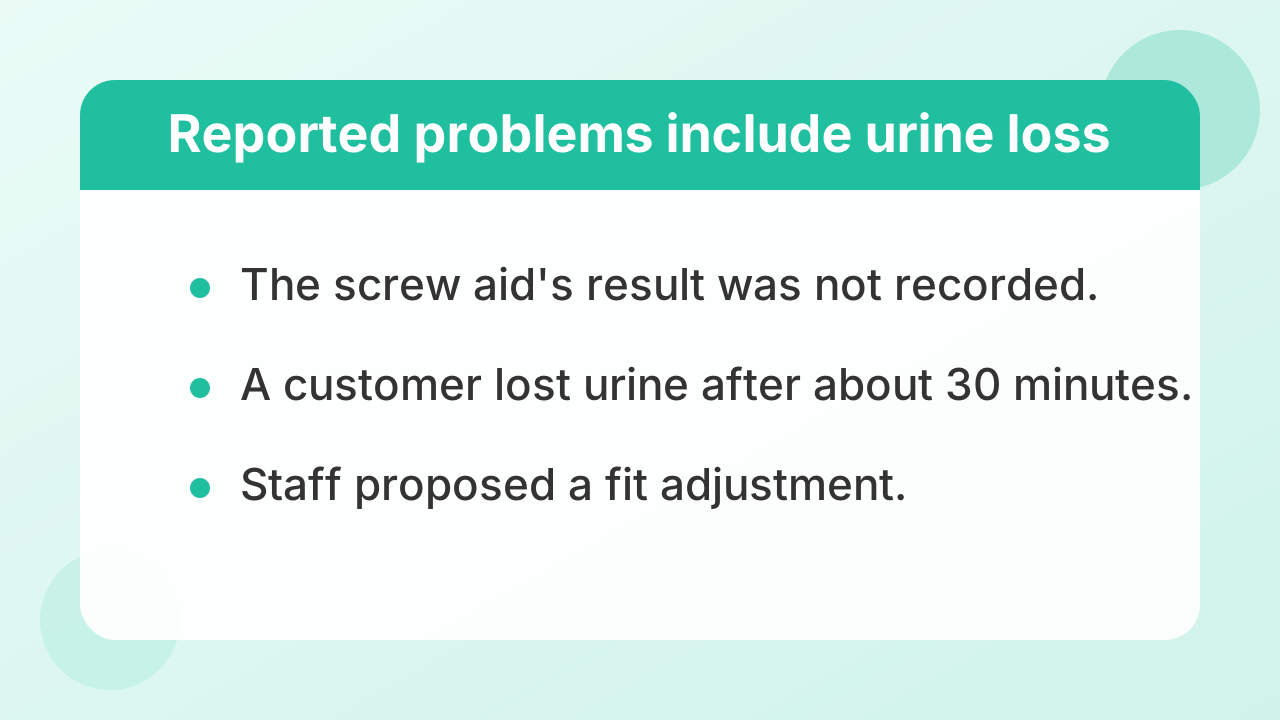
Readers asked about sudden urine loss, pain while sitting, and preventing inward chip movement.
"Could a screw aid stop my chip slipping inward?"
In an entry published in January 2020, a customer asked about a long ceramic four-point twist chip with a screw aid. The customer considered the screw aid (an additional chip connected behind the main device) because existing chips would not stay positioned. Mr. Okada said its flexible connection could accommodate different chip lengths.
The diary does not record whether this combination solved the problem. Mr. Okada warned that the long chip's rear could move past the sphincter. His reassurance depended on limited inward movement and continued access to the aid.
(Source: ok-lab's diary, published January 2020)
https://ok-lab.hatenablog.com/entry/2020/01/04/155235
"Does shopping with a chip mean needing diapers?"
In an entry published in June 2021, a customer described shopping with a version 2 vibrating device. After about 30 minutes, the customer suddenly lost urine into their trousers just before reaching home. The customer asked whether people dealt with outings by wearing diapers.
Mr. Okada said he had experienced such sudden loss only with sphincter injury or inflammation of the urethra. He suspected either problem here; no diagnosis or follow-up was recorded. He described diapers favorably from his hospital experience, without identifying this customer's underlying problem.
(Source: ok-lab's diary, published June 2021)
https://ok-lab.hatenablog.com/entry/2021/06/19/125845
"Why does sitting or driving with the flattening device hurt?"
In an entry published in April 2023, a customer wanted longer wear after trying the flattening device for about 3 hours. Walking felt fine, but sitting hurt, and driving required a substantial shift in hip position. The customer also asked whether stronger bar fastening could damage the main body.
The staff suspected a mismatch in the perineal bar (the device's support beneath the pelvis), specifically its length or curve. No later result from this customer is recorded. Staff proposed a fit adjustment or different bar length.
(Source: ok-lab's diary, published April 2023)
https://ok-lab.hatenablog.com/entry/2023/04/22/123057
Buying from outside Japan

OK Lab ships internationally to countries covered by Japan Post's EMS courier service. Overseas orders are paid in advance by PayPal. Each order carries a ¥400 (about $3 at ¥156 = $1, rate as of 2026-09-04) handling fee, and EMS shipping is charged on top. These terms come from OK Lab's official sales-terms page (written here as plain text, not a link: ok-lab.net/docs/law), checked on September 7, 2026; confirm them on the official store before you order, because they can change.
Summary of this article
| What you wanted to know | The answer |
|---|---|
| What is the short answer? | Outings ranged from comfortable to distracting, painful, or complicated by urine loss. |
| What is the product? | A urethral device made by OK Lab in Japan for prostate stimulation. |
| Which terms matter? | Chip position, bladder movement, and the support parts explain the reported problems. |
| What happened during outings? | The diary includes personal comfort reports and a trapped chip requiring hospital treatment. |
| What did the maker advise? | He cautioned about inward movement and prolonged bladder use; staff addressed support-bar fit. |
| What changed over time? | Parts, exchange policies, and chipless designs changed; experiences still varied. |
| What currently listed items appear? | The long ceramic four-point twist chip, screw aid, and perineal support bar. |
| What worried customers? | Urine loss, painful sitting or driving, and chips slipping out of position. |
| How do overseas purchases work? | Advance PayPal payment, a ¥400 (about $3 at ¥156 = $1, rate as of 2026-09-04) handling fee, and additional EMS shipping. |
| What does the article establish overall? | These are dated individual reports, with several outcomes and current product matches unconfirmed. |
Source: ok-lab's diary (Okada Comfortable Life Laboratory). The original entries are in Japanese; quotations on this page are translated. Photos and videos are on the original entries.
This article is a summary of the maker's development diary. The product is not a medical device and no result is guaranteed. If anything feels wrong or worries you, see a doctor. Prices, specifications and cautions change, so confirm the latest information on the official blog and the official site. Questions about ordering and shipping go to the seller.