![Can I sleep with a prostate chip? | The diary records disturbed sleep and hospital cases [OK Prostate Chip]](/img/a/T0174/eyecatch.svg)
This page is based on entries from "ok-lab's diary" (https://ok-lab.hatenablog.com/), the Japanese development diary written by Mr. Okada, founder of OK Lab, a small company in Japan (Okada Comfortable Life Laboratory). Only the entries about sleeping with a prostate chip and lying on your stomach are summarized here, in order of publication. Past prices and sizes are as written at the time. Current prices come from the official product list (retrieved September 4, 2026). Quotations are translated from Japanese.
Note: This page is a personal reading log by someone with no connection to the maker or the seller. It reflects the source entries as of their publication dates and makes no guarantee of accuracy or safety. The product is not a medical device; talk to a doctor about any health decision. Check the official site for current information. This page contains advertising.
In short
- Overnight reports include disturbed sleep, movement into the bladder, and devices requiring hospital removal.
- Mr. Okada's early reassurance was followed by warnings about particular stoppers and rigid designs.
- A ceramic double-twist chip remains listed, while several later prototypes have no confirmed current match.
If you see blood in your urine, even a small amount or for the first time, do not wait and see. See a urologist right away.
If you suddenly cannot urinate, or the device cannot be removed, do not try to fix it yourself. Go to a medical facility, including emergency care, immediately.
About this product

The OK Prostate Chip is a small device that is placed in the urethra (the urine passage) so that it acts on the prostate; the maker sells it in several shapes, sizes and materials. It is made and sold by OK Lab (Okada Comfortable Life Laboratory), a small company in Japan, through its own online store, and prices are in Japanese yen (JPY). The maker's development diary, "ok-lab's diary", is written in Japanese. This page is an English summary of it, and every quotation is translated. OK Lab ships internationally, so readers outside Japan can order (see "Buying from outside Japan" below). Product names on this page are plain-English descriptions. The official Japanese product name is shown once in the product table so you can find the same item in the store.
Before you read: key terms
| Term | Plain-English meaning |
|---|---|
| Urethra | The urine passage; the chip occupies part of this passage to act on the prostate. |
| Retrieval thread | A thread connected to the device, intended to provide a way to recover it. |
| Internal stopper | An attachment intended to resist movement past the muscle holding the chip and toward the bladder. |
| Urethral sound | A shaft inside the urine passage; these entries discuss it as support for a connected chip. |
| Mesh stopper | A stopper described as mesh, tested to hold connected parts in position. The diary does not explain its mesh construction. |
| Petal-loop attachment | A wire attachment with spreading loops, intended to resist slipping out near the head of the penis. |
| Screw supports | Spiral attachments intended to help hold a chip in position. |
| Locking key | A part controlling tube movement within a holder; the discussed version remained attached as a charm. |
What happens: sleeping with a prostate chip
The OK Prostate Chip is a small device placed in the urethra (the urine passage) to stimulate the prostate. These entries discuss leaving it inside during sleep, sometimes with attachments intended to hold it near the prostate. They also cover lying on the stomach, which Mr. Okada found could press on parts within the penis. The reports describe disturbed sleep, movement toward the bladder, and devices that required hospital treatment.
A retrieval thread broke after a customer slept with a prostate chip
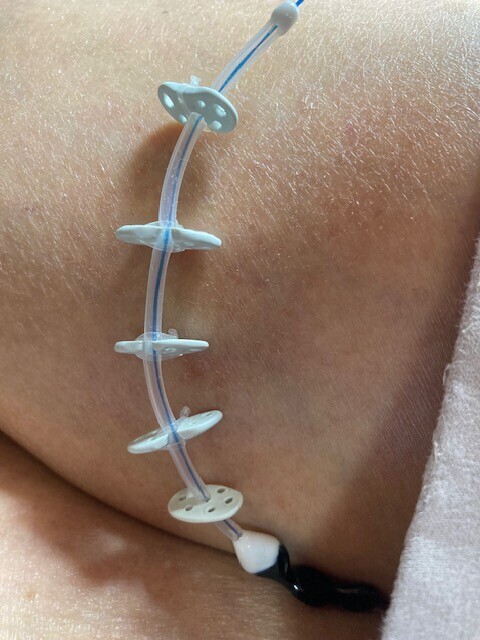
An entry published in April 2019 follows a customer who routinely slept with a two-chip resin device. The retrieval thread (the cord intended to recover the device) broke during attempted removal the next morning, leaving the leading chip inside. Over five and a half days, the customer reported difficult urination, blood, pain, and two episodes of leakage.
The customer eventually recovered the chip and requested an additional thread as a safeguard. Mr. Okada preserved the recovered device as a record and made a separate replacement with two threads.
(Source: ok-lab's diary, published April 2019)
https://ok-lab.hatenablog.com/entry/2019/04/27/153239
Sleeping with a prostate chip caused unresolved pain in one connected assembly
In an entry published in December 2022, Mr. Okada discussed a chip connected by thread to a urethral sound (an internal shaft). He reported waking with pain during sleep and said his attempts to address the problem had not resolved it. His experience concerned the connected arrangement, whose overnight performance remained unsatisfactory. Mr. Okada favored the sound alone in his own testing because he found it more comfortable.
(Source: ok-lab's diary, published December 2022)
https://ok-lab.hatenablog.com/entry/2022/12/03/122846
A mesh stopper shifted during overnight prostate chip testing
In an entry published in November 2023, Mr. Okada described connected mesh stoppers (attachments intended to hold position) during downward wear. He initially thought this arrangement stayed in place well. After sleeping, however, he found a stopper had shifted into the urine passage within the penis. Mr. Okada concluded that the arrangement still needed periodic position checks.
(Source: ok-lab's diary, published November 2023)
https://ok-lab.hatenablog.com/entry/2023/11/25/122934
A petal-loop attachment brought sleep problems during overnight testing
In an entry published in April 2025, Mr. Okada described a petal-loop attachment (a wire support with spreading loops). He intended those loops to resist slipping out near the head of the penis. He reported mild erections through much of sleep and suspected these made his sleep shallow, leaving him short of rest. The diary does not record a solution to this sleep problem.
(Source: ok-lab's diary, published April 2025)
https://ok-lab.hatenablog.com/entry/2025/04/19/122913
Sleeping with a prostate chip led to hospital treatment outside Japan
In an entry published in June 2025, a customer outside Japan described overnight use of the fourth-version chip (Sea Slug ver.4). The customer wanted continued use the following day, but the previously modified connector cord disappeared inside during sleep and the chip entered the bladder. The customer could not retrieve it and reported a hospital operation without an incision after worsening urinary symptoms.
Mr. Okada acknowledged the report, but the cause of the movement remained unknown. The customer's lessons concerned secure cord attachment with sufficient slack and avoiding chip use while unconscious.
(Source: ok-lab's diary, published June 2025)
https://ok-lab.hatenablog.com/entry/2025/06/14/122936
Multiple screw supports made stomach sleeping uncomfortable for Mr. Okada
In an entry published in November 2025, Mr. Okada described pressure from screw supports (spiral attachments intended to hold position). These occupied the urine passage within the penis, where lying on his stomach made compression uncomfortable. The experience led him to investigate support designs without multiple screw attachments.
After repeated prototypes, he developed a continuous-wire design. Mr. Okada considered multiple screw supports unsuitable for stomach sleeping.
(Source: ok-lab's diary, published November 2025)
https://ok-lab.hatenablog.com/entry/2025/11/15/122921
A rigid prototype raised stomach sleeping concerns for Mr. Okada
In an entry published in December 2025, Mr. Okada described a rigid prototype that prevented the penis from bending. He enjoyed daytime use but feared danger when sleeping on his stomach. He subsequently described a modular design with separate chip, shaft, and heart-shaped stopper sections. His response to the perceived overnight danger was to sleep without the rigid prototype.
(Source: ok-lab's diary, published December 2025)
https://ok-lab.hatenablog.com/entry/2025/12/13/122917
The maker's answer to sleeping with a prostate chip
The maker's replies moved from general reassurance toward concerns about particular designs, positioning, and failed stoppers.
Mr. Okada's early answer about sleeping with a prostate chip depended on size
In an entry published in August 2019, a ceramic-chip customer asked about overnight use after a nap felt unusually shallow. The customer wondered whether a smaller chip would help and whether continuous use for about a week was acceptable. Mr. Okada said he thought sleeping with a chip was generally unproblematic, while attributing discomfort to possible shape or size mismatch.
That was his opinion; the diary does not record a tested maximum overnight duration. He also wrote that he personally slept without a chip because of his heart condition. Mr. Okada suggested larger chips for short sessions and smaller ones for longer periods.
(Source: ok-lab's diary, published August 2019)
https://ok-lab.hatenablog.com/entry/2019/08/24/125858
Overnight prostate chip development included minimum spacing for internal stoppers
In an entry published in November 2020, Mr. Okada tested a porcelain chip with an internal stopper (an attachment intended to limit inward movement). The stopper sat approximately 6mm behind the chip, and he reported no trouble during 10 hours of use. He thought the straight connection placed less strain on the surrounding muscle.
His broader concern was that a stopper could obstruct urine flow when its movement was restricted. Mr. Okada's design advice specified at least 5mm of spacing for this stopper with the wire connection under discussion.
(Source: ok-lab's diary, published November 2020)
https://ok-lab.hatenablog.com/entry/2020/11/14/131426
An internal stopper failed during sleep with a prostate chip
In an entry published in April 2022, a customer described sleeping with the ceramic double-twist chip (Rabuka) and an internal stopper. Both entered the bladder, and the customer could not retrieve them. Blood in the urine, leakage, and a strong feeling of incomplete emptying followed; a urologist eventually removed the device.
Mr. Okada questioned whether the stopper had made retrieval harder after entering the bladder. He advised against internal stoppers for someone whose stopper readily passed the muscle holding the chip. In that situation, he said he trusted only a stopper outside the head of the penis.
(Source: ok-lab's diary, published April 2022)
https://ok-lab.hatenablog.com/entry/2022/04/02/123050
If you see blood in your urine, even a small amount or for the first time, do not wait and see. See a urologist right away.
If you suddenly cannot urinate, or the device cannot be removed, do not try to fix it yourself. Go to a medical facility, including emergency care, immediately.
How sleeping with a prostate chip changed over time
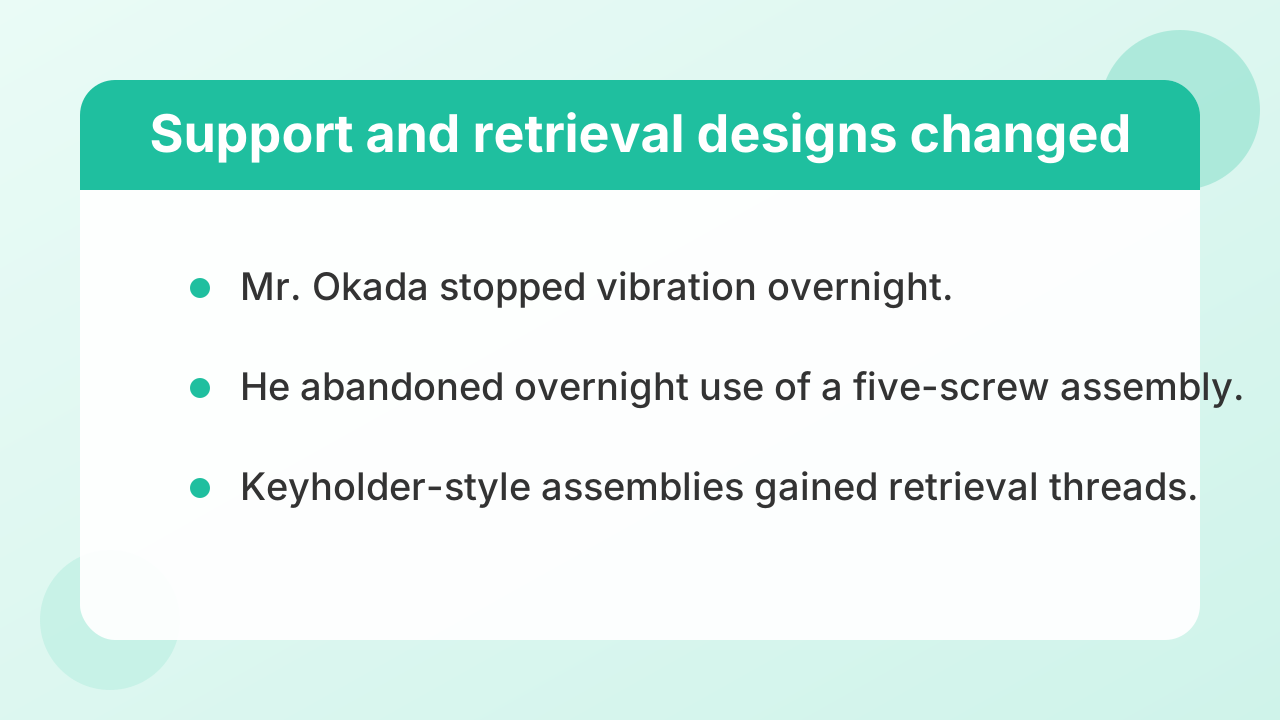
| Published | What the diary said then |
|---|---|
| Feb 2019 | A customer reported insufficient cable length during stomach-down use with a waist-mounted battery box. |
| Nov 2019 | A customer reported waking when a twisted chip shifted forward. |
| Oct 2020 | Mr. Okada reported five days of continuous spring-stent testing, including nights. |
| Mar 2023 | Mr. Okada stopped vibration overnight because he found prolonged vibration mentally tiring. |
| Dec 2023 | Mr. Okada abandoned overnight use of a five-screw assembly because stimulation felt too strong. |
| Aug 2024 | Keyholder-style assemblies gained retrieval threads extending from their loop tips. |
| Dec 2025 | The modular prototype gained four tubes to keep separated parts attached to retrieval threads. |
OK Prostate Chip products related to sleeping with a prostate chip
The current list includes the ceramic double-twist chip named in a hospital case.
Products that appear in these entries
| Product (official name) | Price incl. tax | Relation to this topic |
|---|---|---|
| Ceramic double-twist chip (OKプロステートチップ 陶器素材覚醒タイプ ダブルツイスト(ラブカチップ)) | ¥6,600 (about $42 at ¥156 = $1, rate as of 2026-09-04) | In April 2022, a customer reported this chip entering the bladder with its stopper during sleep and requiring hospital removal. |
(Source: ok-lab's diary, published April 2022)
https://ok-lab.hatenablog.com/entry/2022/04/02/123050
Products the diary mentioned as alternatives
The diary names no alternative.
These entries cover Sea Slug ver.4, a custom resin replacement, and assemblies using tubes, mesh stoppers, petal loops, or rigid shafts. No matching product can be confirmed on the current list.
Common worries about sleeping with a prostate chip
"Why does my prostate chip slip out during sleep?"
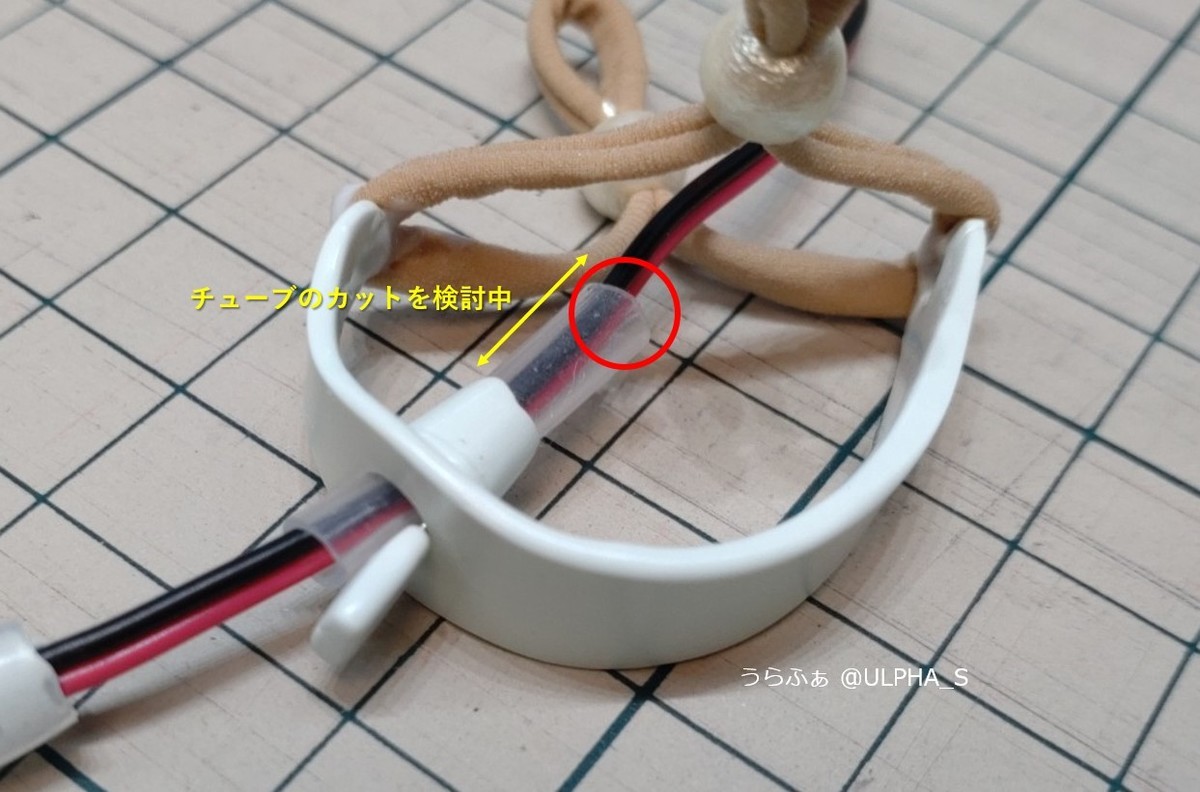
In an entry published in December 2020, a customer wanted the fourth-version chip to remain in position during overnight use. The customer reported that it repeatedly slipped toward the outer urine passage within 15–30 minutes. Mr. Okada suspected that its starting position was too far forward.
His reply focused on positioning and a second chip acting as an internal stopper against movement toward the bladder. He first discussed an unfinished design, then suggested a custom combination using the fourth-version chip with another chip behind it. The diary does not record whether that proposed combination solved this customer's problem.
(Source: ok-lab's diary, published December 2020)
https://ok-lab.hatenablog.com/entry/2020/12/05/130257
"Can a prostate chip adjust to erections during sleep?"
In an entry published in July 2022, a customer asked how a tube-and-holder arrangement accommodated changes between erect and non-erect states. The customer also reported discomfort from an older custom assembly, while Mr. Okada's reply chiefly discussed a newer design. His proposed sleep setting allowed limited tube movement with the locking key (the part controlling that movement) disengaged.
He expected the tube to adjust its depth to some extent, while the key remained attached as a charm. Mr. Okada also noted that sliding depended strongly on moisture. The diary does not record a successful overnight follow-up from this customer.
(Source: ok-lab's diary, published July 2022)
https://ok-lab.hatenablog.com/entry/2022/07/23/123014
"Can a prostate chip move inward while I sleep?"
In an entry published in May 2025, a customer asked whether an overnight change meant the chip had moved toward the bladder. Before sleep, the external stopper was about 5cm from the urinary opening; on waking, it touched the opening, leaving 0cm. Mr. Okada interpreted this as another report of inward movement during sleep.
The customer reported eventually recovering the chip. The diary does not record its exact internal position during the night.
(Source: ok-lab's diary, published May 2025)
https://ok-lab.hatenablog.com/entry/2025/05/03/122907
Buying from outside Japan

OK Lab ships internationally to countries covered by Japan Post's EMS courier service. Overseas orders are paid in advance by PayPal. Each order carries a ¥400 (about $3 at ¥156 = $1, rate as of 2026-09-04) handling fee, and EMS shipping is charged on top. These terms come from OK Lab's official sales-terms page (written here as plain text, not a link: ok-lab.net/docs/law), checked on September 7, 2026; confirm them on the official store before you order, because they can change.
Summary of this article
| What you wanted to know | The answer |
|---|---|
| What is the short answer? | The diary records sleep disruption, inward movement, and hospital cases. |
| What is this product? | A device made by OK Lab in Japan, placed in the urine passage to act on the prostate. |
| What do the attachment names mean? | Threads, stoppers, supports, and locking parts have different intended roles in recovery or positioning. |
| What happened during sleep? | Reports include broken threads, shifted attachments, pain, and disturbed rest. |
| What did the maker suggest? | His replies addressed size, stopper spacing, and limits of internal stoppers. |
| What changed over time? | Overnight testing brought further problems and changes to support and retrieval designs. |
| What does a related current product cost? | The listed ceramic double-twist chip costs ¥6,600 (about $42 at ¥156 = $1, rate as of 2026-09-04) including tax. |
| Can overnight movement be predicted from these reports? | Individual accounts describe movement, but several proposed solutions have no recorded follow-up. |
| Can customers outside Japan order? | The stated terms provide for PayPal payment and Japan Post EMS shipping, with additional fees. |
| What about stomach sleeping specifically? | Mr. Okada found multiple screw supports uncomfortable and considered a rigid prototype dangerous during stomach sleeping. |
Source: ok-lab's diary (Okada Comfortable Life Laboratory). The original entries are in Japanese; quotations on this page are translated. Photos and videos are on the original entries.
This article is a summary of the maker's development diary. The product is not a medical device and no result is guaranteed. If anything feels wrong or worries you, see a doctor. Prices, specifications and cautions change, so confirm the latest information on the official blog and the official site. Questions about ordering and shipping go to the seller.