![Why does a prostate chip cause a sharp sensation? | The maker points to the sphincters [OK Prostate Chip]](/img/a/T0181/eyecatch.svg)
This page is based on entries from "ok-lab's diary" (https://ok-lab.hatenablog.com/), the Japanese development diary written by Mr. Okada, founder of OK Lab, a small company in Japan (Okada Comfortable Life Laboratory). Only the entries about "the sensation when a chip passes the urethral sphincter" are summarized here, in order of publication. Past prices and sizes are as written at the time. Current prices come from the official product list (retrieved September 4, 2026). Quotations are translated from Japanese.
Note: This page is a personal reading log by someone with no connection to the maker or the seller. It reflects the source entries as of their publication dates and makes no guarantee of accuracy or safety. The product is not a medical device; talk to a doctor about any health decision. Check the official site for current information. This page contains advertising.
In short
Mr. Okada links the brief sharp feeling to sphincter passage, while customers describe both pleasure and discomfort.
He cautions that sensation alone cannot establish whether a chip has entered the bladder.
The current list includes related models, but does not confirm the historical custom configurations described below.
If you see blood in your urine, even a small amount or for the first time, do not wait and see. See a urologist right away.
If you suddenly cannot urinate, or the device cannot be removed, do not try to fix it yourself. Go to a medical facility, including emergency care, immediately.
About this product
The OK Prostate Chip is a small device that is placed in the urethra (the urine passage) so that it acts on the prostate; the maker sells it in several shapes, sizes and materials. It is made and sold by OK Lab (Okada Comfortable Life Laboratory), a small company in Japan, through its own online store, and prices are in Japanese yen (JPY). The maker's development diary, "ok-lab's diary", is written in Japanese. This page is an English summary of it, and every quotation is translated. OK Lab ships internationally, so readers outside Japan can order (see "Buying from outside Japan" below). Product names on this page are plain-English descriptions. The official Japanese product name is shown once in the product table so you can find the same item in the store.
Before you read: key terms
| Term | Plain-English meaning |
|---|---|
| Urethra | The urine passage; the chip occupies part of this passage near the prostate. |
| External urethral sphincter | A muscle before the prostate that, according to the diary, opens and closes under voluntary control during urination. |
| Internal urethral sphincter | A muscle at the bladder boundary, outside voluntary control. Its normal function: The diary does not explain this. |
| Bladder migration | Inward movement into the bladder; this distinguishes migration from placement near the prostate. |
| Retrieval thread | A thread connected to the device for retrieval. |
| Auxiliary chip | An additional connected chip, discussed for handling and limiting unwanted movement. |
| Petals | Small wire loops added to a larger loop device for additional stimulation. |
| Nitinol | The wire material used for the loop instruments discussed below. Its composition: The diary does not explain this. |
| Wire sound | A slender urethral instrument, offered for experiencing wire sensations. |
What happens: a sharp sensation with a prostate chip
The OK Prostate Chip is a small device placed in the urethra to act on the prostate. The diary describes a brief, sharp feeling during sphincter passage, which can feel pleasurable or uncomfortable. Mr. Okada distinguishes the external urethral sphincter (the muscle before the prostate) from the internal urethral sphincter (the muscle at the bladder boundary). His entries connect these sensations with passage through those areas, rather than assigning every sharp feeling to the prostate.
Long-chip sphincter sensation came with retrieval problems and a reversed sales decision
In an entry published in January 2018, Mr. Okada reversed an earlier cancellation of the long chip over possible sphincter injury. He reported 2 occasions when he could not remove a test chip, although both episodes eventually ended with removal. He blamed an earlier attachment at the retrieval thread (the thread connected for removal).
Versions 1–3 and 6 were scheduled for January 15, each at ¥6,000 (about $38 at ¥156 = $1, rate as of 2026-09-04) excluding tax. The former were linked short-chip designs; the latter was the long chip. Mr. Okada discouraged beginners and intermediate users from buying the long chip and warned that prolonged placement could damage the sphincters.
(Source: ok-lab's diary, published January 2018)
https://ok-lab.hatenablog.com/entry/20180111/1515662782
An unusual sphincter sensation did not spare one customer from bleeding
In an entry published in January 2018, a customer explored sensations with an enlarged custom short chip. The customer reported a distinct sensation at the external sphincter but little prostate sensation.
Use lasting about 12 hours, and repeated use, brought reports of bleeding, visible clotted blood, and mild pain. Mr. Okada replied that friction could not be eliminated. He also discouraged polishing resin to correct its appearance, because he believed that could introduce tiny scratches.
(Source: ok-lab's diary, published January 2018)
https://ok-lab.hatenablog.com/entry/20180118/1516263011
A slimmer design aimed for easier passage and access to sphincter sensation
In an entry published in August 2020, Mr. Okada introduced a slim ceramic double-twist design with more tip clearance and less curvature. He described those changes as making bladder entry and the internal-sphincter sensation easier. Sales were planned for August 17. Mr. Okada promoted it as a size for everyday use.
(Source: ok-lab's diary, published August 2020)
https://ok-lab.hatenablog.com/entry/2020/08/15/125150

A blue chip promoted for sphincter sensation had unreliable placement
In an entry published in September 2021, Mr. Okada changed how he presented a short blue chip. He withdrew the claim of easy wire-assisted placement and repositioned it as an introductory product.
The published chip price was ¥3,500 (about $22 at ¥156 = $1, rate as of 2026-09-04) excluding tax, with the accompanying hooked wire priced at ¥500 (about $3 at ¥156 = $1, rate as of 2026-09-04). The chip came in 4 sizes: SS, S, M, and L. Mr. Okada cautioned that the wire could catch the chip and bring it out too.
(Source: ok-lab's diary, published September 2021)
https://ok-lab.hatenablog.com/entry/2021/09/04/125843
Mr. Okada reported that sphincter sensation could disappear during unnoticed movement
In an entry published in March 2024, Mr. Okada described repeatedly discovering that a chip had moved into his bladder without him noticing. He wrote that the internal-sphincter sensation could fade during continued contact. His account also distinguished abrupt contact from gradual movement, which he sometimes did not feel at all. Mr. Okada also favored reducing the load on the external sphincter.
(Source: ok-lab's diary, published March 2024)
https://ok-lab.hatenablog.com/entry/2024/03/30/122958
Four added petals intensified sphincter sensation and made retrieval difficult
In an entry published in May 2025, a customer asked about adding petals (small wire loops for stimulation) to a prostate loop. Mr. Okada initially rejected the placement he envisaged, then developed a different arrangement along the loop. His test with 4 petals produced strong passage sensations and retrieval that required considerable force.
The specification required a loop at least 35mm long and excluded double loops. Each added petal cost ¥1,500 (about $10 at ¥156 = $1, rate as of 2026-09-04) excluding tax, as published that month. Mr. Okada warned that the force involved might straighten the hooked end of a retrieval wire.
(Source: ok-lab's diary, published May 2025)
https://ok-lab.hatenablog.com/entry/2025/05/31/122940
Bare wire caused enough sphincter sensation to prompt covered loops
An August 2025 entry described a looped wire sound (a slender urethral instrument) made from nitinol (the wire material). Published prices were ¥2,000 (about $13 at ¥156 = $1, rate as of 2026-09-04) for 25cm and ¥2,500 (about $16 at ¥156 = $1, rate as of 2026-09-04) for 35cm, excluding tax.
He reported that an earlier bare 0.3mm wire prototype had been abandoned because its stimulation was too strong. The newer 0.2mm wire still produced a near-painful sensation where its bare loop crossed a sphincter. Mr. Okada therefore specified tube-covered loops for general products using that thinner wire.
(Source: ok-lab's diary, published August 2025)
https://ok-lab.hatenablog.com/entry/2025/08/16/122934
The maker's answer to a sharp sensation with a prostate chip
Mr. Okada’s replies separate sensation, design, and unwanted movement.
Checking prostate chip sensation did not justify a deeper positioning test
In an entry published in April 2018, a customer asked whether a linked chip had reached the prostate and settled correctly. Mr. Okada thought at least part of the leading chip had reached the prostate region, but rejected a single universally correct resting position.
He suggested either complete bladder entry or weak prostate sensation as possible explanations for feeling little afterward. The exchange does not establish the customer’s final chip location. Although he associated a sharp feeling with the internal sphincter, Mr. Okada rejected deeper probing as a dangerous positioning test.
(Source: ok-lab's diary, published April 2018)
https://ok-lab.hatenablog.com/entry/20180414/1523697398
Mr. Okada linked sphincter sensation to changing shape, rather than steady pressure
In an entry published in November 2020, Mr. Okada considered a customer’s design intended to explore the source of strong sensations. Recalling hospital experiences, he located the strongest feeling around the internal sphincter, with little sensation from a balloon pressing inside the bladder. He proposed that changing the sphincter’s shape mattered more than sustained pressure.
His resulting prototype had a resin second chip and a connection approaching 90 degrees. Ceramic production depended on further testing. For longer placement, Mr. Okada favored a design keeping the leading chip in the prostate region.
(Source: ok-lab's diary, published November 2020)
https://ok-lab.hatenablog.com/entry/2020/11/14/131426

Pleasant sphincter sensation did not resolve a customer’s concerns about bladder migration
A December 2023 entry discussed bladder migration (inward movement into the bladder) with a customer awaiting resin and ceramic double-twist models. Staff initially offered to pause production and change the spacing between parts on an existing device. The customer clarified that discomfort occurred near the urethral opening, rather than between the connected parts.
Mr. Okada said his own problem was outward movement, limiting advice based on his experience. The diary does not record which arrangement was completed. He suggested a screw-shaped auxiliary chip (an extra connected chip), a movement-limiting stopper, or both, acknowledging that either could pass the sphincter.
(Source: ok-lab's diary, published December 2023)
https://ok-lab.hatenablog.com/entry/2023/12/23/122035
If you see blood in your urine, even a small amount or for the first time, do not wait and see. See a urologist right away.
If you suddenly cannot urinate, or the device cannot be removed, do not try to fix it yourself. Go to a medical facility, including emergency care, immediately.
How a sharp sensation with a prostate chip changed over time
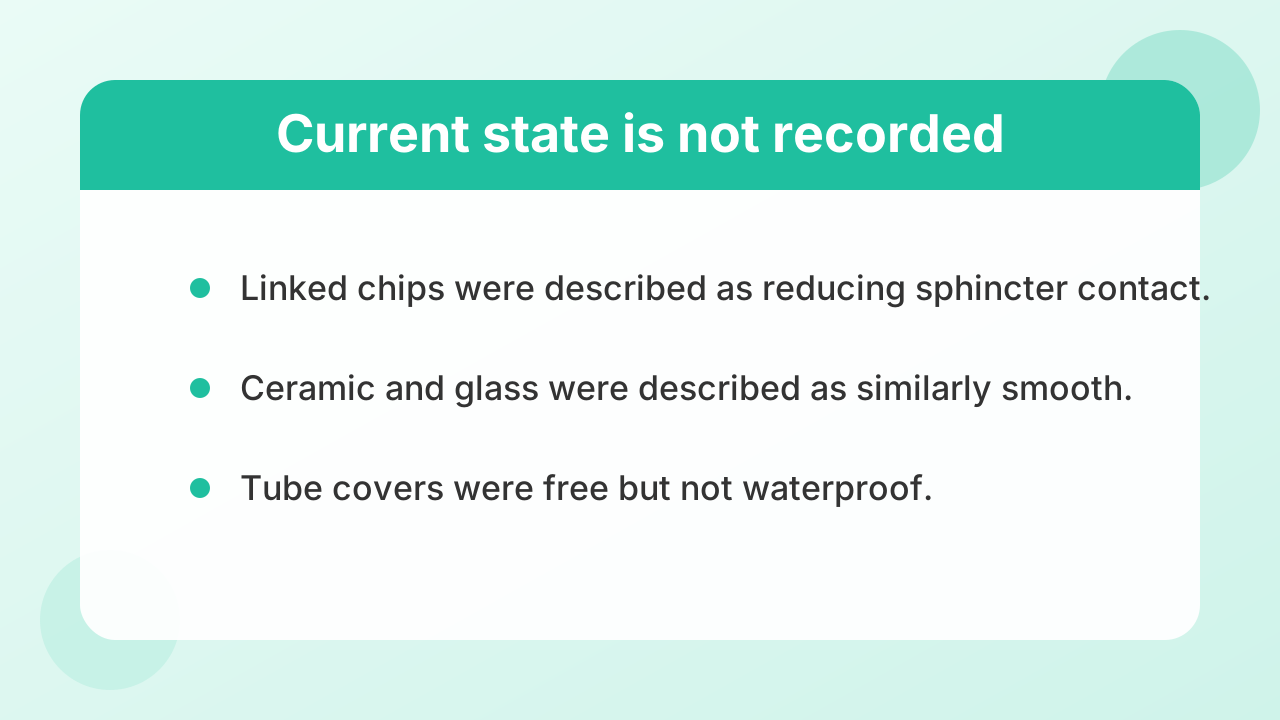
| Published | What the diary said then |
|---|---|
| Oct 2017 | Long and short designs were distinguished by whether they reached the bladder. |
| Jan 2018 | Linked chips with 5mm and 8mm gaps were described as reducing sphincter contact. |
| Jun 2019 | A customer reported pronounced pressure from a custom screw chip, 35mm long and 10mm wide. |
| Mar 2020 | A screw attachment changed a prototype from two catching points to three. |
| May 2020 | Mr. Okada described ceramic and glass as similarly smooth, both smoother than resin. |
| Aug 2025 | Tube covers for the looped wire sound were free but not waterproof. |
The diary does not say what the current state is.
OK Prostate Chip products related to a sharp sensation with a prostate chip
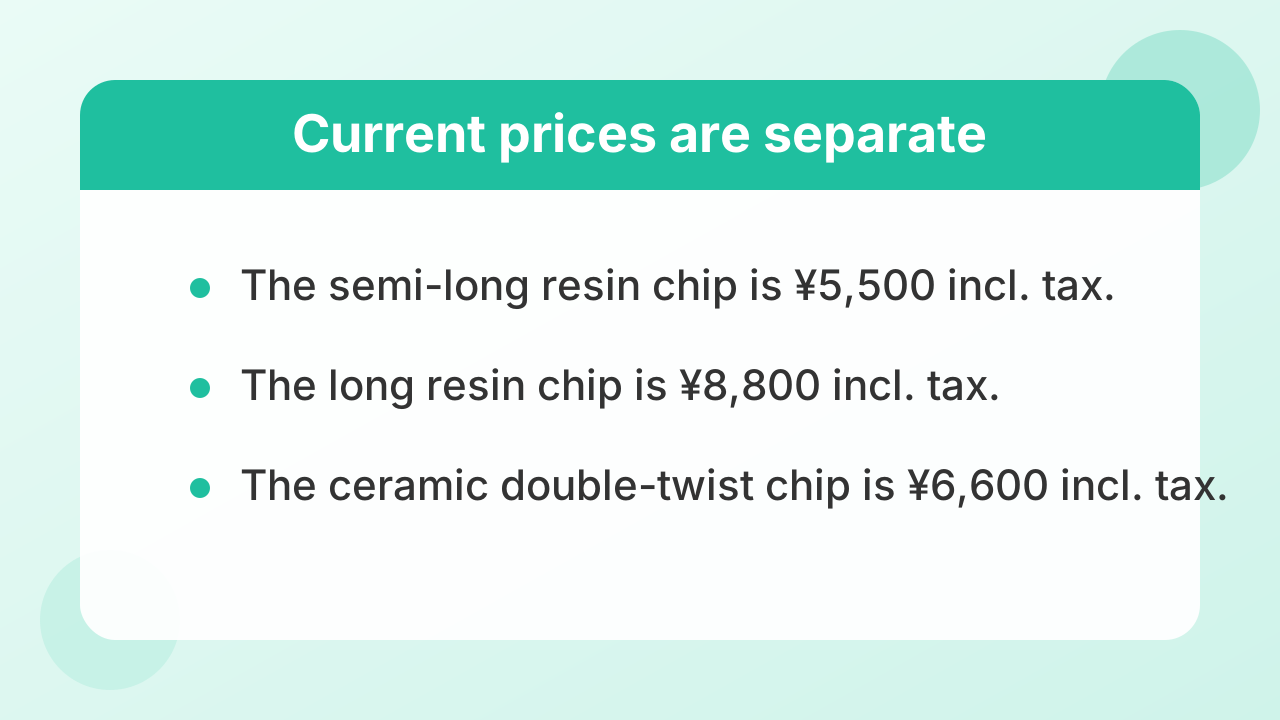
The current list includes models from these questions, priced separately from historical examples.
Products that appear in these entries
| Product (official name) | Price incl. tax | Relation to this topic |
|---|---|---|
| Semi-long resin chip (OKプロステートチップ セミロングタイプ(生体適合樹脂)) | ¥5,500 (about $35 at ¥156 = $1, rate as of 2026-09-04) | In May 2022, its owner asked whether the pleasant passage sensation would continue afterward. |
| Long resin chip (OKプロステートチップ 覚醒タイプ(生体適合樹脂)) | ¥8,800 (about $56 at ¥156 = $1, rate as of 2026-09-04) | In December 2023, a customer awaiting this model asked about preventing movement into the bladder. |
| Ceramic double-twist chip (OKプロステートチップ 陶器素材覚醒タイプ ダブルツイスト(ラブカチップ)) | ¥6,600 (about $42 at ¥156 = $1, rate as of 2026-09-04) | In December 2023, the same customer also sought advice about this model’s stability. |
(Source: ok-lab's diary, published May 2022)
https://ok-lab.hatenablog.com/entry/2022/05/21/124217
(Source: ok-lab's diary, published December 2023)
https://ok-lab.hatenablog.com/entry/2023/12/23/122035
Products the diary mentioned as alternatives
| Product (official name) | Price incl. tax | Relation to this topic |
|---|---|---|
| Screw-shaped auxiliary chip (スクリュー型補助チップ追加オプション) | ¥3,300 (about $21 at ¥156 = $1, rate as of 2026-09-04) | In December 2019, Mr. Okada recommended this addition for slipping during urination after a customer moved from short to semi-long chips. |
(Source: ok-lab's diary, published December 2019)
https://ok-lab.hatenablog.com/entry/2019/12/28/131319
Historical builds and options: linked short chips, long-chip test version, enlarged short chip, slim option, blue introductory chip, custom screw, angled prototype, petals, and wire sound.
No matching product can be confirmed on the current list.
Common worries about a sharp sensation with a prostate chip
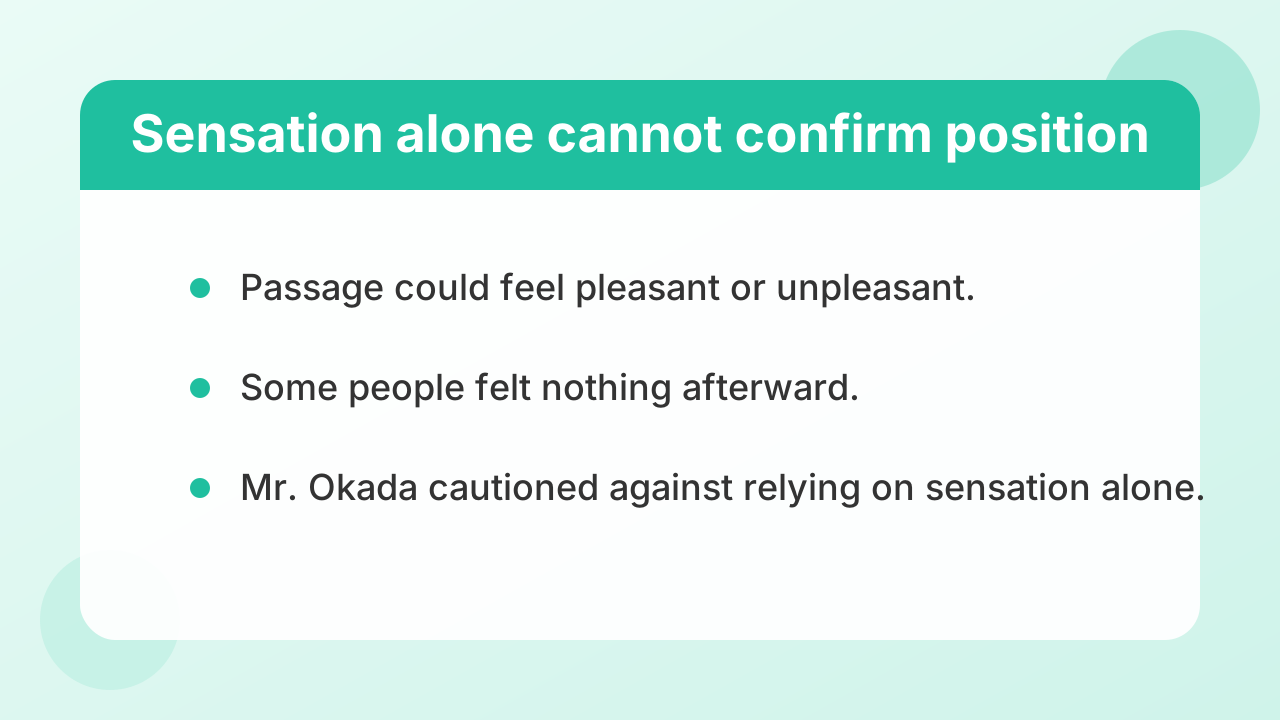
The questions distinguish passing sensations from lasting feelings and confirmed position.
"Does the sharp prostate chip sensation come from that gland?"
In an entry published in January 2019, a customer asked what a brief sharp feeling meant when little sensation followed. Mr. Okada thought it probably marked passage through the internal urethral sphincter, rather than prostate stimulation.
He interpreted further inward movement as entry into the bladder. The diary does not record whether this customer tried the proposed change. Mr. Okada suggested a movement-limiting stopper for that concern.
(Source: ok-lab's diary, published January 2019)
https://ok-lab.hatenablog.com/entry/20190112/1547275441
"Will the prostate chip sensation continue afterward?"
In an entry published in May 2022, a semi-long resin chip owner asked whether the pleasant feeling during passage would persist. Mr. Okada replied that passage could feel pleasant or unpleasant, and some people felt nothing afterward.
He thought the M model would ordinarily remain held by a sphincter. No later experience is recorded for this customer. Mr. Okada’s answer emphasized both physical stimulation and the person’s mental state.
(Source: ok-lab's diary, published May 2022)
https://ok-lab.hatenablog.com/entry/2022/05/21/124217
"Can prostate chip sensation reveal movement into the bladder?"
In an entry published in November 2022, a customer worried that fading sensation meant the device had entered the bladder. Mr. Okada said sensation could not settle that question.
He regarded inward travel of 5cm or more beyond the external-sphincter passage as suggesting bladder entry, judging from changes in exposed thread length. The exchange does not confirm the customer’s actual position. His reply cautioned against relying on sensation alone.
(Source: ok-lab's diary, published November 2022)
https://ok-lab.hatenablog.com/entry/2022/11/05/122757
Buying from outside Japan
OK Lab ships internationally to countries covered by Japan Post's EMS courier service. Overseas orders are paid in advance by PayPal. Each order carries a ¥400 (about $3 at ¥156 = $1, rate as of 2026-09-04) handling fee, and EMS shipping is charged on top. These terms come from OK Lab's official sales-terms page (written here as plain text, not a link: ok-lab.net/docs/law), checked on September 7, 2026; confirm them on the official store before you order, because they can change.
Summary of this article
| What you wanted to know | The answer |
|---|---|
| In short | The maker links the sharp feeling to sphincter passage, without reliable confirmation of position. |
| About this product | A urethral device made by OK Lab in Japan, with prices in JPY. |
| Key terms | The diary distinguishes sphincters before the prostate and at the bladder boundary. |
| What happens | Reports range from brief pleasure to bleeding, difficult retrieval, and unnoticed inward movement. |
| The maker’s answer | He rejects deeper positioning tests and acknowledges uncertainty. |
| Changes over time | Designs changed in response to passage sensations, placement problems, and excessive wire stimulation. |
| Related products | Current prices are separate from historical custom specifications. |
| Common worries | A brief pleasant feeling does not establish lasting sensation or reliable retention. |
| Buying outside Japan | Advance PayPal payment, a ¥400 (about $3 at ¥156 = $1, rate as of 2026-09-04) handling fee, and additional EMS shipping. |
Source: ok-lab's diary (Okada Comfortable Life Laboratory). The original entries are in Japanese; quotations on this page are translated. Photos and videos are on the original entries.
This article is a summary of the maker's development diary. The product is not a medical device and no result is guaranteed. If anything feels wrong or worries you, see a doctor. Prices, specifications and cautions change, so confirm the latest information on the official blog and the official site. Questions about ordering and shipping go to the seller.