![How thick are the wires and tubes? | Sizes depend on the part [OK Prostate Chip]](/img/a/T0853/eyecatch.svg)
This page is based on entries from "ok-lab's diary" (https://ok-lab.hatenablog.com/), the Japanese development diary written by Mr. Okada, founder of OK Lab, a small company in Japan (Okada Comfortable Life Laboratory). Only the entries about "wire and tube thickness" are summarized here, in order of publication. Past prices and sizes are as written at the time. Current prices come from the official product list (retrieved September 4, 2026). Quotations are translated from Japanese.
Note: This page is a personal reading log by someone with no connection to the maker or the seller. It reflects the source entries as of their publication dates and makes no guarantee of accuracy or safety. The product is not a medical device; talk to a doctor about any health decision. Check the official site for current information. This page contains advertising.
In short
Wire and tube dimensions changed with each part; thinner tubing did not always feel milder.
Mr. Okada changed coverings, core sizes, and product availability after tests exposed limitations.
The current list includes a short resin chip at ¥4,400 (about $28 at ¥156 = $1, rate as of 2026-09-04) including tax.
About this product

The OK Prostate Chip is a small device that is placed in the urethra (the urine passage) so that it acts on the prostate; the maker sells it in several shapes, sizes and materials. It is made and sold by OK Lab (Okada Comfortable Life Laboratory), a small company in Japan, through its own online store, and prices are in Japanese yen (JPY).
The maker's development diary, "ok-lab's diary", is written in Japanese. This page is an English summary of it, and every quotation is translated. OK Lab ships internationally, so readers outside Japan can order (see "Buying from outside Japan" below).
Product names on this page are plain-English descriptions. The official Japanese product name is shown once in the product table so you can find the same item in the store.
Before you read: key terms
| Term | Plain-English meaning |
|---|---|
| Urethra | The urine passage, where the maker's device is placed to act on the prostate. |
| Tube outer diameter | The width across the tube's outside, identifying the size of its covering. |
| Tube inner diameter | The width of the opening inside the tube, which accommodates wire or thread. |
| Wire core | A metal strand inside tubing, used to support the device's shape. |
| Nitinol | A nickel-titanium alloy used for flexible, shape-memory wires in these designs. |
| Sphincter | A muscle that closes the urine passage; the diary discusses its role in controlling urine and holding devices. |
| Epoxy resin | A hard resin used to cover, reinforce, or join parts. |
| Crossed loops | Loops arranged across one another to create a three-dimensional structure. |
What happens: wire and tube thickness
The OK Prostate Chip is a device placed in the urethra (urine passage) to act on the prostate. These entries discuss silicone tubing containing wire or thread, including connections behind a chip and loops replacing the chip. Tube outer diameter (outside width) measures the covering; tube inner diameter (opening width) measures the space for a wire core (supporting strand). Mr. Okada changed these dimensions to alter stiffness, fit, and contact with the urine passage.
Sharp ends damaged tubing during an early wire thickness trial
In an entry published in February 2022, Mr. Okada investigated an insertion aid after customers requested something easier to advance. His trial used tubing with a 3 mm inner diameter and 5 mm outer diameter, alongside 0.5 mm wire.
The resulting set contained 25 cm of that tubing and 30 cm of processed wire, priced at ¥1,000 (about $6 at ¥156 = $1, rate as of 2026-09-04) excluding tax. The wire had rounded ends because unfinished cut ends had punctured or scratched tubing during testing. Mr. Okada cautioned that insertion tools could apply unintended force.
(Source: ok-lab's diary, published February 2022)
https://ok-lab.hatenablog.com/entry/2022/02/19/123621
Smaller tube diameter became standard for the auxiliary chip connection
In an entry published in September 2022, the auxiliary-chip connection changed from 2 mm tubing to 1 mm tubing. The new tube's 0.5 mm inner diameter closely accommodated two 0.25 mm threads.
Mr. Okada preferred the appearance but acknowledged weaker resistance to folding. He offered the thicker version for customers who prioritized that resistance.
(Source: ok-lab's diary, published September 2022)
https://ok-lab.hatenablog.com/entry/2022/09/03/122644
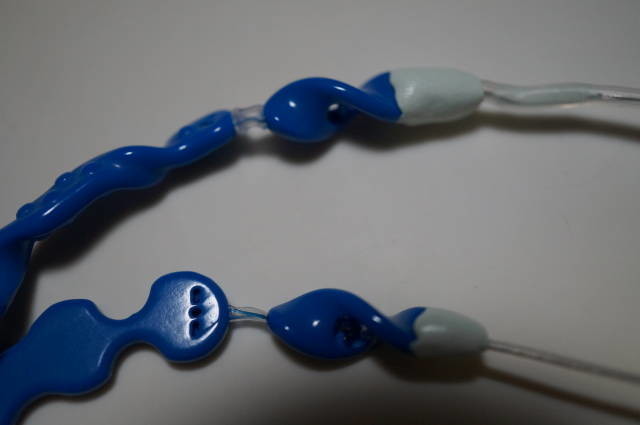
Uneven tube diameter forced a screw design's sales suspension
In an entry published in October 2022, Mr. Okada suspended sales of a screw design intended to grip around the sphincter. Its tubing had a 1 mm outer diameter and a nominal 0.5 mm inner diameter. Actual openings varied, sometimes restricting thread movement and preventing the intended spring action.
He also questioned durability under repeated stretching near 500% over short sections, although he had not experienced a tube snapping that way. Mr. Okada said sales would remain on hold while he assessed the tubing problem.
(Source: ok-lab's diary, published October 2022)
https://ok-lab.hatenablog.com/entry/2022/10/08/122859
A thicker wire size supported the fixed S-shaped rod
In an entry published in January 2023, Mr. Okada selected two parallel 1.2 mm stainless-steel wires for a fixed S-shaped rod. He considered 1.5 mm wire too difficult to bend by hand.
He wanted a structure that would resist deformation inside the body. His proposed protection was tubing or partial epoxy resin coverage (a hard resin covering), because he considered direct wire contact too irritating.
(Source: ok-lab's diary, published January 2023)
https://ok-lab.hatenablog.com/entry/2023/01/21/122941
Wider tube diameter made the loop device milder in testing
In an entry published in November 2024, Mr. Okada reported prickling from an older loop-device prototype with 2 mm tubing. He reported a substantially milder feeling with 2.5 mm tubing, without that prickling.
The specified design used 0.3 mm shape-memory wire inside the covering. Mr. Okada retained the wider tube as his chosen specification for this device.
(Source: ok-lab's diary, published November 2024)
https://ok-lab.hatenablog.com/entry/2024/11/30/122919
Reduced tube thickness was rejected for a proposed crossed-loop device
In an entry published in January 2025, a customer proposed thinner tubing and crossed loops (loops crossing to form a three-dimensional structure). Mr. Okada declined tubing below 2.5 mm because he believed it would no longer sufficiently cushion the thin wire. He made a prototype whose four tubes occupied about 5–6 mm at the joint.
However, he warned that crossed loops caught by the sphincter could cause urine leakage and possibly injury during prolonged contact. The diary does not record whether this customer's order was completed. Mr. Okada offered custom production only with those limitations understood.
(Source: ok-lab's diary, published January 2025)
https://ok-lab.hatenablog.com/entry/2025/01/11/122910
Small tube diameter did not eliminate friction in bead-covered prototypes
In an entry published in March 2026, Mr. Okada tested loop devices with separate resin beads covering the tubing. The 1 mm tube version compressed to about 6 mm wide and 4 mm thick. The 2 mm version compressed to about 8 mm wide and 5 mm thick.
He reported strong friction throughout the urine passage and particular difficulty at the sphincter. Mr. Okada said the design needed improvement before he would begin offering it.
(Source: ok-lab's diary, published March 2026)
https://ok-lab.hatenablog.com/entry/2026/03/07/122907
Extremely fine wire thickness made early loop prototypes difficult to manufacture
In an entry published in May 2026, Mr. Okada described a prototype combining 4 mm tubing, a 0.3 mm core, and 0.03 mm wire loops. He reported that minor mistakes during production could ruin the structure.
At that stage, he could manage personal prototypes but could not accept customer orders for this build. Mr. Okada said reliable manufacturing techniques still needed to be established.
(Source: ok-lab's diary, published May 2026)
https://ok-lab.hatenablog.com/entry/2026/05/16/122906
The maker's answer to wire and tube thickness
Mr. Okada chose dimensions according to each part's function, then revised designs when testing revealed limitations.
Wire breakage defined product life despite the fine wire size
In an entry published in August 2022, Mr. Okada tested doubled 0.3 mm stainless-steel wire inside tubing measuring 3 mm outside and 2 mm inside. He believed the weak wire lacked enough force to pierce the tube after breaking.
Nevertheless, he defined wire breakage as the end of the product's life. Routine replacement was generally unavailable because separating the bonded assembly could damage the chip. Mr. Okada advised treating the failure of that weakest component as the product's lifetime limit.
(Source: ok-lab's diary, published August 2022)
https://ok-lab.hatenablog.com/entry/2022/08/06/123150
Tube diameter determined whether fitted parts stayed put or slid
In an entry published in October 2024, Mr. Okada described a device with loops at both ends and optional fitted parts. The screw pieces and mesh stop pieces had 2 mm openings. On 2 mm tubing, they moved relatively easily; 2.5 mm tubing held them more firmly.
The standard tube was the thinner size, with the thicker option available at the same price. The simple loop device cost ¥4,000 (about $26 at ¥156 = $1, rate as of 2026-09-04) excluding tax for up to 30 cm. Mr. Okada recommended the thicker tube for secure positioning and the thinner tube when easier movement mattered.
(Source: ok-lab's diary, published October 2024)
https://ok-lab.hatenablog.com/entry/2024/10/26/122649
Wire thickness and finished bend angle became separate order choices
In an entry published in February 2025, Mr. Okada described tests using tubing with a 2.5 mm outer diameter and 1.5 mm inner diameter. Wires bent to 90°, 120°, and 150° produced finished angles of approximately 75°, 105°, and 130°.
He announced 0.3 mm and 0.4 mm wire choices, with finished angles of approximately 75°, 90°, 105°, or 130°. The wire's original angle and the completed device's angle were therefore different specifications. Mr. Okada favored the thinner wire for beginners because he considered the thicker wire's pressure substantial.
(Source: ok-lab's diary, published February 2025)
https://ok-lab.hatenablog.com/entry/2025/02/22/122939
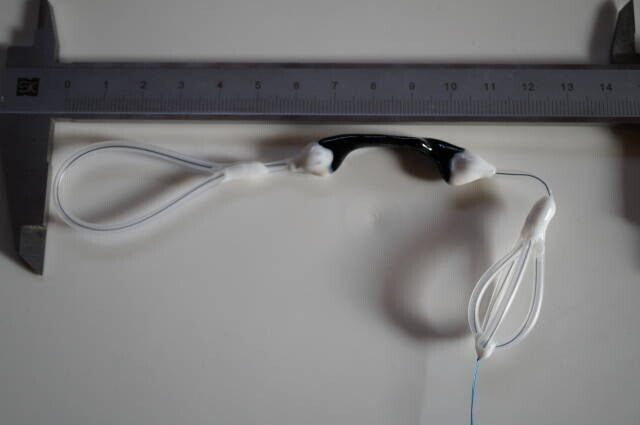
A coating policy changed wire thickness and ended direct metal contact
In an entry published in September 2025, Mr. Okada announced a policy against supplying products with nitinol directly touching skin, citing allergy concerns. Nitinol (a nickel-titanium alloy used for shape-memory wire) received a silicone covering. Thin coatings on 0.1 mm or 0.15 mm wires stayed within 0.3 mm, preserving compatibility with existing thread holes.
A thin coating over the whole strand carried no additional charge. Thicker coating cost ¥500 (about $3 at ¥156 = $1, rate as of 2026-09-04) excluding tax per 5 cm. Mr. Okada cautioned that thickly coated sections would not pass through auxiliary-chip holes.
(Source: ok-lab's diary, published September 2025)
https://ok-lab.hatenablog.com/entry/2025/09/06/122911
How wire and tube thickness changed over time
| Published | What the diary said then |
|---|---|
| Sep 2022 | Covered nylon cord used 10 cm sections to accommodate different stretching behavior. |
| Dec 2022 | Floating rod: 0.35 mm wire, 1 mm outer tube diameter, 0.5 mm inner diameter. |
| Feb 2023 | Flat rod: 1.6 mm wire and 4 mm tubing; approximately 3.7 mm thick. |
| Oct 2024 | A prototype replaced nylon-coated wire with nitinol inside silicone tubing. |
| Mar 2025 | Two-wire versions added ¥2,000 (about $13 at ¥156 = $1, rate as of 2026-09-04) excluding tax to the listed shape-memory configurations. |
| Jul 2025 | Rectal or vaginal models used 4 mm tubes and 0.4 mm wire. |
| May 2026 | A micro device used a narrower shaft and was priced at ¥11,000 (about $70 at ¥156 = $1, rate as of 2026-09-04) excluding tax. |
| Jul 2026 | The helical section used 0.15 mm wire covered by 1 mm tubing. |
OK Prostate Chip products related to wire and tube thickness
The short resin chip appears in a customer's question about covered connections and remains on the current product list.
Products that appear in these entries
| Product (official name) | Price incl. tax | Relation to this topic |
|---|---|---|
| Short resin chip (OKプロステートチップ ショートタイプ(生体適合樹脂)) | ¥4,400 (about $28 at ¥156 = $1, rate as of 2026-09-04) | In July 2025, a customer who struggled to advance this chip asked about a tube-covered connection. |
The short resin chip is listed in OK Lab's own online store.
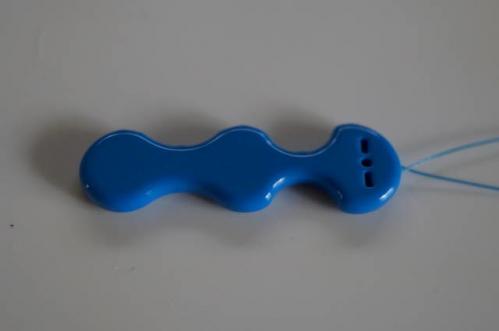
(Source: ok-lab's diary, published July 2025)
https://ok-lab.hatenablog.com/entry/2025/07/26/122909
Products the diary mentioned as alternatives
The diary names no alternative.
Historical tube connections and accessories; fixed and flexible rods; loop devices; covered nylon cord; and the fine-wire prototypes described here:
No matching product can be confirmed on the current list.
Common worries about wire and tube thickness
The replies distinguish component dimensions, custom-order details, and the limits of thinner connections.
"Does tube diameter alone determine a custom tool's opening size?"
In an entry published in April 2024, a customer requested a tool with differently sized openings at its ends. OK Lab's staff identified the tail tube as 2.5 mm thick and the twisted-thread cable as 4 mm thick. They warned that matching an opening exactly to those dimensions could make the fit too tight.
Mr. Okada completed the tool using dimensions within the customer's requested ranges. The diary does not record how the finished tool felt in use. The staff advised specifying both opening sizes precisely.
(Source: ok-lab's diary, published April 2024)
https://ok-lab.hatenablog.com/entry/2024/04/20/122856
"Can tube thickness be chosen before confirming a custom order?"
In an entry published in November 2024, a customer requested a loop device with sliding screw pieces and a mesh stop piece. The staff supplied a provisional quotation and requested the loop sizes, component arrangement, and tube thickness. They also explained that a different, more compact design was awaiting publication.
The customer decided to wait and compare the designs before ordering again. Mr. Okada likewise suggested postponing an order until the forthcoming design could be disclosed.
(Source: ok-lab's diary, published November 2024)
https://ok-lab.hatenablog.com/entry/2024/11/02/122858
"Can thinner tubing replace bare thread on a chip?"
In an entry published in July 2025, a customer outside Japan asked about a covered connection after difficulty advancing a short resin chip. Mr. Okada proposed an attachment containing nylon thread and 0.2 mm shape-memory wire inside 1 mm silicone tubing. The diary does not record this customer's subsequent experience.
In May 2026, Mr. Okada described that attachment as useful for retention and retrieval but of little help advancing ordinary chips. He found its structure sufficient for a new micro device with very fine loops. His later assessment limited its usefulness as an advancing aid to that low-resistance design.
(Source: ok-lab's diary, published July 2025)
https://ok-lab.hatenablog.com/entry/2025/07/26/122909
(Source: ok-lab's diary, published May 2026)
https://ok-lab.hatenablog.com/entry/2026/05/23/122904
Buying from outside Japan

OK Lab ships internationally to countries covered by Japan Post's EMS courier service. Overseas orders are paid in advance by PayPal. Each order carries a ¥400 (about $3 at ¥156 = $1, rate as of 2026-09-04) handling fee, and EMS shipping is charged on top. These terms come from OK Lab's official sales-terms page (written here as plain text, not a link: ok-lab.net/docs/law), checked on September 7, 2026; confirm them on the official store before you order, because they can change.
Summary of this article
| What you wanted to know | The answer |
|---|---|
| What is the main sizing issue? | Wire and tube dimensions differ by part and publication date. |
| What is this product? | A urethral device made and sold by OK Lab in Japan. |
| What do the measurements mean? | Outer diameter describes the covering; inner diameter describes the opening containing wire or thread. |
| Did thinner tubing always improve the design? | No; Mr. Okada reported milder contact after widening one loop device's tubing. |
| How did the maker respond? | He revised dimensions, coverings, and sales plans after identifying limitations. |
| What changed over time? | Designs moved through different core materials, tube sizes, wire counts, and surface coverings. |
| What current product appears here? | The short resin chip is listed at ¥4,400 (about $28 at ¥156 = $1, rate as of 2026-09-04) including tax. |
| What did customers need clarified? | Exact dimensions, proposed configurations, and what covered connections could accomplish. |
| How do overseas purchases work? | EMS shipping, advance PayPal payment, and a ¥400 (about $3 at ¥156 = $1, rate as of 2026-09-04) handling fee plus shipping. |
| What can these records establish? | Historical specifications and replies; the current list confirms product names and prices without size options. |
Source: ok-lab's diary (Okada Comfortable Life Laboratory). The original entries are in Japanese; quotations on this page are translated. Photos and videos are on the original entries.
This article is a summary of the maker's development diary. The product is not a medical device and no result is guaranteed. If anything feels wrong or worries you, see a doctor. Prices, specifications and cautions change, so confirm the latest information on the official blog and the official site. Questions about ordering and shipping go to the seller.