![Will ceramic chips clean easily and avoid sticking? | The maker reports benefits, with limits [OK Prostate Chip]](/img/a/T0822/eyecatch.svg)
This page is based on entries from "ok-lab's diary" (https://ok-lab.hatenablog.com/), the Japanese development diary written by Mr. Okada, founder of OK Lab, a small company in Japan (Okada Comfortable Life Laboratory). Only the entries about "ceramic chip cleaning and sticking" are summarized here, in order of publication. Past prices and sizes are as written at the time. Current prices come from the official product list (retrieved September 4, 2026). Quotations are translated from Japanese.
Note: This page is a personal reading log by someone with no connection to the maker or the seller. It reflects the source entries as of their publication dates and makes no guarantee of accuracy or safety. The product is not a medical device; talk to a doctor about any health decision. Check the official site for current information. This page contains advertising.
In short
Mr. Okada reports easier cleaning and less sticking, but these are his observations.
His design choices also address shape, weight, breakage, and slipping.
The current list includes a ceramic rectal chip (a separate anal device) at ¥6,600 (about $42 at ¥156 = $1, rate as of 2026-09-04) including tax.
About this product

The OK Prostate Chip is a small device that is placed in the urethra (the urine passage) so that it acts on the prostate; the maker sells it in several shapes, sizes and materials. It is made and sold by OK Lab (Okada Comfortable Life Laboratory), a small company in Japan, through its own online store, and prices are in Japanese yen (JPY).
The maker's development diary, "ok-lab's diary", is written in Japanese. This page is an English summary of it, and every quotation is translated.
OK Lab ships internationally, so readers outside Japan can order (see "Buying from outside Japan" below). Product names on this page are plain-English descriptions. The official Japanese product name is shown once in the product table so you can find the same item in the store.
Before you read: key terms
| Term | Plain-English meaning |
|---|---|
| Ceramic urethral chip | A ceramic device used in the urine passage to press on its prostate-area section. |
| Rectal chip | A separate device discussed for pressure or stimulation from inside the bowel, including near the prostate. |
| U-turn chip | A bent rectal-chip design discussed for prostate pressure; the diary distinguishes 1-bump and 2-bump forms. |
| Retaining plate | An external plate with a penis opening, used as part of the groin accessory discussed in May 2023. |
| Fabric covering | A very thin cover described as adding friction between skin and the plate to limit backward slipping. |
What happens: ceramic chip cleaning and sticking
The OK Prostate Chip is a small device placed in the urethra to press on its prostate-area section. Ceramic is one material tested for that device, with Mr. Okada discussing sticking and the ability to stay in place. The entries also cover separate ceramic rectal chips, intended to apply pressure from inside the bowel. A later entry discusses ceramic in an external groin plate, where cleaning, skin contact, and slipping also matter.
Ceramic chip sticking was Mr. Okada's explanation for gentler contact
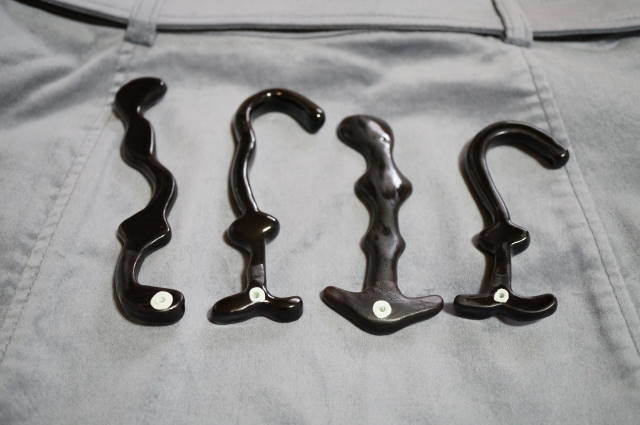
In an entry published in May 2019, Mr. Okada described about two weeks of tests with relatively large ceramic urethral chips. He reported that the short chip stayed in place almost all day, despite limited glide. He could not tell whether size, friction, or both explained that stability.
Mr. Okada suspected ceramic caused little irritation because it did not stick to the body's moist lining as resin did. However, he wrote that differences in glide substantially changed friction-related stimulation. He had stopped developing the comma-shaped prototype because simple chips stayed put, while leaving future ceramic versions open.
(Source: ok-lab's diary, published May 2019)
https://ok-lab.hatenablog.com/entry/2019/05/18/150144
Ceramic chip cleaning was a goal before the first clay prototype broke
In an entry published in November 2019, Mr. Okada proposed ceramic rectal chips partly for easier cleaning. He also expected less sticking to the intestinal lining and reduced dependence on lotion. The passage presented these as expected benefits while ceramic development was still underway.
For quicker shape trials, he used glass while planning ceramic production with molds. The first molded clay sample broke during handling for photography, before it had been fired. He proposed larger, thicker ceramic forms, which he believed would withstand handling better.
(Source: ok-lab's diary, published November 2019)
https://ok-lab.hatenablog.com/entry/2019/11/09/132111
Ceramic chip cleaning impressed Mr. Okada after finished rectal designs arrived
An entry published in December 2019 reported that the finished ceramic rectal chips had arrived. Mr. Okada found them noticeably lighter than his glass test pieces, with a more pleasant feel during handling. He described dirt coming away readily and no lingering odor after water washing.
He also reported no lotion-like leakage, although his account did not say that dryness disappeared completely. His preference for ceramic rested on these practical observations from his own testing. He encouraged interested readers to consider a ceramic rectal chip.
(Source: ok-lab's diary, published December 2019)
https://ok-lab.hatenablog.com/entry/2019/12/07/162608
Ceramic plate cleaning benefits came with extra weight, fragility, and slipping
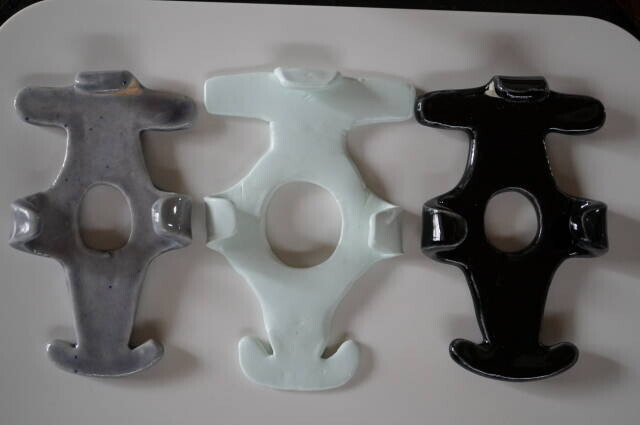
In an entry published in May 2023, Mr. Okada discussed a retaining plate (an external plate with an opening for the penis). He described ceramic as easy to clean and kind to skin, with room for varied shapes and colors. The ceramic plate weighed about 40g, versus about 20g for the earlier resin version; he described it as roughly twice as heavy.
He cautioned that ceramic could break if dropped, although the wide-hole version stayed attached even when the belt was off. He also found ceramic more slippery against skin than resin, with backward slipping when only the penis tip occupied the opening. Mr. Okada proposed a thin fabric covering as a way to increase friction at that contact point.
(Source: ok-lab's diary, published May 2023)
https://ok-lab.hatenablog.com/entry/2023/05/20/123034
The maker's answer to ceramic chip cleaning and sticking
Mr. Okada's responses combined shape choices, separate custom pricing, and planned changes to the external plate.
Ceramic chip sticking was only one concern when choosing a rectal shape
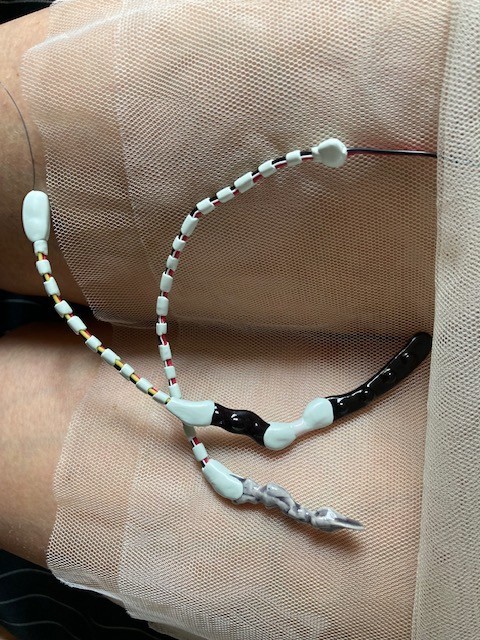
In an entry published in December 2019, Mr. Okada compared four original ceramic rectal-chip shapes. Free-form type 1 had an internal length of 11cm, while free-form type 2 measured 9cm. The U-turn chip (a bent rectal-chip design) came in 2-bump and 1-bump versions, measuring 10cm and 8cm internally.
He described a handle opening that remained open despite resin filling, allowing an optional attachment for reassurance. He found designs other than free-form type 1 tended to be pushed outward by stool during longer periods. Mr. Okada favored free-form type 1 for longer stays, while preferring the 2-bump U-turn for shorter periods.
(Source: ok-lab's diary, published December 2019)
https://ok-lab.hatenablog.com/entry/2019/12/07/162608
Ceramic chip cleaning did not prevent excessive pressure with the 1-bump U-turn
In an entry published in December 2019, Mr. Okada described a pressure problem with the 1-bump U-turn ceramic rectal chip. He described excessive pressure against the prostate in one orientation. He reported a comfortable fit in another orientation.
(Source: ok-lab's diary, published December 2019)
https://ok-lab.hatenablog.com/entry/2019/12/07/162608
Ceramic chip cleaning claims came with separate launch prices and ordering arrangements
In the entry published in December 2019, the launch prices were ¥5,000 (about $32 at ¥156 = $1, rate as of 2026-09-04) for the 1-bump and ¥6,000 (about $38 at ¥156 = $1, rate as of 2026-09-04) for the 2-bump U-turn. Free-form designs were also ¥5,000 (about $32 at ¥156 = $1, rate as of 2026-09-04); all these prices were explicitly tax excluded. The prices for the U-turn designs matched their resin equivalents at that time.
Formal ceramic sales were not ready, and only the four described ceramic designs were covered by the temporary ordering arrangement. His temporary route used an equally priced resin-chip order through the company's own online store. Mr. Okada asked buyers to identify their ceramic choice in that order's message field.
(Source: ok-lab's diary, published December 2019)
https://ok-lab.hatenablog.com/entry/2019/12/07/162608
Ceramic chip cleaning benefits did not remove the cost of custom molds
In an entry published in December 2019, Mr. Okada treated custom ceramic rectal chips as a separate pricing category. He said the mold materials alone could cost about as much as the product. Three-dimensional custom designs would cost more. Mr. Okada offered individual quotations for custom requests, with a minimum of ¥10,000 (about $64 at ¥156 = $1, rate as of 2026-09-04).
(Source: ok-lab's diary, published December 2019)
https://ok-lab.hatenablog.com/entry/2019/12/07/162608
Ceramic plate cleaning plans included larger openings and a return to sales
In an entry published in May 2023, Mr. Okada reported receiving only the 20mm-15mm wide-hole ceramic plate so far. He expected 4 larger sizes within a few weeks: 22mm-20mm, 24mm-22mm, 26mm-24mm, and 28mm-26mm. He planned to resume sales of the ceramic-plate groin accessory after those deliveries.
The planned colors were black and indigo, initially 2 options. The diary does not record whether the larger sizes arrived or sales restarted. Mr. Okada said he would consider still larger openings if demand justified them.
(Source: ok-lab's diary, published May 2023)
https://ok-lab.hatenablog.com/entry/2023/05/20/123034
How ceramic chip cleaning and sticking changed over time
| Published | What the diary said then |
|---|---|
| May 2019 | Test ceramic chips were larger and rougher than the standard glass models then available. |
| Nov 2019 | Ceramic production took at least two weeks before testing. |
| Dec 2019 | The four initial ceramic rectal-chip shapes were approximately 10mm thick. |
| Dec 2019 | Stocked orders could ship within 2-3 days; unavailable stock meant 3-4 weeks. |
| May 2023 | Handmade plate openings varied slightly, which Mr. Okada considered acceptable. |
OK Prostate Chip products related to ceramic chip cleaning and sticking
The current list includes the 2-bump U-turn ceramic rectal model mentioned in July 2022.
Products that appear in these entries
| Product (official name) | Price incl. tax | Relation to this topic |
|---|---|---|
| 2-bump U-turn ceramic rectal chip (OKプロステートお尻チップ 陶器素材2コブUターン型) | ¥6,600 (about $42 at ¥156 = $1, rate as of 2026-09-04) | In July 2022, Mr. Okada reported easy cleaning and unexpectedly strong prostate pressure with this model. |
The 2-bump U-turn ceramic rectal chip is listed in OK Lab's own online store.
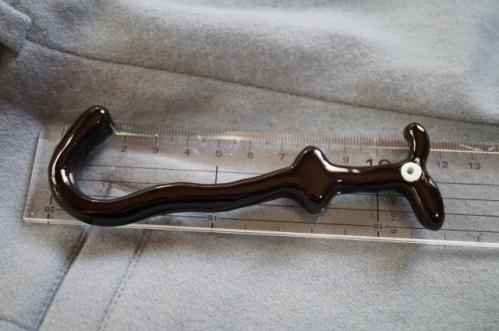
(Source: ok-lab's diary, published July 2022)
https://ok-lab.hatenablog.com/entry/2022/07/09/123142
Products the diary mentioned as alternatives
The diary names no alternative.
May 2019 ceramic test chips and the comma-shaped prototype: No matching product can be confirmed on the current list.
December 2019 initial ceramic versions and custom proposals: No matching product can be confirmed on the current list.
May 2023 ceramic retaining-plate version: No matching product can be confirmed on the current list.
Common worries about ceramic chip cleaning and sticking

(The material contains no questions from readers.)
Buying from outside Japan

OK Lab ships internationally to countries covered by Japan Post's EMS courier service. Overseas orders are paid in advance by PayPal. Each order carries a ¥400 (about $3 at ¥156 = $1, rate as of 2026-09-04) handling fee, and EMS shipping is charged on top. These terms come from OK Lab's official sales-terms page (written here as plain text, not a link: ok-lab.net/docs/law), checked on September 7, 2026; confirm them on the official store before you order, because they can change.
Summary of this article
| What you wanted to know | The answer |
|---|---|
| What is the short answer? | Mr. Okada reports easier cleaning and less sticking, alongside material and shape trade-offs. |
| What is the base product? | A urethral device made by OK Lab, a small company in Japan. |
| Which parts are different? | Urethral chips, separate rectal chips, and an external retaining plate have different locations and purposes. |
| What happened in the tests? | Mr. Okada described cleaning benefits, plus pressure, weight, breakage, and slipping concerns. |
| What did the maker propose? | Different shapes, individual custom quotations, and larger plate openings. |
| What changed over time? | The selected entries move from urethral-chip testing to rectal designs and external plates. |
| Which current model is identifiable? | The listed 2-bump U-turn ceramic rectal chip costs ¥6,600 (about $42 at ¥156 = $1, rate as of 2026-09-04) including tax. |
| Were customer questions recorded? | The material contains no questions from readers. |
| Can buyers outside Japan order? | International orders use PayPal and Japan Post's EMS courier service, with handling and shipping charges. |
Source: ok-lab's diary (Okada Comfortable Life Laboratory). The original entries are in Japanese; quotations on this page are translated. Photos and videos are on the original entries.
This article is a summary of the maker's development diary. The product is not a medical device and no result is guaranteed. If anything feels wrong or worries you, see a doctor. Prices, specifications and cautions change, so confirm the latest information on the official blog and the official site. Questions about ordering and shipping go to the seller.