![Is 0.2mm wire too thin? | The maker added flexibility and a nylon backup [OK Prostate Chip]](/img/a/T0851/eyecatch.svg)
This page is based on entries from "ok-lab's diary" (https://ok-lab.hatenablog.com/), the Japanese development diary written by Mr. Okada, founder of OK Lab, a small company in Japan (Okada Comfortable Life Laboratory). Only the entries about "adopting 0.2mm wire" are summarized here, in order of publication. Past prices and sizes are as written at the time. Current prices come from the official product list (retrieved September 4, 2026). Quotations are translated from Japanese.
Note: This page is a personal reading log by someone with no connection to the maker or the seller. It reflects the source entries as of their publication dates and makes no guarantee of accuracy or safety. The product is not a medical device; talk to a doctor about any health decision. Check the official site for current information. This page contains advertising.
In short
Mr. Okada found 0.2mm wire more flexible, but his stopper tests also identified a limit under forced pressure.
He added nylon thread inside the tubing as a backup if the thin wire broke.
The current product list does not confirm the specific wire builds described in these entries.
About this product

The OK Prostate Chip is a small device that is placed in the urethra (the urine passage) so that it acts on the prostate; the maker sells it in several shapes, sizes and materials. It is made and sold by OK Lab (Okada Comfortable Life Laboratory), a small company in Japan, through its own online store, and prices are in Japanese yen (JPY). The maker's development diary, "ok-lab's diary", is written in Japanese. This page is an English summary of it, and every quotation is translated. OK Lab ships internationally, so readers outside Japan can order (see "Buying from outside Japan" below). Product names on this page are plain-English descriptions. The official Japanese product name is shown once in the product table so you can find the same item in the store.
Before you read: key terms
| Term | Plain-English meaning |
|---|---|
| Shape-memory wire | Wire described as retaining or returning to its intended shape, used to support bendable device parts. |
| Nylon backup | Thread enclosed alongside the wire, intended to preserve the connection if the wire breaks. |
| Loop-ended extension | A tube-covered extension from the device, ending in a loop intended for retrieval. |
| Chipless design | A linked-loop structure used without a solid chip in the versions discussed here. |
| Petal stopper | Small, petal-shaped wire loops intended to prevent the device passing beyond the sphincter. |
| Sphincter | The body structure treated as the stopper's boundary. The diary does not explain this. |
| Four-joint connector | A bendable, covered-wire connection used to join two ceramic chips. |
What happens: 0.2mm wire
The OK Prostate Chip is a small device placed in the urethra (the urine passage) to act on the prostate. The 0.2mm wire discussed here forms part of extensions, loops, and connections between chips, rather than a complete device by itself. Mr. Okada describes shape-memory wire (wire that retains its intended shape) as a way to support these parts while allowing them to bend. Depending on the design, those parts lie along the urethra or extend into the bladder.
Mr. Okada found 0.2mm wire flexible enough for longer extensions
In an entry published in April 2025, Mr. Okada compared 0.2mm wire with the thicker wire previously used in extensions. He described its flexibility as close to thread and noted that it was thinner than 0.24mm nylon thread. In his feel test, he reported no effect on penile movement even with an extension spanning the urethra's length.
He also reported that the thin wire retained its straight shape after being released from a bent position. With the older 0.3mm wire, he had found long extensions too springy when the penis changed direction. For that older wire, Mr. Okada had advised extension lengths of around 3–6cm.
(Source: ok-lab's diary, published April 2025)
https://ok-lab.hatenablog.com/entry/2025/04/12/122910
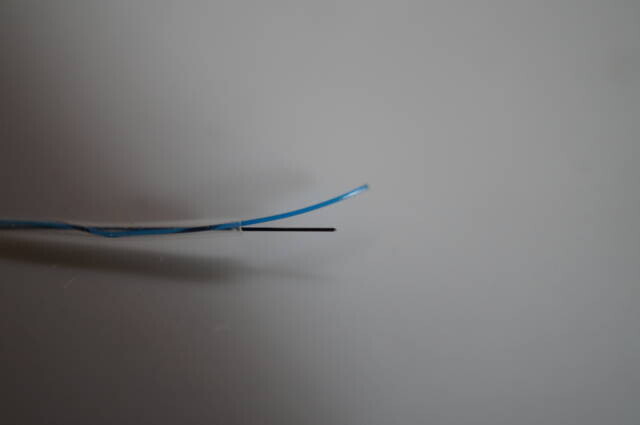
The 0.2mm wire extension had separate charges for length and loops
The 2.5mm tube version cost ¥3,000 (about $19 at ¥156 = $1, rate as of 2026-09-04) excluding tax for lengths up to 10cm, as published in April 2025. A double end loop added ¥1,000 (about $6 at ¥156 = $1, rate as of 2026-09-04) excluding tax, while the 10–20cm length band added ¥1,000 (about $6 at ¥156 = $1, rate as of 2026-09-04) excluding tax.
This was a loop-ended extension (a tube-covered part with an end loop intended for retrieval). Its construction replaced the earlier wire with the thinner wire and nylon thread inside the same tube size. No matching product can be confirmed on the current list. Mr. Okada also offered lengths up to 30cm for a further ¥1,000 (about $6 at ¥156 = $1, rate as of 2026-09-04) excluding tax.
(Source: ok-lab's diary, published April 2025)
https://ok-lab.hatenablog.com/entry/2025/04/12/122910
The narrower 0.2mm wire extension cost more to manufacture
In the same April 2025 entry, the 1mm tube version cost ¥4,000 (about $26 at ¥156 = $1, rate as of 2026-09-04) excluding tax for lengths up to 10cm. Mr. Okada attributed its higher price to the greater difficulty of making the narrower version.
A double end loop added ¥1,000 (about $6 at ¥156 = $1, rate as of 2026-09-04) excluding tax, and the entry listed another ¥1,000 (about $6 at ¥156 = $1, rate as of 2026-09-04) excluding tax for the 10–20cm length band. He described this construction as an update to the narrower tube that had previously contained nylon thread alone. No matching product can be confirmed on the current list. However, Mr. Okada also ruled out lengths of 20cm or more, leaving that endpoint unclear.
(Source: ok-lab's diary, published April 2025)
https://ok-lab.hatenablog.com/entry/2025/04/12/122910
Mr. Okada chose 0.2mm wire after comparing stopper stiffness
In an entry published in April 2025, Mr. Okada described a petal stopper (small wire loops intended to limit the device's movement). Its petals faced the sphincter (the body structure treated as the stopper's boundary). After about 5 days of his own trial, he reported no strong irritation there from the softer wire.
He judged 0.3mm petals too irritating around that area for prolonged placement after testing them. His chosen stopper instead used 3 petals, each containing 0.2mm wire. Mr. Okada favored the thinner petals because of that difference in his tests.
(Source: ok-lab's diary, published April 2025)
https://ok-lab.hatenablog.com/entry/2025/04/26/122909
A 0.2mm wire prototype extended the idea to linked loops
In an entry published in June 2025, Mr. Okada explored a chipless design (a structure of linked loops without a solid chip). His prototype contained 4 loops, each about 12cm, plus an end loop; he reported its overall length as 48cm. The wire throughout this design was 0.2mm.
He had wondered whether such a flexible structure would lack enough firmness, but reported that his prototype reached the bladder. No matching product can be confirmed on the current list. For more usual builds, Mr. Okada suggested 12x2 or 12x3 configurations instead of the longest example.
(Source: ok-lab's diary, published June 2025)
https://ok-lab.hatenablog.com/entry/2025/06/28/122915
The 0.2mm wire bladder-loop proposal awaited a patent consultation
In an entry published in August 2025, Mr. Okada described bladder loops attached to prototypes with solid chips. He used 0.2mm wire for these loops and described his experience of them as gentle on the bladder. His stated aim was to improve how steadily the chip stayed in position.
He withheld specifications and prices that week while planning to consult a patent professional about possible intellectual-property protection. He said sales would remain on hold if that consultation suggested protection was possible; otherwise, he planned to announce prices afterward. No matching product can be confirmed on the current list.
(Source: ok-lab's diary, published August 2025)
https://ok-lab.hatenablog.com/entry/2025/08/16/122934
A 0.2mm wire connector made joined ceramic chips possible
In an entry published in January 2026, Mr. Okada described a four-joint connector (a bendable connection between ceramic chips). It contained doubled 0.2mm wire and could join two ceramic chips into a single connected design. He explained that the wire continued through the connector to the chips, drawing on his earlier wire-reinforcement work.
He also reported that older glass pairs joined with thread had been discontinued because the thread tangled. No matching product can be confirmed on the current list. For the new design, Mr. Okada suggested that smaller ceramic pairings might be easier combinations.
(Source: ok-lab's diary, published January 2026)
https://ok-lab.hatenablog.com/entry/2026/01/10/122922
The maker's answer to 0.2mm wire
Mr. Okada paired thinner wire with nylon support, while retaining limits on stopper strength, tube length, and manufacturing.
The 0.2mm wire received a nylon backup inside its tube
In an entry published in April 2025, Mr. Okada anticipated concerns that the thinner wire might break. He added a nylon backup (thread enclosed alongside the wire) inside the tube containing the 0.2mm wire. He said this would preserve the earlier thread-based extension's function even if the wire failed.
Mr. Okada distinguished the enclosed thread from exposed thread, which he associated with tangling and uncertainty about its position. He regarded nylon's pulling strength as useful and said the tube retained that benefit. His proposed answer was to keep both materials together inside the tubing.
(Source: ok-lab's diary, published April 2025)
https://ok-lab.hatenablog.com/entry/2025/04/12/122910
The 0.2mm wire petals had published prices and limits under pressure
In an entry published in April 2025, the petal-stopper price was ¥1,000 (about $6 at ¥156 = $1, rate as of 2026-09-04) excluding tax per petal, or ¥3,000 (about $19 at ¥156 = $1, rate as of 2026-09-04) excluding tax for 3. Mr. Okada said the stopper could connect to structures containing shape-memory wire inside a tube. He also described excessive pressure or outward displacement when two different petal arrangements opposed each other along an overly long extension.
His favorable report concerned the stopper during ordinary placement. Mr. Okada warned that force from a pushing instrument could invert the 0.2mm petals and carry the stopper beyond the sphincter.
(Source: ok-lab's diary, published April 2025)
https://ok-lab.hatenablog.com/entry/2025/04/26/122909
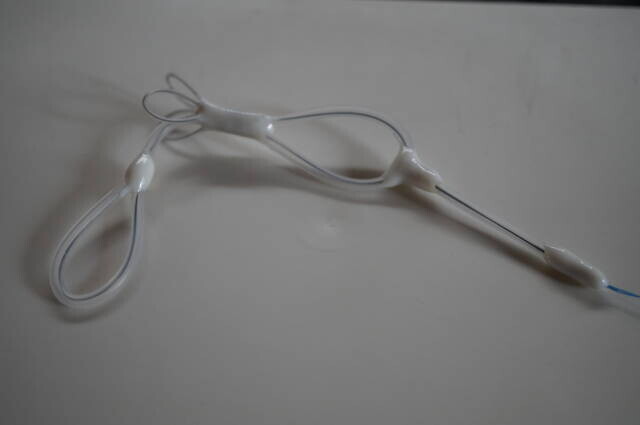
Manufacturing limited each 0.2mm wire loop before additional sections were joined
In an entry published in June 2025, Mr. Okada described a manufacturing limit for the wire-and-thread construction. His maximum workable tube length was 25cm when accommodating both materials inside a 0.5mm hole in 1mm tubing. He therefore set the maximum individual loop length at 12cm.
The published price was ¥4,000 (about $26 at ¥156 = $1, rate as of 2026-09-04) excluding tax for each 12cm loop. He explicitly priced the 12x3 version at ¥12,000 (about $77 at ¥156 = $1, rate as of 2026-09-04) excluding tax. Mr. Okada offered joined loop sections as the way to commission longer structures within that individual-loop limit.
(Source: ok-lab's diary, published June 2025)
https://ok-lab.hatenablog.com/entry/2025/06/28/122915
The 0.2mm wire connector had variable angles and lengthy production
In an entry published in January 2026, Mr. Okada targeted a bend of about 90 degrees but reported considerable variation between finished connectors. He attributed that variation partly to resin drying and the timing of the flexible joint material. He believed the doubled thin wire lacked enough spring force to press strongly against the urethra.
The connection cost ¥6,000 (about $38 at ¥156 = $1, rate as of 2026-09-04) excluding tax, added to the prices of the two chosen chips. The published breakdown was ¥3,000 (about $19 at ¥156 = $1, rate as of 2026-09-04) for the connector, ¥1,000 (about $6 at ¥156 = $1, rate as of 2026-09-04) for the first attachment, and ¥2,000 (about $13 at ¥156 = $1, rate as of 2026-09-04) for the second, all excluding tax. Mr. Okada advised allowing about 2 weeks at minimum after requesting a build, with longer waits possible if orders increased.
(Source: ok-lab's diary, published January 2026)
https://ok-lab.hatenablog.com/entry/2026/01/10/122922
How 0.2mm wire changed over time
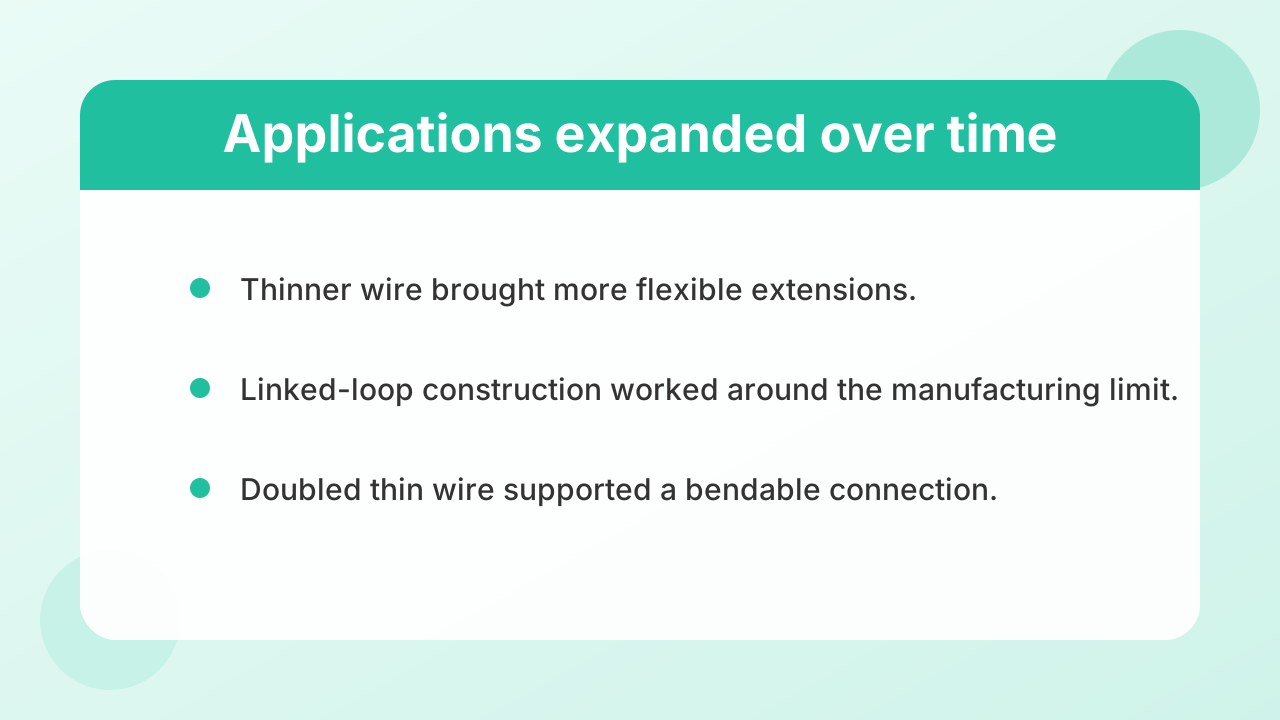
| Published | What the diary said then |
|---|---|
| Apr 2025 | Thinner wire brought more flexible extensions and nylon inside the tubing. |
| Apr 2025 | A customer request extended the nylon-backup idea to thicker wire. |
| Apr 2025 | Softer stopper petals were adopted, with a warning about forced pressure. |
| Jun 2025 | Linked-loop construction worked around the manufacturing limit for individual loops. |
| Aug 2025 | Bladder-loop pricing awaited consultation; a longer sales pause depended on possible protection. |
| Jan 2026 | Doubled thin wire supported a bendable connection between ceramic chips. |
The diary does not say what the current state is.
OK Prostate Chip products related to 0.2mm wire
No current product is directly tied to this topic.
Common worries about 0.2mm wire
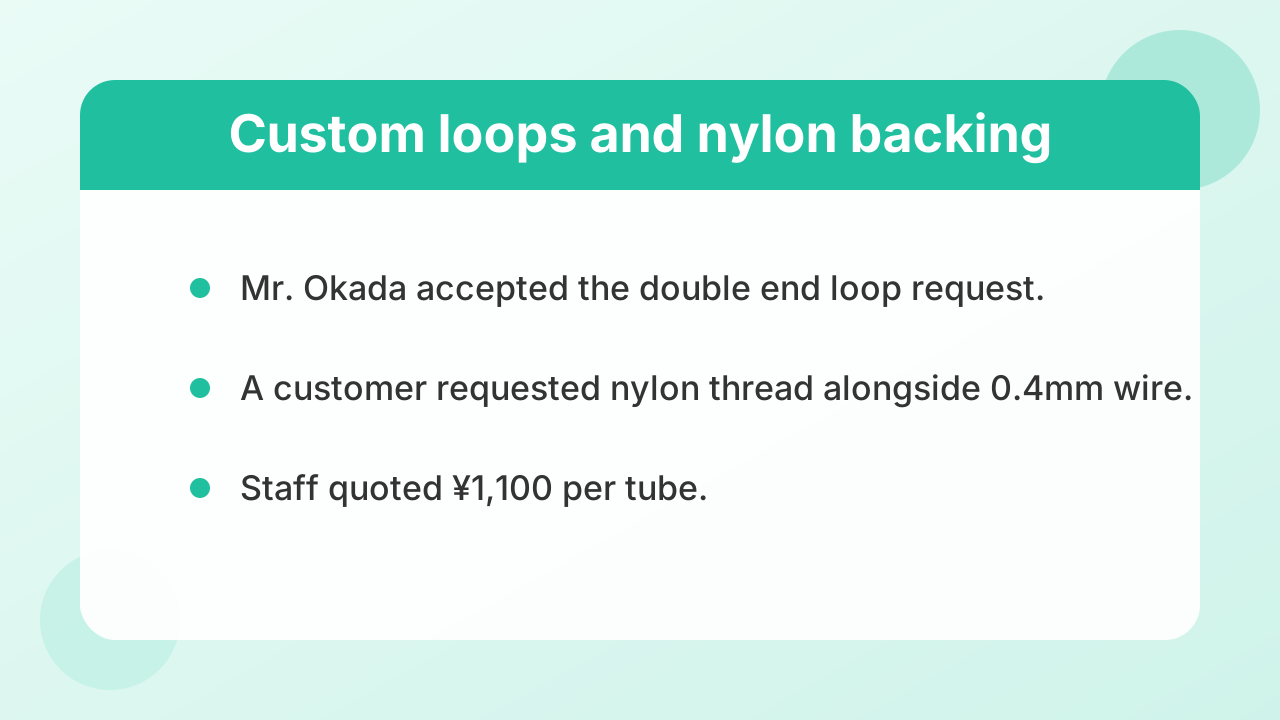
The recorded customer requests concerned double end loops and nylon backing for thicker wire.
"Can 0.2mm wire extensions have double end loops?"
In an entry published in April 2025, a customer requested a double end loop with retrieval in mind. Mr. Okada accepted the request and showed the completed custom build. He considered a doubled loop easier to engage than a single loop.
The request concerned the existing design; his subsequent 0.2mm versions also included the option. The diary does not record that customer's experience after delivery. Mr. Okada said doubled end loops would be available for later custom requests.
(Source: ok-lab's diary, published April 2025)
https://ok-lab.hatenablog.com/entry/2025/04/12/122910
"Can the 0.2mm wire backup idea support thicker versions?"
In an entry published in April 2025, a customer requested nylon thread alongside 0.4mm wire in a chipless build. Staff quoted ¥1,100 (about $7 at ¥156 = $1, rate as of 2026-09-04) per tube, explaining that separate components would each attract that charge. The customer selected the main loop structure and its extension, and the diary showed the finished item.
The diary does not record how that customer found it in use. For the section between the main loops alone, Mr. Okada separately quoted ¥1,000 (about $6 at ¥156 = $1, rate as of 2026-09-04) excluding tax in the same entry. Mr. Okada said he would accommodate nylon-thread requests with 0.3mm or 0.4mm wire.
(Source: ok-lab's diary, published April 2025)
https://ok-lab.hatenablog.com/entry/2025/04/19/122913
Buying from outside Japan

OK Lab ships internationally to countries covered by Japan Post's EMS courier service. Overseas orders are paid in advance by PayPal. Each order carries a ¥400 (about $3 at ¥156 = $1, rate as of 2026-09-04) handling fee, and EMS shipping is charged on top. These terms come from OK Lab's official sales-terms page (written here as plain text, not a link: ok-lab.net/docs/law), checked on September 7, 2026; confirm them on the official store before you order, because they can change.
Summary of this article
| What you wanted to know | The answer |
|---|---|
| What is the short answer? | Mr. Okada favored thinner wire for flexibility and added nylon as a backup. |
| What is the product? | A urethral device made by OK Lab in Japan, with prices in Japanese yen. |
| What do the terms mean? | Extensions, loops, stoppers, and connectors describe different parts that used the wire. |
| What happened in the tests? | The diary records flexible extensions, softer petals, linked loops, and joined ceramic chips. |
| What was the maker's response? | Enclosed nylon, construction limits, a pressure warning, and stated manufacturing charges and lead times. |
| What changed over time? | Applications expanded from extensions to stoppers, loop structures, and ceramic-chip connections. |
| Which current product matches? | No current product is directly tied to this topic. |
| What did customers ask? | Requests covered doubled end loops and nylon alongside thicker wire. |
| How do overseas orders work? | Advance PayPal payment, a handling fee, and Japan Post EMS shipping under the stated terms. |
Source: ok-lab's diary (Okada Comfortable Life Laboratory). The original entries are in Japanese; quotations on this page are translated. Photos and videos are on the original entries.
This article is a summary of the maker's development diary. The product is not a medical device and no result is guaranteed. If anything feels wrong or worries you, see a doctor. Prices, specifications and cautions change, so confirm the latest information on the official blog and the official site. Questions about ordering and shipping go to the seller.