![Is 0.03mm wire better than 0.05mm? | Each presented different problems [OK Prostate Chip]](/img/a/T0852/eyecatch.svg)
This page is based on entries from "ok-lab's diary" (https://ok-lab.hatenablog.com/), the Japanese development diary written by Mr. Okada, founder of OK Lab, a small company in Japan (Okada Comfortable Life Laboratory). Only the entries about "0.03mm and 0.05mm ultra-fine wire" are summarized here, in order of publication. Past prices and sizes are as written at the time. Current prices come from the official product list (retrieved September 4, 2026). Quotations are translated from Japanese.
Note: This page is a personal reading log by someone with no connection to the maker or the seller. It reflects the source entries as of their publication dates and makes no guarantee of accuracy or safety. The product is not a medical device; talk to a doctor about any health decision. Check the official site for current information. This page contains advertising.
In short
Thinner wire felt softer to Mr. Okada, but prototypes brought bleeding, breakage, and manufacturing problems.
Mr. Okada abandoned the retrieval tool and explored other wire structures.
Micro-wire custom orders were suspended in August 2026; later ceramic-chip specifications used both diameters.
If you see blood in your urine, even a small amount or for the first time, do not wait and see. See a urologist right away. If you suddenly cannot urinate, or the device cannot be removed, do not try to fix it yourself. Go to a medical facility, including emergency care, immediately.
About this product

The OK Prostate Chip is a small device that is placed in the urethra (the urine passage) so that it acts on the prostate; the maker sells it in several shapes, sizes and materials. It is made and sold by OK Lab (Okada Comfortable Life Laboratory), a small company in Japan, through its own online store, and prices are in Japanese yen (JPY). The maker's development diary, "ok-lab's diary", is written in Japanese. This page is an English summary of it, and every quotation is translated. OK Lab ships internationally, so readers outside Japan can order (see "Buying from outside Japan" below). Product names on this page are plain-English descriptions. The official Japanese product name is shown once in the product table so you can find the same item in the store.
Before you read: key terms
| Term | Plain-English meaning |
|---|---|
| Urethra | The urine passage; the maker places the chip and experimental wire devices inside it. |
| Retrieval net | A wire structure intended to catch a chip so it could be recovered. |
| Shaft | The supporting stem that carries the experimental wire structures. |
| Straight-memory wire | Wire intended to return toward a straight shape, a property the maker used to support miniature structures. |
| Sphincter | Named as a barrier the retrieval prototype could not pass. The diary does not explain this. |
What happens: 0.03mm vs 0.05mm wire
The OK Prostate Chip is a device placed in the urethra (urine passage) to act on the prostate. In this diary, ultra-fine wire appears in retrieval nets (structures intended to catch a chip) and experimental devices for stimulating the urethral lining. Those devices carried loops or projecting strands on a shaft (the supporting stem). Later entries describe a different use: wire following ceramic chip surfaces.
Bleeding during prototype tests prompted the search for ultra-fine wire
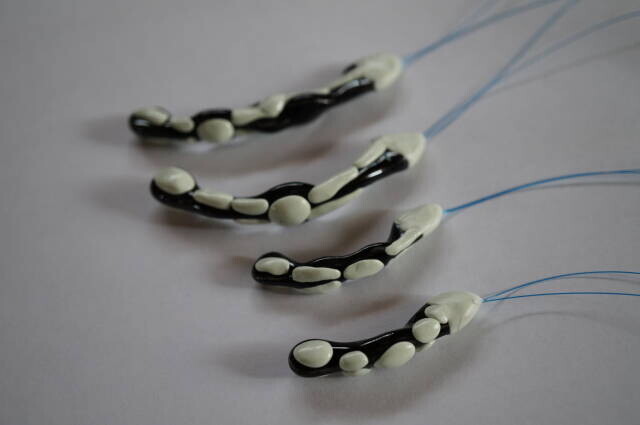
In an entry published in April 2026, Mr. Okada reported minor bleeding during repeated tests of a 0.1mm wire retrieval prototype. The net used wire with a thin rubber coating, and he described testing without lubricating jelly. The diary does not record a successful retrieval with that prototype.
He hoped thinner wire would feel gentler and ordered 0.03mm and 0.05mm samples. No matching product can be confirmed on the current list. Mr. Okada suspended testing after the bleeding.
(Source: ok-lab's diary, published April 2026)
https://ok-lab.hatenablog.com/entry/2026/04/18/122906
0.03mm wire proved too floppy for the first retrieval net
In an entry published in April 2026, Mr. Okada found that 0.03mm wire could not remain straight under gravity. He abandoned it for this net before making a prototype. By contrast, 0.05mm straight-memory wire (wire intended to spring back toward a straight shape) returned straight after bending.
He completed a soft net using that wire and finer nylon thread. However, he reported that 0.05mm wire sometimes broke when tangling concentrated force, despite resisting ordinary tension. Mr. Okada initially deferred use testing because he was unsure he could make a replacement.
(Source: ok-lab's diary, published April 2026)
https://ok-lab.hatenablog.com/entry/2026/04/25/122914
Bare 0.05mm wire still felt too intense around the prostate
In an entry published in May 2026, Mr. Okada described strong sensations from a prototype made entirely with 0.05mm wire. Around the sphincter (not explained in the diary) and prostate, he found the stimulation too intense for extended use. He believed this bare wire lacked enough force to damage the lining, but explicitly declined to guarantee safety.
Manufacturing also remained difficult: he reported more failed attempts than successful ones because the wire was hard to feel. He considered offering such devices only after further personal testing, with short use as a condition.
(Source: ok-lab's diary, published May 2026)
https://ok-lab.hatenablog.com/entry/2026/05/02/122917
A loop made 0.03mm wire workable, but production remained difficult
In an entry published in May 2026, Mr. Okada found that 0.03mm wire could retain a loop despite failing to stay straight unsupported. A little tension within the loop preserved its shape. He completed a prototype with a 4mm silicone tube and 0.3mm central wire.
He could not make it by touch and had to rely on magnified visual work. No matching product can be confirmed on the current list. Mr. Okada said personal prototypes were all he could manage then, so he could not accept customer requests.
(Source: ok-lab's diary, published May 2026)
https://ok-lab.hatenablog.com/entry/2026/05/16/122906
The 0.03mm wire instrument received a price despite approximate dimensions
In an entry published in May 2026, Mr. Okada described a looped micro-wire instrument with a standard 25cm shaft. Its loop-bearing section measured 8cm, leaving 17cm as the supporting shaft. The published prices were ¥3,000 (about $19 at ¥156 = $1, rate as of 2026-09-04) excluding tax for the shaft and ¥8,000 (about $51 at ¥156 = $1, rate as of 2026-09-04) excluding tax for the loop section, totaling ¥11,000 (about $70 at ¥156 = $1, rate as of 2026-09-04) excluding tax.
The target was 8 pairs of loops, roughly 20mm on each side, although the finished count could range from 7 to 10 pairs. No matching product can be confirmed on the current list. Mr. Okada asked buyers to accept approximate loop counts and dimensions because exact production would increase failures and price.
(Source: ok-lab's diary, published May 2026)
https://ok-lab.hatenablog.com/entry/2026/05/23/122904
The ultra-fine wire spiral gained specifications before comparison testing was complete
In an entry published in June 2026, Mr. Okada presented a spiral micro-wire instrument with 0.04mm and 0.05mm wire options. He proposed roughly 20mm spacing, priced at ¥1,500 (about $10 at ¥156 = $1, rate as of 2026-09-04) excluding tax for each pair of intertwined spirals within that interval. No matching product can be confirmed on the current list.
He reported symptoms of heart failure after about 2 hours with the prototype in place. He could not continue comparing its feel with the earlier looped and straight-strand instruments. Mr. Okada therefore left that comparison unfinished.
(Source: ok-lab's diary, published June 2026)
https://ok-lab.hatenablog.com/entry/2026/06/27/122906
Ceramic chip shape determined whether 0.03mm wire or 0.05mm was specified
In an entry published in August 2026, Mr. Okada specified 0.03mm wire for twisted ceramic chips because it followed their curves. It did not hold itself straight. For flat ceramic chips, he specified 0.05mm wire because its tendency to straighten made the work easier.
These specifications concerned wire fitted along ceramic surfaces. He wrote that exposed wire occupied only short valleys between bumps and would not touch skin. No matching product can be confirmed on the current list.
(Source: ok-lab's diary, published August 2026)
https://ok-lab.hatenablog.com/entry/2026/08/15/122912
The maker's answer to 0.03mm vs 0.05mm wire
Mr. Okada changed designs when softness, strength, or manufacturing difficulty made the original plan impractical.
Ultra-fine wire retrieval development ended when shaft reinforcement introduced another risk
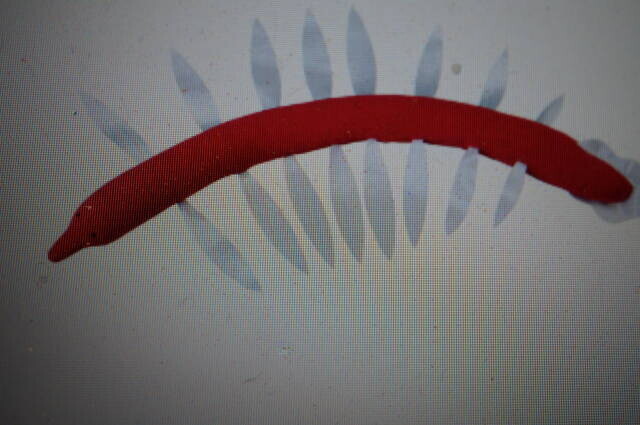
In an entry published in May 2026, Mr. Okada found that the doubled 0.15mm shaft stopped before passing the sphincter. The softness intended to prevent it from moving a chip also kept it from reaching the required position. A revised shaft included 0.3mm wire, but he believed this increased the possibility of pushing the chip farther inward.
He abandoned retrieval-tool development. Mr. Okada concluded that offering this incomplete device to someone expecting medical help would be wrong.
(Source: ok-lab's diary, published May 2026)
https://ok-lab.hatenablog.com/entry/2026/05/02/122917
A thinner shaft led to an unverified claim about ultra-fine wire lubrication
In an entry published in May 2026, the looped instrument's shaft became a 1mm tube containing 0.2mm wire. Mr. Okada considered this construction less resistant to passage than the earlier shaft. For the 1mm wire-core tube, he concluded that lubricant was unnecessary.
That was his assessment of this particular construction. The diary does not record independent testing of the lubrication claim.
(Source: ok-lab's diary, published May 2026)
https://ok-lab.hatenablog.com/entry/2026/05/23/122904
A straight-strand design used 0.04mm ultra-fine wire to simplify production
In an entry published in May 2026, Mr. Okada sought a simpler instrument with straight strands instead of loops. He found 0.03mm too floppy to attach straight, while 0.05mm felt too stimulating. He introduced 0.04mm wire because he could handle it as straight strands.
The resulting design included silicone rubber over the cut ends. Mr. Okada explained that these covers addressed his concern about the tiny, uneven wire tips contacting the lining.
(Source: ok-lab's diary, published May 2026)
https://ok-lab.hatenablog.com/entry/2026/05/30/122914
Ultra-fine wire custom orders paused because production skills proved difficult to retain
In an entry published in August 2026, Mr. Okada suspended new custom requests for the looped and straight-strand micro-wire instruments. These designs used 0.03mm and 0.04mm wire. After several weeks without making them, he found that recreating the intricate work caused repeated failures.
He intended to complete existing orders and considered making batches for stock as a possible route back to sales. No matching product can be confirmed on the current list. Mr. Okada described the custom-order suspension as temporary, without announcing a restart date.
(Source: ok-lab's diary, published August 2026)
https://ok-lab.hatenablog.com/entry/2026/08/08/122906
If you see blood in your urine, even a small amount or for the first time, do not wait and see. See a urologist right away. If you suddenly cannot urinate, or the device cannot be removed, do not try to fix it yourself. Go to a medical facility, including emergency care, immediately.
How 0.03mm vs 0.05mm wire changed over time
| Published | What the diary said then |
|---|---|
| Apr 2026 | Retrieval testing paused after bleeding. |
| Apr 2026 | 0.03mm wire was rejected for the net because it would not stay straight. |
| May 2026 | Retrieval development ended when a reinforced shaft risked moving the chip farther inward. |
| May 2026 | 0.03mm loops became possible, but customer production was not yet feasible. |
| May 2026 | The looped instrument was priced at ¥11,000 (about $70 at ¥156 = $1, rate as of 2026-09-04) excluding tax. |
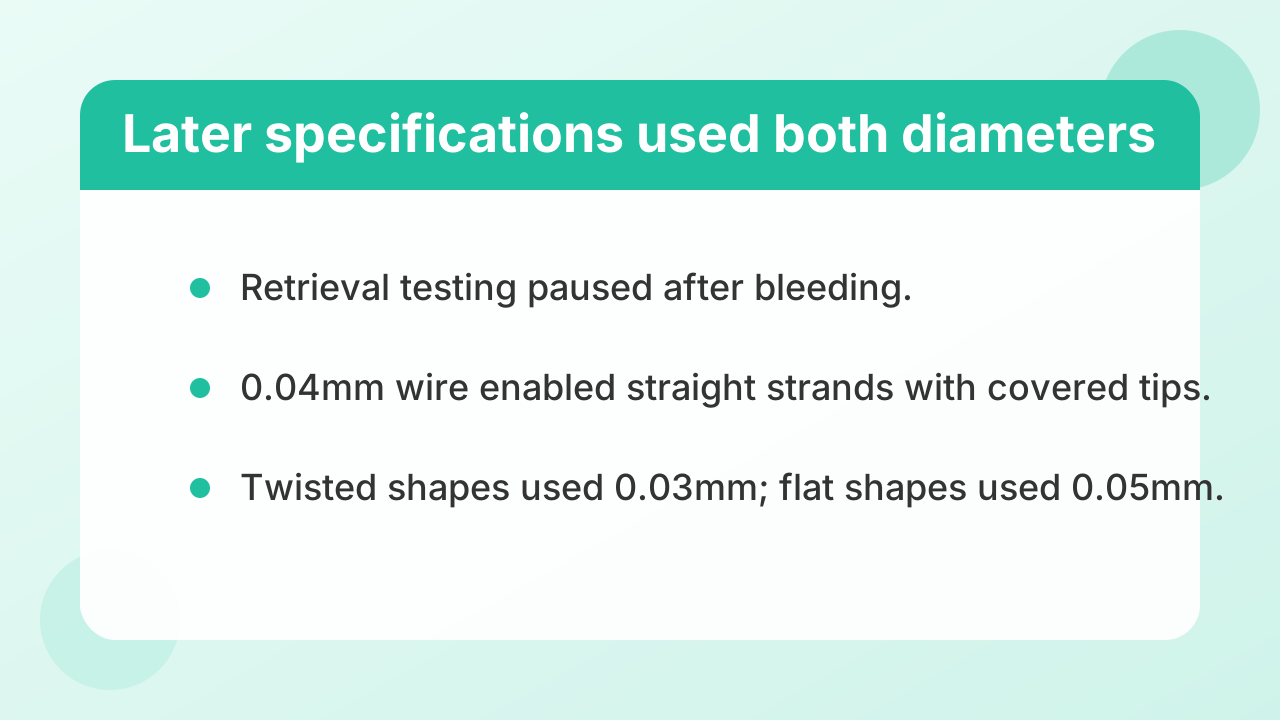
| May 2026 | 0.04mm wire enabled straight strands with covered tips. |
| Jun 2026 | Spiral sections were priced at ¥1,500 (about $10 at ¥156 = $1, rate as of 2026-09-04) excluding tax per 20mm pair. |
| Aug 2026 | Custom orders for both micro-wire designs were temporarily suspended. |
| Aug 2026 | Ceramic-chip specifications assigned 0.03mm wire to twisted shapes and 0.05mm to flat shapes. |
OK Prostate Chip products related to 0.03mm vs 0.05mm wire
No current product is directly tied to this topic.
Common worries about 0.03mm vs 0.05mm wire
The reader messages concern medical care, a shorter shaft, and whether a spiral design could be made.
"Was ultra-fine wire retrieval still needed before a hospital visit?"
In an entry published in April 2026, a customer outside Japan asked whether development should stop if it served only their case. They planned to return to Japan in early May and see a doctor about a chip they could not remove. Mr. Okada replied that development reflected his own interest and that the customer need not worry about its cost.
In an entry published in May 2026, he reported that the customer's doctor had located the chip inside the bladder. The diary does not record whether the chip was removed. Mr. Okada concluded that his proposed retrieval tool would not have helped in that location.
(Source: ok-lab's diary, published April 2026)
https://ok-lab.hatenablog.com/entry/2026/04/18/122906
(Source: ok-lab's diary, published May 2026)
https://ok-lab.hatenablog.com/entry/2026/05/09/122904
"Could ultra-fine wire come on a shorter shaft?"
In an entry published in May 2026, a customer requested a looped micro-wire instrument with a 19.5cm shaft. The requested dimensions were an 8cm loop section and 11.5cm of remaining shaft. Mr. Okada quoted ¥3,300 (about $21 at ¥156 = $1, rate as of 2026-09-04) for the shaft and ¥8,800 (about $56 at ¥156 = $1, rate as of 2026-09-04) for the loop structure.
The request specified loops about 20mm per side and roughly 8 pairs. The diary does not record whether the order was completed. Mr. Okada acknowledged it as the first customer request for this new looped model.
(Source: ok-lab's diary, published May 2026)
https://ok-lab.hatenablog.com/entry/2026/05/30/122914
"Could ultra-fine wire realize the reader's spiral-design suggestion?"
In an entry published in June 2026, Mr. Okada recalled a reader's earlier suggestion for a design resembling intertwined spirals. He no longer remembered which product that suggestion concerned. He had initially believed that OK Lab lacked the skills to make the design.
Later, his work with very soft wire made that shape possible. He credited the flexible material with allowing flowing, irregular curves. Mr. Okada presented the design while acknowledging that he had not established how its sensations compared with the earlier instruments.
(Source: ok-lab's diary, published June 2026)
https://ok-lab.hatenablog.com/entry/2026/06/27/122906
Buying from outside Japan

OK Lab ships internationally to countries covered by Japan Post's EMS courier service. Overseas orders are paid in advance by PayPal. Each order carries a ¥400 (about $3 at ¥156 = $1, rate as of 2026-09-04) handling fee, and EMS shipping is charged on top. These terms come from OK Lab's official sales-terms page (written here as plain text, not a link: ok-lab.net/docs/law), checked on September 7, 2026; confirm them on the official store before you order, because they can change.
Summary of this article
| What you wanted to know | The answer |
|---|---|
| What is the main worry? | Softer wire did not eliminate development problems or establish safety. |
| What is the base product? | A urethral device made by OK Lab in Japan, with prices in Japanese yen. |
| What do the key terms describe? | The urinary passage, experimental retrieval structures, supporting shafts, and wire behavior. |
| What happened in testing? | The diary records bleeding, wire breakage, strong sensations, and manufacturing difficulties. |
| What did the maker change? | He stopped retrieval development, revised other designs, and suspended micro-wire custom orders. |
| How did the subject develop? | April retrieval experiments led to May instruments, June spirals, and August ceramic-wire specifications. |
| Is a matching current product listed? | No current product is directly tied to this topic. |
| What did readers ask for? | Clarification about retrieval development, a shorter instrument, and a spiral design. |
| How are overseas purchases handled? | Advance PayPal payment, EMS shipping, and a ¥400 (about $3 at ¥156 = $1, rate as of 2026-09-04) handling fee, under the stated sales terms. |
Source: ok-lab's diary (Okada Comfortable Life Laboratory). The original entries are in Japanese; quotations on this page are translated. Photos and videos are on the original entries.
This article is a summary of the maker's development diary. The product is not a medical device and no result is guaranteed. If anything feels wrong or worries you, see a doctor. Prices, specifications and cautions change, so confirm the latest information on the official blog and the official site. Questions about ordering and shipping go to the seller.