![Is thinner prostate chip wire gentler? | The maker usually found it gentler [OK Prostate Chip]](/img/a/T0850/eyecatch.svg)
This page is based on entries from "ok-lab's diary" (https://ok-lab.hatenablog.com/), the Japanese development diary written by Mr. Okada, founder of OK Lab, a small company in Japan, formally named Okada Comfortable Life Laboratory. Only the entries about "thinner wire and gentler stimulation" are summarized here, in order of publication. Past prices and sizes are as written at the time. Current prices come from the official product list (retrieved September 4, 2026). Quotations are translated from Japanese.
This article is about thinner wire in the OK Prostate Chip, and summarizes the maker's tests and development. Customer questions, cautions, related products, and buying from outside Japan are also covered.
Note: This page is a personal reading log by someone with no connection to the maker or the seller. It reflects the source entries as of their publication dates and makes no guarantee of accuracy or safety. The product is not a medical device; talk to a doctor about any health decision. Check the official site for current information. This page contains advertising.
In short
- Mr. Okada generally found thinner wire gentler, but position and coverings also affected discomfort.
- His responses included thinner strands, covered loops, and cautions about stronger wire during prolonged wear.
- The September 2026 list prices the short stainless ring chip at ¥3,300 (about $21 at ¥156 = $1, rate as of 2026-09-04) including tax.
If you see blood in your urine, even a small amount or for the first time, do not wait and see. See a urologist right away.
If you suddenly cannot urinate, or the device cannot be removed, do not try to fix it yourself. Go to a medical facility, including emergency care, immediately.
About this product
The OK Prostate Chip is a small device that is placed in the urethra (the urine passage) so that it acts on the prostate; the maker sells it in several shapes, sizes and materials. It is made and sold by OK Lab (Okada Comfortable Life Laboratory), a small company in Japan, through its own online store, and prices are in Japanese yen (JPY). The maker's development diary, "ok-lab's diary", is written in Japanese. This page is an English summary of it, and every quotation is translated. OK Lab ships internationally, so readers outside Japan can order (see "Buying from outside Japan" below). Product names on this page are plain-English descriptions. The official Japanese product name is shown once in the product table so you can find the same item in the store.
Before you read: key terms
| Term | Plain-English meaning |
|---|---|
| Urethra | The urine passage, where the device is placed to act on the prostate. |
| Nitinol | Shape-memory metal wire, used for connections, extensions, and loops. |
| Shape memory | The wire's tendency to return to its set shape, used to support the device's structure. |
| Nylon thread | A connecting thread also added alongside wire as a backup against wire breakage. |
| Internal urethral sphincter | A sensitive muscle where a ring became trapped. Its bodily function: The diary does not explain this. |
| Petal stopper | Flexible wire loops intended to limit movement past a sphincter. |
| Jointed structure | Resin-covered sections separated by flexible gaps, intended to combine bending with support. |
| Helix | A spiral wire shape intended to change contact with the urethral lining. |
What happens: prostate chip wire irritation
The OK Prostate Chip is a small device placed in the urethra to act on the prostate. These entries examine wire used to connect chips, form flexible extensions, or make loops intended to help hold devices in position. Some loops are intended for the bladder, while others act as stoppers near a sphincter. Mr. Okada compares wire thickness, flexibility, coverings, and discomfort in his own tests.
Stainless wire irritation remained when one ring shifted position
In an entry published in January 2021, Mr. Okada favored 0.5 mm stainless wire connecting chips for prolonged wear. He considered 0.7 mm too resistant to bending and insufficiently gentle on the urethra.
His bladder-directed ring prototype still shifted during urination. He reported harsh discomfort when a ring became trapped at the internal urethral sphincter (a muscle whose function the diary does not explain). His preference was the thinner connector, although that did not resolve the ring-position problem.
(Source: ok-lab's diary, published January 2021)
https://ok-lab.hatenablog.com/entry/2021/01/23/130107
A coating reduced wire irritation in the maker's full-day test
In an entry published in February 2021, Mr. Okada described a rubber-coated 0.5 mm wire prototype as comfortable throughout a full day. He thought it felt gentler than bare wire directly contacting the urethra. The coated assembly measured about 2 mm across.
He attributed the improvement to limited friction and less concentrated contact from the thin metal. Mr. Okada cautioned that coating durability remained unknown and extreme bending might damage it.
(Source: ok-lab's diary, published February 2021)
https://ok-lab.hatenablog.com/entry/2021/02/13/121440
Thinner wire extensions felt flexible without restricting the maker's movement
In an entry published in April 2025, Mr. Okada described 0.2 mm nitinol (shape-memory wire) as almost threadlike. It was thinner than the 0.24 mm nylon thread, and he reported no effect on penile movement. The prototype combined wire and nylon thread (a connecting thread) inside a tube.
The nylon was intended to preserve the connecting function if the metal broke. For the earlier 0.3 mm extension, Mr. Okada recommended a length of 3–6 cm because longer versions resisted movement too strongly.
(Source: ok-lab's diary, published April 2025)
https://ok-lab.hatenablog.com/entry/2025/04/12/122910
Thinner wire petal stoppers felt gentler in the maker's test
In an entry published in April 2025, Mr. Okada tested a petal stopper (wire loops intended to limit movement past a sphincter). He reported no strong stimulation after about 5 days with 0.2 mm wire.
However, he said opposing stoppers could press too strongly when their connecting extension was too long. He also acknowledged that forced movement could overturn the petals and defeat the stopper. After finding 0.3 mm petals too stimulating for prolonged wear, Mr. Okada selected 0.2 mm.
(Source: ok-lab's diary, published April 2025)
https://ok-lab.hatenablog.com/entry/2025/04/26/122909
Gentler wire bladder loops reached a temporary sales hold
In an entry published in August 2025, Mr. Okada described a 0.2 mm wire bladder-loop prototype attached beyond a screw-shaped chip. The loop was intended to improve retention, and he described its bladder contact as gentle.
Sales were temporarily on hold while he planned to consult a patent attorney about intellectual property rights. The diary does not say what the current state is. Mr. Okada withheld specifications and prices pending that discussion.
(Source: ok-lab's diary, published August 2025)
https://ok-lab.hatenablog.com/entry/2025/08/16/122934
Gentler wire was preferred for the small wing attachment
In an entry published in September 2025, Mr. Okada introduced a wing attachment intended to help retain a chip near the bladder. The available wire choices then were 0.1 mm and 0.15 mm.
The published attachment price was ¥3,000 (about $19 at ¥156 = $1, rate as of 2026-09-04) excluding tax for sizes up to 40 mm. Mr. Okada recommended 0.1 mm for the gentler feeling he associated with this design.
(Source: ok-lab's diary, published September 2025)
https://ok-lab.hatenablog.com/entry/2025/09/27/123018
Thinner wire felt gentler in an unfinished jointed prototype
In an entry published in November 2025, Mr. Okada introduced a jointed structure (resin-covered sections separated by flexible gaps). It combined nitinol with nylon thread, aiming to provide support without enclosing everything in a continuous tube.
In brief testing, he found 0.1 mm much gentler on the urethra. With 0.15 mm, he reported strong stimulation when 2 loops occupied the prostate region. Mr. Okada said the jointed design still needed further investigation.
(Source: ok-lab's diary, published November 2025)
https://ok-lab.hatenablog.com/entry/2025/11/22/122910
Fine wire irritation concerns led to covered tips and another diameter
In an entry published in May 2026, Mr. Okada selected 0.04 mm wire for a fine-wire legged device. He found 0.05 mm slightly too stimulating, while the finer material could still be manufactured as straight legs.
Each leg measured about 20 mm on either side of the central support. Its published price was ¥7,000 (about $45 at ¥156 = $1, rate as of 2026-09-04) excluding tax, including the support and legged section. Because he remained concerned about cut ends contacting the lining, Mr. Okada specified silicone rubber on every tip.
(Source: ok-lab's diary, published May 2026)
https://ok-lab.hatenablog.com/entry/2026/05/30/122914
Gentler wire claims for the helix lacked a completed comparison
In an entry published in June 2026, Mr. Okada introduced a helix (spiral wire structure). He selected 0.04 mm and 0.05 mm wire because he thought the spiral shape softened contact.
However, he had not established how its sensation compared with the earlier fine-wire designs. He reported heart-failure symptoms after about 2 hours, leaving him unable to conduct comparative wear tests. His softer-contact claim remained an impression from limited testing.
(Source: ok-lab's diary, published June 2026)
https://ok-lab.hatenablog.com/entry/2026/06/27/122906
The maker's answer to prostate chip wire irritation
Mr. Okada changed coverings, strand combinations, and thickness according to the particular design.
Covered loops addressed wire irritation that thinner bare metal still caused
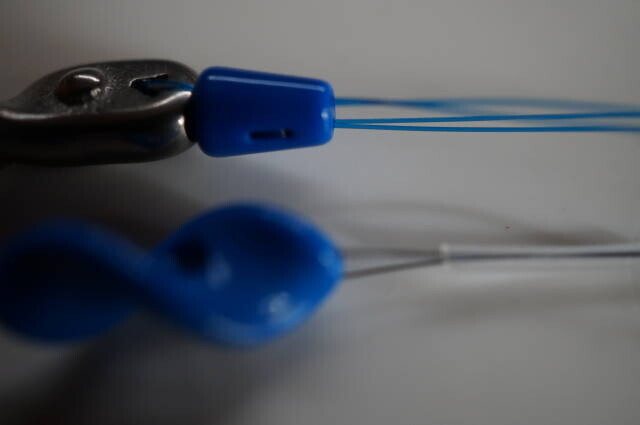
In another passage published in August 2025, Mr. Okada said bare 0.2 mm wire felt acceptable along a straight section. A bare loop, however, produced stimulation close to pain at the sphincter. He had abandoned earlier bare 0.3 mm experiments because stimulation was too strong.
This distinction concerned the wire's shape and contact point, even though its diameter was unchanged. Mr. Okada therefore specified tube coverings for loops in general-sale products.
(Source: ok-lab's diary, published August 2025)
https://ok-lab.hatenablog.com/entry/2025/08/16/122934
Thinner wire bundles became the maker's proposed thread standard
In an entry published in August 2025, Mr. Okada revised his definition of nitinol thread to 0.15 mm or less. A bundle of 4 strands, each 0.15 mm, became his proposed standard.
He considered this substantially softer than the earlier wire while retaining useful strength. A 0.1 mm trial lacked the firmness he wanted for support. His proposal favored multiple finer strands instead of assuming the thinnest possible strand would meet every purpose.
(Source: ok-lab's diary, published August 2025)
https://ok-lab.hatenablog.com/entry/2025/08/23/122935
Prolonged wear made stronger wire irritation unacceptable in the legged design
In an entry published in October 2025, Mr. Okada compared wire thicknesses for a device made from repeated leglike loops. He described 0.1 mm as distinctly milder.
In his experience, 0.15 mm became too demanding for more than half a day or during sleep. He reserved that thicker option for stronger stimulation without extended continuous wear. For gentleness, Mr. Okada favored 0.1 mm.
(Source: ok-lab's diary, published October 2025)
https://ok-lab.hatenablog.com/entry/2025/10/18/122911
If you see blood in your urine, even a small amount or for the first time, do not wait and see. See a urologist right away.
If you suddenly cannot urinate, or the device cannot be removed, do not try to fix it yourself. Go to a medical facility, including emergency care, immediately.
How prostate chip wire irritation changed over time
| Published | What the diary said then |
|---|---|
| Jan 2021 | Stainless connector durability was unknown; Mr. Okada considered breakage from repeated bending possible. |
| Feb 2021 | Coating cost ¥500 (about $3 at ¥156 = $1, rate as of 2026-09-04) through 10cm, or ¥1,000 (about $6 at ¥156 = $1, rate as of 2026-09-04) for 11–20cm, excluding tax. |
| Mar 2025 | A double-wire version was planned at ¥8,000 (about $51 at ¥156 = $1, rate as of 2026-09-04) instead of ¥6,000, (about $38 at ¥156 = $1, rate as of 2026-09-04) both excluding tax. |
| Jun 2025 | Manufacturing limited each linked loop to 12cm. |
| Sep 2025 | Mr. Okada proposed internal nitinol connections with nylon thread continuing outside the body. |
| Nov 2025 | A continuous-wire prototype aimed to avoid sharply bent or knotted connections. |
| Feb 2026 | Mr. Okada preferred 0.3mm over 0.4mm in the twin-wire vibrating prototype. |
| May 2026 | Mr. Okada rejected thicker massage-wire versions over tissue-stress concerns, even without bleeding. |
| Jul 2026 | Thinner extension supports were proposed to reduce the burden of prolonged wear. |
OK Prostate Chip products related to prostate chip wire irritation
The short stainless ring chip appears in these entries and on the September 2026 product list.
Products that appear in these entries
| Product (official name) | Price incl. tax | Relation to this topic |
|---|---|---|
| Short stainless ring chip (OKプロステートチップ ステンレスリング ショートタイプ) | ¥3,300 (about $21 at ¥156 = $1, rate as of 2026-09-04) | In January 2021, a customer's report of this chip slipping during urination prompted discussion of wire connections. |
The short stainless ring chip is listed in OK Lab's own online store.
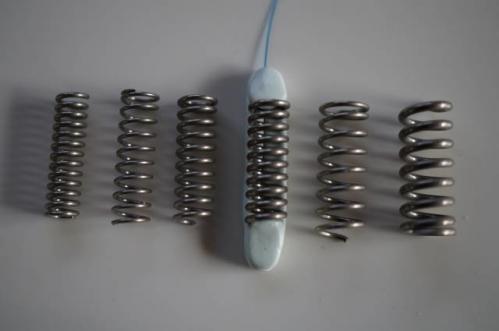
(Source: ok-lab's diary, published January 2021)
https://ok-lab.hatenablog.com/entry/2021/01/23/130107
Products the diary mentioned as alternatives
The diary names no alternative.
Custom wire builds and prototypes discussed above: No matching product can be confirmed on the current list.
Common worries about prostate chip wire irritation
Customer questions exposed limits in stronger-wire tests and requests for new configurations.
"Can a thicker prostate chip wire be supplied?"
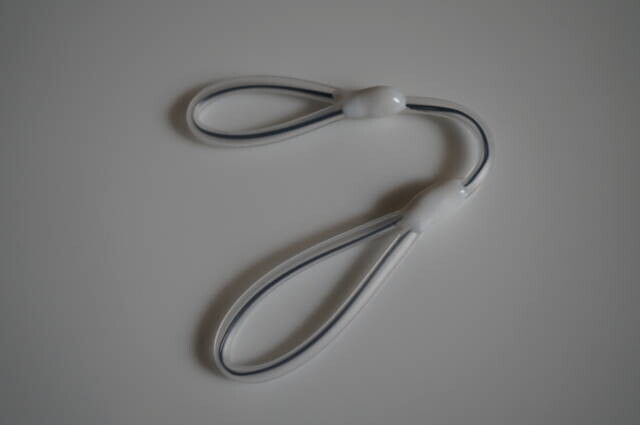
In an entry published in February 2021, a customer asked whether a long wire extension could use 0.6 mm. Mr. Okada had none in stock, so he tested 0.7 mm instead.
After about 4 hours, sudden prostate pain ended that test. The diary does not record whether the customer received a wire. He considered 0.7 mm possible for short sessions, but advised against 0.5 mm or thicker for all-day wear.
(Source: ok-lab's diary, published February 2021)
https://ok-lab.hatenablog.com/entry/2021/02/06/125245
"Can double prostate chip wire provide a stronger hold?"
In an entry published in March 2025, a customer requested two 0.4 mm wires inside one tube for a stronger hold. Staff initially postponed testing until more wire arrived, but Mr. Okada then made a prototype. He reported excessive stimulation and what he described as heart failure after about 2 hours, ending the test.
He subsequently made a 0.3 mm double-wire version, but had not yet tested it in place. The diary does not record whether the customer received the requested build. Mr. Okada favored that thinner pair for himself because he considered the thicker pair too intense.
(Source: ok-lab's diary, published March 2025)
https://ok-lab.hatenablog.com/entry/2025/03/08/123016
"Can a bare prostate chip wire pair be ordered?"
In an entry published in August 2025, a customer requested a bare-wire device with a loop-free pair of strands. Staff limited acceptance to published specifications and declined the requested pair.
Mr. Okada explained that he was reconsidering 0.2 mm wire, which might be too stiff for bare contact with the urethral lining. Mr. Okada advised waiting while the nitinol specifications were still changing.
(Source: ok-lab's diary, published August 2025)
https://ok-lab.hatenablog.com/entry/2025/08/23/122935
Buying from outside Japan
OK Lab ships internationally to countries covered by Japan Post's EMS courier service. Overseas orders are paid in advance by PayPal. Each order carries a ¥400 (about $3 at ¥156 = $1, rate as of 2026-09-04) handling fee, and EMS shipping is charged on top. These terms come from OK Lab's official sales-terms page (written here as plain text, not a link: ok-lab.net/docs/law), checked on September 7, 2026; confirm them on the official store before you order, because they can change.
Summary of this article
| What you wanted to know | The answer |
|---|---|
| Is thinner wire gentler? | Usually in Mr. Okada's comparisons, with differences between designs. |
| What is the product? | A urethral device made by OK Lab in Japan to act on the prostate. |
| What do the terms mean? | Wire and thread connect parts; loops and stoppers are intended to limit movement. |
| What discomfort appeared? | Reports included ring pressure, sudden prostate pain, and strong stimulation from thicker loops. |
| What did the maker change? | Wire thickness, coverings, strand combinations, and supporting structures. |
| What changed over time? | Development moved from stainless connectors toward finer nitinol and varied loop designs. |
| What current product appears here? | The short stainless ring chip, listed at ¥3,300 (about $21 at ¥156 = $1, rate as of 2026-09-04) including tax. |
| What did customers' questions reveal? | Stronger builds could be intolerable; some requested configurations were refused. |
| How do overseas orders work? | Advance PayPal payment, a ¥400 (about $3 at ¥156 = $1, rate as of 2026-09-04) handling fee, and additional EMS shipping. |
| What is the overall answer? | The maker's preferred wire depended on the design, contact point, and intended duration. |
Source: ok-lab's diary (Okada Comfortable Life Laboratory). The original entries are in Japanese; quotations on this page are translated. Photos and videos are on the original entries.
This article is a summary of the maker's development diary. The product is not a medical device and no result is guaranteed. If anything feels wrong or worries you, see a doctor. Prices, specifications and cautions change, so confirm the latest information on the official blog and the official site. Questions about ordering and shipping go to the seller.