![Nitinol vs nylon thread: which is better? | The maker found reasons to combine them [OK Prostate Chip]](/img/a/T0849/eyecatch.svg)
This page is based on entries from "ok-lab's diary" (https://ok-lab.hatenablog.com/), the Japanese development diary written by Mr. Okada, founder of OK Lab, a small company in Japan (Okada Comfortable Life Laboratory). Only the entries about "nitinol vs nylon thread" are summarized here, in order of publication. Past prices and sizes are as written at the time. Current prices come from the official product list (retrieved September 4, 2026). Quotations are translated from Japanese.
Note: This page is a personal reading log by someone with no connection to the maker or the seller. It reflects the source entries as of their publication dates and makes no guarantee of accuracy or safety. The product is not a medical device; talk to a doctor about any health decision. Check the official site for current information. This page contains advertising.
In short
Mr. Okada describes nitinol (metal that returns toward its earlier shape) as springier than nylon, with no breakage guarantee.
He later favored nitinol inside the body and nylon near the penis tip or outside.
The current list does not confirm the diary’s custom nitinol thread configurations.
About this product

The OK Prostate Chip is a small device that is placed in the urethra (the urine passage) so that it acts on the prostate; the maker sells it in several shapes, sizes and materials. It is made and sold by OK Lab (Okada Comfortable Life Laboratory), a small company in Japan, through its own online store, and prices are in Japanese yen (JPY). The maker's development diary, "ok-lab's diary", is written in Japanese. This page is an English summary of it, and every quotation is translated. OK Lab ships internationally, so readers outside Japan can order (see "Buying from outside Japan" below). Product names on this page are plain-English descriptions. The official Japanese product name is shown once in the product table so you can find the same item in the store.
Before you read: key terms
| Term | Plain-English meaning |
|---|---|
| Urethra | The urine passage, where the chip and its internal connecting threads sit. |
| Nylon thread | Nylon filament used to connect chip parts and provide a retrieval thread. |
| Nitinol thread | Fine wire made from a nickel–titanium alloy, used as a connecting thread. |
| Tube-covered extension | A flexible extension containing wire and nylon, intended to keep the thread system from tangling. |
| Silicone coating | A rubber covering intended to reduce direct contact between metal and the body. |
| Screw attachment | A screw-shaped auxiliary chip used to help position connected parts. |
| Stopper | An accessory intended to help keep the chip or thread in position. |
| Kgf | The unit used for stated breaking forces. The diary does not explain this. |
| Jointed assembly | Connected resin-covered sections containing threads, developed to help position a chip. |
What happens: nitinol vs nylon thread
The OK Prostate Chip is a device placed in the urethra (urine passage) to act on the prostate. Nylon and nitinol threads connect the main chip to smaller attachments and can continue toward the outside of the body. These entries compare how the threads bend, retain their shape, and behave as parts of those assemblies. They also form part of the retrieval system.
Thinner nitinol wire led to a flexible extension containing both materials
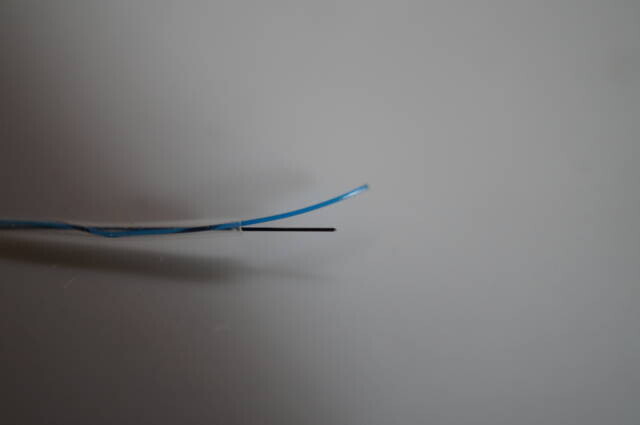
In an entry published in April 2025, Mr. Okada found 0.2mm wire almost as flexible as thread, and thinner than 0.24mm nylon. His prototype retained its straight shape after being released from a bend. He put both materials inside a tube-covered extension, intending nylon to preserve its function if the wire broke.
The published prices, tax excluded, were ¥3,000 (about $19 at ¥156 = $1, rate as of 2026-09-04) for the 2.5mm tube version and ¥4,000 (about $26 at ¥156 = $1, rate as of 2026-09-04) for the 1mm version, each up to 10cm. The wider version was also offered up to 30cm, with a further ¥1,000 (about $6 at ¥156 = $1, rate as of 2026-09-04) charge. Mr. Okada proposes the combined core as reassurance for people concerned about thin wire breaking.
(Source: ok-lab's diary, published April 2025)
https://ok-lab.hatenablog.com/entry/2025/04/12/122910
Nitinol thread launched after a short test, with compatibility limits
In an entry published in August 2025, Mr. Okada reports secure connections through the chip’s thread holes. He also reports no problems during his own 3-day test with the device continuously in place. He then announced nylon and nitinol connection options for blue resin, stainless-steel, and ceramic chips.
The published change from nylon to nitinol cost ¥2,000 (about $13 at ¥156 = $1, rate as of 2026-09-04) tax excluded, with a maximum thread length of 35cm. He describes about 2mm of raised thread at a connection, compared with about 1mm for nylon. Mr. Okada excludes the blue safety attachment because its required bend would put excessive strain on the nitinol.
(Source: ok-lab's diary, published August 2025)
https://ok-lab.hatenablog.com/entry/2025/08/09/122924
Mr. Okada found nitinol thread recovered its shape more readily than nylon
In another part of the entry published in August 2025, Mr. Okada compares 0.2mm nitinol with 0.24mm nylon. He describes nitinol as springier and able to recover its shape unless bent beyond its limit. He says nylon has less stiffness and does not fully recover after bending.
His standard at that point used two nitinol strands, with the remaining strand intended as backup if one broke. Mr. Okada’s safety principle assumes that either material can break.
(Source: ok-lab's diary, published August 2025)
https://ok-lab.hatenablog.com/entry/2025/08/09/122924
Mr. Okada proposed finer nitinol thread to balance flexibility and stiffness
In a later entry published in August 2025, Mr. Okada describes nylon folding inside the urethra, becoming slack, and disappearing from view. He also says loose nylon can advance ahead of the chip and become tangled. His proposed standard used 4 strands of 0.15mm nitinol, with a stated breaking force of 9Kgf.
He compares that with 8Kgf for 2 strands of 0.2mm wire. His 0.1mm prototype lacked the stiffness needed for a pushing effect, while an 8-strand version would be substantially more expensive. Mr. Okada therefore proposes the intermediate thickness as his standard.
(Source: ok-lab's diary, published August 2025)
https://ok-lab.hatenablog.com/entry/2025/08/23/122935
Mr. Okada describes different weaknesses in nylon thread and nitinol
In an entry published in August 2025, Mr. Okada describes separate nylon and 0.1mm nitinol threads attached to a semi-long ceramic chip. He says nylon is vulnerable to heat and blades, while nitinol is vulnerable to strong compression. At this thickness, he found the materials similarly soft to the touch.
The published ceramic connection charge was ¥1,000 (about $6 at ¥156 = $1, rate as of 2026-09-04) tax excluded, plus ¥500 (about $3 at ¥156 = $1, rate as of 2026-09-04) tax excluded per nitinol strand up to 35cm. Mr. Okada’s stated precaution is protective treatment of the nitinol ends.
(Source: ok-lab's diary, published August 2025)
https://ok-lab.hatenablog.com/entry/2025/08/30/122943
Coated nitinol thread followed concerns about nickel exposure from cut ends
In an entry published in September 2025, Mr. Okada reports a supplier’s warning that cut wire ends could release nickel. He announced a policy against offering nitinol products involving direct metal contact with skin. His thin silicone coating (a rubber covering) kept coated wire at 0.3mm or less, while he found its flexibility largely unchanged.
He also reports less accessory slippage than with nylon, because the coating increased friction. Thin coating carried no extra charge; thicker coating cost ¥500 (about $3 at ¥156 = $1, rate as of 2026-09-04) tax excluded per 5cm. Mr. Okada suggests thicker coating for sensitive contact areas, while noting that thick sections cannot pass through accessory holes.
(Source: ok-lab's diary, published September 2025)
https://ok-lab.hatenablog.com/entry/2025/09/06/122911
Mr. Okada’s jointed nitinol thread prototypes could still slip out
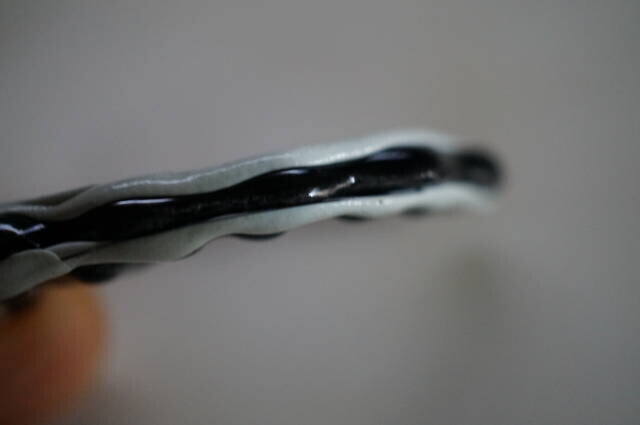
In an entry published in November 2025, Mr. Okada describes a jointed assembly (connected, resin-covered sections) containing both materials. It used two 0.15mm nitinol strands and two nylon strands in a structure about 4mm across. He regarded the mixed core as useful because the materials had different weaknesses.
However, he reports poor ability to stay in place without additional friction from other parts. Mr. Okada presents the assembly as an option for people who find earlier designs difficult to position.
(Source: ok-lab's diary, published November 2025)
https://ok-lab.hatenablog.com/entry/2025/11/29/122908
The maker's answer to nitinol vs nylon thread
Mr. Okada’s proposals depend on breakage concerns, the thread’s position, and whether metal is covered.
Mr. Okada advises delaying nitinol thread when breakage concerns remain
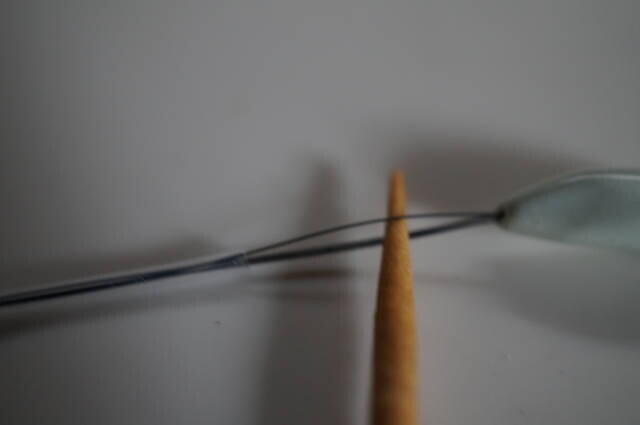
In an entry published in August 2025, Mr. Okada says durability depends partly on the conditions of use. He does not guarantee that either nylon or nitinol will never break. He also acknowledges that both strands could break together.
For people worried about this, he offers two responses. Mr. Okada advises waiting before adopting nitinol, or considering the more expensive tube-covered extension containing both nylon and nitinol.
(Source: ok-lab's diary, published August 2025)
https://ok-lab.hatenablog.com/entry/2025/08/09/122924
Nitinol thread inside and nylon outside became the maker’s preferred combination
In an entry published in September 2025, Mr. Okada favors nitinol internally and nylon outside the body or near the penis tip. He finds nylon’s willingness to stay bent useful outside, while nitinol helps preserve spacing between connected chips.
The published additions were tax excluded and depended on nitinol length and strand count. Up to 10cm, 2 strands cost ¥1,500 (about $10 at ¥156 = $1, rate as of 2026-09-04) extra and 4 cost ¥2,000 (about $13 at ¥156 = $1, rate as of 2026-09-04) extra. Up to 20cm, these were ¥2,000 (about $13 at ¥156 = $1, rate as of 2026-09-04) and ¥2,500 (about $16 at ¥156 = $1, rate as of 2026-09-04); up to 30cm, ¥2,500 (about $16 at ¥156 = $1, rate as of 2026-09-04) and ¥3,000 (about $19 at ¥156 = $1, rate as of 2026-09-04), respectively. Mr. Okada recommends combining the materials according to their position.
(Source: ok-lab's diary, published September 2025)
https://ok-lab.hatenablog.com/entry/2025/09/13/122925
Nitinol thread with multiple screw attachments received a different covering policy
In an entry published in November 2025, Mr. Okada permits uncovered nitinol in a design with multiple screw attachments. He believes those attachments reduce contact between wire and the urethral lining. This later allowance concerns that particular arrangement.
He describes two strands as softer to handle and four as preferable when breakage is a concern. Mr. Okada still recommends tube covers for anyone concerned about metal allergy.
(Source: ok-lab's diary, published November 2025)
https://ok-lab.hatenablog.com/entry/2025/11/01/122937
How nitinol vs nylon thread changed over time
| Published | What the diary said then |
|---|---|
| Apr 2025 | Fine wire and nylon were combined inside a flexible extension. |
| Aug 2025 | Nitinol connections launched, with an extra charge and accessory limits. |
| Aug 2025 | A finer, four-strand standard was proposed. |
| Aug 2025 | Separate nylon and nitinol connections appeared on ceramic chips. |
| Sep 2025 | Nickel concerns prompted coating and a policy against direct metal contact. |
| Sep 2025 | The maker favored different materials inside and outside the body. |
| Oct 2025 | A customer’s integrated nylon loop showed unexpected shape recovery. |
| Nov 2025 | Uncovered nitinol became an option in assemblies with multiple screw attachments. |
| Nov 2025 | Jointed mixed-material assemblies still had problems staying in place. |
| Mar 2026 | A factory improvement accommodated four nylon threads through a screw attachment. |
OK Prostate Chip products related to nitinol vs nylon thread
The current list includes a ceramic base chip and an accessory mentioned in the experiments; custom thread specifications remain unconfirmed.
Products that appear in these entries
| Product (official name) | Price incl. tax | Relation to this topic |
|---|---|---|
| Six-hole safety chip (六穴方式オプションチップ(セーフティチップ)) | ¥1,100 (about $7 at ¥156 = $1, rate as of 2026-09-04) | In August 2025, this accessory helped secure an external loop on a ceramic-chip prototype. |
| Semi-long ceramic chip (OKプロステートチップ 陶器素材セミロングタイプ) | ¥4,400 (about $28 at ¥156 = $1, rate as of 2026-09-04) | In August 2025, a semi-long ceramic chip was the base for a comparison using separate nylon and nitinol threads. |
(Source: ok-lab's diary, published August 2025)
https://ok-lab.hatenablog.com/entry/2025/08/09/122924
(Source: ok-lab's diary, published August 2025)
https://ok-lab.hatenablog.com/entry/2025/08/30/122943
Products the diary mentioned as alternatives
The diary names no alternative.
The entries also describe custom tube-covered extensions, joined-thread builds, integrated loops, jointed hybrid assemblies, and a four-thread stainless-steel assembly. No matching product can be confirmed on the current list.
Common worries about nitinol vs nylon thread
The recorded customer requests concern loop design and thread compatibility, rather than a direct choice between materials.
"Can a nitinol wire loop be easier to catch?"
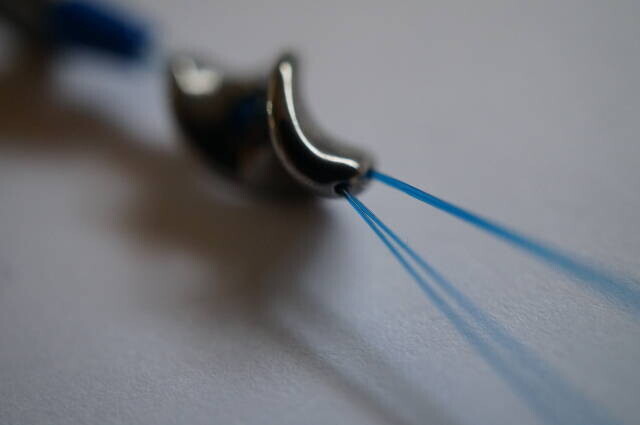
In an entry published in April 2025, a customer requested a double end loop on a custom wire extension. Mr. Okada made the requested structure and interpreted the request as a concern about dependable retrieval. He believed the doubled loop would be easier to catch than a single loop.
The diary does not record the customer’s subsequent experience. Mr. Okada offers the double-loop option for an additional ¥1,000 (about $6 at ¥156 = $1, rate as of 2026-09-04) tax excluded.
(Source: ok-lab's diary, published April 2025)
https://ok-lab.hatenablog.com/entry/2025/04/12/122910
"Can nylon thread form a loop attached to the chip?"
In an entry published in October 2025, a customer requested a nylon loop joined directly to a custom device. Mr. Okada made it and found that the whole loop largely recovered its original shape after bending. The diary does not record the customer’s experience in use.
The additions were ¥1,000 (about $6 at ¥156 = $1, rate as of 2026-09-04) up to 10cm, ¥1,500 (about $10 at ¥156 = $1, rate as of 2026-09-04) up to 20cm, and ¥3,000 (about $19 at ¥156 = $1, rate as of 2026-09-04) up to 30cm, tax excluded. Separate accessories were difficult to fit. Mr. Okada recommends an integrated stopper when one is needed.
(Source: ok-lab's diary, published October 2025)
https://ok-lab.hatenablog.com/entry/2025/10/25/122907
"Can four nylon threads pass through the screw attachment?"
In an entry published in March 2026, a customer requested four nylon threads with a stainless-steel chip and screw attachment. Mr. Okada initially expected some threads to remain outside the attachment. His completed assembly accommodated all four through it.
He explains that nylon could buckle against roughness inside the holes, while nitinol retained enough stiffness to pass. The diary does not record how the completed assembly felt in use.
(Source: ok-lab's diary, published March 2026)
https://ok-lab.hatenablog.com/entry/2026/03/28/122908
Buying from outside Japan

OK Lab ships internationally to countries covered by Japan Post's EMS courier service. Overseas orders are paid in advance by PayPal. Each order carries a ¥400 (about $3 at ¥156 = $1, rate as of 2026-09-04) handling fee, and EMS shipping is charged on top. These terms come from OK Lab's official sales-terms page (written here as plain text, not a link: ok-lab.net/docs/law), checked on September 7, 2026; confirm them on the official store before you order, because they can change.
Summary of this article
| What you wanted to know | The answer |
|---|---|
| What is the short answer? | Mr. Okada favors different thread properties for different parts of the assembly. |
| What is the product? | A urethral device made and sold by OK Lab in Japan. |
| What do the terms mean? | Nylon is the original connecting thread; nitinol is the metal alternative. |
| How do the materials compare? | The maker describes differences in shape recovery, slack, damage, coating, and staying in place. |
| What does the maker propose? | Waiting, covered mixed cores, or different materials inside and outside. |
| What changed over time? | Trials led to finer wire, coating, combined threads, and revised loop designs. |
| What is listed currently? | The listed ceramic chip and safety accessory do not establish availability of custom thread configurations. |
| What did customers ask for? | Different loop structures and four-thread compatibility with a screw attachment. |
| How can overseas buyers order? | Advance PayPal payment, a ¥400 (about $3 at ¥156 = $1, rate as of 2026-09-04) handling fee, and additional EMS shipping charges. |
Source: ok-lab's diary (Okada Comfortable Life Laboratory). The original entries are in Japanese; quotations on this page are translated. Photos and videos are on the original entries.
This article is a summary of the maker's development diary. The product is not a medical device and no result is guaranteed. If anything feels wrong or worries you, see a doctor. Prices, specifications and cautions change, so confirm the latest information on the official blog and the official site. Questions about ordering and shipping go to the seller.