![Why switch to nitinol thread? | The maker sought less slack, then kept nylon outside [OK Prostate Chip]](/img/a/T0848/eyecatch.svg)
This page is based on entries from "ok-lab's diary" (https://ok-lab.hatenablog.com/), the Japanese development diary written by Mr. Okada, founder of OK Lab, a small company in Japan (Okada Comfortable Life Laboratory). Only the entries about "switching to nitinol connecting thread" are summarized here, in order of publication. Past prices and sizes are as written at the time. Current prices come from the official product list (retrieved September 4, 2026). Quotations are translated from Japanese.
Note: This page is a personal reading log by someone with no connection to the maker or the seller. It reflects the source entries as of their publication dates and makes no guarantee of accuracy or safety. The product is not a medical device; talk to a doctor about any health decision. Check the official site for current information. This page contains advertising.
In short
Mr. Okada explored nitinol thread because nylon could become slack, disappear from view, or tangle around connected chips.
His later proposal used nitinol internally and nylon near the outside, with protection for the metal thread.
The supplied current product list does not identify a nitinol thread option.
About this product

The OK Prostate Chip is a small device that is placed in the urethra (the urine passage) so that it acts on the prostate; the maker sells it in several shapes, sizes and materials. It is made and sold by OK Lab (Okada Comfortable Life Laboratory), a small company in Japan, through its own online store, and prices are in Japanese yen (JPY).
The maker's development diary, "ok-lab's diary", is written in Japanese. This page is an English summary of it, and every quotation is translated.
OK Lab ships internationally, so readers outside Japan can order (see "Buying from outside Japan" below). Product names on this page are plain-English descriptions. The official Japanese product name is shown once in the product table so you can find the same item in the store.
Before you read: key terms
| Term | Plain-English meaning |
|---|---|
| Urethra | The urine passage, where the device and its internal connecting thread sit. |
| Nitinol thread | Fine nickel-titanium alloy wire used to connect chips; the maker values its tendency to straighten. |
| Nylon thread | The earlier connecting material, later retained for the section near and outside the body. |
| Silicone coating | A covering on the metal thread, introduced by the maker as a response to metal-allergy concerns. |
| Auxiliary chip | An additional chip linked to the main device; nitinol was intended to help preserve the space between them. |
| Safety part | A part used to fasten the thread's end or help retain an external loop. |
| Sphincter area | A body location where the maker added protection against thread pressure. The diary does not explain this. |
What happens: nitinol thread
The OK Prostate Chip is a device placed in the urethra (the urine passage) near the prostate. Its connecting thread links the main device with auxiliary chips (additional attached chips) and parts near or outside the body. Nitinol thread (fine nickel-titanium alloy wire) was explored as a replacement for nylon thread (the earlier connecting material). Mr. Okada wanted a connection that resisted slack and tangling while remaining flexible along the device's length.
The first nitinol thread prototype encouraged further development and testing
In an entry published in October 2024, Mr. Okada described a successful initial connection using 0.3mm nitinol wire. His interest also concerned an older silicone-covered connector whose metal core, he wrote, could eventually break. He hoped changing that core to nitinol would address this weakness.
He found that uncovered nitinol slipped when formed into a loop, whereas silicone friction helped a covered version retain its shape. Mr. Okada said he intended to continue development and testing cautiously.
(Source: ok-lab's diary, published October 2024)
https://ok-lab.hatenablog.com/entry/2024/10/12/122911
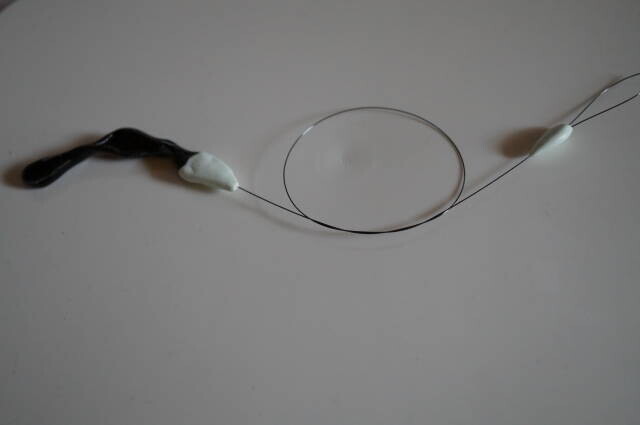
Nitinol thread became an option after the maker's short test
In an entry published in August 2025, Mr. Okada reported that the chip's thread-hole design held nitinol securely. He found no problems during his own continuous test lasting 3 days. He then announced nylon and nitinol connection choices for blue, stainless-steel, and ceramic chips.
The announced change from nylon to nitinol cost an additional ¥2,000 (about $13 at ¥156 = $1, rate as of 2026-09-04) excluding tax, with a maximum thread length of 35cm. For the loop version, that limit described the thread before it formed a loop. Mr. Okada nevertheless advised people concerned about breakage to postpone using nitinol.
(Source: ok-lab's diary, published August 2025)
https://ok-lab.hatenablog.com/entry/2025/08/09/122924
Nitinol thread addressed the maker's concerns about nylon slack
In an entry published in August 2025, Mr. Okada explained why nylon's behavior had prompted the change. He wrote that nylon could fold inside the urethra, become slack, and disappear from view. He also described thread moving ahead of the chip and becoming tangled.
He expected nitinol's tendency to straighten to reduce those problems. However, Mr. Okada favored protection for 0.15mm wire ends while he looked for better designs.
(Source: ok-lab's diary, published August 2025)
https://ok-lab.hatenablog.com/entry/2025/08/23/122935
Nitinol thread allowed separate connections using two different materials
In an entry published in August 2025, Mr. Okada reported that wire measuring 0.15mm or less could be connected to ceramic chips like nylon. He tested separate attachment points with nylon as the main thread and 0.1mm nitinol as the auxiliary thread. The entry included a ceramic semi-long prototype using the different materials.
He expected their different responses to damage to reduce the chance of a shared failure cause. He also found that very fine nitinol could still feel sharp against skin. Mr. Okada therefore planned protective finishes for its ends.
(Source: ok-lab's diary, published August 2025)
https://ok-lab.hatenablog.com/entry/2025/08/30/122943
Nitinol thread eventually shared the connection with nylon again
In an entry published in September 2025, Mr. Okada reconsidered replacing nylon throughout the whole connection. He wrote that nitinol was insufficiently soft for unfinished ends and returned to a straight shape whenever no force restrained it. Nylon, he found, was more convenient outside the body because it could remain curved.
His revised proposal linked the main chip and internal auxiliary chips with nitinol, then joined nylon before the external section. No matching product can be confirmed on the current list. Mr. Okada favored nylon near the penis tip and for external parts.
(Source: ok-lab's diary, published September 2025)
https://ok-lab.hatenablog.com/entry/2025/09/13/122925
The maker's answer to nitinol thread
Mr. Okada's proposals addressed breakage concerns, exposed ends, tight bends, coating, and the choice of wire thickness.
Nitinol thread came with no guarantee against eventual breakage
In the entry published in August 2025, Mr. Okada said nylon and nitinol durability could not be compared simply. He considered the conditions of use important and gave no guarantee that either material would never break. Nor did he rule out both strands breaking together.
He described a higher-priced existing covered connector containing both nylon and nitinol. No matching product can be confirmed on the current list. Mr. Okada recommended that design for people uneasy about the new thread.
(Source: ok-lab's diary, published August 2025)
https://ok-lab.hatenablog.com/entry/2025/08/09/122924
Nitinol thread required covered joints and space around bends
The connection described in the entry published in August 2025 differed from the earlier nylon arrangement. Mr. Okada said the nitinol then used could not form a tight knot, so that area had a 1mm tube cover. Its bent section stood about 2mm above the chip rather than lying tightly against it.
He reported that the connection remained secure with that clearance. The blue safety part (a thread-end fastening part) was excluded from direct nitinol connections because its tight bends placed excessive stress on the wire. Mr. Okada cautioned against excessive force at these connections.
(Source: ok-lab's diary, published August 2025)
https://ok-lab.hatenablog.com/entry/2025/08/09/122924
The nitinol thread loop needed more than a tube
In an entry published in August 2025, Mr. Okada distinguished straight and loop connection designs. The straight version ended at a fixed safety part, with optional auxiliary chips along the connection. He specified spacing tubes of 1mm or 2.5mm, no longer than 20mm, between the main device and auxiliary parts.
The loop design used a 2.5mm tube, also up to 20mm, for length adjustment. Tubes were free, but orders needed specified lengths and, for the straight sections, a size choice. Mr. Okada specified a six-hole stopper or safety part to keep the loop from coming undone.
(Source: ok-lab's diary, published August 2025)
https://ok-lab.hatenablog.com/entry/2025/08/09/122924
Ceramic nitinol thread connections carried separate labor and material charges
The ceramic connection pricing published in August 2025 separated the attachment work from the thread material. Connection work cost ¥1,000 (about $6 at ¥156 = $1, rate as of 2026-09-04) excluding tax, because Mr. Okada said it required the same labor as nylon. Nitinol material added ¥500 (about $3 at ¥156 = $1, rate as of 2026-09-04) excluding tax per strand, for a strand up to 35cm. For separate connections, the entry compared an extra ¥1,000 (about $6 at ¥156 = $1, rate as of 2026-09-04) excluding tax for nylon with ¥1,500 (about $10 at ¥156 = $1, rate as of 2026-09-04) excluding tax for the mixed-thread arrangement.
(Source: ok-lab's diary, published August 2025)
https://ok-lab.hatenablog.com/entry/2025/08/30/122943
A nitinol thread order received coating and added pressure protection
In an entry published in September 2025, Mr. Okada described the first customer request for a nitinol-thread product. He believed the request referred to the previous week's example, but changed it to the newly chosen specification. That specification used silicone coating (a covering intended by the maker to address metal-allergy concerns).
He also added protection against the thread pressing into tissue near the sphincter area (a body location the diary does not explain). The diary does not record whether delivery was completed or how the finished item felt in use. Mr. Okada chose the revised specification because he expected it to be easier to handle.
(Source: ok-lab's diary, published September 2025)
https://ok-lab.hatenablog.com/entry/2025/09/06/122911
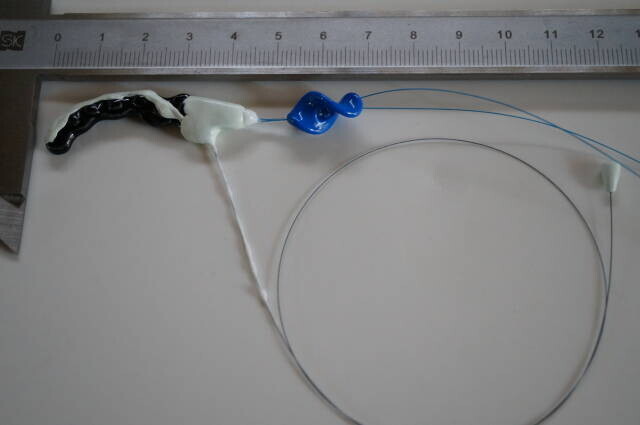
Coating limited nitinol thread to two strands in the chip holes
In the later entry published in September 2025, Mr. Okada favored 0.15mm nitinol for the internal section. Silicone-coated thread was limited to 2 strands because coating made a four-strand arrangement too thick for the chip's holes. Uncoated wire could also have 4 strands.
He reported that the coated two-strand example largely preserved spacing between chips, whereas 0.1mm thread was much less effective at maintaining that spacing. For uncoated arrangements, Mr. Okada specified tubing over most of the wire to reduce direct contact.
(Source: ok-lab's diary, published September 2025)
https://ok-lab.hatenablog.com/entry/2025/09/13/122925
Longer nitinol thread sections carried higher historical connection surcharges
In the entry published in September 2025, the mixed-material connection prices depended on nitinol length and strand count. Up to 20cm added ¥2,000 (about $13 at ¥156 = $1, rate as of 2026-09-04) for 2 strands or ¥2,500 (about $16 at ¥156 = $1, rate as of 2026-09-04) for 4. Up to 30cm added ¥2,500 (about $16 at ¥156 = $1, rate as of 2026-09-04) for 2 strands or ¥3,000 (about $19 at ¥156 = $1, rate as of 2026-09-04) for 4.
A shorter option placed nitinol only around auxiliary chips. Up to 10cm added ¥1,500 (about $10 at ¥156 = $1, rate as of 2026-09-04) for 2 strands or ¥2,000 (about $13 at ¥156 = $1, rate as of 2026-09-04) for 4. These September 2025 prices excluded tax; Mr. Okada proposed the shorter option when nitinol was wanted only around those parts.
(Source: ok-lab's diary, published September 2025)
https://ok-lab.hatenablog.com/entry/2025/09/13/122925
How nitinol thread changed over time
| Published | What the diary said then |
|---|---|
| Oct 2024 | A silicone-covered nitinol connector was explored as a replacement for an older breakable core. |
| Aug 2025 | Nylon and nitinol connection choices were announced for blue, stainless-steel, and ceramic chips. |
| Aug 2025 | The maker narrowed his definition of nitinol thread to wire measuring 0.15mm or less. |
| Aug 2025 | Ceramic prototypes gained separate nylon and nitinol connections. |
| Sep 2025 | Silicone coating and protection against localized thread pressure entered a customer-requested build. |
| Sep 2025 | The proposal changed to internal nitinol joined to nylon near the outside. |
The diary does not say what the current state is.
OK Prostate Chip products related to nitinol thread
No current product is directly tied to this topic.
Common worries about nitinol thread

(The material contains no questions from readers.)
Buying from outside Japan

OK Lab ships internationally to countries covered by Japan Post's EMS courier service. Overseas orders are paid in advance by PayPal. Each order carries a ¥400 (about $3 at ¥156 = $1, rate as of 2026-09-04) handling fee, and EMS shipping is charged on top. These terms come from OK Lab's official sales-terms page (written here as plain text, not a link: ok-lab.net/docs/law), checked on September 7, 2026; confirm them on the official store before you order, because they can change.
Summary of this article
| What you wanted to know | The answer |
|---|---|
| In short: why consider nitinol? | Mr. Okada wanted less slack and tangling, then retained nylon for the outer section. |
| About the product | A urethral device made by OK Lab in Japan and priced in JPY. |
| Key terms | Nitinol and nylon are connecting materials; coating and tubes were intended as protective features. |
| What happened? | Early enthusiasm led to connection options, ceramic prototypes, and eventually mixed-material designs. |
| What did the maker propose? | Protected connections, limits on bending, coating choices, and specified strand counts and lengths. |
| What changed over time? | The entries run from October 2024 experiments to September 2025 proposals. |
| Which current products match? | No current product is directly tied to this topic. |
| What did readers ask? | The material contains no questions from readers. |
| Can customers order internationally? | The stated terms are advance PayPal payment, a ¥400 (about $3 at ¥156 = $1, rate as of 2026-09-04) handling fee, and additional EMS shipping. |
Source: ok-lab's diary (Okada Comfortable Life Laboratory). The original entries are in Japanese; quotations on this page are translated. Photos and videos are on the original entries.
This article is a summary of the maker's development diary. The product is not a medical device and no result is guaranteed. If anything feels wrong or worries you, see a doctor. Prices, specifications and cautions change, so confirm the latest information on the official blog and the official site. Questions about ordering and shipping go to the seller.