![What is the silicone-covered thread made of? | Nylon inside silicone, with a later wire option [OK Prostate Chip]](/img/a/T0847/eyecatch.svg)
This page is based on entries from "ok-lab's diary" (https://ok-lab.hatenablog.com/), the Japanese development diary written by Mr. Okada, founder of OK Lab, a small company in Japan (Okada Comfortable Life Laboratory). Only the entries about silicone-covered thread specifications are summarized here, in order of publication. Past prices and sizes are as written at the time. Current prices come from the official product list (retrieved September 4, 2026). Quotations are translated from Japanese.
Note: This page is a personal reading log by someone with no connection to the maker or the seller. It reflects the source entries as of their publication dates and makes no guarantee of accuracy or safety. The product is not a medical device; talk to a doctor about any health decision. Check the official site for current information. This page contains advertising.
In short
- The original cord enclosed nylon in silicone; the maker still reported dust and friction drawbacks.
- Mr. Okada offered specific configurations and restricted replacements, compatibility, and lengths.
- A wire-reinforced version appeared later, but the current list does not confirm these cord options.
If you see blood in your urine, even a small amount or for the first time, do not wait and see. See a urologist right away. If you suddenly cannot urinate, or the device cannot be removed, do not try to fix it yourself. Go to a medical facility, including emergency care, immediately.
About this product

The OK Prostate Chip is a small device that is placed in the urethra (the urine passage) so that it acts on the prostate; the maker sells it in several shapes, sizes and materials. It is made and sold by OK Lab (Okada Comfortable Life Laboratory), a small company in Japan, through its own online store, and prices are in Japanese yen (JPY). The maker's development diary, "ok-lab's diary", is written in Japanese. This page is an English summary of it, and every quotation is translated. OK Lab ships internationally, so readers outside Japan can order (see "Buying from outside Japan" below). Product names on this page are plain-English descriptions. The official Japanese product name is shown once in the product table so you can find the same item in the store.
Before you read: key terms
| Term | Plain-English meaning |
|---|---|
| Urethra | The urine passage; it is where the chip and internal cord are placed. |
| Silicone-covered thread | Nylon enclosed in soft silicone tubing; it provides a connection for controlling and retrieving the chip. |
| Nylon | The inner thread material; Mr. Okada used it for pulling strength and to limit stretching. |
| Silicone tubing | The soft outer covering; it was intended to isolate the nylon from water. |
| Hydrolysis | Water-related material breakdown; Mr. Okada cited it to explain his concern about nylon aging. |
| Auxiliary screw chip | An additional screw-shaped chip behind the main chip; the diary explores its effect on contact inside the body. |
| Stopper chip | A separate part excluded from the original covered-cord offer. The diary does not explain this. |
| Shape-memory wire | Wire described as returning to a straight shape; it gives the later cord shape while allowing flexibility. |
| Double loop | A paired end-loop feature; a customer requested it to make retrieval more dependable. |
| External ring | A cord-and-loop version intended as a penis ring outside the urethra. |
What happens: silicone-covered thread
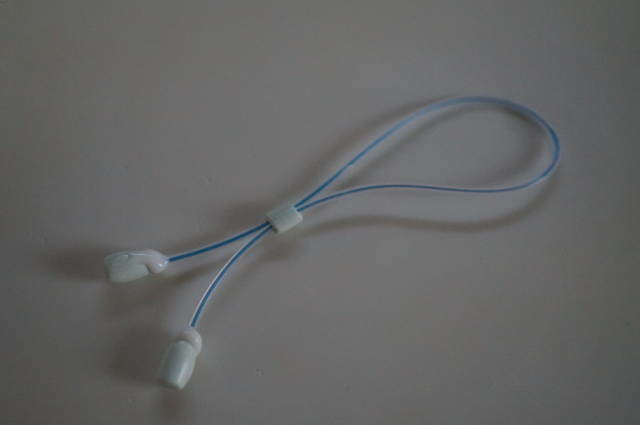
The OK Prostate Chip is a small device placed in the urethra (the urine passage) to act on the prostate. The attached silicone-covered thread provides a connection for controlling and retrieving the chip. Its original design enclosed nylon inside a soft tube, with sections intended for the urethra and optional loops outside the body. Later entries describe an external ring and a version containing wire alongside nylon.
Silicone-covered thread enclosed nylon, but the maker still reported drawbacks
In an entry published in September 2022, Mr. Okada estimated nylon thread might last a few years, or less than 1 year continuously underwater. He blamed hydrolysis (water-related breakdown), claiming that sealing nylon away from water would prevent that deterioration and improve durability. The tube measured 1mm outside and 0.5mm inside, enclosing 2 nylon strands measuring 0.25mm each.
He said the nylon remained continuous throughout, claiming its previous safety would remain unchanged even if its connection with the tube separated. He also warned that force on exposed nylon could dig into the urethral lining and cause bleeding. His cautions about the covered cord included dust sticking to it and somewhat greater friction against the urethral lining than nylon.
(Source: ok-lab's diary, published September 2022)
https://ok-lab.hatenablog.com/entry/2022/09/24/122837
Silicone-covered thread sections limited stretching and carried a separate historical price
In an entry published in September 2022, Mr. Okada described the first cord prototype as 3 sections totaling 30cm. Each 10cm section cost ¥1,000 (about $6 at ¥156 = $1, rate as of 2026-09-04) excluding tax, with the illustrated cord priced at ¥3,000 (about $19 at ¥156 = $1, rate as of 2026-09-04) excluding tax. He explained that nylon stretched about 5%, while the silicone tube stretched about 500%.
The section boundaries were intended to keep stretching within each section instead of allowing it to spread along the cord. Mr. Okada described silicone alone as too stretchy to function well as thread, despite its resistance to water, heat, and aging. He limited this prototype to 4 sections because longer cords became harder to manufacture.
(Source: ok-lab's diary, published September 2022)
https://ok-lab.hatenablog.com/entry/2022/09/24/122837
Silicone-covered thread loop had a specific length range and surcharge
In an entry published in September 2022, Mr. Okada described a loop-equipped prototype for a particular length of urethra behind the chip. Its stated range was 10cm to 20cm, and the loop used part of the existing covered cord. The loop component's installation cost ¥1,000 (about $6 at ¥156 = $1, rate as of 2026-09-04) excluding tax, bringing the published prototype price to ¥4,000 (about $26 at ¥156 = $1, rate as of 2026-09-04) excluding tax.
A ceramic-chip version had the same cord length and price; he also standardized ceramic versions on 2 internal nylon strands for strength. The diary records these as prototype specifications, alongside an announcement that regular sales were planned soon. Mr. Okada specified a different, longer arrangement for greater lengths of urethra behind the chip.
(Source: ok-lab's diary, published September 2022)
https://ok-lab.hatenablog.com/entry/2022/09/24/122837
Silicone-covered thread ring used one continuous length outside the body
In an entry published in October 2022, Mr. Okada proposed an external ring made from 20cm of covered cord with a loop component. Its published price was ¥2,000 (about $13 at ¥156 = $1, rate as of 2026-09-04) excluding tax. Because this version was intended for use outside the body, its tube ran continuously rather than having the internal cord's section boundaries.
He described the nylon core as limiting stretch while the silicone formed the surface against the skin. He also claimed the combination resisted tight knots and was easier to untie than either material alone. Mr. Okada cautioned that the loop component alone slipped and could not provide tightening.
(Source: ok-lab's diary, published October 2022)
https://ok-lab.hatenablog.com/entry/2022/10/01/122944
Wire-reinforced thread added a straightening element while retaining the nylon core
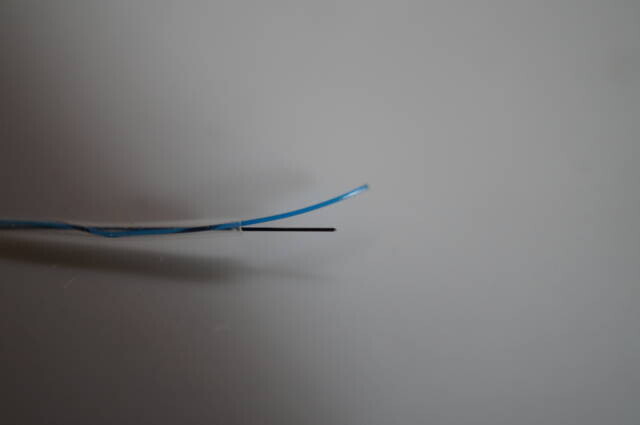
In an entry published in April 2025, Mr. Okada introduced 1mm tubing containing nylon alongside 0.2mm shape-memory wire (wire that returns toward a set shape). He described this as an evolved version of the earlier silicone-covered cord. He compared the wire's flexibility to thread and noted that it was thinner than the 0.24mm nylon discussed in that entry.
He reported that the wire returned to a straight shape after being held folded with a rubber band. His proposed benefit was a flexible extension whose shape was easier to maintain than loose thread. Mr. Okada retained nylon as a backup, saying it would preserve the earlier cord's function if the fine wire broke.
(Source: ok-lab's diary, published April 2025)
https://ok-lab.hatenablog.com/entry/2025/04/12/122910
The maker's answer to silicone-covered thread
Mr. Okada's offers came with limits on replacement work, compatible parts, and the lengths he could manufacture.
Silicone-covered thread replacements were limited to products originally supplied that way
In an entry published in September 2022, Mr. Okada declined to offer the covered cord as a thread replacement for chips customers already owned. He expected the enclosed design to reduce the need for future thread replacement. He described silicone as heat-resistant above 200 degrees, claiming it could protect nylon against accidental contact with a hot pan. His service offer was replacement to the same specification for customers who had bought the covered-cord version.
(Source: ok-lab's diary, published September 2022)
https://ok-lab.hatenablog.com/entry/2022/09/24/122837
Silicone-covered thread compatibility excluded some parts from the original offer
In an entry published in September 2022, Mr. Okada described an auxiliary screw chip (an additional screw-shaped chip behind the main chip). Adding it to the first cord prototype cost ¥3,000 (about $19 at ¥156 = $1, rate as of 2026-09-04) extra, excluding tax. At that time, the covered-cord specification did not support stopper chips or blue auxiliary screw chips; the auxiliary option used white resin only.
He said a blue main chip followed by a blue auxiliary screw chip and covered cord was technically possible. However, that arrangement left nylon exposed near the front. Mr. Okada cautioned that the exposed section would leave durability at the level of the conventional nylon specification.
(Source: ok-lab's diary, published September 2022)
https://ok-lab.hatenablog.com/entry/2022/09/24/122837
Wire-reinforced thread pricing left the exact maximum length unclear
In an entry published in April 2025, the 1mm wire-and-nylon version cost ¥4,000 (about $26 at ¥156 = $1, rate as of 2026-09-04) excluding tax for lengths up to 10cm. A double loop (paired end loops) added ¥1,000 (about $6 at ¥156 = $1, rate as of 2026-09-04) excluding tax, and the longer-length option added a separate ¥1,000 (about $6 at ¥156 = $1, rate as of 2026-09-04) excluding tax. The length supplement was described as covering over 10cm through 20cm.
However, the same entry also said the 1mm version could not be made at 20cm or longer. These two statements leave the exact 20cm boundary unclear. Mr. Okada attributed the manufacturing limit to the difficulty of working with the narrow tube.
(Source: ok-lab's diary, published April 2025)
https://ok-lab.hatenablog.com/entry/2025/04/12/122910
If you see blood in your urine, even a small amount or for the first time, do not wait and see. See a urologist right away. If you suddenly cannot urinate, or the device cannot be removed, do not try to fix it yourself. Go to a medical facility, including emergency care, immediately.
How silicone-covered thread changed over time

| Published | What the diary said then |
|---|---|
| Sep 2022 | Covered-cord prototypes introduced a proposed barrier against water-related nylon deterioration. |
| Oct 2022 | An auxiliary-chip gap stretched from 2mm to about 10mm, then returned to 2mm. |
| Oct 2022 | An external ring used continuous tubing instead of the internal cord's segmented construction. |
| Mar 2024 | Custom screw-chip builds were completed after requests specifying covered thread. |
| Apr 2025 | A wire-and-nylon version added shape control and separate pricing for the narrow tube. |
The diary does not say what the current state is.
OK Prostate Chip products related to silicone-covered thread

The listed resin screw model appeared in a custom request; the current list does not confirm those historical cord options.
Products that appear in these entries
| Product (official name) | Price incl. tax | Relation to this topic |
|---|---|---|
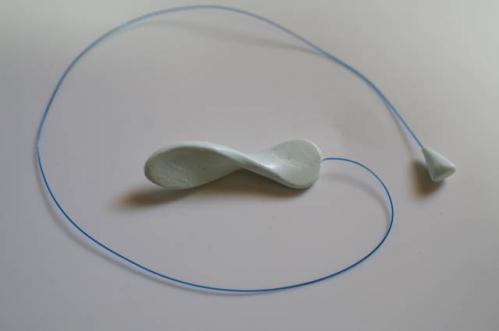
| Single-chip resin screw model (OKプロステートチップ 樹脂素材1チップタイプ スクリュー) | ¥4,400 (about $28 at ¥156 = $1, rate as of 2026-09-04) | March 2024: a customer named this model as the starting point for custom builds requesting covered thread. |
The single-chip resin screw model is listed in OK Lab's own online store.
(Source: ok-lab's diary, published March 2024)
https://ok-lab.hatenablog.com/entry/2024/03/30/122958
Products the diary mentioned as alternatives
The diary names no alternative.
Historical cord prototypes, the external ring, wire-reinforced extensions, and finished custom builds: No matching product can be confirmed on the current list.
Common worries about silicone-covered thread

The documented customer requests concern custom thread specifications and access to an end loop.
"Could silicone-covered thread be supplied on the requested screw chips?"
In an entry published in March 2024, a customer requested 20cm covered thread on customized resin screw-chip assemblies. For the linked assembly, the customer specified 2 nylon strands if the covered version could not be supplied. The request also included a simpler screw-chip version with covered thread.
Mr. Okada wrote that staff handled further discussions and that the pictured products were completed. The diary does not separately confirm the final thread specification on each item or record how the finished products felt in use.
(Source: ok-lab's diary, published March 2024)
https://ok-lab.hatenablog.com/entry/2024/03/30/122958
"Would a double loop make chip retrieval more dependable?"
In an entry published in April 2025, a customer requested a paired end loop on a custom wire assembly, identifying retrieval as its purpose. Mr. Okada interpreted the request as a call for more dependable access to the assembly. He showed the completed request and said a single loop's usefulness depended on its orientation.
The diary does not record this customer's experience with the completed product. Mr. Okada agreed to accept paired end-loop requests and favored locating the end nearer the penis head to reduce anxiety about reaching it.
(Source: ok-lab's diary, published April 2025)
https://ok-lab.hatenablog.com/entry/2025/04/12/122910
Buying from outside Japan

OK Lab ships internationally to countries covered by Japan Post's EMS courier service. Overseas orders are paid in advance by PayPal. Each order carries a ¥400 (about $3 at ¥156 = $1, rate as of 2026-09-04) handling fee, and EMS shipping is charged on top. These terms come from OK Lab's official sales-terms page (written here as plain text, not a link: ok-lab.net/docs/law), checked on September 7, 2026; confirm them on the official store before you order, because they can change.
Summary of this article
| What you wanted to know | The answer |
|---|---|
| What is the short answer? | Covered nylon was followed by a wire-and-nylon design; both had specifications and limitations. |
| What is the base product? | The OK Prostate Chip is made by OK Lab in Japan for placement in the urethra. |
| What do the material names mean? | Silicone forms the covering, nylon provides reinforcement, and the later wire supplies shape control. |
| What did the early designs offer? | Internal cords, loop-equipped prototypes, and an external ring had different constructions and historical prices. |
| What limits did the maker set? | Replacement eligibility, compatible auxiliary parts, and manufacturing length restricted the offers. |
| What changed over time? | The diary moved from covered nylon to additional ring, spring, and wire-based designs. |
| What is currently listed? | The resin screw base model is listed; its historical custom cord configuration is not confirmed. |
| What did customers ask? | They requested covered thread on custom chips and a paired loop for more dependable retrieval. |
| How do overseas orders work? | The stated terms use advance PayPal payment, a handling fee, and additional EMS postage. |
| What does the overall history establish? | Several designs were described; their historical specifications do not establish today's cord availability. |
Source: ok-lab's diary (Okada Comfortable Life Laboratory). The original entries are in Japanese; quotations on this page are translated. Photos and videos are on the original entries.
This article is a summary of the maker's development diary. The product is not a medical device and no result is guaranteed. If anything feels wrong or worries you, see a doctor. Prices, specifications and cautions change, so confirm the latest information on the official blog and the official site. Questions about ordering and shipping go to the seller.