![Why use shape memory wire in a prostate chip? | Flexible connections retain a preset shape [OK Prostate Chip]](/img/a/T0844/eyecatch.svg)
This page is based on entries from "ok-lab's diary" (https://ok-lab.hatenablog.com/), the Japanese development diary written by Mr. Okada, founder of OK Lab, a small company in Japan (Okada Comfortable Life Laboratory). Only the entries about "adopting shape memory alloy" are summarized here, in order of publication. Past prices and sizes are as written at the time. Current prices come from the official product list (retrieved September 4, 2026). Quotations are translated from Japanese.
Note: This page is a personal reading log by someone with no connection to the maker or the seller. It reflects the source entries as of their publication dates and makes no guarantee of accuracy or safety. The product is not a medical device; talk to a doctor about any health decision. Check the official site for current information. This page contains advertising.
In short
Shape memory wire (metal that returns to a preset shape) allows connected chip parts to bend.
Mr. Okada developed protective coverings and flexible connections, while recording problems during testing.
The latest supplied entries describe further wire designs, but matching current products cannot be confirmed.
If you see blood in your urine, even a small amount or for the first time, do not wait and see. See a urologist right away. If you suddenly cannot urinate, or the device cannot be removed, do not try to fix it yourself. Go to a medical facility, including emergency care, immediately.
About this product

The OK Prostate Chip is a small device that is placed in the urethra (the urine passage) so that it acts on the prostate; the maker sells it in several shapes, sizes and materials. It is made and sold by OK Lab (Okada Comfortable Life Laboratory), a small company in Japan, through its own online store, and prices are in Japanese yen (JPY). The maker's development diary, "ok-lab's diary", is written in Japanese. This page is an English summary of it, and every quotation is translated. OK Lab ships internationally, so readers outside Japan can order (see "Buying from outside Japan" below). Product names on this page are plain-English descriptions. The official Japanese product name is shown once in the product table so you can find the same item in the store.
Before you read: key terms
| Term | Plain-English meaning |
|---|---|
| Shape memory wire | Wire that returns to a preset shape; used to connect parts while allowing them to bend. |
| Nitinol | A nickel–titanium alloy used for the springy connections and later wire attachments described here. |
| Urethra | The urine passage; the channel where the maker places the device. |
| Epoxy resin | Material that hardens around a connection; used to secure the wire and chip together. |
| Metal fatigue | Damage associated with repeated bending; discussed when comparing ordinary wire with shape memory wire. |
| Silicone tube | A sleeve around wire; used as a covering and, in one design, to help loops hold their shape. |
What happens: shape memory wire in prostate chips
The OK Prostate Chip is a small device placed in the urethra to act on the prostate. These entries describe flexible metal connections between chip components, including parts near the prostate and, in some designs, inside the bladder. The wire can bend and return to a preset curve, which Mr. Okada wanted to use for support as the device changes shape. Later entries describe thinner wire attachments and flexible connections between a motor and a ceramic chip.
Shape memory wire did not prevent the first ceramic prototype from shifting
In an entry published in March 2024, Mr. Okada described replacing a rubber-covered connection between ceramic chips with springy metal wire. During his own test, the assembly moved more than 3 centimeters toward the bladder with little force, despite his intended position. No matching product can be confirmed on the current list.
He attributed that movement to the ceramic surface and the absence of rubber at the connection. He questioned whether this especially slippery assembly suited staying in one fixed position.
(Source: ok-lab's diary, published March 2024)
https://ok-lab.hatenablog.com/entry/2024/03/16/123023
Shape memory wire retained its curve at room temperature
In an entry published in April 2024, Mr. Okada explained the wire's response to temperature. He described recovery at around 10 degrees, meaning it already retained its preset shape at room temperature.
The connection used wire around 0.6 mm thick, with a curve approaching 90 degrees in the position he described. He expected it to adapt more readily than a long, rigid assembly, which he said could catch during removal. The diary does not record a measured removal-failure rate for this design.
(Source: ok-lab's diary, published April 2024)
https://ok-lab.hatenablog.com/entry/2024/04/06/122941
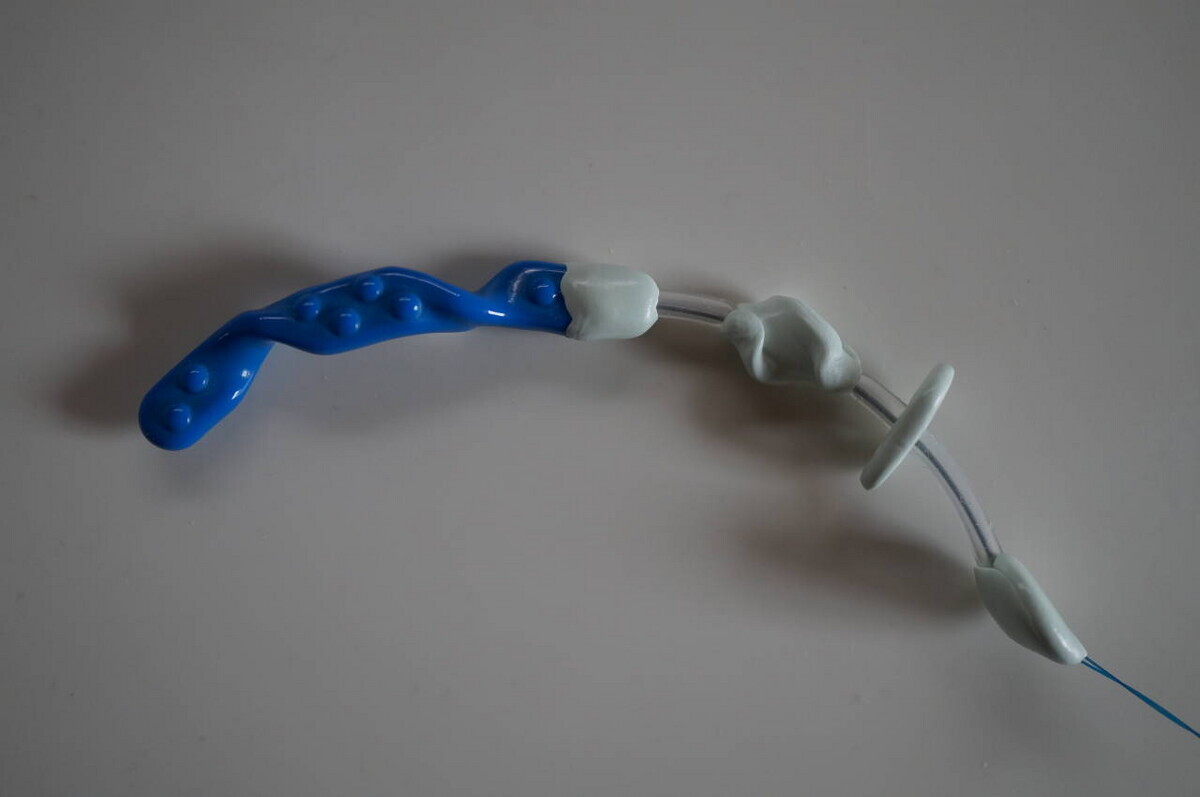
Shape memory wire was intended to accommodate changes in posture
In another entry published in April 2024, a patent attorney asked Mr. Okada how the design differed from ordinary bent wire. His answer focused on movement: he wrote that posture and pressure from sitting continually changed the shape of the urethra.
He argued that thin ordinary wire could bend permanently, while thick wire could resist those changes. He described shape memory wire as returning to its original curve after the force ended. The diary does not record comparative test measurements.
(Source: ok-lab's diary, published April 2024)
https://ok-lab.hatenablog.com/entry/2024/04/13/123053
Shape memory wire assemblies reached an announced sales stage
In an entry published in April 2024, Mr. Okada said he had completed patent applications covering curved wire connections. His designs included an assembly linking prostate-area and lower urethral components, plus a version with an additional bladder component. No matching product can be confirmed on the current list.
He announced that shape memory chip sales could begin following the filing. However, prices and sales conditions for the three-part bladder assembly (Prostate Alien) were still undecided, and he asked prospective buyers to wait.
(Source: ok-lab's diary, published April 2024)
https://ok-lab.hatenablog.com/entry/2024/04/20/122856
Shape memory wire enabled a motor prototype with troubling test results
In an entry published in May 2024, Mr. Okada described a motorized prototype based on the three-part bladder assembly. This followed a rigid arrangement whose prostate-area section he found too long for the proposed reversed orientation. No matching product can be confirmed on the current list.
The prototype had an 8 mm motor and chip sections around 9 mm wide. Mr. Okada reported an abnormal heart episode during his test and described the sensations as 90% pain. He wrote that he did not intend to operate its vibration again because of his heart condition.
(Source: ok-lab's diary, published May 2024)
https://ok-lab.hatenablog.com/entry/2024/05/11/122910
Shape memory wire made an S-shaped assembly possible for the maker
In a later entry published in May 2024, Mr. Okada explained why he changed the three-part assembly's overall shape. He reported occasional irritation with the earlier C-shaped arrangement, whose bladder section curved toward the abdomen.
The revised design curved its bladder section in the opposite direction, producing an S shape. He credited the flexible connections with making that shape possible and believed it better resisted movement in either direction. He also recommended a covering over this assembly's wire because of discomfort he associated with bare metal.
(Source: ok-lab's diary, published May 2024)
https://ok-lab.hatenablog.com/entry/2024/05/18/122913
Thinner nitinol wire introduced a different role from curved connectors
In an entry published in October 2024, Mr. Okada explored longer, thread-like attachments using nitinol (a nickel–titanium alloy). The earlier three-part assembly's wire was described here as 0.7 mm, whereas he obtained 0.3 mm wire for this experiment.
He wanted a flexible attachment that could perform functions previously assigned to nylon thread. After connecting it to a chip, he suggested that nitinol might eventually become the standard attachment material. He said development and testing would proceed cautiously.
(Source: ok-lab's diary, published October 2024)
https://ok-lab.hatenablog.com/entry/2024/10/12/122911
Jointed nitinol wire remained an idea for reducing metal-related drawbacks
In an entry published in November 2025, Mr. Okada proposed adding joints to nitinol attachments. He hoped to retain the alloy's elasticity while reducing disadvantages he associated with metal contacting the body.
The diary does not explain the proposed joint construction. It does not record whether this proposal became a completed product.
(Source: ok-lab's diary, published November 2025)
https://ok-lab.hatenablog.com/entry/2025/11/22/122910
Nitinol wire reduced the need for bulky motor connections
In an entry published in February 2026, Mr. Okada described a flexible connection between a motor and a ceramic chip. He explained that securing both parts through wire allowed thinner resin covering than the previous directly bonded construction. No matching product can be confirmed on the current list.
He offered connection diameters of around 5 mm as standard, or around 3 mm for greater flexibility. He also believed the ceramic end vibrated more strongly, based on his own sensory comparison. He cautioned that prolonged bladder vibration might be harmful.
(Source: ok-lab's diary, published February 2026)
https://ok-lab.hatenablog.com/entry/2026/02/14/121602
Longer nitinol wire connections initially transmitted less vibration than expected
In a later entry published in February 2026, Mr. Okada described testing a much longer motor-to-chip connection. At 15 centimeters, he found that vibration weakened, blaming thicker wire and a close-fitting tube.
His next prototype used two uncovered parallel wires, which he reported moved in waves when the motor ran. He warned that this bare-wire design was unsuitable for people with metal allergies.
(Source: ok-lab's diary, published February 2026)
https://ok-lab.hatenablog.com/entry/2026/02/21/122935
The maker's answer to shape memory wire in prostate chips
Mr. Okada's measures addressed wire contact, connection strength, assembly dimensions, and manufacturing limits.
Shape memory wire still required covering and connection checks
In the March 2024 entry, Mr. Okada identified the connection as a separate concern from the wire's flexibility. It depended on epoxy resin (material that hardens around the joint), which he said could become unstable if the resin cracked.
He also covered the fine wire with a 2.5 mm tube because he worried about direct contact with the lining. Although he argued that elastic bending avoided metal fatigue (damage from repeated bending), he still planned further connection and breakage tests. He initially intended to wait for full hardening, but the same entry says he tested the prototype sooner.
(Source: ok-lab's diary, published March 2024)
https://ok-lab.hatenablog.com/entry/2024/03/16/123023
Shape memory wire assemblies gained defined sizes and historical prices
Published May 2024 widths were SS = 7 mm, S = 8 mm, M = 9 mm, L = 10 mm. The bladder section was 20 mm long, and the prostate-area and lower urethral sections were each 25 mm.
Their connecting gaps were 6 mm and 30 mm, with published curves of about 30 degrees and 80 degrees. The published standard price was ¥13,000, (about $83 at ¥156 = $1, rate as of 2026-09-04) tax excluded, including the wire connection and tube covering. Mr. Okada suggested considering a narrower version than the reader's usual chip, based on his expectations for this particular design.
(Source: ok-lab's diary, published May 2024)
https://ok-lab.hatenablog.com/entry/2024/05/18/122913
Silicone-covered nitinol wire addressed concerns about older attachment wires
In the October 2024 entry, Mr. Okada proposed replacing the core of an older silicone-covered wire that he said could eventually break. His new example contained two 0.3 mm nitinol wires inside a silicone tube (a sleeve covering the metal).
The tube had an outside diameter of 1 mm and an inside diameter of 0.5 mm. He reported that bare-wire loops changed size easily, while the silicone covering helped loops retain their shape. No matching product can be confirmed on the current list.
(Source: ok-lab's diary, published October 2024)
https://ok-lab.hatenablog.com/entry/2024/10/12/122911
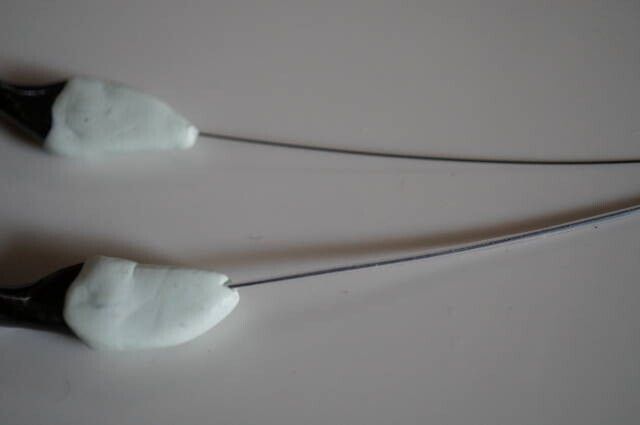
Flexible nitinol wire motor assemblies still had manufacturing limits
In the February 2026 entry, Mr. Okada ruled out a 6 mm motor because he doubted the connection's reliability. He offered 8 mm or 10 mm motors, with ceramic chips only.
The planned motor-to-chip distance was approximately 15–30 mm, and approximate curve choices were 45, 60, or 90 degrees. The extra flexible-connection charge was ¥4,000, (about $26 at ¥156 = $1, rate as of 2026-09-04) tax excluded, for short and semi-long ceramic versions, beyond the existing vibrating-chip price. The Awakening (覚醒) and long ceramic versions carried a ¥5,000, (about $32 at ¥156 = $1, rate as of 2026-09-04) tax-excluded charge.
(Source: ok-lab's diary, published February 2026)
https://ok-lab.hatenablog.com/entry/2026/02/14/121602
Parallel nitinol wire introduced further compatibility limits and added charges
The later February 2026 entry offered parallel connections using 0.3 mm or 0.4 mm wire. Mr. Okada said the thicker option generally could not be attached to twisted or bumped ceramic chips.
He allowed some bumped chips with the thinner wire, but excluded cases where bump placement prevented attachment. Published additional charges were ¥5,000 (about $32 at ¥156 = $1, rate as of 2026-09-04) for connections up to 10 cm, ¥6,000 (about $38 at ¥156 = $1, rate as of 2026-09-04) up to 15 cm, and ¥8,000 (about $51 at ¥156 = $1, rate as of 2026-09-04) up to 20 cm, all tax excluded. No matching product can be confirmed on the current list.
(Source: ok-lab's diary, published February 2026)
https://ok-lab.hatenablog.com/entry/2026/02/21/122935
If you see blood in your urine, even a small amount or for the first time, do not wait and see. See a urologist right away. If you suddenly cannot urinate, or the device cannot be removed, do not try to fix it yourself. Go to a medical facility, including emergency care, immediately.
How shape memory wire in prostate chips changed over time
| Published | What the diary said then |
|---|---|
| Mar 2024 | Mr. Okada cited a supplier's claim of about 100,000 bends without deterioration. |
| Apr 2024 | Mr. Okada proposed support against movement in both directions, unlike the earlier thread connection. |
| May 2024 | The prototype's 25 cm cable could be too short, according to Mr. Okada. |
| May 2024 | Nonstandard dimension changes carried a published ¥300 (about $2 at ¥156 = $1, rate as of 2026-09-04) charge per altered location. |
| Oct 2024 | Mr. Okada suggested wire loops might also help prevent unwanted chip movement. |
| Feb 2026 | The standard ceramic chip was 10 mm shorter than the usual vibrating-chip version. |
| Feb 2026 | The stronger 10 mm motor did not necessarily feel better to Mr. Okada. |
OK Prostate Chip products related to shape memory wire in prostate chips
No current product is directly tied to this topic.
Common worries about shape memory wire in prostate chips

(The material contains no questions from readers.)
Buying from outside Japan

OK Lab ships internationally to countries covered by Japan Post's EMS courier service. Overseas orders are paid in advance by PayPal. Each order carries a ¥400 (about $3 at ¥156 = $1, rate as of 2026-09-04) handling fee, and EMS shipping is charged on top. These terms come from OK Lab's official sales-terms page (written here as plain text, not a link: ok-lab.net/docs/law), checked on September 7, 2026; confirm them on the official store before you order, because they can change.
Summary of this article
| What you wanted to know | The answer |
|---|---|
| What is the short answer? | The maker used springy wire for flexible connections, while continuing to revise the designs. |
| What is the product? | A urethral device made by OK Lab in Japan and sold in Japanese yen. |
| What do the key terms mean? | Nitinol is the nickel–titanium alloy; coverings and resin serve different purposes around its connections. |
| What happened during development? | Mr. Okada reported shifting, revised shapes, a troubling motor test, and later vibration experiments. |
| What measures did the maker describe? | Coverings, connection checks, specified dimensions, and limits on compatible motors and chips. |
| What changed over time? | Short curved connectors were followed by longer attachments, proposed joints, and flexible motor assemblies. |
| Which current products match? | No current product is directly tied to this topic. |
| Were reader questions recorded? | The material contains no questions from readers. |
| How do overseas orders work? | Advance PayPal payment, a ¥400 (about $3 at ¥156 = $1, rate as of 2026-09-04) handling fee, and additional EMS shipping charges. |
Source: ok-lab's diary (Okada Comfortable Life Laboratory). The original entries are in Japanese; quotations on this page are translated. Photos and videos are on the original entries.
This article is a summary of the maker's development diary. The product is not a medical device and no result is guaranteed. If anything feels wrong or worries you, see a doctor. Prices, specifications and cautions change, so confirm the latest information on the official blog and the official site. Questions about ordering and shipping go to the seller.