![Stainless steel ring chip: will it feel gentle? | Small sizes can still feel demanding [OK Prostate Chip]](/img/a/T0831/eyecatch.svg)
This page is based on entries from "ok-lab's diary" (https://ok-lab.hatenablog.com/), the Japanese development diary written by Mr. Okada, founder of OK Lab, a small company in Japan (Okada Comfortable Life Laboratory). Only the entries about "stainless steel ring chips" are summarized here, in order of publication. Past prices and sizes are as written at the time. Current prices come from the official product list (retrieved September 4, 2026). Quotations are translated from Japanese.
Note: This page is a personal reading log by someone with no connection to the maker or the seller. It reflects the source entries as of their publication dates and makes no guarantee of accuracy or safety. The product is not a medical device; talk to a doctor about any health decision. Check the official site for current information. This page contains advertising.
In short
Ring chips can feel demanding, and the diary records irritation and unexplained black residue.
Mr. Okada restricted spring movement and recommended support against movement into the bladder.
The current list includes the short ring chip at ¥3,300 (about $21 at ¥156 = $1, rate as of 2026-09-04) including tax.
If you see blood in your urine, even a small amount or for the first time, do not wait and see. See a urologist right away. If you suddenly cannot urinate, or the device cannot be removed, do not try to fix it yourself. Go to a medical facility, including emergency care, immediately.
About this product

The OK Prostate Chip is a small device that is placed in the urethra (the urine passage) so that it acts on the prostate; the maker sells it in several shapes, sizes and materials. It is made and sold by OK Lab (Okada Comfortable Life Laboratory), a small company in Japan, through its own online store, and prices are in Japanese yen (JPY).
The maker's development diary, "ok-lab's diary", is written in Japanese. This page is an English summary of it, and every quotation is translated. OK Lab ships internationally, so readers outside Japan can order (see "Buying from outside Japan" below).
Product names on this page are plain-English descriptions. The official Japanese product name is shown once in the product table so you can find the same item in the store.
Before you read: key terms
| Term | Plain-English meaning |
|---|---|
| Urethra | The urine passage, through which urine leaves the body; the chip is placed inside it. |
| Resin | Material attached to the rings to hold the thread and, in the standard design, prevent spring movement. |
| Retention | Staying in place; here, keeping the chip in its intended position. |
| Fully internal | A design with no thread outside the body, proposed to avoid an exposed thread catching on clothing. |
| Sphincter stopper | An accessory intended to resist movement toward the bladder near the muscle that controls urine flow. |
| Screw-shaped auxiliary chip | An additional support chip, discussed as part of an arrangement intended to help maintain position. |
| Six-hole safety chip | A thread-holding part used in the maker's adjustable internal-loop proposal. |
| Silicone tube | A hollow tube proposed for the spring's interior, intended to make contact with the lining gentler. |
What happens: stainless steel ring chip problems
The OK Prostate Chip is a small device placed in the urethra (the urine passage) to act on the prostate. The stainless steel ring chip is its short version built around a row of metal rings. The December 2020 launch described a device intended to sit within the prostate area, with resin (material securing the thread) at both ends. Later entries discuss both the product and separate experimental springs.
The stainless steel ring chip launched with a price and size limits
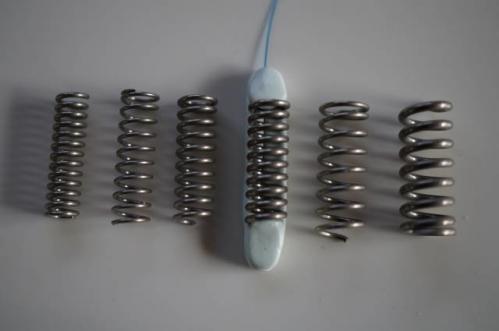
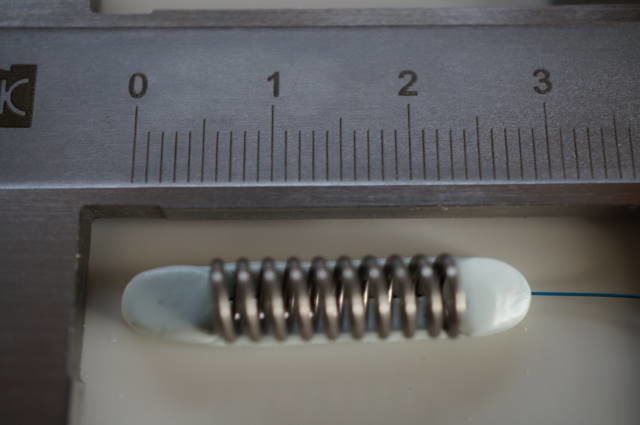
An entry published in December 2020 announced the short stainless steel ring chip for release the following week. Its price was ¥3,000 (about $19 at ¥156 = $1, rate as of 2026-09-04) excluding tax, matching the short ceramic and glass versions at that time. Standard length was just under 30mm: about 16mm of rings, with resin sections of about 6mm at each end.
Custom lengths up to 39mm were offered. The thickest resin section extended more than 1mm beyond the ring diameter because it held the thread. Based on his own tests, Mr. Okada suggested ring diameters around 5.6mm, 5.8mm, and 6.0mm as the usual choices.
(Source: ok-lab's diary, published December 2020)
https://ok-lab.hatenablog.com/entry/2020/12/19/132929
Freely stretching stainless steel ring chip prototypes trapped the lining during tests
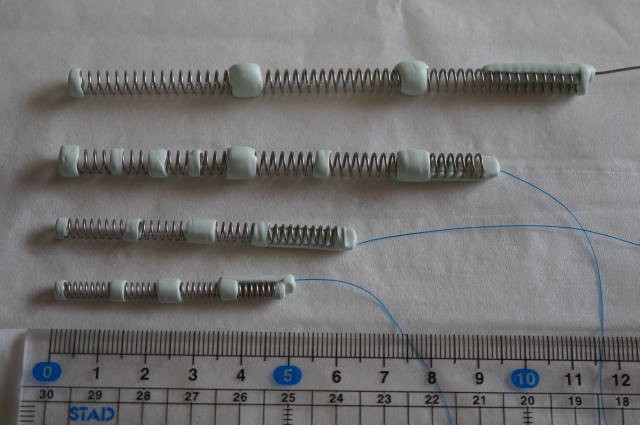
In an entry published in March 2021, Mr. Okada described attempts to improve and downsize a prototype involved in a bleeding incident. He wrote that making the exposed spring smaller, shorter, or easier to bend had not solved the problem. In his tests, stretching coils caught the urethral lining and became difficult to free.
Even a spring with an outside diameter of 3.7mm and wire thickness of 0.5mm required considerable force to remove, he reported. He distinguished these experimental springs from the standard product discussed below. Mr. Okada concluded that freely stretching stainless steel rings were a poor match for the lining.
(Source: ok-lab's diary, published March 2021)
https://ok-lab.hatenablog.com/entry/2021/03/06/125456
A stainless steel ring chip faced size limits at the penis head
In an entry published in November 2023, Mr. Okada explained a limitation of the ring design while discussing other ways to hold devices internally. He wrote that the rings spread the urethra, but their diameter was limited by what could pass through the penis head. Wanting a wider ring farther inside did not remove that constraint.
His discussion described the inner part of the passage as wider than the passage through the penis head. For a fixed ring, he identified passage through that narrower area as the size limit.
(Source: ok-lab's diary, published November 2023)
https://ok-lab.hatenablog.com/entry/2023/11/25/122934
The thinnest stainless steel ring chip still felt demanding to one customer
In an entry published in June 2025, a customer described the thinnest ring model, made that March. They found insertion and removal relatively easy and retention (staying in place) good, but felt substantial physical strain. They reported fatigue around the prostate after about 15 minutes, despite having chosen the thinnest type.
A planned 4–6 hours ended after about 1 hour because they felt tired. The customer therefore considered even this version an option for experienced users. Mr. Okada acknowledged that he also found stainless steel rings demanding.
(Source: ok-lab's diary, published June 2025)
https://ok-lab.hatenablog.com/entry/2025/06/07/122954
The maker's answer to stainless steel ring chip problems
The diary describes changes to thread placement, added support, and restricted spring movement as the maker's responses to different problems.
An internal thread addressed snagging concerns with the stainless steel ring chip
In an entry published in December 2020, Mr. Okada chose the ring-chip name because he considered a sequence of rings the important feature. He reported his most stable personal experience after a week with a prototype, but an exposed thread could catch on clothing and shift it. That led to his fully internal proposal (a design with no thread outside the body).
He proposed an internal thread loop with a six-hole safety chip (a thread-holding part), allowing the loop length to change. The diary does not record the completed test results in that entry. His proposed response to snagging was to keep the thread inside the urethra.
(Source: ok-lab's diary, published December 2020)
https://ok-lab.hatenablog.com/entry/2020/12/05/130257

Extra support was advised against stainless steel ring chip movement toward the bladder
In the entry published in December 2020, Mr. Okada wanted to reduce the risk of a ring chip entering the bladder. He named a sphincter stopper (a part intended to resist movement toward the bladder) and a screw-shaped auxiliary chip (an extra support chip). The diary does not record how reliably either accessory prevented this problem. Mr. Okada recommended one of these additions because he wanted to avoid that movement.
(Source: ok-lab's diary, published December 2020)
https://ok-lab.hatenablog.com/entry/2020/12/19/132929
Resin prevented the standard stainless steel ring chip from stretching or compressing
In an entry published in March 2021, Mr. Okada explained the structure of the standard product already on sale. Resin ran along the whole chip and was bonded to the coil, preventing the spring from stretching or compressing. He had considered allowing that movement during development, then chosen the fixed structure with safety in mind. After his separate spring tests, Mr. Okada judged that keeping the standard spring fixed had been the right decision.
(Source: ok-lab's diary, published March 2021)
https://ok-lab.hatenablog.com/entry/2021/03/06/125456
If you see blood in your urine, even a small amount or for the first time, do not wait and see. See a urologist right away. If you suddenly cannot urinate, or the device cannot be removed, do not try to fix it yourself. Go to a medical facility, including emergency care, immediately.
How stainless steel ring chip problems changed over time
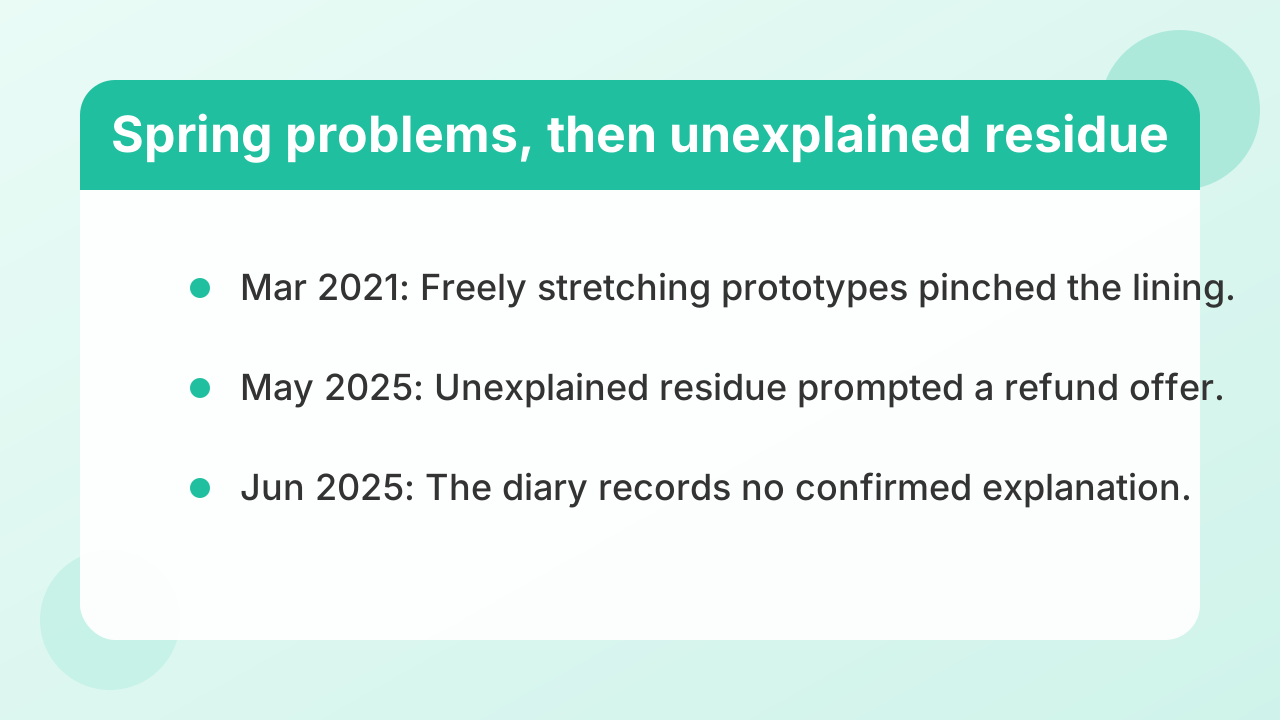
| Published | What the diary said then |
|---|---|
| Dec 2020 | Early plans mentioned rings around 6mm, 7mm, 8mm, and 9mm. |
| Dec 2020 | A 4.8mm ring with 0.8mm wire was among the launch options. |
| Mar 2021 | Freely stretching prototypes pinched the lining; the standard product prevented spring movement. |
| Nov 2023 | Ring size was limited by passage through the penis head. |
| May 2025 | Unexplained residue prompted a refund offer and conditional discussion of stopping sales. |
| Jun 2025 | A correspondent suspected boiling caused black marks; the diary records no confirmed explanation. |
OK Prostate Chip products related to stainless steel ring chip problems
The supplied current list includes the short ring chip and two accessories mentioned in these entries.
Products that appear in these entries
| Product (official name) | Price incl. tax | Relation to this topic |
|---|---|---|
| Short stainless steel ring chip (OKプロステートチップ ステンレスリング ショートタイプ) | ¥3,300 (about $21 at ¥156 = $1, rate as of 2026-09-04) | December 2020 introduced the short ring model whose historical dimensions and launch price are described above. |
| Six-hole thread-loop safety chip (六穴方式オプションチップ(セーフティチップ)) | ¥1,100 (about $7 at ¥156 = $1, rate as of 2026-09-04) | December 2020 used this part in the proposal for an adjustable internal thread loop. |
| Screw-shaped auxiliary chip option (スクリュー型補助チップ追加オプション) | ¥3,300 (about $21 at ¥156 = $1, rate as of 2026-09-04) | December 2020 recommended this support alongside the ring chip to address possible movement into the bladder. |
The short stainless steel ring chip is listed in OK Lab's own online store.
(Source: ok-lab's diary, published December 2020)
https://ok-lab.hatenablog.com/entry/2020/12/05/130257
(Source: ok-lab's diary, published December 2020)
https://ok-lab.hatenablog.com/entry/2020/12/19/132929
Products the diary mentioned as alternatives
The diary names no alternative.
Freely stretching prototypes and historical custom-length builds: No matching product can be confirmed on the current list.
Common worries about stainless steel ring chip problems
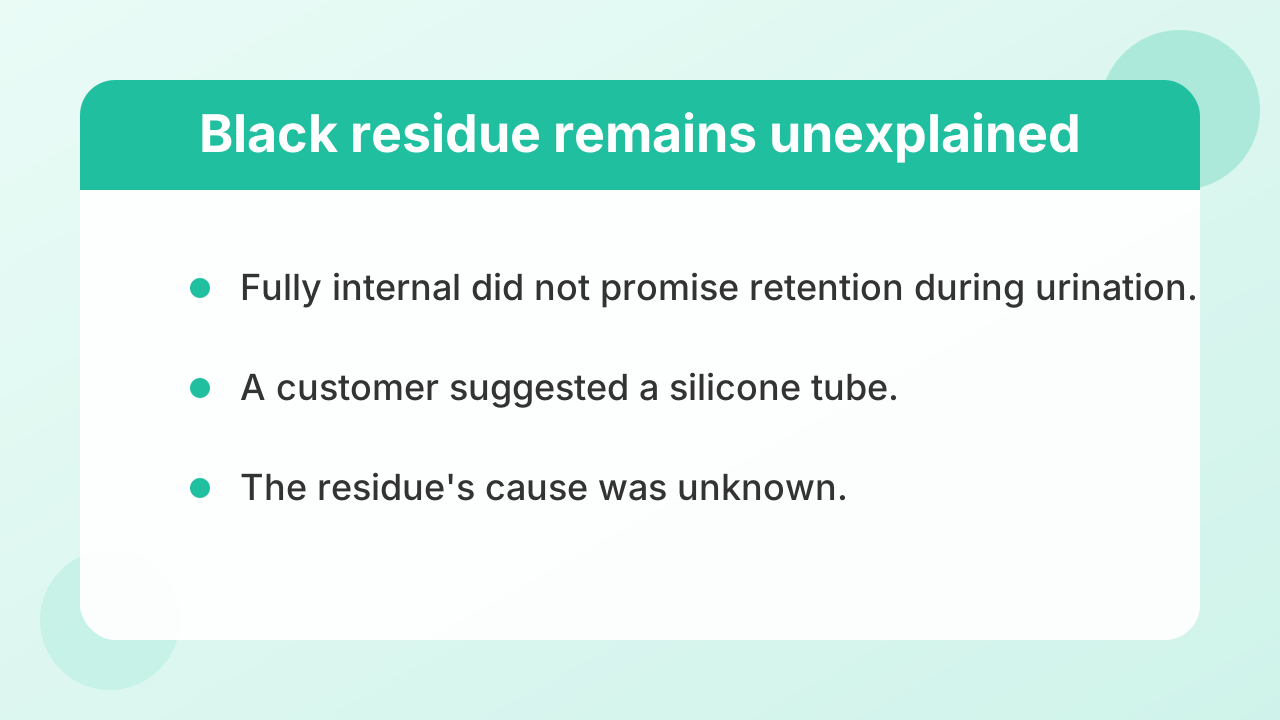
The replies distinguish thread placement from staying put, propose gentler contact, and leave the black residue unexplained.
"Will a stainless steel ring chip stay put during urination?"
In an entry published in March 2021, a customer reported difficulty with a 6mm main chip and 5.6mm auxiliary chip. They warned that forcing this combination could injure the urethra and reported that it came out during urination. The customer asked whether the fully internal design suited only certain users.
Mr. Okada explained that fully internal described thread placement, without promising retention during urination. He said the main chip and moisture affected whether it slipped out; the diary does not record this customer's experience after his reply. Mr. Okada described an auxiliary chip as support for maintaining the intended position.
(Source: ok-lab's diary, published March 2021)
https://ok-lab.hatenablog.com/entry/2021/03/06/125456
"Could a stainless steel ring chip be made gentler?"
An entry published in March 2021 included a customer's request for gentler contact after trying two ring-chip versions with electrical contacts. They suggested a silicone tube (a hollow tube) inside the spring and asked what caused irritation. Mr. Okada thought the tube could greatly improve safety and said he would restart development.
However, he worried that the tube would conflict with his aim of allowing normal muscle closure to stop urine flow. The diary does not record a completed redesign or its testing outcome in this exchange. Mr. Okada also proposed a thin resin layer on the opposite side of the coil to soften contact.
(Source: ok-lab's diary, published March 2021)
https://ok-lab.hatenablog.com/entry/2021/03/06/125456
"Is black residue on a stainless steel ring chip harmless?"
In an entry published in May 2025, a buyer reported black, oil-like residue during alcohol wiping, which worsened with further cleaning. Staff said this was their first such report; the commercially sourced coil's detailed composition and the residue's cause were unknown. They offered a refund on return if residue remained after cleaning or boiling, or if the buyer felt uneasy.
The buyer found an online explanation they considered reassuring and intended to continue using it. The diary does not record whether the residue disappeared or how subsequent use felt. Mr. Okada asked for reports of problems and said he would consider stopping sales if problems were identified.
(Source: ok-lab's diary, published May 2025)
https://ok-lab.hatenablog.com/entry/2025/05/31/122940
Buying from outside Japan

OK Lab ships internationally to countries covered by Japan Post's EMS courier service. Overseas orders are paid in advance by PayPal. Each order carries a ¥400 (about $3 at ¥156 = $1, rate as of 2026-09-04) handling fee, and EMS shipping is charged on top. These terms come from OK Lab's official sales-terms page (written here as plain text, not a link: ok-lab.net/docs/law), checked on September 7, 2026; confirm them on the official store before you order, because they can change.
Summary of this article
| What you wanted to know | The answer |
|---|---|
| What is the short answer? | Small rings still produced demanding sensations in the June 2025 report. |
| What is the base product? | A urethral device made and sold by OK Lab in Japan. |
| What does fully internal mean? | The thread stays inside; the term does not promise retention during urination. |
| What problems were described? | Prototype pinching, size limits, and strain even with the thinnest ring. |
| What did the maker change or suggest? | Internal thread placement, additional support, and a coil fixed with resin. |
| What changed over time? | Early development optimism was followed by spring problems and an unresolved residue report. |
| What is listed today? | The short ring model is ¥3,300 (about $21 at ¥156 = $1, rate as of 2026-09-04) including tax; historical custom specifications remain separate. |
| What remains unanswered? | The residue's cause and the outcome of the proposed gentler redesign. |
| How do overseas orders work? | Advance PayPal payment, a ¥400 (about $3 at ¥156 = $1, rate as of 2026-09-04) handling fee, and additional EMS shipping charges. |
Source: ok-lab's diary (Okada Comfortable Life Laboratory). The original entries are in Japanese; quotations on this page are translated. Photos and videos are on the original entries.
This article is a summary of the maker's development diary. The product is not a medical device and no result is guaranteed. If anything feels wrong or worries you, see a doctor. Prices, specifications and cautions change, so confirm the latest information on the official blog and the official site. Questions about ordering and shipping go to the seller.