![Can I customize a ceramic chip? | The maker says molds limit size and shape changes [OK Prostate Chip]](/img/a/T0820/eyecatch.svg)
This page is based on entries from "ok-lab's diary" (https://ok-lab.hatenablog.com/), the Japanese development diary written by Mr. Okada, founder of OK Lab, a small company in Japan (Okada Comfortable Life Laboratory). Only the entries about ceramic chip customization are summarized here, in order of publication. Past prices and sizes are as written at the time. Current prices come from the official product list (retrieved September 4, 2026). Quotations are translated from Japanese.
Note: This page is a personal reading log by someone with no connection to the maker or the seller. It reflects the source entries as of their publication dates and makes no guarantee of accuracy or safety. The product is not a medical device; talk to a doctor about any health decision. Check the official site for current information. This page contains advertising.
In short
- The maker says existing molds limit ceramic chip sizes, shapes, and bump positions.
- His replies include declining individual changes, proposing shared demand, and planning a new ceramic version.
- The current list includes ceramic chips and a bump option, without confirming the historical custom builds.
About this product
The OK Prostate Chip is a small device that is placed in the urethra (the urine passage) so that it acts on the prostate; the maker sells it in several shapes, sizes and materials. It is made and sold by OK Lab (Okada Comfortable Life Laboratory), a small company in Japan, through its own online store, and prices are in Japanese yen (JPY). The maker's development diary, "ok-lab's diary", is written in Japanese. This page is an English summary of it, and every quotation is translated. OK Lab ships internationally, so readers outside Japan can order (see "Buying from outside Japan" below). Product names on this page are plain-English descriptions. The official Japanese product name is shown once in the product table so you can find the same item in the store.
Before you read: key terms
| Term | Plain-English meaning |
|---|---|
| Urethra | The urine passage, where these chips are placed. |
| Mold | A form used to shape clay into a ceramic chip. |
| Resin | A material used for original models, ring-chip reinforcement, and chips containing electrical parts. |
| Twist | A three-dimensional chip shape. Its separate purpose: The diary does not explain this. |
| Bumps | Raised features offered as a chip surface option. Their intended effect: The diary does not explain this. |
| Stainless-steel ring chip | A chip based on a metal ring, proposed as an alternative to an oversized ceramic build. |
| Electrode chip | A chip containing embedded electrical parts, discussed in connection with electrical stimulation. |
What happens: ceramic chip customization
The OK Prostate Chip is a small device placed in the urethra (the urine passage) to act on the prostate. Ceramic chip customization includes requests for different sizes, twists (three-dimensional shapes), or bumps (raised surface features). These features belong to the chip itself, which goes inside the urine passage. Mr. Okada explains that molds (forms used to shape clay) limit which ceramic designs his company can supply.
Larger ceramic chip sizes depended on demand for new molds
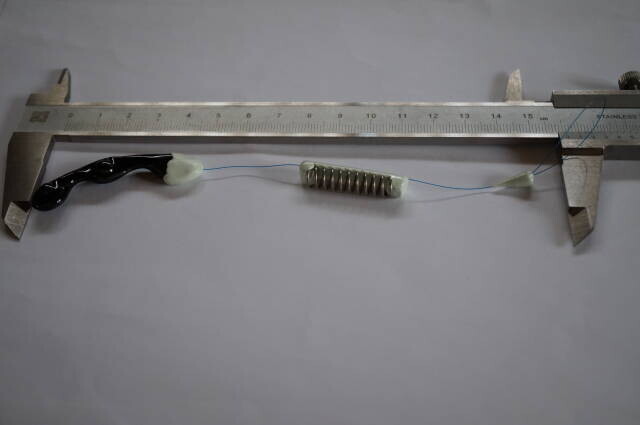
In an entry published in February 2020, a customer requested a long four-point ceramic twist larger than L. Mr. Okada explained that flat ceramic chips used original models made from resin (a material used for models) and press-style molds for clay. He said three-dimensional twisted molds were much harder to make than flat ones, making a single custom piece too costly with their techniques then.
The customer clarified that L was sufficient and that a larger version was simply a preference. The supplied material does not record whether the proposed larger version was eventually produced. Mr. Okada offered to begin production when 3 purchase requests for the proposed size had been received.
(Source: ok-lab's diary, published February 2020)
https://ok-lab.hatenablog.com/entry/2020/02/08/151653
Ceramic chip size labels did not guarantee the expected width
In an entry published in February 2021, a customer reported that a semi-long chip in L, with bumps, would not fit. Its third bulge from the tip caught at the first narrow point near the urethral opening. The customer had used other chips and wanted help understanding this unexpected difficulty.
Mr. Okada explained that semi-long L was deliberately oversized; he believed its width was even greater than long S. He said short L and semi-long L answered requests for large chips at lower prices, but no successful outcome is recorded for this customer. Mr. Okada also asked readers with relevant experience to contribute their accounts.
(Source: ok-lab's diary, published February 2021)
https://ok-lab.hatenablog.com/entry/2021/02/13/121440
Ceramic chip bumps required a planned version after an initial refusal
In an entry published in March 2022, a customer asked whether the ceramic chip with little resin at its end (Mokushi) could have bumps. Staff replied that its molded construction meant bumps were not supported at that time. Their initial response offered to consider a future version.
Mr. Okada then said he intended to support bumps on that model soon. The entry records this commitment, but the supplied material does not establish when a finished version became available. His response was a plan for further ceramic development.
(Source: ok-lab's diary, published March 2022)
https://ok-lab.hatenablog.com/entry/2022/03/05/123200
Ceramic chip bumps could not be rearranged in the latest reply
In an entry published in August 2026, a customer requested a fat double-twist ceramic chip with a particular bump pattern. They wanted several small bumps on the central bulge, ordinary bumps toward the front, and none on certain other areas. This was a request to change the surface arrangement, beyond simply selecting the bump option.
The order recorded ¥6,600 (about $42 at ¥156 = $1, rate as of 2026-09-04) for the ceramic chip and ¥1,100 (about $7 at ¥156 = $1, rate as of 2026-09-04) for the bump option, as published in August 2026. The supplied passage does not record whether the customer accepted the available pattern or whether the order was completed. Mr. Okada replied that molded ceramic construction prevented changes to bump positions or shapes.
(Source: ok-lab's diary, published August 2026)
https://ok-lab.hatenablog.com/entry/2026/08/01/122916
The maker's answer to ceramic chip customization
The maker's replies distinguish existing ceramic options, possible new designs, and requests that require another material.
An oversized ceramic chip request received a metal-ring alternative
In a separate exchange published in February 2021, a customer wanted a larger four-chip set because existing ceramic models would not stay in place. Mr. Okada replied that ceramic chips, including the sea-slug-style designs, were limited to established mold sizes. He declined the oversized ceramic request and said glass was also limited by the size of the glass rods available.
He instead proposed a stainless-steel ring chip (a chip based on a metal ring), for which a larger ring could be considered. The supplied material does not record completion of this customer's proposed set. Mr. Okada offered the ring design for consideration, with reservations about its shape and resistance.
(Source: ok-lab's diary, published February 2021)
https://ok-lab.hatenablog.com/entry/2021/02/13/121440
Ceramic chip customization could not accommodate the requested embedded electrodes
Another customer question published in February 2021 concerned electrode chips (chips containing embedded electrical parts). The customer asked whether both designs under discussion could be made from ceramic. Mr. Okada replied that their embedded components required resin construction.
He said the electrical designs were made to customer requests without testing or a guarantee. He also said he could not explain their use to customers. His reply specified resin as the material available for those requests.
(Source: ok-lab's diary, published February 2021)
https://ok-lab.hatenablog.com/entry/2021/02/13/121440
Ceramic chip customization prompted plans for designs with less resin
In the entry published in March 2022, Mr. Okada explained the business circumstances behind his ceramic development plans. He wrote that ceramic sales had fallen sharply and that the model involved in the bump request had sold poorly. This was why support for bumps had not previously been planned.
Mr. Okada described ceramic's sliding properties as a particular strength, presenting this as his assessment of the material. Alongside the promised bump version, he wanted more ceramic designs with little resin at their ends. His stated response was to give new ceramic products more attention.
(Source: ok-lab's diary, published March 2022)
https://ok-lab.hatenablog.com/entry/2022/03/05/123200
How ceramic chip customization changed over time
| Published | What the diary said then |
|---|---|
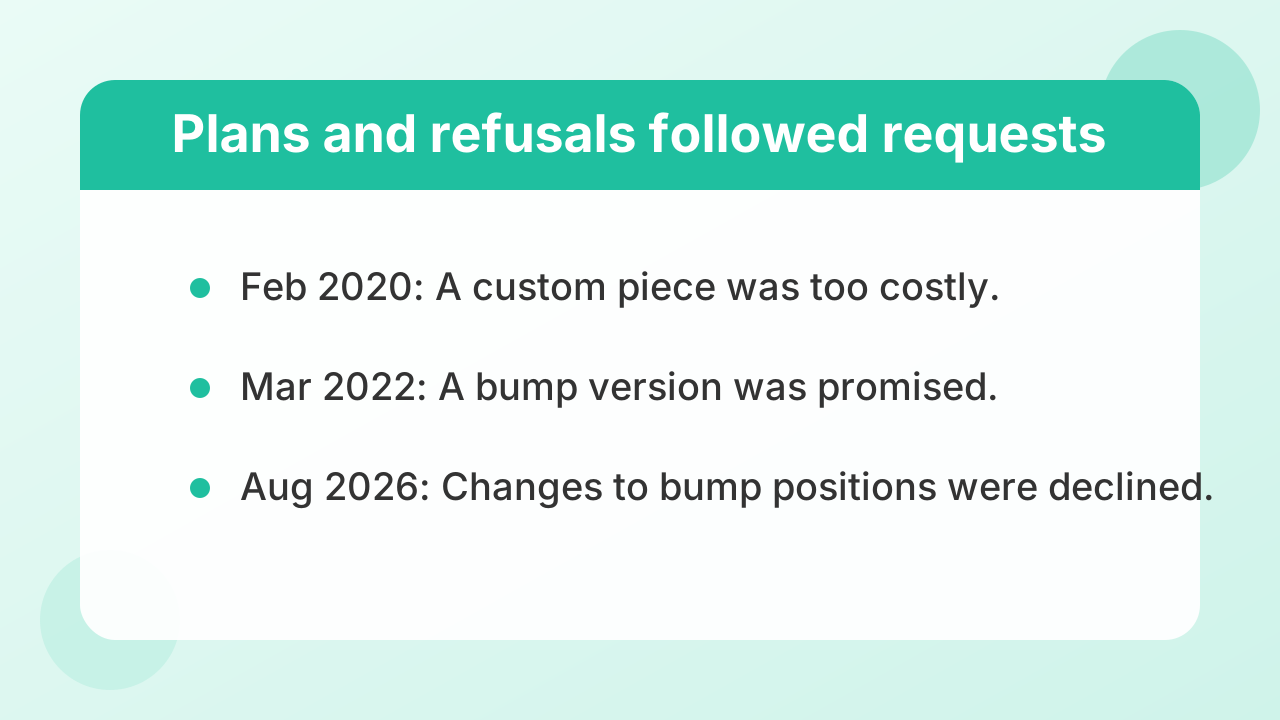
| Feb 2020 | Complex twist molds made a single custom ceramic piece too costly. |
| Feb 2020 | A larger twist could proceed after 3 purchase requests for that size. |
| Feb 2021 | A fitting complaint revealed deliberately oversized short L and semi-long L specifications. |
| Feb 2021 | An oversized ceramic request received a stainless-steel ring alternative. |
| Mar 2022 | Staff's initial bump refusal was followed by a promise to develop that version. |
| Aug 2026 | The maker declined changes to ceramic bump positions and shapes. |
OK Prostate Chip products related to ceramic chip customization
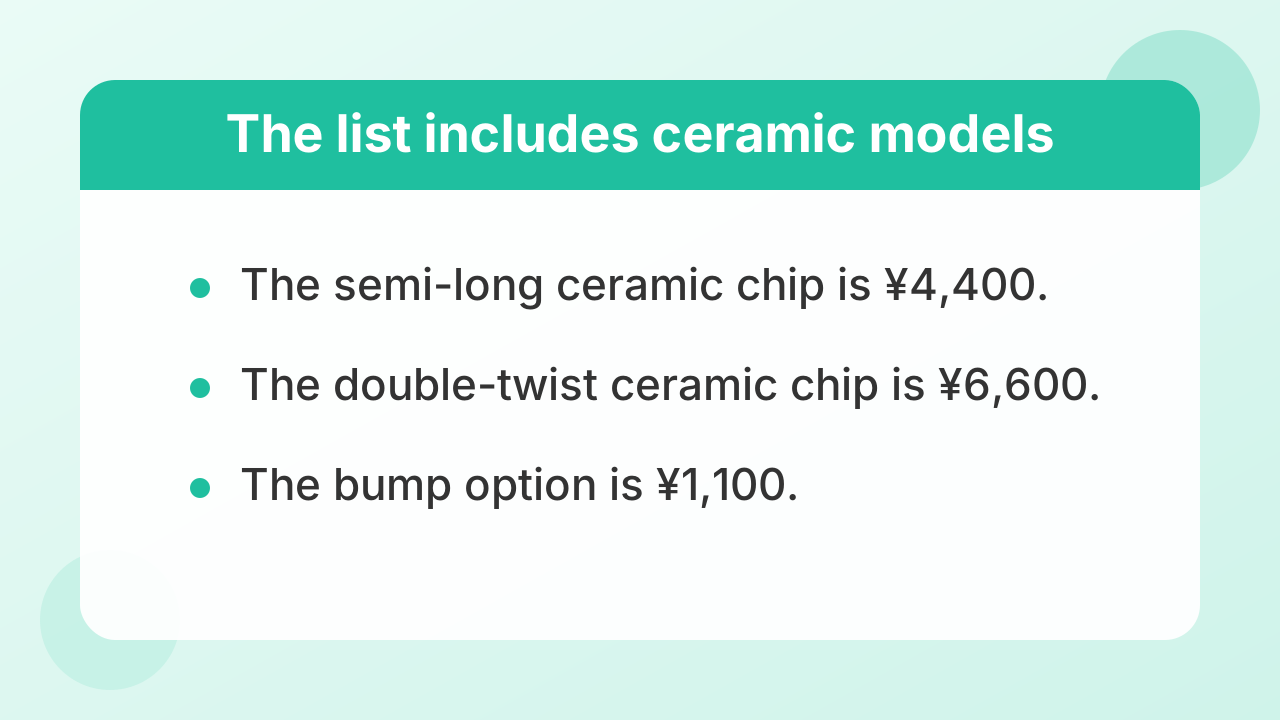
The current list includes ceramic models, a bump option, and the ring chip mentioned as an alternative.
Products that appear in these entries
| Product (official name) | Price incl. tax | Relation to this topic |
|---|---|---|
| Long four-point ceramic twist (OKプロステートチップ 陶器素材ロングタイプ 4点ツイスト) | ¥7,700 (about $49 at ¥156 = $1, rate as of 2026-09-04) | In February 2020, a customer requested a version larger than this model's existing L size. |
| Semi-long ceramic chip (OKプロステートチップ 陶器素材セミロングタイプ) | ¥4,400 (about $28 at ¥156 = $1, rate as of 2026-09-04) | In February 2021, a customer reported that this model's L size with bumps would not fit. |
| Double-twist ceramic chip (OKプロステートチップ 陶器素材覚醒タイプ ダブルツイスト(ラブカチップ)) | ¥6,600 (about $42 at ¥156 = $1, rate as of 2026-09-04) | In August 2026, a customer requested a different bump arrangement on this model. |
| Bump option (イボ付きチップに変更オプション) | ¥1,100 (about $7 at ¥156 = $1, rate as of 2026-09-04) | In August 2026, this option appeared in the order whose requested bump changes were refused. |
(Source: ok-lab's diary, published February 2020)
https://ok-lab.hatenablog.com/entry/2020/02/08/151653
(Source: ok-lab's diary, published February 2021)
https://ok-lab.hatenablog.com/entry/2021/02/13/121440
(Source: ok-lab's diary, published August 2026)
https://ok-lab.hatenablog.com/entry/2026/08/01/122916
Products the diary mentioned as alternatives
| Product (official name) | Price incl. tax | Relation to this topic |
|---|---|---|
| Short stainless-steel ring chip (OKプロステートチップ ステンレスリング ショートタイプ) | ¥3,300 (about $21 at ¥156 = $1, rate as of 2026-09-04) | In February 2021, Mr. Okada proposed this design instead of oversized ceramic chips, while warning about its resistance. |
(Source: ok-lab's diary, published February 2021)
https://ok-lab.hatenablog.com/entry/2021/02/13/121440
The historical requests include an oversized ceramic twist, a larger four-chip set, a larger custom ring build, and the ceramic model nicknamed Mokushi. No matching product can be confirmed on the current list.
Common worries about ceramic chip customization
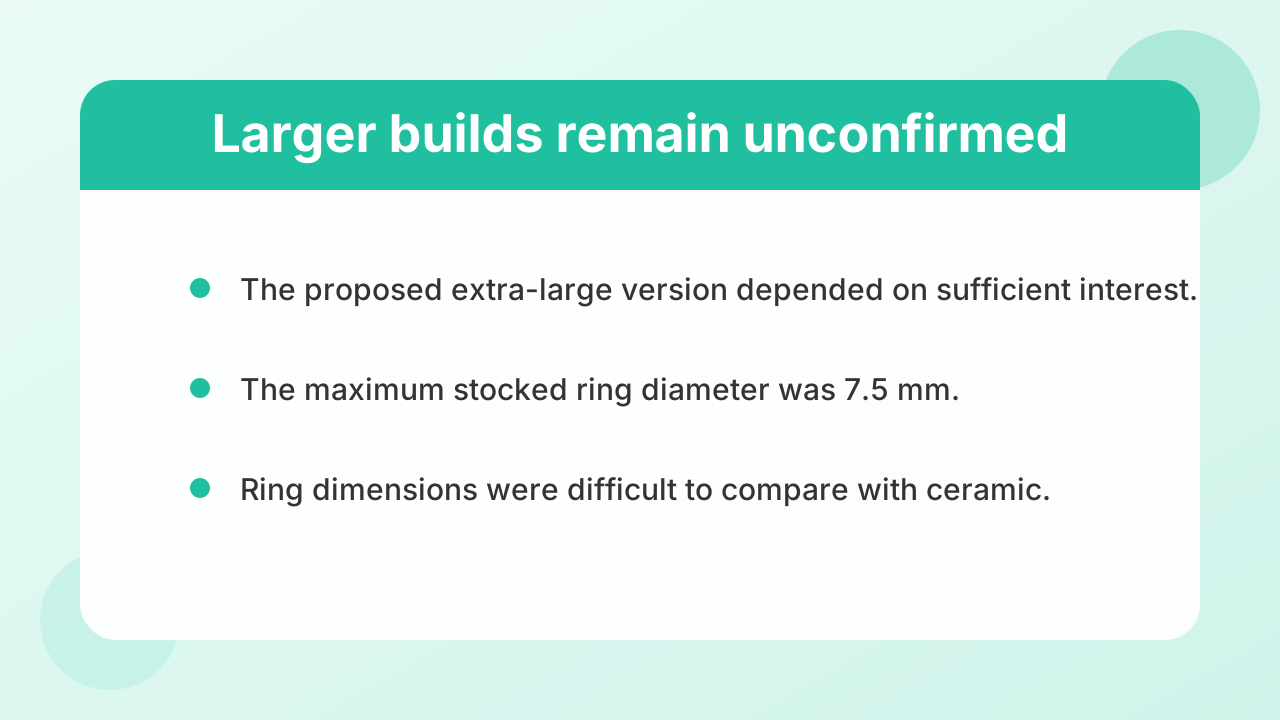
The diary's size questions involve both available shapes and differences between materials.
"Are larger ceramic chip sizes available beyond the standard L?"
The entry published in February 2020 described the long four-point ceramic twist as having 3 sizes: S, M, and L. Mr. Okada wrote that sales were concentrated in S and M, with L selling very little. This was his reason for doubting demand for an even larger version.
The proposed extra-large version depended on sufficient interest and was not described as ready to buy. The current product list contains no size options, so it does not establish the availability of that proposed size. Mr. Okada asked interested customers to specify the dimensions they wanted.
(Source: ok-lab's diary, published February 2020)
https://ok-lab.hatenablog.com/entry/2020/02/08/151653
"Why did the curved ceramic chip stop near its end?"
A separate customer exchange published in February 2021 concerned a chip the customer called "Fat". The customer asked why its final white section would not pass, despite the earlier parts fitting. Mr. Okada sought permission to publish the question and collect readers' experiences.
The customer agreed and clarified that the first two bulges passed, while the third did not. Mr. Okada's reply emphasized the chip's pronounced curve and referred to his own experience. The supplied material does not record whether this customer later managed to use that chip.
(Source: ok-lab's diary, published February 2021)
https://ok-lab.hatenablog.com/entry/2021/02/13/121440
"Would a ring chip solve a custom ceramic size request?"
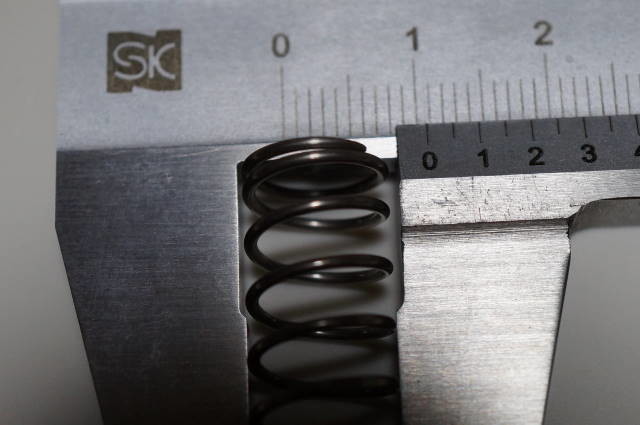
The February 2021 reply described a maximum stocked ring diameter of 7.5 mm and the possibility of a build based on a 10 mm ring. Mr. Okada explained that resin reinforcement made the actual chip 1–2 mm larger than the ring size. Those figures described the historical proposal, not confirmed options on today's product list.
According to Mr. Okada, the ring design's cylindrical shape and resistance made its dimensions difficult to compare with flat ceramic chips. He reported that people able to accommodate 12 mm flat ceramic chips had struggled with 7.5 mm ring chips. Mr. Okada offered the ring alternative for consideration with those reservations.
(Source: ok-lab's diary, published February 2021)
https://ok-lab.hatenablog.com/entry/2021/02/13/121440
Buying from outside Japan
OK Lab ships internationally to countries covered by Japan Post's EMS courier service. Overseas orders are paid in advance by PayPal. Each order carries a ¥400 (about $3 at ¥156 = $1, rate as of 2026-09-04) handling fee, and EMS shipping is charged on top. These terms come from OK Lab's official sales-terms page (written here as plain text, not a link: ok-lab.net/docs/law), checked on September 7, 2026; confirm them on the official store before you order, because they can change.
Summary of this article
| What you wanted to know | The answer |
|---|---|
| What is the short answer? | Mr. Okada says ceramic molds limit individual changes to size, shape, and bumps. |
| What is this product? | A small urethral device made and sold by OK Lab in Japan, priced in Japanese yen. |
| What do the manufacturing terms mean? | Molds shape the ceramic clay; twists and bumps describe features of the finished chip. |
| What happened when customers requested changes? | Replies included refusals, a demand-dependent size proposal, and a promised bump version. |
| What alternatives did the maker offer? | A ring-chip design for one oversized request, and resin construction for embedded electrical components. |
| What changed over time? | The diary recorded a 2022 development commitment and an August 2026 refusal to rearrange bumps. |
| Which related products are listed now? | The product tables identify current names and prices; historical custom options remain unconfirmed. |
| Can dimensions be compared across materials? | Mr. Okada reported different fitting difficulties with flat ceramic chips and cylindrical ring chips. |
| How can someone order from abroad? | The stated terms use advance PayPal payment, EMS shipping, and a ¥400 (about $3 at ¥156 = $1, rate as of 2026-09-04) handling fee. |
| What remains unknown? | The supplied entries do not establish completion or later availability of the proposed custom builds. |
Source: ok-lab's diary (Okada Comfortable Life Laboratory). The original entries are in Japanese; quotations on this page are translated. Photos and videos are on the original entries.
This article is a summary of the maker's development diary. The product is not a medical device and no result is guaranteed. If anything feels wrong or worries you, see a doctor. Prices, specifications and cautions change, so confirm the latest information on the official blog and the official site. Questions about ordering and shipping go to the seller.