![Will my ceramic chip come out the right size? | The maker allows for firing shrinkage [OK Prostate Chip]](/img/a/T0813/eyecatch.svg)
This page is based on entries from "ok-lab's diary" (https://ok-lab.hatenablog.com/), the Japanese development diary written by Mr. Okada, founder of OK Lab, a small company in Japan (Okada Comfortable Life Laboratory). Only the entries about "ceramic chip shrinkage" are summarized here, in order of publication. Past prices and sizes are as written at the time. Current prices come from the official product list (retrieved September 4, 2026). Quotations are translated from Japanese.
Note: This page is a personal reading log by someone with no connection to the maker or the seller. It reflects the source entries as of their publication dates and makes no guarantee of accuracy or safety. The product is not a medical device; talk to a doctor about any health decision. Check the official site for current information. This page contains advertising.
In short
- Mr. Okada reports that ceramic chips shrink during firing, and errors in the allowance can affect their finished size.
- His approach uses enlarged models and retained molds, with additional waiting time for custom ceramic work.
- The current list includes ceramic and resin models from the June 2019 discussion, without confirming its custom options.
If you see blood in your urine, even a small amount or for the first time, do not wait and see. See a urologist right away.
If you suddenly cannot urinate, or the device cannot be removed, do not try to fix it yourself. Go to a medical facility, including emergency care, immediately.
About this product

The OK Prostate Chip is a small device that is placed in the urethra (the urine passage) so that it acts on the prostate; the maker sells it in several shapes, sizes and materials. It is made and sold by OK Lab (Okada Comfortable Life Laboratory), a small company in Japan, through its own online store, and prices are in Japanese yen (JPY). The maker's development diary, "ok-lab's diary", is written in Japanese. This page is an English summary of it, and every quotation is translated. OK Lab ships internationally, so readers outside Japan can order (see "Buying from outside Japan" below). Product names on this page are plain-English descriptions. The official Japanese product name is shown once in the product table so you can find the same item in the store.
Before you read: key terms
| Term | Plain-English meaning |
|---|---|
| Urethra | The urine passage; it carries urine and is where the maker places the chip. |
| Firing | Heating clay until it becomes ceramic, used to produce the chip or plate. |
| Mold | A form used to shape clay, allowing a chip design to be reproduced. |
| Resin model | An original shape made from resin, used to create a mold for ceramic production. |
| Glaze | A glass-like surface coating, used to give ceramic a smooth finish. |
| Holding plate | A plate with an opening around part of the penis, used to hold it in the maker's described arrangements. |
| A–D test arrangements | The maker's labels for positions relative to the holding plate, used to distinguish his personal trials. |
What happens: ceramic chip shrinkage

The OK Prostate Chip is a small device placed in the urethra (the urine passage) to act on the prostate. For the ceramic versions, Mr. Okada reports a size change during firing (heating clay to make ceramic). That change affects the chip itself, which goes inside the urine passage. The entries also cover a ceramic holding plate (a plate around part of the penis), whose opening changed size during manufacture.
A ceramic chip sizing error left short pieces wider than intended
In an entry published in May 2019, Mr. Okada reported a batch of short ceramic chips measuring 11 mm across. He attributed their unexpected size to his own error in calculating shrinkage. The diary does not record the intended width of that batch.
He wrote that he was testing the oversized pieces himself. He thought the larger chips seemed less likely to slip out after he became accustomed to them. He described this only as an apparent advantage in his own testing.
(Source: ok-lab's diary, published May 2019)
https://ok-lab.hatenablog.com/entry/2019/05/11/152432
Custom ceramic chip sizes required an enlarged model and substantial waiting time
In an entry published in June 2019, a customer requested a ceramic semi-long chip with individually specified dimensions. Mr. Okada accepted custom work but distinguished it from existing molds (forms used to shape clay). He described a resin model (the original shape for making a mold) about 15% larger than the requested finished chip.
His estimate was at least 5 weeks, allowing for exchanges with the pottery teacher and both people's schedules. He said a firing fault meant remaking the piece, adding about 2 weeks before the replacement was fired. Mr. Okada asked customers to understand the delays involved in ceramic production.
(Source: ok-lab's diary, published June 2019)
https://ok-lab.hatenablog.com/entry/2019/06/01/155432
Ceramic firing shrinkage made an oversized prototype difficult to test
In an entry published in December 2021, Mr. Okada described testing an enlarged chip prototype. This prototype chip (nicknamed Angel's Touch) provided the original shape for a ceramic mold. He said he had made it bigger to allow for about 15% shrinkage during firing.
His account says the enlarged prototype was difficult to insert. The diary does not record the final dimensions of the fired ceramic chip. Mr. Okada explicitly warned against copying this experiment.
(Source: ok-lab's diary, published December 2021)
https://ok-lab.hatenablog.com/entry/2021/12/11/124426
Ceramic hole shrinkage preceded a difficult removal during Mr. Okada's trial
In an entry published in May 2023, Mr. Okada described the ceramic holding plate, a separate item from the internal chip. Its finished opening measured about 20 mm vertically and 15 mm horizontally; he said the dimensions were uncertain until firing ended.
He reported reaching his illustrated test arrangements (positions relative to the plate), labeled A, B, C and D, with that opening. About 1 hour after falling asleep, he experienced what he described as heart failure. He wrote that removing the plate took about 30 minutes. Mr. Okada judged arrangement D unsuitable for prolonged use with the 20 mm–15 mm opening.
(Source: ok-lab's diary, published May 2023)
https://ok-lab.hatenablog.com/entry/2023/05/20/123034
The maker's answer to ceramic chip shrinkage

Mr. Okada described allowing for shrinkage in advance, keeping molds for repeat orders and accounting for additional production time.
Ceramic chip shrinkage was allowed for before the finished piece existed
An entry published in May 2019 described an early firing stage at about 800 degrees. Mr. Okada reported shrinkage of about 13–15% at that stage. He said this was why the original resin shape had to be larger than the intended ceramic chip.
He described the partly fired material as stone-like, while still allowing the workshop to correct the final shape. He contrasted this flexibility with glass and resin chips, which he said could not be corrected after completion. Mr. Okada presented ceramic production as offering greater control over custom shapes.
(Source: ok-lab's diary, published May 2019)
https://ok-lab.hatenablog.com/entry/2019/05/04/162111
Reusable molds improved ceramic chip size consistency without guaranteeing identical pieces
In an entry published in May 2019, Mr. Okada said repeat orders could use the customer's previous mold. He said that reference allowed fairly precise adjustments when a replacement was requested larger or smaller. The retained mold could also help reproduce a previously featured custom design for a different customer.
For standard chips, he said the shared production process extended only through the mold stage. Work after that stage varied from piece to piece. Mr. Okada cautioned that even standard ceramic chips would therefore not be completely identical.
(Source: ok-lab's diary, published May 2019)
https://ok-lab.hatenablog.com/entry/2019/05/04/162111
Ceramic chip sizing requests took longer when a new mold was needed
In an entry published in June 2019, Mr. Okada set out different waiting periods for ceramic chip orders. He said pieces already supplied by the pottery teacher could be shipped in 7–10 days. An out-of-stock shape with an existing mold required about 2 weeks extra for firing.
A custom piece requiring a new mold needed about 2 weeks beyond that. He also allowed about 5 days for drying when a thread was embedded. Mr. Okada asked customers to allow for the production work their particular order required.
(Source: ok-lab's diary, published June 2019)
https://ok-lab.hatenablog.com/entry/2019/06/01/155432
If you see blood in your urine, even a small amount or for the first time, do not wait and see. See a urologist right away.
If you suddenly cannot urinate, or the device cannot be removed, do not try to fix it yourself. Go to a medical facility, including emergency care, immediately.
How ceramic chip shrinkage changed over time

| Published | What the diary said then |
|---|---|
| May 2019 | Enlarged models and reusable molds formed the basis of the ceramic production approach. |
| May 2019 | A shrinkage calculation error produced oversized short chips. |
| Jun 2019 | Delivery estimates distinguished stocked pieces, existing molds and entirely custom work. |
| Dec 2021 | A prototype enlarged for firing shrinkage proved difficult for Mr. Okada to test. |
| May 2023 | A small finished plate opening accompanied a difficult removal in Mr. Okada's account. |
The diary does not say what the current state is.
OK Prostate Chip products related to ceramic chip shrinkage

The current list confirms standard models discussed in June 2019, but it does not confirm the historical custom specifications.
Products that appear in these entries
| Product (official name) | Price incl. tax | Relation to this topic |
|---|---|---|
| Resin single-chip screw model (OKプロステートチップ 樹脂素材1チップタイプ スクリュー) | ¥4,400 (about $28 at ¥156 = $1, rate as of 2026-09-04) | In June 2019, the customer awaiting ceramic chips asked whether this resin screw model could be made with reversed twist. |
(Source: ok-lab's diary, published June 2019)
https://ok-lab.hatenablog.com/entry/2019/06/01/155432
Products the diary mentioned as alternatives
| Product (official name) | Price incl. tax | Relation to this topic |
|---|---|---|
| Ceramic semi-long chip (OKプロステートチップ 陶器素材セミロングタイプ) | ¥4,400 (about $28 at ¥156 = $1, rate as of 2026-09-04) | In June 2019, Mr. Okada suggested waiting for this ordinary ceramic model instead of commissioning a resin semi-long chip. |
The ceramic semi-long chip is listed in the company's own online store.
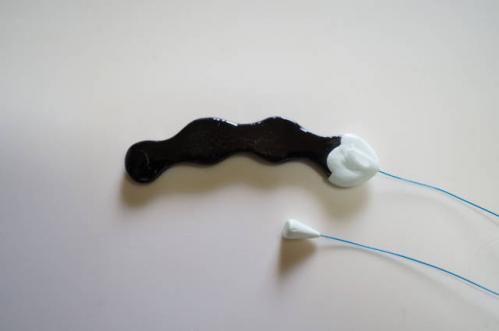
(Source: ok-lab's diary, published June 2019)
https://ok-lab.hatenablog.com/entry/2019/06/01/155432
For the historical oversized short chips, custom ceramic versions, enlarged chip prototype and ceramic holding plate:
No matching product can be confirmed on the current list.
Common worries about ceramic chip shrinkage

The June 2019 questions concerned custom dimensions, an unfinished thread opening and whether to wait for a ceramic model.
"Can custom ceramic chip sizes match a detailed request?"
In an entry published in June 2019, the customer specified a ceramic semi-long chip 43 mm long. The requested tip and narrow section were each 6 mm, with a 10 mm prostate section and 11 mm rear section.
Mr. Okada thought the requested shape was feasible. The diary does not record whether this custom ceramic order was completed. His reply cautioned that overly thin ceramic sections could present strength problems.
(Source: ok-lab's diary, published June 2019)
https://ok-lab.hatenablog.com/entry/2019/06/01/155432
"Does ceramic firing leave the thread opening without glaze?"
In an entry published in June 2019, the customer wanted a ceramic chip with a hole but no permanently embedded thread. Mr. Okada initially said the opening still needed resin coating because it lacked glaze (a glass-like surface coating). He explained that the bare area was needed to support the chip during firing.
When asked further, he said the chip could instead be supplied with the rough opening unchanged. The diary does not record delivery or subsequent use of that version. Mr. Okada's later offer was conditional on the customer accepting that unfinished surface.
(Source: ok-lab's diary, published June 2019)
https://ok-lab.hatenablog.com/entry/2019/06/01/155432
"Could a ceramic semi-long chip replace the requested resin version?"
In an entry published in June 2019, the customer expressed concern about glass and asked whether a resin semi-long chip could be made. Mr. Okada said it could, quoting ¥3,240 (about $21 at ¥156 = $1, rate as of 2026-09-04) for that custom resin version. He expected the ordinary ceramic semi-long model to launch that June.
The customer said waiting sounded sensible, although they might also wait for other customers' experiences. The diary does not record whether that purchase happened. Mr. Okada's advice in this exchange was to wait for the anticipated ceramic release.
(Source: ok-lab's diary, published June 2019)
https://ok-lab.hatenablog.com/entry/2019/06/01/155432
Buying from outside Japan

OK Lab ships internationally to countries covered by Japan Post's EMS courier service. Overseas orders are paid in advance by PayPal. Each order carries a ¥400 (about $3 at ¥156 = $1, rate as of 2026-09-04) handling fee, and EMS shipping is charged on top. These terms come from OK Lab's official sales-terms page (written here as plain text, not a link: ok-lab.net/docs/law), checked on September 7, 2026; confirm them on the official store before you order, because they can change.
Summary of this article
| What you wanted to know | The answer |
|---|---|
| What is the short answer about shrinkage? | Mr. Okada reports firing shrinkage and allows for it before producing the finished ceramic piece. |
| What is the product, and who makes it? | The OK Prostate Chip is a urethral device made by OK Lab in Japan; store prices are in JPY. |
| What do the manufacturing terms mean? | A resin model supplies the original shape, a mold shapes the clay, and firing turns it into ceramic. |
| What problems appeared in the entries? | The diary records oversized chips, a difficult prototype test and difficult removal of a separate ceramic plate. |
| What was the maker's answer? | Larger original models, retained molds and production schedules that account for the work still required. |
| How did the account develop? | The entries move from ceramic production explanations in 2019 to prototype testing in 2021 and a plate trial in 2023. |
| Which related products have current prices? | The listed resin screw and ceramic semi-long models each cost ¥4,400 (about $28 at ¥156 = $1, rate as of 2026-09-04) including tax; historical custom specifications remain unconfirmed. |
| What did the customer ask? | The June 2019 exchange covered specific dimensions, an opening without embedded thread and waiting for the ceramic semi-long model. |
| How can someone outside Japan order? | The stated terms use advance PayPal payment, a ¥400 (about $3 at ¥156 = $1, rate as of 2026-09-04) handling fee and additional Japan Post EMS shipping charges. |
Source: ok-lab's diary (Okada Comfortable Life Laboratory). The original entries are in Japanese; quotations on this page are translated. Photos and videos are on the original entries.
This article is a summary of the maker's development diary. The product is not a medical device and no result is guaranteed. If anything feels wrong or worries you, see a doctor. Prices, specifications and cautions change, so confirm the latest information on the official blog and the official site. Questions about ordering and shipping go to the seller.