![Can ceramic chips be made to order? | Molds help, but shape and timing limit custom work [OK Prostate Chip]](/img/a/T0812/eyecatch.svg)
This page is based on entries from "ok-lab's diary" (https://ok-lab.hatenablog.com/), the Japanese development diary written by Mr. Okada, founder of OK Lab (Okada Comfortable Life Laboratory). Only the entries about "ceramic chip development and homemade molds" are summarized here, in order of publication. Past prices and sizes are as written at the time. Current prices come from the official product list (retrieved September 4, 2026). Quotations are translated from Japanese.
Note: This page is a personal reading log by someone with no connection to the maker or the seller. It reflects the source entries as of their publication dates and makes no guarantee of accuracy or safety. The product is not a medical device; talk to a doctor about any health decision. Check the official site for current information. This page contains advertising.
In short
- OK Lab, a small company in Japan, developed ceramic chips after glass breakage reports and difficult early production.
- Mr. Okada developed reusable molds, while acknowledging limits involving strength, complex shapes, and production time.
- The current list includes ceramic products, but does not confirm every historical prototype or custom specification.
About this product

The OK Prostate Chip is a small device that is placed in the urethra (the urine passage) so that it acts on the prostate; the maker sells it in several shapes, sizes and materials. It is made and sold by OK Lab (Okada Comfortable Life Laboratory), a small company in Japan, through its own online store, and prices are in Japanese yen (JPY). The maker's development diary, "ok-lab's diary", is written in Japanese. This page is an English summary of it, and every quotation is translated. OK Lab ships internationally, so readers outside Japan can order (see "Buying from outside Japan" below). Product names on this page are plain-English descriptions. The official Japanese product name is shown once in the product table so you can find the same item in the store.
Before you read: key terms
| Term | Plain-English meaning |
|---|---|
| Urethra | The urine passage, where the maker intends the device to be placed. |
| Mold | A shaped form used to reproduce a chip design in clay. |
| Resin master | A model used as the basis for a ceramic chip mold. |
| Glaze | A surface coating used to give ceramic chips a smooth finish. |
| Firing | Heating ceramic in a pottery oven as part of producing the finished piece. |
What happens: custom ceramic chips
The OK Prostate Chip is a small device placed in the urethra, the urine passage. The ceramic versions discussed here are shaped components made with purpose-built molds, which hold clay while a design takes form. These molds are production tools; the finished ceramic parts are the components intended for the body. Mr. Okada explored ceramic to address glass breakage and make custom shapes easier to reproduce.
Early ceramic chips had proposed prices alongside resin and glass versions
In an entry published in March 2019, Mr. Okada showed a comma-shaped ceramic chip that remained a prototype. Planned short versions cost ¥4,000 (about $26 at ¥156 = $1, rate as of 2026-09-04) in resin, ¥5,000 (about $32 at ¥156 = $1, rate as of 2026-09-04) in glass, and ¥5,000 (about $32 at ¥156 = $1, rate as of 2026-09-04) in ceramic, all tax excluded.
Planned medium-length glass and ceramic versions each cost ¥6,000 (about $38 at ¥156 = $1, rate as of 2026-09-04), tax excluded. Other versions were to cost the existing chip price plus ¥2,000 (about $13 at ¥156 = $1, rate as of 2026-09-04), tax excluded. No matching product can be confirmed on the current list.
(Source: ok-lab's diary, published March 2019)
https://ok-lab.hatenablog.com/entry/2019/03/30/160657
Glass breakage prompted interest in ceramic chips without establishing their safety
In April 2019, a customer requested investigation after glass damage appeared following about 1 hour with an electronically controlled vibrating chip. The customer reported no injury; Mr. Okada suspected cracking that could occur dozens of days after manufacture. He thought larger glass chips faced greater risk because longer processing could accumulate internal strain; he offered replacement but acknowledged no fundamental solution.
Mr. Okada thought ceramic could break under impact, but might resist spontaneous breakage and be less likely to produce sharp edges. He described resin as the only safe material then; the customer requested resin instead, but the diary does not confirm replacement delivery. Mr. Okada advised the customer to consider these limitations when deciding about the pending order.
(Source: ok-lab's diary, published April 2019)
https://ok-lab.hatenablog.com/entry/2019/04/27/153239
Small ceramic chips needed molds that released clay before drying
In another passage published in April 2019, Mr. Okada explained why ceramic chips had been difficult to introduce. He had initially chosen glass because ceramic required too many production stages. Even trials with a ceramics specialist struggled with cost, while tiny pieces cracked during drying.
He reported developing a mold, a shaped form for reproducing a design, that released the clay before it dried. Mr. Okada said the ceramics specialist found it useful and planned to introduce ceramic chips later that year.
(Source: ok-lab's diary, published April 2019)
https://ok-lab.hatenablog.com/entry/2019/04/27/153239

Long twisted ceramic chips remained prototypes awaiting production in December 2019
In an entry published in December 2019, Mr. Okada announced a long four-point twist ceramic prototype. Its predicted length was 55mm, with a front bulge 9mm wide, a prostate-positioned bulge 10mm, and a rear bulge about 10.5mm.
The mold was still drying, and production by the ceramics specialist had yet to start. These were expected dimensions; the entry did not report measurements of a finished ceramic piece. No matching product can be confirmed on the current list.
(Source: ok-lab's diary, published December 2019)
https://ok-lab.hatenablog.com/entry/2019/12/14/151232
Requests for shorter ceramic chips led to six planned textured designs
In an entry published in September 2020, a customer requested shorter textured ceramic chips because longer, more curved designs caused discomfort. Mr. Okada responded with 6 planned designs, including short and medium-length versions. He showed resin models, with ceramic molds and firing (heating in a pottery oven) still ahead.
Mr. Okada expected the additions to appear about 3 weeks later. The diary does not record whether the customer received or tried those proposed versions. No matching product can be confirmed on the current list.
(Source: ok-lab's diary, published September 2020)
https://ok-lab.hatenablog.com/entry/2020/09/26/124400
New ceramic chips needed enough sales to cover their mold costs
In an entry published in November 2020, a customer proposed a plain-tipped ceramic design (Umiushi ver.5) to test a particular shape. Mr. Okada accepted the revised design and expected completion around Christmas. He planned to retain its components for other products even if the customer's experiment failed.
He explained that mold costs required sales of about 10 identical pieces to avoid a loss. The diary does not record whether the customer's hoped-for result occurred. No matching product can be confirmed on the current list.
(Source: ok-lab's diary, published November 2020)
https://ok-lab.hatenablog.com/entry/2020/11/21/130647
The maker's answer to custom ceramic chips
Reusable molds helped with repeat orders, but did not remove limits involving production time, strength, or difficult shapes.
Saved ceramic chip molds allowed repeat orders without guaranteeing identical results
In an entry published in May 2019, Mr. Okada described keeping individual ceramic chip molds for repeat orders. A resin master (a model used to create a mold) allowed corrections before ceramic production. The saved mold could carry the date and requested dimensions, giving later orders a reference.
He wrote that repeats could be almost identical, while requested size changes could be assessed against the earlier mold. Mr. Okada also said glaze (a surface coating) could give finished ceramic a glass-like feel. He cautioned that individual finishing meant even standard products were not completely identical.
(Source: ok-lab's diary, published May 2019)
https://ok-lab.hatenablog.com/entry/2019/05/04/162111
Custom ceramic chips required longer waits when new molds were needed
In June 2019, Mr. Okada warned that thin ceramic could lack strength; only 9 designs qualified for normal production times. Custom designs requiring new molds needed at least 5 weeks, he said. Firing trouble could add about 2 weeks because the piece would need to be made again.
For ceramic pieces already supplied by the specialist, thread attachment and drying meant dispatch in 7–10 days. Out-of-stock designs needed about 2 extra weeks for firing, even when their molds already existed. Mr. Okada asked customers to allow for these production delays.
(Source: ok-lab's diary, published June 2019)
https://ok-lab.hatenablog.com/entry/2019/06/01/155432
Delicate ceramic chips still raised strength concerns after a prototype appeared
In an entry published in July 2021, Mr. Okada considered an illustrator's complex design and possible ceramic manufacturing routes. He then raised concerns about ceramic strength and expressed hope for titanium. An entry published in December 2021 showed his decorative prototype (Angel's Touch), with ceramic production still proposed.
He thought its many thin sections could prevent manufacture and said the rear section needed greater thickness. The diary does not record whether a finished ceramic version was produced. No matching product can be confirmed on the current list.
(Source: ok-lab's diary, published July 2021)
https://ok-lab.hatenablog.com/entry/2021/07/31/125702
(Source: ok-lab's diary, published December 2021)
https://ok-lab.hatenablog.com/entry/2021/12/04/124140
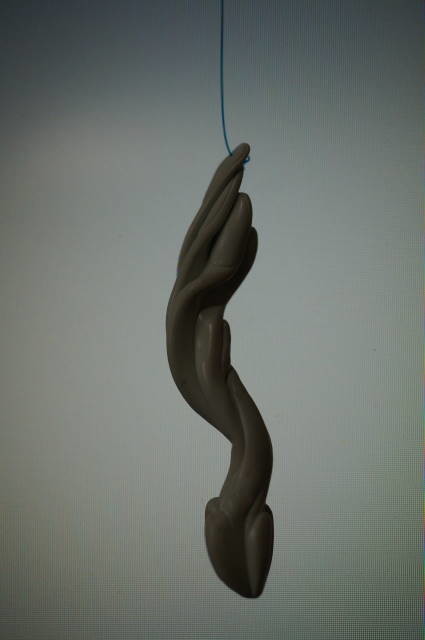
How custom ceramic chips changed over time
| Published | What the diary said then |
|---|---|
| Mar 2019 | Mr. Okada planned ceramic because decorative holes were relatively easy to make. |
| Apr 2019 | Custom ceramic orders were expected to take more than a month. |
| May 2019 | Mr. Okada reported 13–15% shrinkage during an early firing stage. |
| Feb 2020 | Three twist sizes existed; Mr. Okada reported little demand for L. |
| Sep 2020 | Bumps became larger after the ceramics specialist reported difficulty making tiny ones. |
| Nov 2020 | Large short and medium-length textured versions were planned for completion before Christmas. |
| Jul 2021 | Mr. Okada considered about a month of work on a resin model. |
| Dec 2021 | Specialist finishing was considered for details beyond the mold's rough outline. |
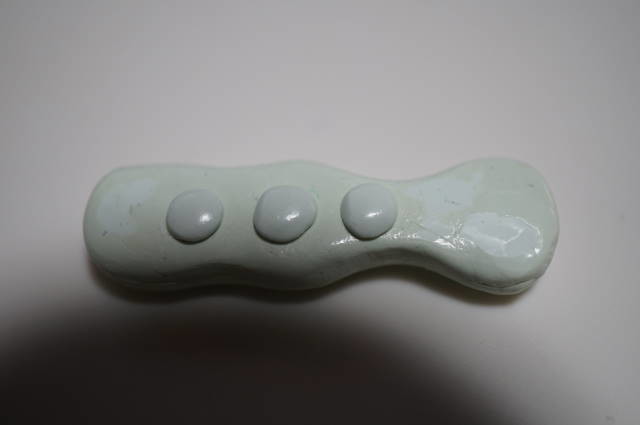
The diary does not say what the current state is.
OK Prostate Chip products related to custom ceramic chips
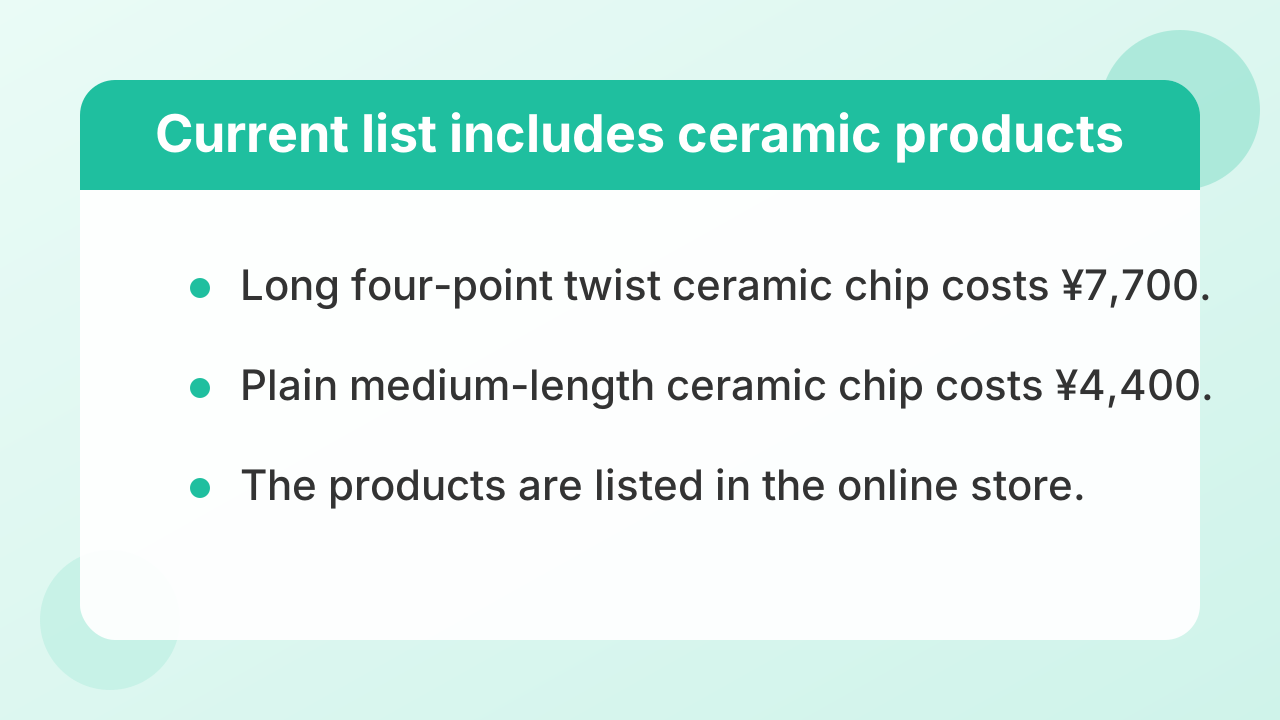
The current list includes the long four-point twist ceramic chip and the plain medium-length ceramic chip.
Products that appear in these entries
| Product (official name) | Price incl. tax | Relation to this topic |
|---|---|---|
| Long four-point twist ceramic chip (OKプロステートチップ 陶器素材ロングタイプ 4点ツイスト) | ¥7,700 (about $49 at ¥156 = $1, rate as of 2026-09-04) | In February 2020, a customer requested a size beyond the existing largest version, prompting Mr. Okada's explanation of mold costs. |
The long four-point twist ceramic chip is listed in the company's own online store.
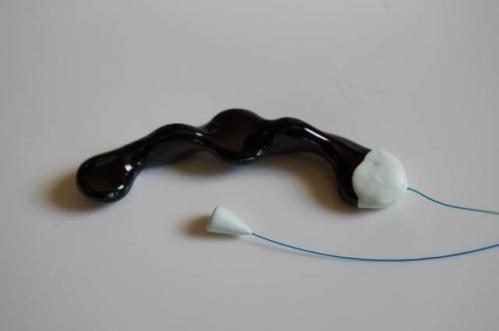
(Source: ok-lab's diary, published February 2020)
https://ok-lab.hatenablog.com/entry/2020/02/08/151653
Products the diary mentioned as alternatives
| Product (official name) | Price incl. tax | Relation to this topic |
|---|---|---|
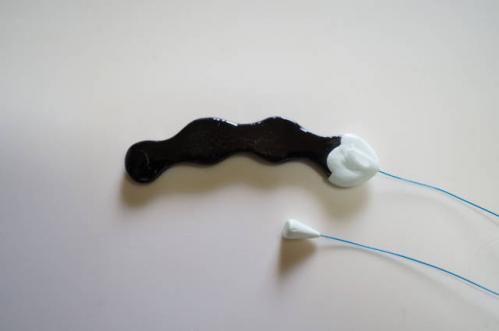
| Plain medium-length ceramic chip (OKプロステートチップ 陶器素材セミロングタイプ) | ¥4,400 (about $28 at ¥156 = $1, rate as of 2026-09-04) | In June 2019, Mr. Okada suggested awaiting this planned release instead of ordering a custom resin medium-length chip. |
The plain medium-length ceramic chip is listed in the company's own online store.
(Source: ok-lab's diary, published June 2019)
https://ok-lab.hatenablog.com/entry/2019/06/01/155432
Common worries about custom ceramic chips
"Could customers order ceramic chips while the launch was pending?"
In an entry published in June 2019, a reader worried about glass asked whether a resin medium-length chip could be made. Mr. Okada said yes and quoted ¥3,240 (about $21 at ¥156 = $1, rate as of 2026-09-04). No matching product can be confirmed on the current list.
He had no immediate plans for ceramic screw or twist shapes, but expected the plain medium-length ceramic chip to launch that June. The customer agreed that waiting sounded preferable, although they might first wait for other buyers' accounts. Mr. Okada suggested waiting for the plain ceramic version instead.
(Source: ok-lab's diary, published June 2019)
https://ok-lab.hatenablog.com/entry/2019/06/01/155432
"Why did ceramic chips have an unglazed thread hole?"
In an entry published in June 2019, the customer asked for a hole without a permanently attached thread. Mr. Okada agreed, but initially said the hole still needed resin coating. He explained that full glaze coverage would make the chip stick to the kiln or shelves; heat-resistant wire supported it through an unglazed hole.
He compared that rough, dull area to the underside of a bowl. The diary does not record whether the requested ceramic order was completed. Mr. Okada later offered an unfinished hole if the customer accepted its rough surface.
(Source: ok-lab's diary, published June 2019)
https://ok-lab.hatenablog.com/entry/2019/06/01/155432
"Why were larger twisted ceramic chips difficult to order?"
In an entry published in February 2020, a customer requested a long four-point twist ceramic chip larger than the existing L. Mr. Okada replied that three-dimensional molds were much harder to make than molds for flatter shapes. A single custom piece was too costly with his production methods at that time.
The customer accepted that immediate manufacture was difficult and supplied the requested dimensions. The diary does not record whether that larger design reached production. Mr. Okada offered to begin if 3 buyers requested that size.
(Source: ok-lab's diary, published February 2020)
https://ok-lab.hatenablog.com/entry/2020/02/08/151653
Buying from outside Japan

OK Lab ships internationally to countries covered by Japan Post's EMS courier service. Overseas orders are paid in advance by PayPal. Each order carries a ¥400 (about $3 at ¥156 = $1, rate as of 2026-09-04) handling fee, and EMS shipping is charged on top. These terms come from OK Lab's official sales-terms page (written here as plain text, not a link: ok-lab.net/docs/law), checked on September 7, 2026; confirm them on the official store before you order, because they can change.
Summary of this article
| What you wanted to know | The answer |
|---|---|
| Why develop ceramic chips? | Glass failures and difficult early production drove the work. |
| What is the base product? | A urethral device made and sold by OK Lab in Japan. |
| What do the manufacturing terms mean? | Molds reproduce shapes; glaze provides a surface finish. |
| What did the development entries establish? | Proposed prices, prototype dimensions, production problems, and the cost of new molds. |
| What was the maker's response? | Reusable molds helped repeat orders, while difficult shapes and production delays remained limits. |
| What changed over time? | Ceramic plans expanded to twisted, textured, and more elaborate designs. |
| Which related products appear on the current list? | The long four-point twist and plain medium-length ceramic chips. |
| What did customers ask? | Questions about availability, unfinished thread holes, and larger custom sizes. |
| How do overseas orders work? | Advance PayPal payment, a handling fee, and additional EMS shipping charges apply. |
Source: ok-lab's diary (Okada Comfortable Life Laboratory). The original entries are in Japanese; quotations on this page are translated. Photos and videos are on the original entries.
This article is a summary of the maker's development diary. The product is not a medical device and no result is guaranteed. If anything feels wrong or worries you, see a doctor. Prices, specifications and cautions change, so confirm the latest information on the official blog and the official site. Questions about ordering and shipping go to the seller.