![Can silicone irritate the urethra? | The maker reports friction problems [OK Prostate Chip]](/img/a/T0807/eyecatch.svg)
This page is based on entries from "ok-lab's diary" (https://ok-lab.hatenablog.com/), the Japanese development diary written by Mr. Okada, founder of OK Lab, a small company in Japan (Okada Comfortable Life Laboratory). Only the entries about "silicone and urethral irritation" are summarized here, in order of publication. Past prices and sizes are as written at the time. Current prices come from the official product list (retrieved September 4, 2026). Quotations are translated from Japanese.
This article is about soft materials in the urine passage, and summarizes the maker's testing, designs, and customer concerns. It includes alternative materials, current products, and buying from outside Japan.
Note: This page is a personal reading log by someone with no connection to the maker or the seller. It reflects the source entries as of their publication dates and makes no guarantee of accuracy or safety. The product is not a medical device; talk to a doctor about any health decision. Check the official site for current information. This page contains advertising.
In short
- Mr. Okada reports silicone friction and irritation, particularly when moisture declines during prolonged contact.
- His responses include thinner components, reduced silicone exposure, and stopping unsuitable designs.
- The current list includes a slide-lock retainer named in a qualified alternative proposal.
If you see blood in your urine, even a small amount or for the first time, do not wait and see. See a urologist right away. If you suddenly cannot urinate, or the device cannot be removed, do not try to fix it yourself. Go to a medical facility, including emergency care, immediately.
About this product

The OK Prostate Chip is a small device that is placed in the urethra (the urine passage) so that it acts on the prostate; the maker sells it in several shapes, sizes and materials. It is made and sold by OK Lab (Okada Comfortable Life Laboratory), a small company in Japan, through its own online store, and prices are in Japanese yen (JPY).
The maker's development diary, "ok-lab's diary", is written in Japanese. This page is an English summary of it, and every quotation is translated.
OK Lab ships internationally, so readers outside Japan can order (see "Buying from outside Japan" below). Product names on this page are plain-English descriptions. The official Japanese product name is shown once in the product table so you can find the same item in the store.
Before you read: key terms
| Term | Plain-English meaning |
|---|---|
| Silicone | A soft material used to make flexible coatings, connecting joints, and chip-support tubes. |
| Parallel cable | Electrical wires running alongside each other, used for power or mechanical support in these designs. |
| Nitinol | Shape-memory wire used to support a flexible connection and help determine its shape. |
| Resin | A material used for hard coatings and raised surfaces intended to limit silicone contact. |
| Epoxy | A resin used to cover wires and reduce direct silicone contact. |
| Elastomer | A soft, bendable material tested as an alternative chip material. |
| Bougie | A supporting instrument; the version discussed here was intended to move a chip. |
| Sphincter | A muscle described as gripping the chip and helping hold it in position. |
| Lubricant | A substance used to reduce friction between the device and the urethra. |
| Male pessary | A flexible silicone tube support intended to keep a chip in place. |
What happens: silicone urethral irritation
The OK Prostate Chip is a small device placed in the urethra to act on the prostate. These entries examine silicone, a soft material used for prototype chip surfaces, connecting joints, and tubes supporting chips inside the urine passage. Mr. Okada wanted the parts to bend while helping chips stay in position. His reports distinguish brief contact from longer periods when he believed moisture loss increased friction.
Early prototypes developed silicone friction problems during prolonged contact
In an entry published in October 2017, Mr. Okada described silicone prototypes that worked well during brief, lubricated tests. Longer wear brought moisture loss, and he found the surfaces could not handle repeated friction. He favored glass in those conditions, while warning that glass chips could break and carried risks.
(Source: ok-lab's diary, published October 2017)
https://ok-lab.hatenablog.com/entry/20171005/1507210406
Silicone irritation appeared after several days with coated glass
In an entry published in January 2018, Mr. Okada described glass coated with 100% silicone from a United States manufacturer. Initial comfort gave way to unusual urethral irritation after several days. He did not identify the cause and cautioned that silicone seemed poorly suited to the urethral lining (the urine passage's inner surface).
(Source: ok-lab's diary, published January 2018)
https://ok-lab.hatenablog.com/entry/20180111/1515662782
Thin coatings prompted different impressions of rubber friction than wider surfaces
In an entry published in February 2021, Mr. Okada described comfortable testing of 0.5 mm wire coated to about 2 mm. He thought rubber 6 mm or wider would irritate more than bare 6 mm wire. These were his impressions, with durability still unknown.
As published in February 2021, coating cost ¥500 (about $3 at ¥156 = $1, rate as of 2026-09-04) excluding tax for up to 10 cm. The 11–20 cm bracket cost ¥1,000 (about $6 at ¥156 = $1, rate as of 2026-09-04) excluding tax. He cautioned that coverage was uneven and exposed wire was unacceptable.
(Source: ok-lab's diary, published February 2021)
https://ok-lab.hatenablog.com/entry/2021/02/13/121440
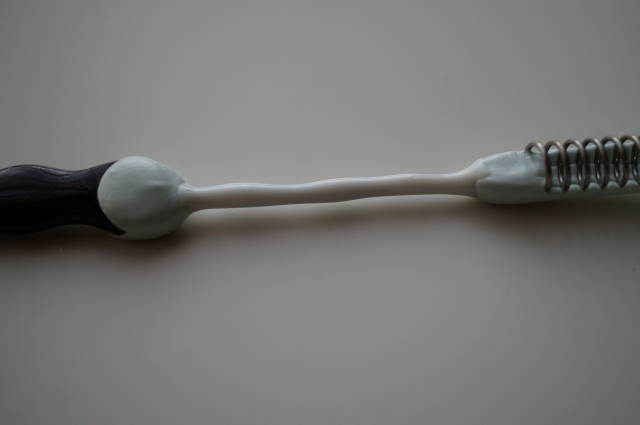
Recurring silicone tube pain ended plans for a longer retainer
In an entry published in April 2022, Mr. Okada described severe pain after several hours with a long silicone tube. Pain disappeared completely in repeat tests involving water, then returned over time. He suspected sticking between silicone and the lining as moisture declined.
He reported no discomfort around 2 cm inside the penis head, but discomfort with 7 cm extending farther. Mr. Okada rejected that long-tube retainer (Gatekeeper) for prolonged wear and decided not to sell it.
(Source: ok-lab's diary, published April 2022)
https://ok-lab.hatenablog.com/entry/2022/04/23/123121
Silicone friction concerns shaped a thin, flexible wire-filled tube
In an entry published in August 2022, Mr. Okada described silicone tubing measuring 3 mm outside and 2 mm inside. It contained doubled 0.3 mm wire intended to provide flexible support. He reported no discomfort with that narrow design.
The connection cost ¥1,000 (about $6 at ¥156 = $1, rate as of 2026-09-04) excluding tax through 20 cm, plus ¥500 (about $3 at ¥156 = $1, rate as of 2026-09-04) excluding tax per additional 10 cm, as published in August 2022. He warned that eventual wire breakage marked the product's end of life.
(Source: ok-lab's diary, published August 2022)
https://ok-lab.hatenablog.com/entry/2022/08/06/123150
Silicone friction remained concerning in the newer covered cable
In an entry published in October 2023, Mr. Okada introduced a silicone-covered parallel cable (electrical wires running alongside each other). Tube covering added ¥2,000 (about $13 at ¥156 = $1, rate as of 2026-09-04) excluding tax to the product price as published in October 2023.
The covered section was limited to 25 cm, with the whole cable within 40 cm. He warned that contact with an unmoistened lining could stop the silicone surface from moving.
(Source: ok-lab's diary, published October 2023)
https://ok-lab.hatenablog.com/entry/2023/10/14/122718
Silicone joint problems prompted a replacement with added wire support
In an entry published in January 2026, a customer requested an older angled, rubber-coated connection. OK Lab said its nylon-core design had effectively been discontinued because stability, peeling, and angle control were problems. Mr. Okada then prototyped a joint combining thread and nitinol (shape-memory wire).
As published in January 2026, the movable connection added ¥3,000 (about $19 at ¥156 = $1, rate as of 2026-09-04) excluding tax above a standard chip with screw support. The diary does not record whether that customer's order was completed. OK Lab said similar shapes could be considered with added wire support.
(Source: ok-lab's diary, published January 2026)
https://ok-lab.hatenablog.com/entry/2026/01/24/122909
Silicone joint pain remained a concern despite comfortable support
In an entry published in February 2026, a customer described pain even from silicone around ceramic chips' thread connections. They reported strong resistance with a movable-joint chip during entry and removal, despite comfortable support once positioned. Afterward, they reported almost no pain when urinating and suspected reduced silicone contact had helped.
Mr. Okada's reply focused on the handling difficulties. He proposed a more flexible joint in response.
(Source: ok-lab's diary, published February 2026)
https://ok-lab.hatenablog.com/entry/2026/02/07/122919
Rubber friction complicated withdrawal of a newer chip-pushing aid
In an entry published in March 2026, Mr. Okada described a rubber-membrane pushing aid (Apple bougie Ver.3). A bougie here is a supporting instrument intended to move a chip; this version gripped a wider range of shapes.
As published in March 2026, it cost ¥7,000 (about $45 at ¥156 = $1, rate as of 2026-09-04) excluding tax up to 20 cm or ¥9,000 (about $58 at ¥156 = $1, rate as of 2026-09-04) excluding tax up to 30 cm. Mr. Okada warned that it was unsuitable for people troubled by rubber, and its friction complicated withdrawal.
(Source: ok-lab's diary, published March 2026)
https://ok-lab.hatenablog.com/entry/2026/03/21/122906
The maker's answer to silicone urethral irritation
Mr. Okada explored thinner coatings, shorter silicone exposure, different materials, and raised surfaces around joints.
Thin cables prompted a qualified exception for silicone friction
In an entry published in March 2019, Mr. Okada replaced a vinyl-coated cable measuring 1 mm, with 6 internal strands. Its silicone-coated replacement measured 1.2 mm and contained 24 strands. He considered this narrow cable less concerning because he expected little strong friction against the lining.
(Source: ok-lab's diary, published March 2019)
https://ok-lab.hatenablog.com/entry/2019/03/23/173222
A shorter fixing sleeve offered an option for silicone irritation
In an entry published in October 2023, Mr. Okada proposed a slide-lock urethral retainer using only a short silicone sleeve near the entrance. The retainer (Gatekeeper) was intended to hold an existing vibrating or electrode chip's cable. He suggested this arrangement for people troubled by silicone tubes, while cautioning that cable bending could still allow some chip movement.
(Source: ok-lab's diary, published October 2023)
https://ok-lab.hatenablog.com/entry/2023/10/28/122832
Soft elastomer did not resolve the maker's silicone irritation concern
In an entry published in March 2024, Mr. Okada tested an elastomer (a soft, bendable material) chip. He felt more lining irritation than with other chips, although the unfinished surface might have contributed.
He ranked glass, ceramic, and hard resin (a coating material) ahead of silicone and elastomer for sliding. He cautioned that people troubled by silicone tubes might face similar problems with elastomer.
(Source: ok-lab's diary, published March 2024)
https://ok-lab.hatenablog.com/entry/2024/03/02/123027
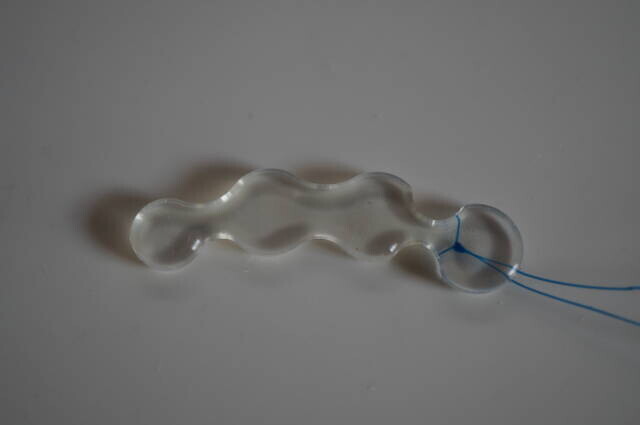
Resin ridges addressed silicone irritation around a movable joint
In a separate prototype published in January 2026, Mr. Okada placed resin ridges beside a 5 mm rubber joint. He expected the raised surfaces to take most of the contact with the lining. He proposed this design for a customer who reported that silicone did not suit their skin.
(Source: ok-lab's diary, published January 2026)
https://ok-lab.hatenablog.com/entry/2026/01/24/122909
If you see blood in your urine, even a small amount or for the first time, do not wait and see. See a urologist right away. If you suddenly cannot urinate, or the device cannot be removed, do not try to fix it yourself. Go to a medical facility, including emergency care, immediately.
How silicone urethral irritation changed over time
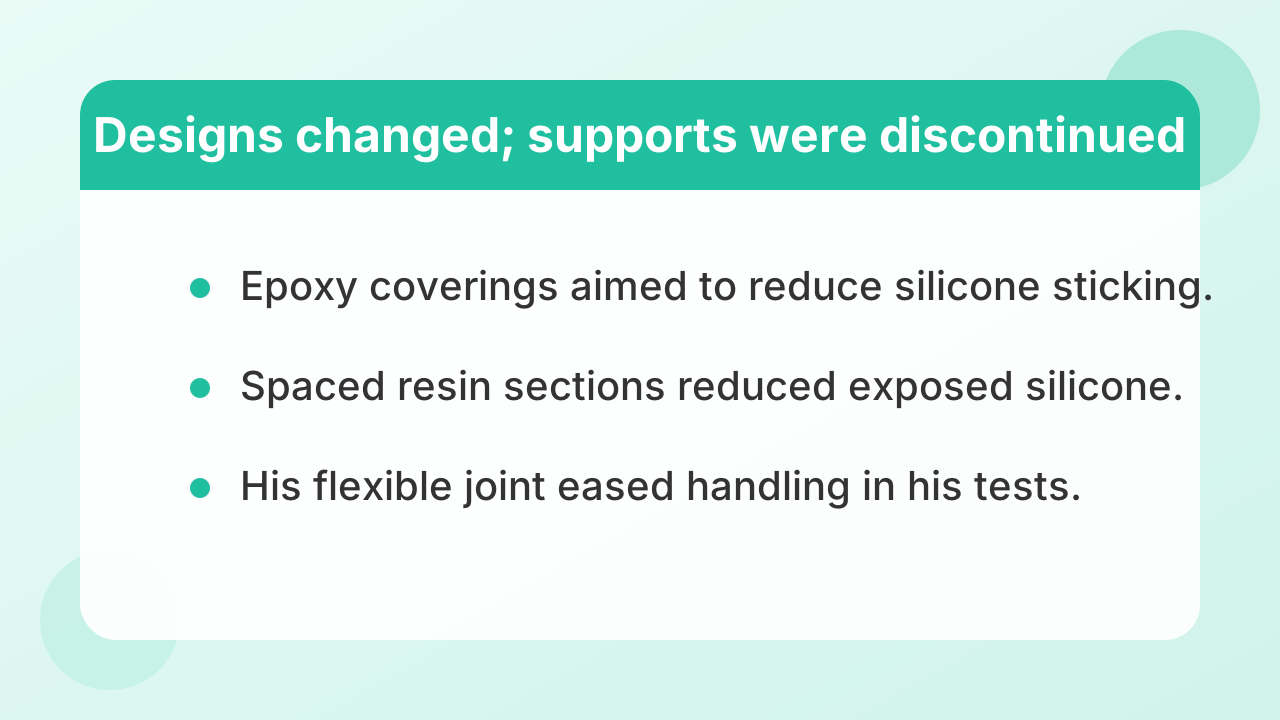
| Published | What the diary said then |
|---|---|
| Mar 2018 | An external silicone stopper appeared, but its material and shape were marked as superseded. |
| Feb 2022 | A silicone-coated prototype stayed still during testing; longer testing was planned. |
| Jun 2022 | Epoxy (a resin) coverings aimed to reduce silicone sticking and pressure from straightening. |
| Aug 2022 | Wire-filled tube replacement was generally refused because the chip could break. |
| Oct 2022 | A floating-wire cable introduced broader bending and epoxy contact surfaces. |
| Oct 2023 | Earlier four-wire, six-wire, and loop-support designs had been discontinued over durability concerns. |
| Feb 2024 | Spaced resin sections reduced exposed silicone on a prototype tail. |
| Feb 2025 | Mr. Okada described a hybrid wire-and-cable design with flexibility and low friction. |
| Feb 2026 | His more flexible joint eased handling in his tests, with milder pressure. |
| Mar 2026 | Mr. Okada found the earlier pushing aid easier to withdraw without rubber friction. |
OK Prostate Chip products related to silicone urethral irritation
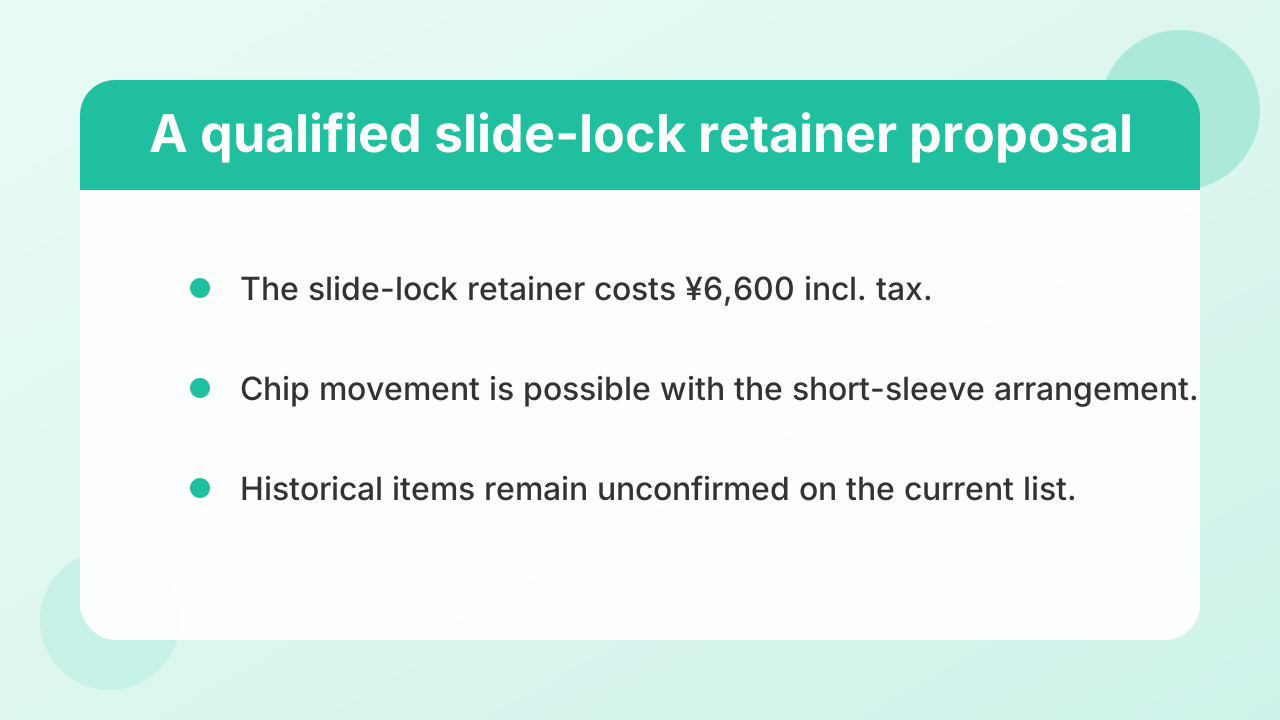
The listed slide-lock retainer appears in a qualified proposal for limiting silicone exposure.
Products that appear in these entries
No current product appears in these entries.
Products the diary mentioned as alternatives
| Product (official name) | Price incl. tax | Relation to this topic |
|---|---|---|
| Slide-lock urethral retainer (スライドロック式尿道ゲートキーパー) | ¥6,600 (about $42 at ¥156 = $1, rate as of 2026-09-04) | In October 2023, Mr. Okada proposed a short-sleeve arrangement for silicone-sensitive users, with possible chip movement. |
The slide-lock urethral retainer is sold through OK Lab's own online store.

(Source: ok-lab's diary, published October 2023)
https://ok-lab.hatenablog.com/entry/2023/10/28/122832
| Historical items | Availability | Relation to this topic |
|---|---|---|
| Silicone and elastomer prototypes, old external stoppers and retainers, coated-wire builds, wire-filled tubes, historical cables, movable joints, and the rubber-membrane aid | No matching product can be confirmed on the current list. | These older parts appear in the diary entries about silicone and the urethral lining discussed above. |
Common worries about silicone urethral irritation
"Could a different retainer prevent silicone tube pain?"
In an entry published in July 2022, a customer reported suspected injury at the rear edge of a 4 mm retainer tube. They still felt slight discomfort 3 days later and asked whether a different tube would stick and hurt. Mr. Okada did not identify the original injury's cause.
He suggested a flexible all-silicone retainer (Unicorn Gatekeeper), expecting fewer edge-related injuries. The diary does not record how that alternative felt for this customer. He cautioned that dryness-related lining friction could still occur.
(Source: ok-lab's diary, published July 2022)
https://ok-lab.hatenablog.com/entry/2022/07/23/123014
"Why did silicone friction persist despite plenty of lubricant?"
In an entry published in August 2022, a customer said a tube stopped moving despite generous lubricant (a substance intended to reduce friction). They reported severe burning during urination afterward. Staff could not identify the cause and initially suggested lubricant compatibility might matter.
A follow-up surface-cleaning experiment left the drag essentially unchanged. Mr. Okada continued existing orders pending review but said he would propose no new tube products. He said he lacked the lubricant knowledge needed to give advice.
(Source: ok-lab's diary, published August 2022)
https://ok-lab.hatenablog.com/entry/2022/08/20/122920
"Would flexible loop support avoid silicone irritation during longer wear?"
In a separate question published in August 2022, a customer compared six-wire support with a silicone loop support (male pessary). They wanted stable positioning over several days without discomfort from stiffness. Mr. Okada preferred the loop's flexibility but thought six-wire support might be gentler on the lining.
He could not rule out injury if even a thin tube stayed stuck against one area. The diary does not record which design the customer chose. His prolonged-wear warning concerned silicone beyond the sphincter (the muscle gripping the chip), or uninterrupted contact with that muscle.
(Source: ok-lab's diary, published August 2022)
https://ok-lab.hatenablog.com/entry/2022/08/20/122920
Buying from outside Japan

OK Lab ships internationally to countries covered by Japan Post's EMS courier service. Overseas orders are paid in advance by PayPal.
Each order carries a ¥400 (about $3 at ¥156 = $1, rate as of 2026-09-04) handling fee, and EMS shipping is charged on top. These terms come from OK Lab's official sales-terms page (written here as plain text, not a link: ok-lab.net/docs/law), checked on September 7, 2026; confirm them on the official store before you order, because they can change.
Summary of this article
| What you wanted to know | The answer |
|---|---|
| What is the central concern? | Mr. Okada reports friction problems with silicone, especially during prolonged contact. |
| What is the product? | A urethral device made and sold by OK Lab in Japan, priced in yen. |
| What do the terms mean? | The material and part both matter in the maker's accounts. |
| What happened in testing? | Initial comfort sometimes gave way to irritation; small silicone joints also troubled a customer. |
| What did the maker change? | He tried thinner components, limited exposure, alternative materials, and resin ridges. |
| What changed over time? | Designs changed, and several supports were discontinued. |
| What is listed today? | The slide-lock retainer costs ¥6,600 (about $42 at ¥156 = $1, rate as of 2026-09-04) incl. tax; historical custom builds remain unconfirmed. |
| What worried customers? | Tube injury, friction despite lubricant, and comfort during longer wear. |
| How do overseas orders work? | Advance PayPal payment, a ¥400 (about $3 at ¥156 = $1, rate as of 2026-09-04) handling fee, and additional EMS shipping charges. |
Source: ok-lab's diary (Okada Comfortable Life Laboratory). The original entries are in Japanese; quotations on this page are translated. Photos and videos are on the original entries.
This article is a summary of the maker's development diary. The product is not a medical device and no result is guaranteed. If anything feels wrong or worries you, see a doctor. Prices, specifications and cautions change, so confirm the latest information on the official blog and the official site. Questions about ordering and shipping go to the seller.