![Is my chip's resin fully hardened? | Mr. Okada says full strength can take months [OK Prostate Chip]](/img/a/T0801/eyecatch.svg)
This page is based on entries from "ok-lab's diary" (https://ok-lab.hatenablog.com/), the Japanese development diary written by Mr. Okada, founder of OK Lab, a small company in Japan (Okada Comfortable Life Laboratory). Only the entries about "resin taking at least a month to fully harden" are summarized here, in order of publication. Past prices and sizes are as written at the time. Current prices come from the official product list (retrieved September 4, 2026). Quotations are translated from Japanese.
Note: This page is a personal reading log by someone with no connection to the maker or the seller. It reflects the source entries as of their publication dates and makes no guarantee of accuracy or safety. The product is not a medical device; talk to a doctor about any health decision. Check the official site for current information. This page contains advertising.
In short
- Mr. Okada says full resin strength can take months, even after initial hardening.
- His responses include design changes, repairs, and allowing time for resin to develop strength.
- The current list includes the ceramic chip from the prickling case; historical hardening estimates differ by application.
About this product
The OK Prostate Chip is a small device that is placed in the urethra (the urine passage) so that it acts on the prostate; the maker sells it in several shapes, sizes and materials. It is made and sold by OK Lab (Okada Comfortable Life Laboratory), a small company in Japan, through its own online store, and prices are in Japanese yen (JPY). The maker's development diary, "ok-lab's diary", is written in Japanese. This page is an English summary of it, and every quotation is translated. OK Lab ships internationally, so readers outside Japan can order (see "Buying from outside Japan" below). Product names on this page are plain-English descriptions. The official Japanese product name is shown once in the product table so you can find the same item in the store.
Before you read: key terms
| Term | Plain-English meaning |
|---|---|
| Curing (hardening over time) | The hardening discussed in these entries, during which Mr. Okada says resin develops strength for its supporting role. |
| Epoxy | Resin used to coat or reinforce chip parts and connections; Mr. Okada distinguishes initial hardening from full strength. |
| Wire core | The wire inside a resin anal chip, used to support its shape. |
| Thread connection | The joint between a chip and its nylon thread; the July entry discusses its contact with the urine passage. |
| Controller | The motor-control unit; the March entry describes resin around its cable connection and inside its box. |
| Silicone | Material inside the balancing assembly's connection, intended to cushion movement beneath the outer epoxy. |
What happens: resin curing time
The OK Prostate Chip is a small device placed in the urethra to act on the prostate. These entries concern epoxy (resin used to coat or reinforce parts), including wire-supported anal chips and joints on urethral chips. Some resin sits around the thread connection; other examples reinforce the cable where it joins an external controller. Mr. Okada describes these parts gaining strength after manufacture, sometimes while customers already have the product.
Short resin curing time was blamed when a large spiral deformed
In an entry published in October 2018, a customer reported lengthwise deformation of a 90mm anal spiral, reducing its diameter to 80mm. The customer later reported a crack across the epoxy 2.5cm from the tip after a forceful attempt to restore its shape. Mr. Okada blamed incomplete drying, saying full hardening took at least a month.
He then questioned whether large spirals could withstand intestinal pressure or serve as practical products. He also doubted that changing resin alone would overcome the spiral's unsupported structure. Mr. Okada suggested restricting sales to spirals 4cm or smaller that had dried for at least a month.
(Source: ok-lab's diary, published October 2018)
https://ok-lab.hatenablog.com/entry/20181027/1540618195
Resin curing time still mattered after the internal wire became thicker
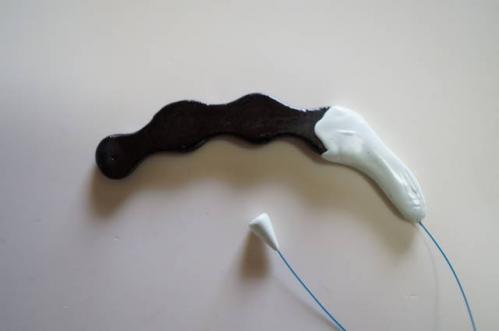
In an entry published in December 2018, Mr. Okada discussed deformation of the bent resin anal chip. He wrote that resin remained incompletely dry for 1–2 months, so even thicker internal wire could leave the shape vulnerable. Orders shipped after about a week, because he considered a wait of roughly 2 months too long.
The wire core (internal support wire) changed from 1.6mm to 2mm, starting with items made two days before publication. Mr. Okada described that change as 56% thicker by volume, while still warning about the resin's early softness. He advised an initial settling-in period without rough handling.
(Source: ok-lab's diary, published December 2018)
https://ok-lab.hatenablog.com/entry/20181201/1543652709
Brief resin curing time accompanied deformation during an attachment test
In another entry published in December 2018, Mr. Okada reported testing an anal chip with a wand-massager attachment. The resin deformed considerably under force; the piece had been made only 1 day earlier. He described the attachment as an option costing ¥1,000 (about $6 at ¥156 = $1, rate as of 2026-09-04) excluding tax at that time.
The quoted price covered the attachment to the anal chip, rather than the massager itself. Mr. Okada described the experience favorably, despite the deformation observed during his test. He advised treating the first 2 months after purchase as a period requiring care.
(Source: ok-lab's diary, published December 2018)
https://ok-lab.hatenablog.com/entry/20181222/1545459719
Resin curing time became relevant to a prickly ceramic chip connection
In an entry published in July 2019, a customer asked about rubber covering for the semi-long curved ceramic chip's thread connection. The customer reported mild, prickling pain during prostate stimulation and felt that the curved rear connection was touching the urethra. The customer said earlier glass chips and a straight-ended resin design had not caused that discomfort.
He postponed deciding whether every product should receive that covering. The diary does not record whether this customer's chip was returned or whether the discomfort improved. Mr. Okada offered free rubber covering for an unused chip or one used only once.
(Source: ok-lab's diary, published July 2019)
https://ok-lab.hatenablog.com/entry/2019/07/06/152113
The maker's answer to resin curing time
Mr. Okada's responses depended on the part: strengthening a design, repairing a fault, or allowing more time for resin strength.
Longer resin curing time made an older prototype stiffer but crack-prone
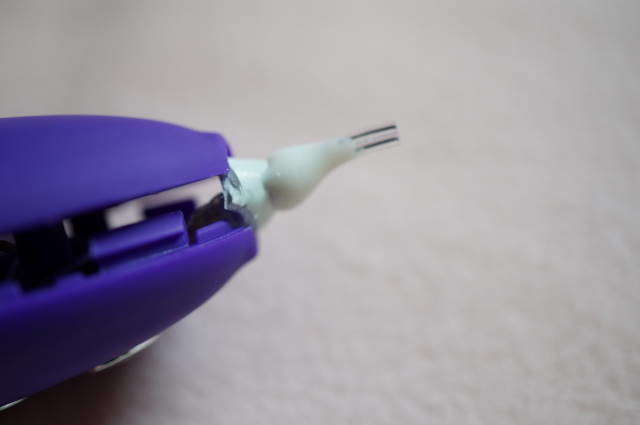
In the October 2018 entry, Mr. Okada compared the damaged spiral with an earlier prototype about 2 months old. He wrote that the older piece had become difficult to bend, while stronger bending forces could cause cracks. That observation concerned an earlier prototype, not a successful follow-up using the customer's damaged item.
Mr. Okada considered stronger wire or a thicker resin layer as possible changes. He also raised stopping sales of large designs that faced strong forces. Mr. Okada suggested reconsidering the material, since he doubted epoxy was the right choice for these large designs.
(Source: ok-lab's diary, published October 2018)
https://ok-lab.hatenablog.com/entry/20181027/1540618195
Extra resin curing time was unlikely to fix the controller fault
In an entry published in March 2019, a customer's controller light worked while its motor repeatedly stopped. Mr. Okada initially suspected the motor and offered replacement if the fault returned. The customer's follow-up said touching the reinforced cable connection restarted the motor, leading Mr. Okada to consider a controller fault.
He wrote that reinforcement reached full strength after about a month, but a few days of hardening sufficed for this connection problem. The entry records a repair and increased resin inside newer controller boxes, but no later customer report confirming lasting reliability. Mr. Okada advised returning the unit if the fault recurred, because he did not expect additional curing time to resolve it.
(Source: ok-lab's diary, published March 2019)
https://ok-lab.hatenablog.com/entry/2019/03/02/151104
The June 2024 resin curing time estimate extended to several months
In an entry published in June 2024, Mr. Okada distinguished ordinary epoxy hardening from reaching full strength. He wrote that epoxy usually hardened in 1–2 days, but needed at least several months to develop full strength. He based this estimate on his experience with epoxy during thread-replacement work.
According to him, resin only a few months old came away relatively easily, while resin older than half a year resisted removal. He presented his strength assessment as experience and judgment, acknowledging that he lacked the knowledge for a technical answer. Mr. Okada advised avoiding excessive force for about 3 months, which he described as a settling-in period for epoxy-finished products.
(Source: ok-lab's diary, published June 2024)
https://ok-lab.hatenablog.com/entry/2024/06/15/123132
How resin curing time changed over time
| Published | What the diary said then |
|---|---|
| Oct 2018 | A deformed spiral prompted doubts about large designs, alongside concern about incomplete hardening. |
| Dec 2018 | A thicker wire core accompanied warnings that recently made resin could still deform. |
| Dec 2018 | An attachment prototype also deformed during testing soon after manufacture. |
| Mar 2019 | Recurring controller trouble prompted repair and additional internal resin reinforcement. |
| Jul 2019 | A prickly ceramic connection brought an offer of rubber covering. |
| Jun 2024 | Mr. Okada described a longer full-strength period and warned against using cracked connections. |
The diary does not say what the current state is.
OK Prostate Chip products related to resin curing time
The current list includes the bent resin anal chip and semi-long curved ceramic chip discussed in these entries.
Products that appear in these entries
| Product (official name) | Price incl. tax | Relation to this topic |
|---|---|---|
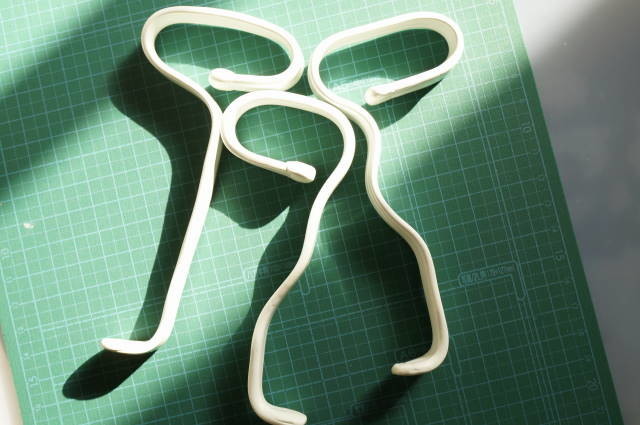
| Bent resin anal chip (OKプロステートお尻チップ 樹脂素材尸の字型) | ¥7,700 (about $49 at ¥156 = $1, rate as of 2026-09-04) | December 2018: Mr. Okada discussed deformation and changed the internal wire; the current list does not confirm those wire specifications. |
| Semi-long curved ceramic chip (OKプロステートチップ 陶器素材セミロング勾玉タイプ) | ¥5,500 (about $35 at ¥156 = $1, rate as of 2026-09-04) | July 2019: a customer reported prickling where the thread joined this ceramic chip. |
The bent resin anal chip is listed in OK Lab's own online store.
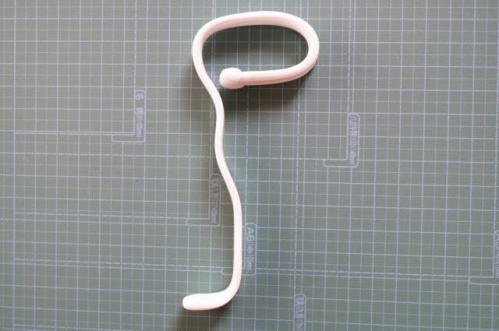
The semi-long curved ceramic chip also has a listing in the company's own online store.
(Source: ok-lab's diary, published December 2018)
https://ok-lab.hatenablog.com/entry/20181201/1543652709
(Source: ok-lab's diary, published July 2019)
https://ok-lab.hatenablog.com/entry/2019/07/06/152113
Products the diary mentioned as alternatives
The diary names no alternative.
Historical custom spiral, massager attachment, repaired controller, and balancing assembly: No matching product can be confirmed on the current list.
Common worries about resin curing time
The reader questions concern damaged resin, an uncomfortable connection, and whether a thin chip can withstand force.
"Is a cracked resin chip still usable?"
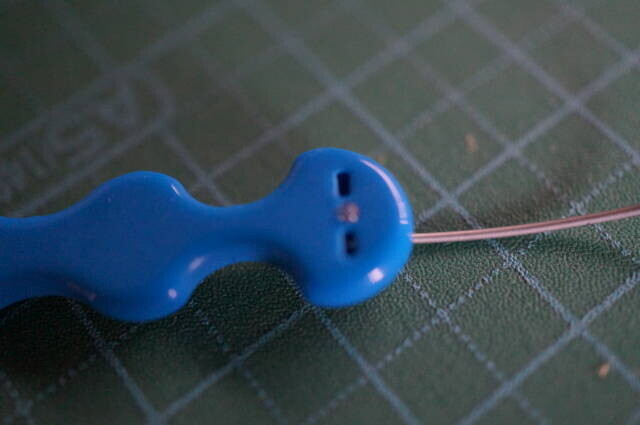
In the October 2018 entry, the customer asked whether the spiral should still be used after discovering its crack. The customer thought it might remain usable but wanted Mr. Okada's view. His reply focused on the limits of large spirals under pressure and apologized for failing to meet the customer's expectations.
The diary does not record approval for further use of that damaged piece. It also does not record what the customer did with it afterward. Mr. Okada proposed limiting future sales to smaller designs, rather than endorsing the cracked item.
(Source: ok-lab's diary, published October 2018)
https://ok-lab.hatenablog.com/entry/20181027/1540618195
"Can a ceramic chip's soft resin connection feel prickly?"
In the July 2019 entry, the customer was concerned about the connection despite liking the ceramic chip's smooth overall shape. Mr. Okada said supplied products were around a week old, with resin that had not yet fully hardened. He explained that the sharp area could still change shape slightly at that age.
His estimate for complete hardening was at least a month, specifically in this discussion of the thread connection. The diary does not record a later assessment of the same joint after it had hardened. Mr. Okada warned that cutting near this joint could damage the nylon thread.
(Source: ok-lab's diary, published July 2019)
https://ok-lab.hatenablog.com/entry/2019/07/06/152113
"Is resin chip strength adequate at the thin section?"
In the June 2024 entry, a customer questioned the thin section's strength in a balancing chip assembly (Yajirobee). Mr. Okada acknowledged that his tests showed the thin parts of the resin chip body could break under force. He considered the assembly's wire connection its weakest point, because the chip was connected there without its other end being similarly fixed.
He described silicone (a cushioning material) inside the connection and epoxy covering it for protection. Mr. Okada thought silicone might keep the parts joined after an epoxy crack, preventing immediate complete separation; this was his assessment. He advised stopping use if a crack appeared in the epoxy.
(Source: ok-lab's diary, published June 2024)
https://ok-lab.hatenablog.com/entry/2024/06/15/123132
Buying from outside Japan
OK Lab ships internationally to countries covered by Japan Post's EMS courier service. Overseas orders are paid in advance by PayPal. Each order carries a ¥400 (about $3 at ¥156 = $1, rate as of 2026-09-04) handling fee, and EMS shipping is charged on top. These terms come from OK Lab's official sales-terms page (written here as plain text, not a link: ok-lab.net/docs/law), checked on September 7, 2026; confirm them on the official store before you order, because they can change.
Summary of this article
| What you wanted to know | The answer |
|---|---|
| What is the short answer? | Mr. Okada says newly hardened resin may still need time to gain strength. |
| What is the product? | A small device made by OK Lab in Japan; these entries also discuss anal designs. |
| What do the terms mean? | Resin and internal supports serve different roles in chip bodies and connections. |
| What happened in the reports? | Early deformation and connection discomfort led to different replies for different parts. |
| What did the maker suggest? | Design changes, repair for a recurring controller fault, and an initial period without excessive force. |
| How did the account develop? | The entries move from early deformation reports to a later discussion of joint strength. |
| Which current products are identified? | The bent resin anal chip and semi-long curved ceramic chip; the table gives current yen prices. |
| What concerns did customers raise? | A cracked spiral, a prickly connection, and possible breakage at a thin section. |
| How do overseas orders work? | Advance PayPal payment, Japan Post's EMS shipping, and a separate ¥400 (about $3 at ¥156 = $1, rate as of 2026-09-04) handling fee. |
Source: ok-lab's diary (Okada Comfortable Life Laboratory). The original entries are in Japanese; quotations on this page are translated. Photos and videos are on the original entries.
This article is a summary of the maker's development diary. The product is not a medical device and no result is guaranteed. If anything feels wrong or worries you, see a doctor. Prices, specifications and cautions change, so confirm the latest information on the official blog and the official site. Questions about ordering and shipping go to the seller.