![Does epoxy get stronger with time? | The maker reports gains over months, with limits [OK Prostate Chip]](/img/a/T0799/eyecatch.svg)
This page is based on entries from "ok-lab's diary" (https://ok-lab.hatenablog.com/), the Japanese development diary written by Mr. Okada, founder of OK Lab, a small company in Japan (Okada Comfortable Life Laboratory). Only the entries about "epoxy getting stronger over time" are summarized here, in order of publication. Past prices and sizes are as written at the time. Current prices come from the official product list (retrieved September 4, 2026). Quotations are translated from Japanese.
Note: This page is a personal reading log by someone with no connection to the maker or the seller. It reflects the source entries as of their publication dates and makes no guarantee of accuracy or safety. The product is not a medical device; talk to a doctor about any health decision. Check the official site for current information. This page contains advertising.
In short
Mr. Okada reports that epoxy (a resin) keeps hardening for months, but age does not prevent every failure.
His advice emphasizes allowing time, avoiding excessive force, and stopping use when epoxy cracks.
Current listings include models discussed here, but the diary names no product alternative for insufficient epoxy hardening.
If you see blood in your urine, even a small amount or for the first time, do not wait and see. See a urologist right away. If you suddenly cannot urinate, or the device cannot be removed, do not try to fix it yourself. Go to a medical facility, including emergency care, immediately.
About this product
The OK Prostate Chip is a small device that is placed in the urethra (the urine passage) so that it acts on the prostate; the maker sells it in several shapes, sizes and materials. It is made and sold by OK Lab (Okada Comfortable Life Laboratory), a small company in Japan, through its own online store, and prices are in Japanese yen (JPY). The maker's development diary, "ok-lab's diary", is written in Japanese. This page is an English summary of it, and every quotation is translated. OK Lab ships internationally, so readers outside Japan can order (see "Buying from outside Japan" below). Product names on this page are plain-English descriptions. The official Japanese product name is shown once in the product table so you can find the same item in the store.
Before you read: key terms
| Term | Plain-English meaning |
|---|---|
| Epoxy | A resin used to form some chips and secure or cover connections on others. |
| Retrieval thread | A thread attached to a chip for removal; epoxy covers its connection in the ceramic cases here. |
| Destructive test | A check continued until something fails, used here to investigate thread-connection strength. |
| Wire core | Metal inside a resin chip, used as reinforcement. |
| Silicone | A flexible material used around wires, including as cushioning beneath an epoxy covering. |
What happens: epoxy hardening time
The OK Prostate Chip is a device placed in the urethra to act on the prostate. These entries discuss epoxy, used to form some chips and secure attachments on ceramic models. It covers the connection between a chip and its retrieval thread (the thread used for removal). Mr. Okada reports continued hardening over time, alongside cases involving cracks, deformation, and difficult repairs.
Short epoxy hardening time was suspected after two thread failures
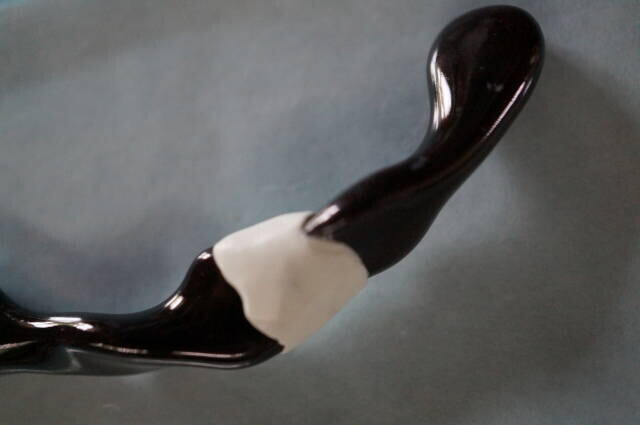
In an entry published in May 2018, a customer reported a detached thread from a newly delivered custom chip. Part of the resin came away with it, despite force reportedly comparable to their usual long chip. Mr. Okada connected this with an earlier report, making 2 cases of resin splitting away around the thread.
He suspected incomplete hardening and identified cooler rooms and rainy, humid weather as possible reasons. The diary does not record how the newly reported incident was resolved. Mr. Okada concluded that variable room conditions required more hardening time.
(Source: ok-lab's diary, published May 2018)
https://ok-lab.hatenablog.com/entry/20180510/1525959878
Older resin resisted failure better in a customer's epoxy strength tests
In an entry published in May 2018, a customer compared a chip bought 7 months earlier with a new custom medium-length chip. In destructive tests (checks continued until failure), their threads separated above 2 kg and 1.5 kg, respectively. The older resin was also much harder to detach, becoming powdery during the comparison.
Mr. Okada published the report following a thread-detachment incident and says the customer was awaiting surgery. The customer's warning concerned sudden pulling forces and extra force after the thread had stretched.
(Source: ok-lab's diary, published May 2018)
https://ok-lab.hatenablog.com/entry/20180515/1526348315
An angled anal chip's epoxy hardening time extended beyond dispatch
In an entry published in December 2018, Mr. Okada discussed deformation of the angled resin anal chip. He said its resin could remain incompletely hardened for 1–2 months, even with a wire core (internal metal reinforcement). He reported no deformation after about 2 months, although shipment was planned roughly one week after ordering.
The wire core changed from 1.6 mm to 2 mm as another response to possible rough handling. Mr. Okada asked for gentle treatment during the early period.
(Source: ok-lab's diary, published December 2018)
https://ok-lab.hatenablog.com/entry/20181201/1543652709
Epoxy strength increased while older connections became less flexible
In an entry published in June 2022, a customer requested thinner connections after several cable-supported chips proved too large. Mr. Okada explained that earlier connections added about 2 mm at the rear because cable and resin overlapped the chip. Four-wire supports were no longer available, and he described epoxy's bond to silicone (a flexible wire covering) as imperfect.
He said epoxy remained slightly flexible for several months after mixing, but barely flexed after 1 year. The diary does not record whether the revised order was completed. Mr. Okada's proposed answer was thinner connections secured through metal attachments.
(Source: ok-lab's diary, published June 2022)
https://ok-lab.hatenablog.com/entry/2022/06/11/123420
Epoxy strength did not guarantee intact ceramic beneath the covering
In an entry published in September 2025, a customer reported a short twisted ceramic chip breaking inside its white thread-connection resin. It had seen about 4 months of use and roughly 10 uses. Bubbles appeared during boiling, and the hidden ceramic section separated under slight pressure before further use.
Mr. Okada thought heated air had escaped from a fracture beneath the resin, acknowledging that ceramic could break while still covered. The customer had discarded the chip without taking a photograph. Mr. Okada considered bubbles during boiling a useful warning of concealed ceramic damage.
(Source: ok-lab's diary, published September 2025)
https://ok-lab.hatenablog.com/entry/2025/09/20/122912
The maker's answer to epoxy hardening time
Mr. Okada's responses distinguish early usable strength from later hardening, while retaining limits for prototypes and repairs.
The stated epoxy hardening time differed from Mr. Okada's experience
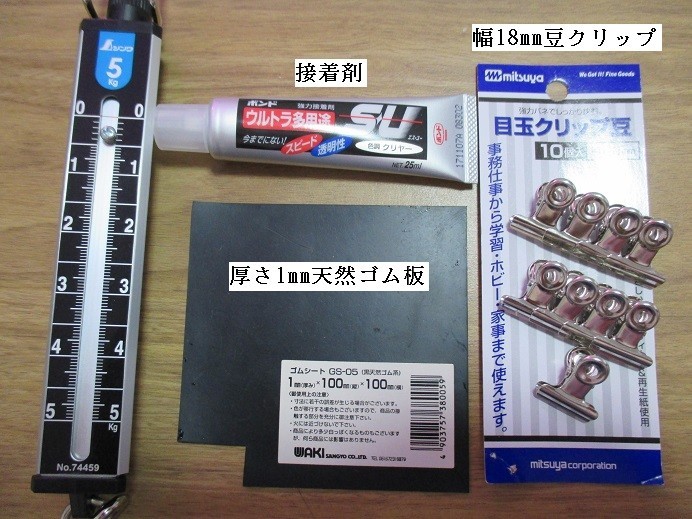
In an entry published in May 2018, Mr. Okada questioned the hardening period stated in the resin maker's instructions. He reported a specification of 24 hours at 20–25°C, compared with about 5 days to reach usable strength in his experience.
He also described heated test samples that reportedly became usable in one day. He thought the water had not harmed the epoxy, but identified this shortcut as his own practice, absent from the resin maker's instructions.
(Source: ok-lab's diary, published May 2018)
https://ok-lab.hatenablog.com/entry/20180511/1526036007
A prototype's epoxy strength remained unresolved despite an early personal trial
In an entry published in March 2024, Mr. Okada described a two-piece ceramic prototype joined by springy wire. He said cracked epoxy could destabilize its connection and initially planned to wait for fuller hardening before testing. The same entry then says he had already tried it, reversing that stated intention.
He reported unexpected movement more than 3 cm toward the bladder. The diary does not record completed strength testing of this prototype. Mr. Okada said sales would follow further personal trials and tests of wire breakage and epoxy cracking.
(Source: ok-lab's diary, published March 2024)
https://ok-lab.hatenablog.com/entry/2024/03/16/123023
A ceramic repair still carried limits despite increasing epoxy strength
In an entry published in July 2024, a customer asked about repairing a long four-point-twist ceramic chip damaged in the Noto Peninsula earthquake. Staff said some breaks could be repaired, but added resin would increase thickness and the repaired strength could not be guaranteed. Although repairs normally carried a charge, they offered this attempt free as support after the earthquake.
Mr. Okada reported difficulty matching the original twist because the resin concealed the joining surfaces. The diary does not record the customer's later experience with the repair. Mr. Okada advised gentle handling for a while because the epoxy would continue to harden.
(Source: ok-lab's diary, published July 2024)
https://ok-lab.hatenablog.com/entry/2024/07/13/123018
If you see blood in your urine, even a small amount or for the first time, do not wait and see. See a urologist right away. If you suddenly cannot urinate, or the device cannot be removed, do not try to fix it yourself. Go to a medical facility, including emergency care, immediately.
How epoxy hardening time changed over time
| Published | What the diary said then |
|---|---|
| May 2018 | Incomplete hardening was suspected after resin split around retrieval threads. |
| May 2018 | Mr. Okada's usable-strength estimate exceeded the resin maker's stated hardening time. |
| Oct 2018 | Spiral deformation and cracking prompted doubts about larger designs. |
| Dec 2018 | The angled anal chip received thicker wire reinforcement. |
| Jun 2022 | Four-wire supports had ended; metal attachments enabled thinner connections. |
| Apr 2023 | Mr. Okada considered the wider plate less vulnerable at narrow sections. |
| Jun 2024 | Mr. Okada described several months as necessary for full epoxy strength. |
| Jul 2024 | A ceramic repair was offered without a guarantee of repaired strength. |
| Sep 2025 | A ceramic break beneath resin challenged assumptions about protection from the covering. |
The diary does not say what the current state is.
OK Prostate Chip products related to epoxy hardening time
The current list includes the angled resin anal chip and the ceramic models discussed in repair and breakage reports.
Products that appear in these entries
| Product (official name) | Price incl. tax | Relation to this topic |
|---|---|---|
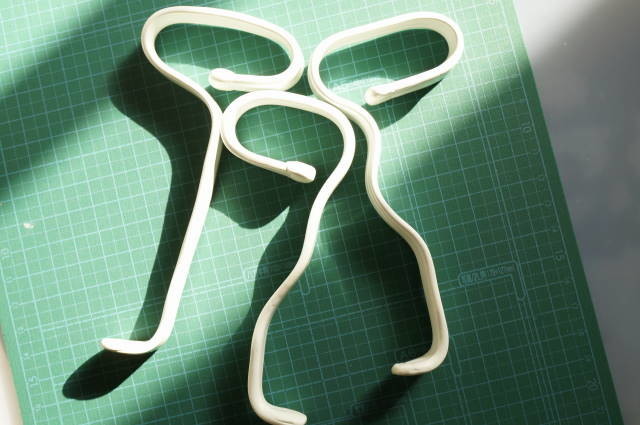
| Angled resin anal chip (OKプロステートお尻チップ 樹脂素材尸の字型) | ¥7,700 (about $49 at ¥156 = $1, rate as of 2026-09-04) | In December 2018, Mr. Okada discussed early deformation and a thicker wire core for this shape. |
| Long four-point-twist ceramic chip (OKプロステートチップ 陶器素材ロングタイプ 4点ツイスト) | ¥7,700 (about $49 at ¥156 = $1, rate as of 2026-09-04) | In July 2024, a customer requested repair after earthquake damage, with no guarantee of repaired strength. |
| Short twisted ceramic chip (OKプロステートチップ 陶器素材ショートタイプ ツイスト) | ¥4,400 (about $28 at ¥156 = $1, rate as of 2026-09-04) | In September 2025, a customer reported a concealed ceramic break beneath this model's thread-connection resin. |
(Source: ok-lab's diary, published December 2018)
https://ok-lab.hatenablog.com/entry/20181201/1543652709
(Source: ok-lab's diary, published July 2024)
https://ok-lab.hatenablog.com/entry/2024/07/13/123018
(Source: ok-lab's diary, published September 2025)
https://ok-lab.hatenablog.com/entry/2025/09/20/122912
Products the diary mentioned as alternatives
The diary names no alternative.
For the historical custom chips, oversized spiral, experimental wire-connected builds, balancing chip, and wider-hole plate:
No matching product can be confirmed on the current list.
Common worries about epoxy hardening time
Readers questioned cracked spirals, wider plate openings, and the strength of a wire-connected chip.
"Can a cracked epoxy spiral chip still be used?"

In an entry published in October 2018, a customer reported a 90 mm anal spiral's diameter decreasing to 80 mm during one use. The report described pink mucus without obvious bleeding, followed by pain. A crack appeared 2.5 cm from the tip during an attempt to restore its shape, prompting a question about continued use.
Mr. Okada first blamed incomplete hardening, saying full hardening needed over one month, while 2-month-old prototypes barely bent. After the crack report, he doubted large spirals were practical, despite initially considering stronger wire, thicker resin, or other materials. He tentatively favored spirals no wider than 4 cm, hardened for more than one month.
(Source: ok-lab's diary, published October 2018)
https://ok-lab.hatenablog.com/entry/20181027/1540618195
"Does a larger hole weaken the plate's epoxy strength?"
In an entry published in April 2023, a customer considering the wider-hole support plate asked whether its larger opening increased breakage risk. Mr. Okada said strong forces could break epoxy. He thought the wider version was less likely to break than the initial design because it lacked extremely narrow sections between holes.
He explained that the surrounding central area had been enlarged along with the opening. Staff offered the newer plate without requiring the old one back; the diary does not record this customer's later experience. Mr. Okada encouraged customers considering replacement to request the wider version.
(Source: ok-lab's diary, published April 2023)
https://ok-lab.hatenablog.com/entry/2023/04/29/123107
"Is epoxy strength sufficient at the balancing chip's connection?"
In an entry published in June 2024, a customer asked whether the balancing chip's narrow sections were strong enough. Mr. Okada described a single wire attachment, cushioned by silicone and covered with epoxy, and considered that joint the likeliest weak point. He said epoxy was commonly described as hardening in 1–2 days, but full strength took at least several months in his experience.
He reported that resin older than half a year resisted his usual removal work, even under impacts or squeezing. His advice was to avoid excessive force for about 3 months, because forces beyond the epoxy's strength could crack the joint. Mr. Okada advised stopping use if cracks appeared in the epoxy.
(Source: ok-lab's diary, published June 2024)
https://ok-lab.hatenablog.com/entry/2024/06/15/123132
Buying from outside Japan
OK Lab ships internationally to countries covered by Japan Post's EMS courier service. Overseas orders are paid in advance by PayPal. Each order carries a ¥400 (about $3 at ¥156 = $1, rate as of 2026-09-04) handling fee, and EMS shipping is charged on top. These terms come from OK Lab's official sales-terms page (written here as plain text, not a link: ok-lab.net/docs/law), checked on September 7, 2026; confirm them on the official store before you order, because they can change.
Summary of this article
| What you wanted to know | The answer |
|---|---|
| What is the short answer? | Mr. Okada reports strengthening over time, alongside failures that age alone did not prevent. |
| What is the product? | A device made by OK Lab in Japan, sold in different forms and materials. |
| What do the terms describe? | Resin, attachment materials, reinforcement, and tests used to investigate connection strength. |
| What happened in these reports? | Threads detached, fresh shapes deformed, older resin stiffened, and ceramic broke beneath its covering. |
| What measures did the maker describe? | Allowing hardening time, evaluating joints, and treating repaired pieces gently despite uncertain strength. |
| How did the account develop? | Early hardening estimates were followed by longer-term observations and further reports of damage. |
| Which current products appear? | The angled resin anal chip, long four-point-twist ceramic chip, and short twisted ceramic chip. |
| What did readers question? | Whether cracks, larger openings, or narrow connections made particular designs vulnerable. |
| How are overseas orders handled? | Advance PayPal payment, EMS shipping, and a ¥400 (about $3 at ¥156 = $1, rate as of 2026-09-04) handling fee under the stated terms. |
| What does this article establish? | The maker's account distinguishes initial hardening from later strength without resolving every product's condition. |
Source: ok-lab's diary (Okada Comfortable Life Laboratory). The original entries are in Japanese; quotations on this page are translated. Photos and videos are on the original entries.
This article is a summary of the maker's development diary. The product is not a medical device and no result is guaranteed. If anything feels wrong or worries you, see a doctor. Prices, specifications and cautions change, so confirm the latest information on the official blog and the official site. Questions about ordering and shipping go to the seller.