![Can I leave a resin chip in for hours? | The maker reported problems and later design changes [OK Prostate Chip]](/img/a/T0797/eyecatch.svg)
This page is based on entries from "ok-lab's diary" (https://ok-lab.hatenablog.com/), the Japanese development diary written by Mr. Okada, founder of OK Lab, a small company in Japan (Okada Comfortable Life Laboratory). Only the entries about "leaving a resin chip in" are summarized here, in order of publication. Past prices and sizes are as written at the time. Current prices come from the official product list (retrieved September 4, 2026). Quotations are translated from Japanese.
Note: This page is a personal reading log by someone with no connection to the maker or the seller. It reflects the source entries as of their publication dates and makes no guarantee of accuracy or safety. The product is not a medical device; talk to a doctor about any health decision. Check the official site for current information. This page contains advertising.
In short
- Early resin designs drew reports of discomfort and bleeding during continued wear.
- Mr. Okada suggested breaks, limited resin use, and alternatives depending on the design.
- Linked resin and separate socket chips remain on the current product list.
If you see blood in your urine, even a small amount or for the first time, do not wait and see. See a urologist right away. If you suddenly cannot urinate, or the device cannot be removed, do not try to fix it yourself. Go to a medical facility, including emergency care, immediately.
About this product

The OK Prostate Chip is a small device that is placed in the urethra (the urine passage) so that it acts on the prostate; the maker sells it in several shapes, sizes and materials. It is made and sold by OK Lab (Okada Comfortable Life Laboratory), a small company in Japan, through its own online store, and prices are in Japanese yen (JPY). The maker's development diary, "ok-lab's diary", is written in Japanese. This page is an English summary of it, and every quotation is translated. OK Lab ships internationally, so readers outside Japan can order (see "Buying from outside Japan" below). Product names on this page are plain-English descriptions. The official Japanese product name is shown once in the product table so you can find the same item in the store.
Before you read: key terms
| Term | Plain-English meaning |
|---|---|
| Urethra | The urine passage; the chip sits inside it to act on the prostate. |
| Resin | Material used to form chip bodies; these entries discuss its behavior during continued wear. |
| Screw design | A twisted chip shape intended, according to Mr. Okada, to reduce sticking. |
| Separate socket chip | The hollow resin partner in a two-part design; it can also serve as a stopper. |
| Vibration motor | A component that makes the chip vibrate; the maker explored vibration as a response to sticking. |
| Epoxy | The earlier resin material discussed here, used in chip bodies and connections. |
| Biocompatible resin | Resin described as compatible with the body, used for a prototype. The basis for that description: The diary does not explain this. |
What happens: leaving a resin chip in
The OK Prostate Chip is a small device placed in the urethra (urine passage) for prostate stimulation. Resin is one material used for the chip itself, including connected designs with a second chip and versions containing vibration motors. The diary examines whether those resin surfaces remain comfortable against the lining of the urine passage during continuous use. Mr. Okada’s reports cover changes to chip shape, vibration, and a later resin formulation.
Early tests raised concerns about leaving a resin chip in

In an entry published in October 2017, Mr. Okada described resin prototypes that felt comfortable during brief tests. After several consecutive days, however, he became dissatisfied with their friction resistance.
He wrote that glass alone had met his requirement for smooth movement after urination had washed away lubricant. His preference for glass came with an explicit warning: he believed chips could break and did not promise complete safety.
(Source: ok-lab's diary, published October 2017)
https://ok-lab.hatenablog.com/entry/20171005/1507210406
A screw design changed his view of resin chip sticking
In an entry published in July 2018, Mr. Okada distinguished earlier flat resin chips from the screw design (a twisted chip shape). He described the flat versions as difficult to advance, difficult to remove when dry, and prone to sticking against one spot. In his view, that sticking could damage the lining of the urine passage.
He reported a week of continuous wear without trouble using the screw-shaped resin chip. He also judged its smoothness comparable to glass, reversing his earlier assessment of resin for that shape. For short chips that could use this design, he now favored resin and thought it might offer safety and durability advantages.
(Source: ok-lab's diary, published July 2018)
https://ok-lab.hatenablog.com/entry/20180714/1531551648
Stronger vibration did not resolve the long-term resin chip problem
In an entry published in February 2019, Mr. Okada said he was not selling long resin chips because he considered them problematic. His dual-motor extended-tip model caused some discomfort after about half a day without vibration. He believed vibration largely addressed dryness and sticking, but found this model’s stimulation too strong for all-day vibration.
His conclusion was that the dual-motor version belonged to short-duration use. For extended wear, he instead recommended the ordinary chip with 1 vibration motor (a component that makes the chip vibrate).
(Source: ok-lab's diary, published February 2019)
https://ok-lab.hatenablog.com/entry/2019/02/09/152257
The February 2019 resin chip price schedule charged separately for motors
In the same entry published in February 2019, Mr. Okada announced prices for an expanded resin range, with prices stated as tax excluded. Longer resin bodies were priced ¥1,000 (about $6 at ¥156 = $1, rate as of 2026-09-04) below glass: ¥2,000 (about $13 at ¥156 = $1, rate as of 2026-09-04) for the semi-long body and ¥3,000 (about $19 at ¥156 = $1, rate as of 2026-09-04) for the extended-tip body. The short resin body without a thread was ¥1,000 (about $6 at ¥156 = $1, rate as of 2026-09-04).
The listed additions were ¥1,000 (about $6 at ¥156 = $1, rate as of 2026-09-04) for nylon thread, ¥3,000 (about $19 at ¥156 = $1, rate as of 2026-09-04) for a 1-motor vibration unit, and ¥5,000 (about $32 at ¥156 = $1, rate as of 2026-09-04) for a 2-motor unit. The dual-motor extended-tip chip was ¥8,000 (about $51 at ¥156 = $1, rate as of 2026-09-04), tax excluded, with another ¥1,000 (about $6 at ¥156 = $1, rate as of 2026-09-04) for nylon thread. His accompanying advice still limited that dual-motor design to short-duration use.
(Source: ok-lab's diary, published February 2019)
https://ok-lab.hatenablog.com/entry/2019/02/09/152257
A later prototype brought a different resin chip comfort report
In an entry published in May 2021, Mr. Okada described receiving a prototype made from biocompatible resin (resin described as compatible with the body). A collaborator had produced it using resin intended for a 3D printer. Mr. Okada reported 5 consecutive days without feeling any burden, contrasting this with discomfort during extended wear of epoxy (the earlier resin material) chips.
This was his account of the first prototype supplied to him. The diary does not record a longer test of that prototype. Mr. Okada encouraged readers to look forward to its development.
(Source: ok-lab's diary, published May 2021)
https://ok-lab.hatenablog.com/entry/2021/05/01/130245
The maker's answer to leaving a resin chip in
Mr. Okada proposed rest periods, limits for particular parts, and changes intended to reduce sticking.
Mr. Okada proposed rest periods after reports of resin chip bleeding
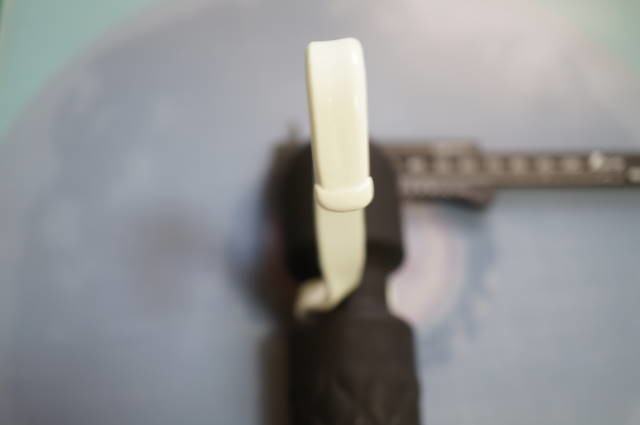
In an entry published in March 2018, Mr. Okada suggested that resin moved less freely than glass. He suspected dry resin could remain against the same area, causing prolonged irritation and damage to the lining.
He also described about half a year without bleeding in his own glass-chip use, which included 8 hours of rest each day. He acknowledged that he lacked equivalent experience with long-term resin wear. His proposed precaution was regular breaks lasting several hours so that the urine passage could rest.
(Source: ok-lab's diary, published March 2018)
https://ok-lab.hatenablog.com/entry/20180324/1521875816
His separate resin chip test also led to shorter-use advice
In another passage published in March 2018, Mr. Okada discussed the separate socket chip (the hollow resin partner in a two-part design). He reported unpleasant pain after about 10 days of continued wear during his own test. He recorded no bleeding, but thought resin use might require breaks.
In a further entry published in March 2018, he explicitly included this component in his shorter-use advice. His recommendation was short-duration use for the socket component, excluding it from prolonged continuous wear.
(Source: ok-lab's diary, published March 2018)
https://ok-lab.hatenablog.com/entry/20180324/1521875816
(Source: ok-lab's diary, published March 2018)
https://ok-lab.hatenablog.com/entry/20180331/1522485734
Mr. Okada proposed vibration as another answer to resin chip sticking
In an entry published in December 2018, Mr. Okada presented vibration as another response to the sticking problem. He claimed that a vibrating chip separated from the lining of the urine passage.
He also reported easier movement with vibrating models, including larger chips. His proposed measure against sticking was intermittent vibration.
(Source: ok-lab's diary, published December 2018)
https://ok-lab.hatenablog.com/entry/20181222/1545459719
If you see blood in your urine, even a small amount or for the first time, do not wait and see. See a urologist right away. If you suddenly cannot urinate, or the device cannot be removed, do not try to fix it yourself. Go to a medical facility, including emergency care, immediately.
How leaving a resin chip in changed over time

| Published | What the diary said then |
|---|---|
| Oct 2017 | Brief resin tests felt comfortable; consecutive days exposed friction concerns. |
| Mar 2018 | A linked-resin-chip user reported bleeding during the second afternoon. |
| Mar 2018 | Mr. Okada preferred glass for continued wear and limited-duration resin use. |
| Apr 2018 | A resin second-chip design had been withdrawn from standard sales; custom requests remained possible. |
| Jul 2018 | A screw-shaped resin chip changed Mr. Okada’s assessment after a trouble-free week. |
| Dec 2018 | Mr. Okada proposed vibration as a further response to sticking. |
| Feb 2019 | Dual-motor stimulation brought a short-use limit and a single-motor alternative. |
| May 2021 | A different resin prototype produced a favorable personal comfort report. |
OK Prostate Chip products related to leaving a resin chip in
Two resin products remain listed; the diary’s general alternatives do not establish an exact current model.
Products that appear in these entries
| Product (official name) | Price incl. tax | Relation to this topic |
|---|---|---|
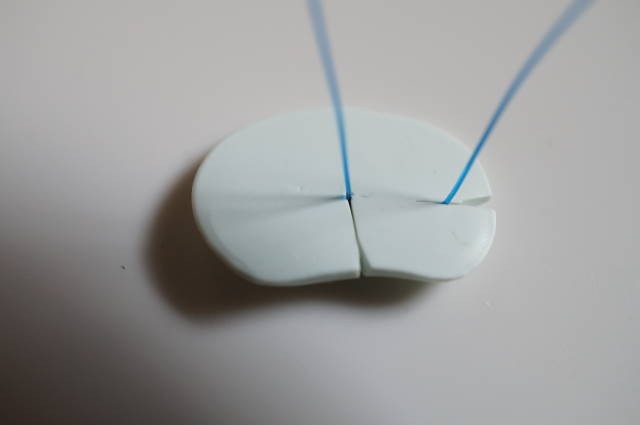
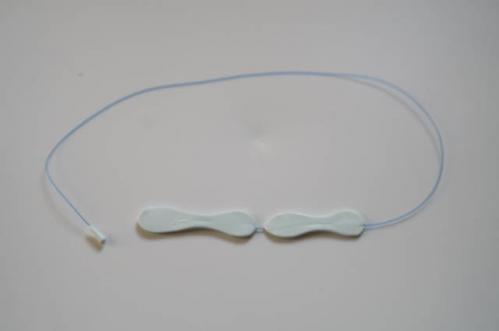
| Linked resin chip pair (OKプロステートチップ 樹脂素材2連結タイプ) | ¥4,400 (about $28 at ¥156 = $1, rate as of 2026-09-04) | In March 2018, a customer reported blood in urine after continuous use extending into the following afternoon. |
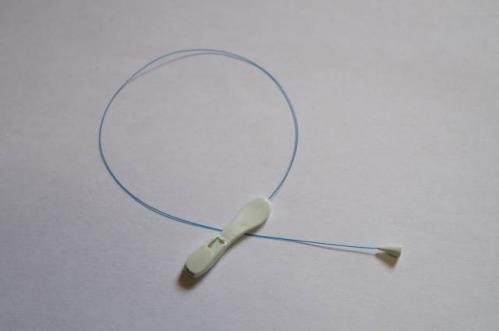
| Separate resin socket chip (OKプロステートチップ 樹脂素材セパレートタイプ♀チップ) | ¥2,750 (about $18 at ¥156 = $1, rate as of 2026-09-04) | In March 2018, Mr. Okada reported pain during his own extended test and later advised short-duration use. |
The linked resin chip pair is listed in the company’s own online store.
The separate resin socket chip is listed in the company’s own online store.
(Source: ok-lab's diary, published March 2018)
https://ok-lab.hatenablog.com/entry/20180324/1521875816
(Source: ok-lab's diary, published March 2018)
https://ok-lab.hatenablog.com/entry/20180331/1522485734
Products the diary mentioned as alternatives
The diary names no alternative.
The prototypes, screw-shaped test chip, custom hybrid, longer resin bodies, and dual-motor extended-tip model appear only in historical accounts here. No matching product can be confirmed on the current list.
Common worries about leaving a resin chip in
Reader questions concerned warning signs, symptoms, and whether changing one component would solve the problem.
"How long can I keep a resin chip in?"
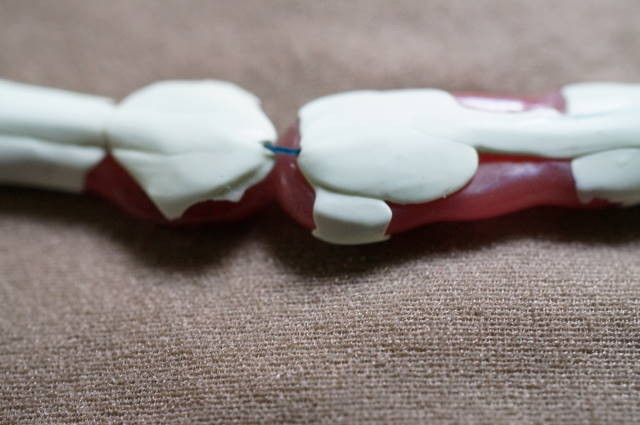
In an entry published in March 2018, a customer asked how to recognize the limit for continuous linked-resin-chip use. Use had continued from noon until after noon the next day, with blood appearing that second afternoon. The customer stopped using it; the diary does not record their recovery.
Mr. Okada said no external sign established that limit, and he believed most users recognized damage only after bleeding. His closing advice was not to overdo use.
(Source: ok-lab's diary, published March 2018)
https://ok-lab.hatenablog.com/entry/20180324/1521875816
"Would a single resin chip avoid discomfort during longer wear?"
In an entry published in March 2018, a customer who liked custom resin chips reported more bleeding and pain with prolonged use than with glass. That customer wanted a single resin component and suspected the second chip contributed to the trouble. Mr. Okada discussed changing the requested length because the proposed shape would not fit.
The diary does not record a use result for the requested custom chip. Mr. Okada’s broader reply favored glass for continued wear and resin for limited periods.
(Source: ok-lab's diary, published March 2018)
https://ok-lab.hatenablog.com/entry/20180331/1522485734
"Could a resin second chip replace a glass one?"
In an entry published in April 2018, a customer described prolonged resin use as difficult and reported repeated joint failures with a linked glass pair. The customer proposed a hybrid with a glass first chip and resin second chip. Mr. Okada replied that he had already tested a resin second-chip version at the linked model’s launch.
He had abandoned that standard version because extended use caused problems, but agreed to handle this request as a custom build. The diary does not record whether that order was completed. He also offered repair service for the customer’s damaged linked chip.
(Source: ok-lab's diary, published April 2018)
https://ok-lab.hatenablog.com/entry/20180428/1524898558
Buying from outside Japan

OK Lab ships internationally to countries covered by Japan Post's EMS courier service. Overseas orders are paid in advance by PayPal. Each order carries a ¥400 (about $3 at ¥156 = $1, rate as of 2026-09-04) handling fee, and EMS shipping is charged on top. These terms come from OK Lab's official sales-terms page (written here as plain text, not a link: ok-lab.net/docs/law), checked on September 7, 2026; confirm them on the official store before you order, because they can change.
Summary of this article
| What you wanted to know | The answer |
|---|---|
| What is the short answer? | The maker reported problems with early resin designs and later changed some designs and materials. |
| What is this product? | A small device sold by a Japanese company for prostate stimulation through the urine passage. |
| What do the key terms mean? | They distinguish chip materials, shapes, components, and vibration. |
| What happened during continued wear? | Reports varied with the design; a later prototype received a favorable personal report. |
| What did the maker suggest? | Breaks, shorter use for particular resin components, and changes intended to reduce sticking. |
| What changed over time? | His reports moved from early friction concerns to screw designs, vibration, and a different resin. |
| Which related products are currently listed? | The linked resin pair costs ¥4,400 (about $28 at ¥156 = $1, rate as of 2026-09-04); the separate socket chip costs ¥2,750, (about $18 at ¥156 = $1, rate as of 2026-09-04) both including tax. |
| What did customers ask? | How to recognize a limit, and whether different component arrangements could address their problems. |
| How do overseas orders work? | Advance PayPal payment, a ¥400 (about $3 at ¥156 = $1, rate as of 2026-09-04) handling fee, and additional EMS shipping charges. |
Source: ok-lab's diary (Okada Comfortable Life Laboratory). The original entries are in Japanese; quotations on this page are translated. Photos and videos are on the original entries.
This article is a summary of the maker's development diary. The product is not a medical device and no result is guaranteed. If anything feels wrong or worries you, see a doctor. Prices, specifications and cautions change, so confirm the latest information on the official blog and the official site. Questions about ordering and shipping go to the seller.