![Did patent rejection end the OK Prostate Chip application? | The diary later reported approval [OK Prostate Chip]](/img/a/T0696/eyecatch.svg)
This page is based on entries from "ok-lab's diary" (https://ok-lab.hatenablog.com/), the Japanese development diary written by Mr. Okada, founder of OK Lab, a small company in Japan (Okada Comfortable Life Laboratory). Only the entries about "patent rejection and prospects for approval" are summarized here, in order of publication. Past prices and sizes are as written at the time. Current prices come from the official product list (retrieved September 4, 2026). Quotations are translated from Japanese.
Note: This page is a personal reading log by someone with no connection to the maker or the seller. It reflects the source entries as of their publication dates and makes no guarantee of accuracy or safety. The product is not a medical device; talk to a doctor about any health decision. Check the official site for current information. This page contains advertising.
In short
A rejection notice did not end the basic application; the diary later reported approval.
Mr. Okada describes revised claims, attorney arguments, and decisions against pursuing some applications.
The latest supplied update, published in August 2025, reports accepted applicant-change paperwork for the thread-hole patent.
About this product
The OK Prostate Chip is a small device that is placed in the urethra (the urine passage) so that it acts on the prostate; the maker sells it in several shapes, sizes and materials. It is made and sold by OK Lab (Okada Comfortable Life Laboratory), a small company in Japan, through its own online store, and prices are in Japanese yen (JPY). The maker's development diary, "ok-lab's diary", is written in Japanese. This page is an English summary of it, and every quotation is translated. OK Lab ships internationally, so readers outside Japan can order (see "Buying from outside Japan" below). Product names on this page are plain-English descriptions. The official Japanese product name is shown once in the product table so you can find the same item in the store.
Before you read: key terms
| Term | Plain-English meaning |
|---|---|
| Notice of reasons for refusal | An examiner's notice identifying objections; these entries describe responses through changed claims or arguments. |
| Patent claim | Wording describing features for which protection is sought; revisions changed what the application asked to protect. |
| Allowance | A favorable examination decision; the July 2025 entry still described paperwork and fees needed afterward. |
| International searching authority | The body that assessed the international application and sent the written opinion reported in January 2019. |
| Novelty, inventive step, industrial applicability | Criteria named in the international assessment of the vibrating design. The diary does not explain these. |
| Perineum | A body area named as the pressure target in the curved-support application. The diary does not explain this. |
| Shape-memory wire | Wire described as remembering a curve; Mr. Okada proposed it for connecting device parts. |
| 3D-printed form | A shape made with a printer; the attorney discussed it as another way to produce the protected design. |
| Patent fees | Payments the July 2025 entry said were needed, alongside transfer procedures, before that patent became effective. |
What happens: patent rejection
The OK Prostate Chip is a device placed in the urethra, the urine passage, to act on the prostate. These entries discuss patent applications seeking protection for its design and for related devices, including models intended for the rectum. They describe objections to particular claims (the features for which protection was requested), revisions, and later decisions. Mr. Okada also records expectations about applications whose eventual outcomes are absent from the supplied entries.
International patent review gave the vibrating design a favorable assessment

In an entry published in January 2019, Mr. Okada reports a favorable written opinion on the international application. The opinion came from the international searching authority (the body assessing that application). He writes that the urethral device had already been submitted in Japan and through an international patent application.
The assessment named novelty, inventive step and industrial applicability (criteria the diary does not explain). According to Mr. Okada, the chip's shape with a vibrator attached met those criteria. This entry reports the searching authority's opinion, without recording a decision to grant a patent.
(Source: ok-lab's diary, published January 2019)
https://ok-lab.hatenablog.com/entry/20190112/1547275441
A patent rejection notice left Mr. Okada expecting broad protection
In an entry published in November 2021, Mr. Okada reports objections to the basic design application filed in 2017. He compares the notice of reasons for refusal (the examiner's objections) to editing feedback, saying revisions would let the remaining claims be allowed. He writes that the objections concerned only parts he had expected to struggle with, leaving him confident about the rest.
If allowed, he expected roughly 95% of the chips then sold to fall within the patent's coverage. He included electrode and vibrating chips in his forecast of 16 years of protection. However, he excluded the cylindrical-motor vibrating version and stainless-steel rings from that expected protection.
(Source: ok-lab's diary, published November 2021)
https://ok-lab.hatenablog.com/entry/2021/11/27/124314
U-turn patent approval arrived without an earlier objection notice
In an entry published in September 2022, Mr. Okada reports an August 2022 allowance (a favorable examination decision) for a rectal prostate massager. He says the application, filed in 2018, succeeded without an earlier notice of reasons for refusal.
The allowed design used a long, flat strip whose tip turned back toward its base by 100° or more. Mr. Okada regarded that wording as broad and credited his patent attorney with identifying the structure to protect. He estimated 16 years of remaining protection at that time.
(Source: ok-lab's diary, published September 2022)
https://ok-lab.hatenablog.com/entry/2022/09/03/122644
Penis-holding patent approval remained a forecast dependent on earlier examples
In an entry published in December 2022, Mr. Okada reports filing for a device designed to hold the penis against the body. He wanted protection against inexpensive copies if the idea became popular.
He writes that his attorney drafted wording broad enough, in his view, to cover later product changes. The attorney expected the application to succeed if no earlier example emerged. Mr. Okada explicitly says filing was complete, but a patent had not yet been obtained.
(Source: ok-lab's diary, published December 2022)
https://ok-lab.hatenablog.com/entry/2022/12/31/123019
Curved-support patent approval remained uncertain because wording could face objections
In an entry published in March 2023, Mr. Okada describes difficulty expressing a penis-holding device's structure in the application. He wanted the wording to capture the effect he attributed to pressure against the perineum (a body area the diary does not explain).
His attorney replied that describing a desired effect alone did not specify the structure producing it. The final wording described a curve capable of pressing against that area, but the attorney warned that an examiner might still reject it. The material does not record an examination outcome for this filing.
(Source: ok-lab's diary, published March 2023)
https://ok-lab.hatenablog.com/entry/2023/03/18/122146
Curved-wire patent approval was still conditional when filing was reported
In an entry published in April 2024, Mr. Okada reports filing for devices connected by shape-memory wire (wire described as remembering a curved shape). He says the focus shifted from one linked device to the curved wire joining its parts.
He believed an approximately 90° curve might support a patent, provided no earlier invention had already used the idea. He forecast 20 years of exclusive sales if those claims were allowed. The entry leaves the examiner's decision open and does not report approval.
(Source: ok-lab's diary, published April 2024)
https://ok-lab.hatenablog.com/entry/2024/04/20/122856
Mr. Okada sought separate patent protection for the chipless design
In an entry published in November 2024, Mr. Okada reports a fresh application for a wire-and-tube device without a solid chip. He says earlier chip patents did not protect that construction, making a separate filing necessary for his sales plans. The proposed protection centered on paired urethral loops and the connecting wire section.
An additional claim specified a connecting arc with a central angle of 50–140°. Mr. Okada writes that both he and his attorney strongly expected allowance. The material does not record whether this application was later allowed.
(Source: ok-lab's diary, published November 2024)
https://ok-lab.hatenablog.com/entry/2024/11/23/123015
Thread-hole patent paperwork moved into the designer's company name
In an entry published in August 2025, Mr. Okada reports acceptance of an applicant-name change for the thread-hole patent. He explains that the application had initially been filed in OK Lab's name because of circumstances he does not detail.
Mr. Okada says the invention belonged to the person responsible for designing the printed products. After allowance, he asked the patent attorney to change the applicant to that person's company. His update reports acceptance of that paperwork; it does not confirm payment of the fees discussed in July 2025.
(Source: ok-lab's diary, published August 2025)
https://ok-lab.hatenablog.com/entry/2025/08/09/122924
The maker's answer to patent rejection
Mr. Okada reports changing claims, contesting objections, and abandoning applications his attorney considered unpromising.
Electrode patent rejection concerns led Mr. Okada to abandon separate applications
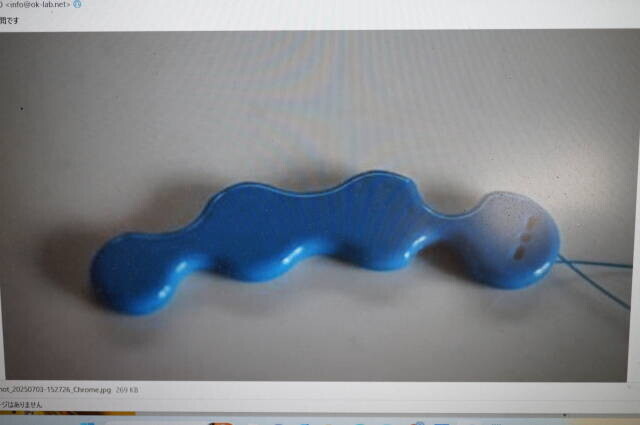
In an entry published in April 2019, Mr. Okada says he explored several electrode-chip approaches with his patent attorney. He reports that the attorney considered none of those approaches promising for obtaining a patent.
Mr. Okada also writes that, in his assessment, applications concerning this kind of electrode rarely reached allowance. He therefore did not plan to seek a separate electrode-chip patent. He still found other applicants' documents useful for understanding earlier work.
(Source: ok-lab's diary, published April 2019)
https://ok-lab.hatenablog.com/entry/2019/04/13/150233
Narrower claims brought basic patent approval after the earlier notice
In an entry published in March 2022, Mr. Okada reports allowance for the basic shape of the urethral device. His attorney's message says the claims had been limited to those considered acceptable.
Mr. Okada writes that he had responded to the November objections without arguing against them. He had expected a quicker decision and says the lack of news had worried him. He wondered whether the flat structure was the central point of the accepted design.
(Source: ok-lab's diary, published March 2022)
https://ok-lab.hatenablog.com/entry/2022/03/05/123200
A long-strip condition brought spiral patent approval after an earlier objection
In an entry published in October 2022, Mr. Okada reports allowance of the spiral rectal device. He had filed it around the same time as the U-turn application, but a September 2022 entry reported objections requiring amendments. The objection cited an earlier patent application for a spiral stool-removal tool; defining the design merely as spiral did not establish novelty.
The revised claim added that the spiral element was a long, flat strip, and Mr. Okada reports that this version was allowed. He describes the application as covering an aid for bowel movements. His attorney advised in September 2022 that matching 3D-printed forms (shapes made with a printer) also fell within the patent's coverage.
(Source: ok-lab's diary, published September 2022)
https://ok-lab.hatenablog.com/entry/2022/09/10/122847
(Source: ok-lab's diary, published October 2022)
https://ok-lab.hatenablog.com/entry/2022/10/01/122944
An attorney's rebuttal secured thread-hole patent approval with nearly full acceptance
In an entry published in July 2025, Mr. Okada reports allowance for the structure of holes through which chip threads pass. He says objections had arrived around March 2025, and his attorney's arguments secured acceptance of almost everything requested.
Mr. Okada writes that transferring the rights and paying annual patent fees remained necessary before the patent became effective. For interested readers, he points to the opinion dated April 23, 2025, under publication 2022-187510 in Japan's patent search records.
(Source: ok-lab's diary, published July 2025)
https://ok-lab.hatenablog.com/entry/2025/07/05/122905
How patent rejection changed over time
| Published | What the diary said then |
|---|---|
| Oct 2018 | Mr. Okada expected the pelvic-floor support application to receive a decision around early 2019. |
| Jan 2019 | An international assessment favored the vibrating chip design on the named criteria. |
| Apr 2019 | Mr. Okada decided against seeking separate electrode-chip patents after consulting his attorney. |
| Nov 2021 | Objections arrived for the basic application; Mr. Okada still expected substantial coverage. |
| Mar 2022 | The basic urethral-device application received allowance after its claims were narrowed. |
| Sep 2022 | Mr. Okada reported August allowance for the U-turn design without earlier objections. |
| Oct 2022 | Adding the long-strip condition overcame the spiral design's novelty objection. |
| Mar 2023 | The attorney warned that curved-support wording might still attract rejection. |
| Jul 2025 | Attorney arguments secured nearly full acceptance for the thread-hole structure. |
| Aug 2025 | Mr. Okada reported acceptance of the thread-hole patent's applicant-name change. |
The diary does not say what the current state is.
OK Prostate Chip products related to patent rejection
No current product is directly tied to this topic.
Common worries about patent rejection
(The material contains no questions from readers.)
Buying from outside Japan
OK Lab ships internationally to countries covered by Japan Post's EMS courier service. Overseas orders are paid in advance by PayPal. Each order carries a ¥400 (about $3 at ¥156 = $1, rate as of 2026-09-04) handling fee, and EMS shipping is charged on top. These terms come from OK Lab's official sales-terms page (written here as plain text, not a link: ok-lab.net/docs/law), checked on September 7, 2026; confirm them on the official store before you order, because they can change.
Summary of this article
| What you wanted to know | The answer |
|---|---|
| What is the short answer? | The basic application received objections, followed by reported allowance. |
| What is this product? | A urethral device made by OK Lab in Japan; the company's prices are in Japanese yen. |
| Which terms matter? | Claims describe requested protection; allowance is the favorable examination decision discussed in these entries. |
| What happened to the applications? | Some received favorable decisions; others remained forecasts in the supplied entries. |
| How did Mr. Okada respond? | He reports narrower wording, attorney arguments, and decisions against pursuing separate applications. |
| What changed over time? | The diary moves from expectations and objections to specific reported decisions and later paperwork. |
| Which current product addresses patent rejection? | No current product is directly tied to this topic. |
| Were reader questions about patent rejection recorded? | The material contains no reader questions about this topic. |
| How do overseas orders work? | Advance PayPal payment, a ¥400 (about $3 at ¥156 = $1, rate as of 2026-09-04) handling fee, and additional EMS shipping charges. |
Source: ok-lab's diary (Okada Comfortable Life Laboratory). The original entries are in Japanese; quotations on this page are translated. Photos and videos are on the original entries.
This article is a summary of the maker's development diary. The product is not a medical device and no result is guaranteed. If anything feels wrong or worries you, see a doctor. Prices, specifications and cautions change, so confirm the latest information on the official blog and the official site. Questions about ordering and shipping go to the seller.