![Is the OK Prostate Chip safe? | The maker reports failures and changes [OK Prostate Chip]](/img/a/T0687/eyecatch.svg)
This page is based on entries from "ok-lab's diary" (https://ok-lab.hatenablog.com/), the Japanese development diary written by Mr. Okada, founder of OK Lab, a small company in Japan (Okada Comfortable Life Laboratory). Only the entries about "manufacturer responsibility and putting safety first" are summarized here, in order of publication. Past prices and sizes are as written at the time. Current prices come from the official product list (retrieved September 4, 2026). Quotations are translated from Japanese.
Note: This page is a personal reading log by someone with no connection to the maker or the seller. It reflects the source entries as of their publication dates and makes no guarantee of accuracy or safety. The product is not a medical device; talk to a doctor about any health decision. Check the official site for current information. This page contains advertising.
In short
- The diary records breakages, difficult removal, and injury; Mr. Okada does not promise safety.
- His responses include stronger components, written warnings, and changes following customer reports.
- The latest entry promises stronger wire joints; the material does not record subsequent results.
If you see blood in your urine, even a small amount or for the first time, do not wait and see. See a urologist right away. If you suddenly cannot urinate, or the device cannot be removed, do not try to fix it yourself. Go to a medical facility, including emergency care, immediately.
About this product
The OK Prostate Chip is a small device that is placed in the urethra (the urine passage) so that it acts on the prostate; the maker sells it in several shapes, sizes and materials. It is made and sold by OK Lab (Okada Comfortable Life Laboratory), a small company in Japan, through its own online store, and prices are in Japanese yen (JPY). The maker's development diary, "ok-lab's diary", is written in Japanese. This page is an English summary of it, and every quotation is translated. OK Lab ships internationally, so readers outside Japan can order (see "Buying from outside Japan" below). Product names on this page are plain-English descriptions. The official Japanese product name is shown once in the product table so you can find the same item in the store.
Before you read: key terms
| Term | Plain-English meaning |
|---|---|
| Urethra | The urine passage; the chip is intended to sit in its prostate section. |
| Stopper chip | A part attached to the chip's thread. The diary does not explain this. |
| Retrieval thread | Thread attached to a chip, intended to allow its recovery. |
| Resin | Material used to form chips and cover components or joints. The diary describes its strengthening role. |
| Electrode | An electrical contact used to deliver current through an electrode chip. |
| Controller | The electrical unit supplying current to an electrode chip. |
| Product liability | Responsibility for harm caused by a product; discussed here in connection with claims against the maker. |
| Joke goods | Mr. Okada's product classification, used in his explanation of its status and disclaimers. |
| Retrieval prototype | An experimental tool intended to recover a chip from the bladder. |
What happens: OK Prostate Chip safety
The OK Prostate Chip is a small device intended to sit in the urethra, in the section passing through the prostate. These entries concern the maker's responsibility when a device breaks, causes injury, or becomes difficult to recover from the body. Mr. Okada discusses the strength of parts, electrical stimulation, and warnings supplied with the product. His accounts also cover proposed changes to components and joints, intended to address problems reported by customers.
Stopper chip breakage continued while the cheaper version stayed on sale
In an entry published in February 2019, a customer reported a stopper chip (a thread attachment) breaking before use. The break occurred during thread attachment, prompting the customer to question material strength and request improved quality control. Mr. Okada acknowledged earlier breakage reports and said he had wanted to stop selling that version.
He explained that sales staff opposed withdrawing the cheaper option because some customers still used it. He considered changing the resin (the material forming the part), but had no clear plan for strengthening it. Mr. Okada suggested softer stopper materials, while acknowledging the unresolved weakness of the sold version.
(Source: ok-lab's diary, published February 2019)
https://ok-lab.hatenablog.com/entry/2019/02/16/171153
Chip breakage was linked to force across the retrieval thread
In an entry published in February 2019, a customer praised a reinforced curved chip supplied after repeated breakages. The customer preferred its reversed curve orientation; Mr. Okada suspected this made removal harder and hastened damage to the resin attachment. No matching product can be confirmed on the current list.
Mr. Okada linked the possible damage to the retrieval thread (the thread intended for recovering the chip). He cautions that force across this thread can pull the resin attachment apart.
(Source: ok-lab's diary, published February 2019)
https://ok-lab.hatenablog.com/entry/2019/02/16/171153
A chip stuck inside the bladder proved difficult to recover medically
In an entry published in July 2021, Mr. Okada described a customer whose chip could not be recovered from the bladder. He reported that medical grasping tools kept slipping, with another attempt on a different day and bladder surgery discussed. The customer later reported getting the chip out; the diary does not record their condition afterward.
Mr. Okada wrote that he had known about difficult hospital removals before drafting the manual. He cautions that recovery without seeing the chip inside the bladder is difficult.
(Source: ok-lab's diary, published July 2021)
https://ok-lab.hatenablog.com/entry/2021/07/31/125702
Electrode chip safety remained uncertain despite a customer's reassuring follow-up
In an entry published in April 2022, a customer reported abandoning an electrical controller (the power unit) because its stimulation felt excessive. After trying another unit, the customer reported no problems two days later. Mr. Okada said he could not test electrode chips (chips with electrical contacts) himself and relied on customer reports.
He acknowledged that staff had recently forgotten the earlier warning that custom orders involved products the company had not tested. He believed a buyer-responsibility statement would not free the company from product liability (responsibility for harm caused by products). Mr. Okada cautions that these chips are not necessarily safe and could be life-threatening for someone with severe heart failure.
(Source: ok-lab's diary, published April 2022)
https://ok-lab.hatenablog.com/entry/2022/04/09/123458
Chip liability concerns persisted even after an order was delivered
In an entry published in July 2023, Mr. Okada reported completing delivery after further discussion with a customer. He said a lawsuit following failed removal surgery and lasting injury could force the company to close. He also acknowledged that a serious accident would probably leave the seller unable to escape responsibility.
Mr. Okada said he was reluctant to sell to customers who might pursue responsibility after an accident. Mr. Okada warns that simple descriptions could encourage buyers to assume the device is safe.
(Source: ok-lab's diary, published July 2023)
https://ok-lab.hatenablog.com/entry/2023/07/01/123130
The maker's answer to OK Prostate Chip safety
Mr. Okada describes changes to manufacturing, documentation, and joints, while acknowledging limits in testing and responsibility.
Vibrating chip safety prompted reinforcement before the finished device was formed
In an entry published in January 2019, Mr. Okada acknowledged that the vibration components were intended for phones or robot parts. He said preparing them for demanding conditions inside the body was the chip maker's responsibility. His revised process reinforced individual components with resin, followed by drying and demanding tests before embedding.
He reported that reinforcement and drying needed several days, extending production after ordering to about two weeks. The manufacturing change also delayed the provisional vibrating chip's release, although its specifications had changed little. Mr. Okada's message to buyers was that this additional preparation required a longer production period.
(Source: ok-lab's diary, published January 2019)
https://ok-lab.hatenablog.com/entry/20190112/1547275441
Written chip safety warnings accompanied the maker's joke-goods classification
In an entry published in July 2021, Mr. Okada decided to provide instructions despite a lawyer identifying problems with his proposed approach. He separated the product description from the handling manual and described the latter as a joke manual. His joke-goods classification (his description of the product's status) accompanied statements denying guaranteed effects and responsibility for accidents.
Mr. Okada said clinical trial evidence was not ready for a medical-device application, and the sex-aid registration route remained unclear. He nevertheless regarded providing information as a duty, even if the instructions were imperfect. His draft warns against self-repair, modification, and combining the chip with other urethral devices.
(Source: ok-lab's diary, published July 2021)
https://ok-lab.hatenablog.com/entry/2021/07/24/125923
A stuck chip retrieval prototype had no testing inside the bladder
In an entry published in July 2021, Mr. Okada described a retrieval prototype (an experimental tool for recovering a chip from the bladder). He said it had not undergone testing inside the bladder. His expectation that it could work under a doctor's visual guidance was therefore a proposal, without a recorded clinical result.
He stated there were no plans for general sale, although he offered to make it as a custom item when contacted. No matching product can be confirmed on the current list. Mr. Okada's proposal was for the tool to accompany the customer to a doctor.
(Source: ok-lab's diary, published July 2021)
https://ok-lab.hatenablog.com/entry/2021/07/31/125702
Wire chip safety prompted larger joints after a bleeding report
In an entry published in December 2025, a customer reported pain and bleeding during insertion of a sheath-style wire device made six months earlier. A wire fragment protruded outside; Mr. Okada identified a separated loop joint and offered a refund or remake. The customer declined compensation and requested more custom work; the diary does not record whether the injury resolved.
No matching product can be confirmed on the current list. Mr. Okada promised precautions against separation at every joint on all future shipments. He advised that white resin coverings would become larger because he considered safety more important than keeping the joints small.
(Source: ok-lab's diary, published December 2025)
https://ok-lab.hatenablog.com/entry/2025/12/27/122915
If you see blood in your urine, even a small amount or for the first time, do not wait and see. See a urologist right away. If you suddenly cannot urinate, or the device cannot be removed, do not try to fix it yourself. Go to a medical facility, including emergency care, immediately.
How OK Prostate Chip safety changed over time
| Published | What the diary said then |
|---|---|
| Jan 2019 | Components gained separate reinforcement and testing before chip manufacture. |
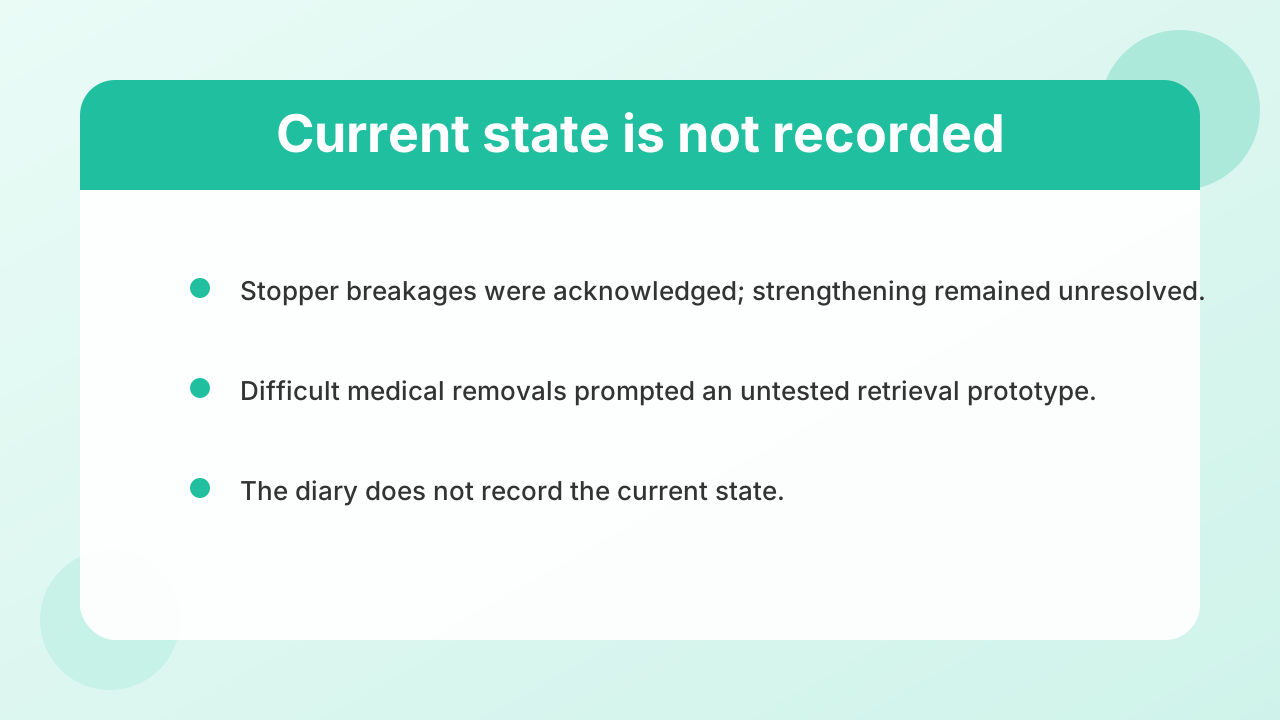
| Feb 2019 | Stopper breakages were acknowledged; strengthening remained unresolved. |
| May 2019 | A close-spaced electrode prototype retained cable-durability concerns. |
| Jul 2021 | Product descriptions and handling instructions were separated after legal discussion. |
| Jul 2021 | Difficult medical removals prompted an untested retrieval prototype. |
| Apr 2022 | Mr. Okada acknowledged missed custom-order warnings and possible serious electrical harm. |
| Jul 2023 | Mr. Okada said a serious injury lawsuit could end the business. |
| Dec 2025 | A bleeding report led to promised anti-separation measures at every wire joint. |
The diary does not say what the current state is.
OK Prostate Chip products related to OK Prostate Chip safety
No current product is directly tied to this topic.
Common worries about OK Prostate Chip safety
The replies show unresolved strength limits, uncertain sizing, and compromises in custom electrical designs.
"Does spiral chip safety limit custom sizes?"
In an entry published in February 2019, a customer asked about enlarging an anal spiral chip from 35 mm to 50 mm. Mr. Okada cited a separate report that a 10 cm spiral had been crushed. He quoted an additional ¥2,500 (about $16 at ¥156 = $1, rate as of 2026-09-04) excluding tax, as published in February 2019, for the requested custom size.
The diary does not record whether this customer completed the purchase or how the larger spiral performed. No matching product can be confirmed on the current list. Mr. Okada cautions that the maximum diameter the structure could withstand was unknown.
(Source: ok-lab's diary, published February 2019)
https://ok-lab.hatenablog.com/entry/2019/02/16/171153
"Do vibrating chip sizes establish a safe fit?"
In an entry published in February 2019, a customer asked how to choose between the vibrating chip's M and L sizes. Mr. Okada admitted that these labels began as his own estimates, without an established sizing basis. He described M as about 55 mm and L as 60 mm, linking length to the prostate portion of the urine passage.
The diary does not record which size the customer chose or whether either fitted. Mr. Okada describes choosing a size as uncertain, including the possibility of buying again after a poor fit.
(Source: ok-lab's diary, published February 2019)
https://ok-lab.hatenablog.com/entry/2019/02/16/171153
"Does electrode chip safety rule out custom designs?"
In an entry published in May 2019, a customer proposed a workaround, believing Mr. Okada would no longer make two-electrode chips. Mr. Okada's beginner proposal was one electrode per body opening, based on concerns about faulty older electrical units or higher-voltage controllers. However, Mr. Okada confirmed that knowledgeable customers could request 2 mm electrode spacing, prompting this customer to switch to a linked-chip design.
The resulting prototype had electrode spacing within 10 mm, but he remained concerned about the cable's durability. No matching product can be confirmed on the current list. Mr. Okada asked the customer to weigh close spacing against durability and function.
(Source: ok-lab's diary, published May 2019)
https://ok-lab.hatenablog.com/entry/2019/05/11/152432
Buying from outside Japan
OK Lab ships internationally to countries covered by Japan Post's EMS courier service. Overseas orders are paid in advance by PayPal. Each order carries a ¥400 (about $3 at ¥156 = $1, rate as of 2026-09-04) handling fee, and EMS shipping is charged on top. These terms come from OK Lab's official sales-terms page (written here as plain text, not a link: ok-lab.net/docs/law), checked on September 7, 2026; confirm them on the official store before you order, because they can change.
Summary of this article
| What you wanted to know | The answer |
|---|---|
| What is the short answer? | The diary records failures and changes, without a promise of safety. |
| What is this product? | A device placed in the urine passage, made by OK Lab in Japan; prices use JPY. |
| What do the terms mean? | Components, electrical contacts, and retrieval parts serve different roles; their limits matter in these accounts. |
| What happened? | Customers reported breakages, difficult removal, and injury; Mr. Okada discussed responsibility for those problems. |
| What did the maker change? | Component preparation, written warnings, a retrieval proposal, and measures against wire-joint separation. |
| How did the account develop? | The entries span January 2019 through December 2025; later outcomes are not recorded. |
| Which current product addresses responsibility? | No current product is directly tied to this topic. |
| What did customers ask? | Whether larger spirals, size labels, or custom electrode arrangements could meet their needs. |
| How do overseas orders work? | Advance PayPal payment, a ¥400 (about $3 at ¥156 = $1, rate as of 2026-09-04) handling fee, and additional EMS shipping charges. |
Source: ok-lab's diary (Okada Comfortable Life Laboratory). The original entries are in Japanese; quotations on this page are translated. Photos and videos are on the original entries.
This article is a summary of the maker's development diary. The product is not a medical device and no result is guaranteed. If anything feels wrong or worries you, see a doctor. Prices, specifications and cautions change, so confirm the latest information on the official blog and the official site. Questions about ordering and shipping go to the seller.