![Does OK Lab have penile support device patents? | An older grant and later applications are recorded [OK Prostate Chip]](/img/a/T0688/eyecatch.svg)
This page is based on entries from "ok-lab's diary" (https://ok-lab.hatenablog.com/), the Japanese development diary written by Mr. Okada, founder of OK Lab, a small company in Japan (Okada Comfortable Life Laboratory). Only the entries about "patents for penile holding and fixation devices" are summarized here, in order of publication. Past prices and sizes are as written at the time. Current prices come from the official product list (retrieved September 4, 2026). Quotations are translated from Japanese.
Note: This page is a personal reading log by someone with no connection to the maker or the seller. It reflects the source entries as of their publication dates and makes no guarantee of accuracy or safety. The product is not a medical device; talk to a doctor about any health decision. Check the official site for current information. This page contains advertising.
In short
The diary records a granted penile holder patent and later applications for different fixation designs.
Mr. Okada broadened the later design to work without a urethral rod.
The diary does not say what the current state is.
About this product

The OK Prostate Chip is a small device that is placed in the urethra (the urine passage) so that it acts on the prostate; the maker sells it in several shapes, sizes and materials. It is made and sold by OK Lab (Okada Comfortable Life Laboratory), a small company in Japan, through its own online store, and prices are in Japanese yen (JPY). The maker's development diary, "ok-lab's diary", is written in Japanese. This page is an English summary of it, and every quotation is translated. OK Lab ships internationally, so readers outside Japan can order (see "Buying from outside Japan" below). Product names on this page are plain-English descriptions. The official Japanese product name is shown once in the product table so you can find the same item in the store.
Before you read: key terms
| Term | Plain-English meaning |
|---|---|
| Urethra | The urine passage; it carries urine and is where the chip sits. |
| Prostate | The organ targeted by pressure from the chip, according to the maker. |
| Penile holder | A frame around the penis root, intended to keep that area in position. |
| Penile fixation device | An apparatus intended to hold the penis against the body and reduce the visible bulge. |
| Inward fixation | The diary's idea of holding the penis inward to reduce its outward projection. |
| Urethral rod | An instrument extending into the urine passage, used in earlier fixation designs for support and pressure. |
| Flexible 4-wire tip | A flexible section of a prototype rod, intended to accommodate bending deeper inside the urine passage. |
| Perineal bar | A curved support beneath the scrotum, intended to press from below and stabilize the penis root. |
| Gatekeeper | The diary's name for the front component that presses against the penis head to hold it inward. |
| Patent attorney | The specialist preparing Mr. Okada's applications and advising him about their contents. |
| Heart failure | The condition named in Mr. Okada's account of illness during testing. The diary does not explain this. |
| Patent claims | Written descriptions of the device features for which Mr. Okada sought protection. |
| USB connection | The electrical connection specified for the older vibrating frame and its battery box. |
What happens: penile support device patents
The OK Prostate Chip is a small device placed in the urethra to act on the prostate. The penile holding and fixation devices discussed here are supports around the penis, developed to keep it in a chosen position. The earlier frame worked from the pubic side, according to Mr. Okada, while later designs aimed to hold the penis inward against the body. Those later designs included supports at the penis head and beneath the scrotum.
A penile holder patent remained unbuilt because its frame was difficult to make
In an entry published in August 2019, Mr. Okada identified Japanese patent 5547309 as a penile holder. He described the invention as a support for keeping the penis stable, with pressure near the prostate as its underlying purpose. The frame had not reached production because he lacked the physical strength needed to manufacture its bent structure.
(Source: ok-lab's diary, published August 2019)
https://ok-lab.hatenablog.com/entry/2019/08/17/132641
The penile holder became a custom product with an added motor
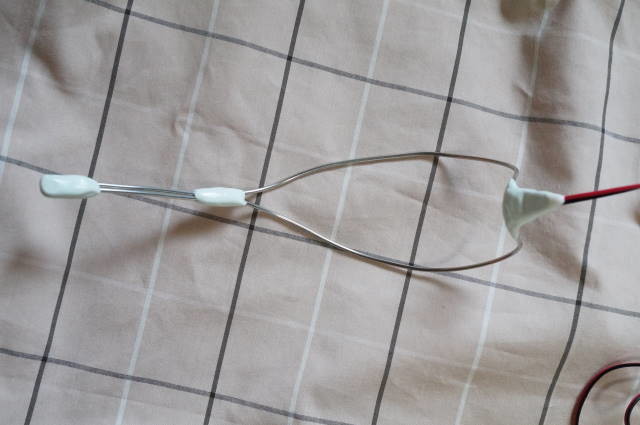
In an entry published in April 2020, Mr. Okada announced a vibrating external frame, initially available through custom orders. He described pressure around the prostate from the pubic side without contact with internal tissue lining. The diary gave the older patent's registration date as May 23, 2014, and publication date as July 9, 2014.
The commercial version added a motor and stocking fabric over the wire, which Mr. Okada said otherwise could stick to skin. Its published price was ¥7,000 (about $45 at ¥156 = $1, rate as of 2026-09-04) excluding tax, with a 3V battery box and USB connection (its electrical connector) included as standard. Mr. Okada specified USB connections only because the product was intended to be washable, and invited inquiries about custom orders.
(Source: ok-lab's diary, published April 2020)
https://ok-lab.hatenablog.com/entry/2020/04/11/151453
A tube garment discovery redirected penile fixation development toward another application
In an entry published in October 2022, Mr. Okada reported an unexpected result while testing a tube garment prototype. He wrote that the penis and testicles stayed contained more successfully than his earlier approach had allowed. He considered seeking a patent, although he had not yet consulted his patent attorney (the specialist preparing patent applications).
He consequently limited further disclosures and paused work on the existing inward-holding front component, called a gatekeeper in the diary. He expected that component's shape to change to suit the garment, whose design was still unfinished. No matching product can be confirmed on the current list.
(Source: ok-lab's diary, published October 2022)
https://ok-lab.hatenablog.com/entry/2022/10/29/122854
Patent plans delayed disclosure of penile fixation improvements and the expected launch
In an entry published in November 2022, Mr. Okada confirmed that he wanted to seek a patent for the fixation prototype. He reported continuing improvements informed by feedback from an illustrator, but withheld their details. His attorney expected filing before the year's end, while Mr. Okada anticipated sales beginning after the new year. During the delay, Mr. Okada invited readers to suggest features they wanted.
(Source: ok-lab's diary, published November 2022)
https://ok-lab.hatenablog.com/entry/2022/11/26/122622
A flexible rod extended penile fixation testing but introduced unstable positioning
In an entry published in December 2022, Mr. Okada described a rigid stainless-steel prototype that had not reached its intended position. A later version had a flexible 4-wire tip over approximately 5-6cm, which he reported could reach the bladder. However, he found that pressure around the prostate could make the rod's position unstable.
His account said the position needed checking after each urination, showing that the prototype still required repeated attention. No matching product can be confirmed on the current list.
(Source: ok-lab's diary, published December 2022)
https://ok-lab.hatenablog.com/entry/2022/12/10/123048
The December penile fixation filing described a rod connected to external supports
In an entry published in December 2022, Mr. Okada announced filing a penile fixation device application under reference PA220009. Its description combined a urethral rod, a body pressing against the penis, and cords worn around the waist. The stated aim was to maintain the penis in position despite changes in its shape, firmness, and size.
Mr. Okada hoped the application would protect future improvements as well as the immediate design. He explicitly acknowledged that filing had been completed but a patent had not yet been granted.
(Source: ok-lab's diary, published December 2022)
https://ok-lab.hatenablog.com/entry/2022/12/31/123019
A successful penile fixation trial left Mr. Okada revising his explanation
In an entry published in February 2023, Mr. Okada reported inward fixation (holding the penis inward) that felt unusually comfortable to him. He contacted his attorney about another application, then recognized that his original explanation for the result was mistaken. He still believed the result was repeatable, but had not settled on an explanation connecting the device's shape with its performance.
The diary therefore separated his personal test result from his uncertain account of why it worked. At his attorney's request, Mr. Okada suspended further related disclosures until the application was finished.
(Source: ok-lab's diary, published February 2023)
https://ok-lab.hatenablog.com/entry/2023/02/11/123054
Penile fixation without a rod prompted broader claims and delayed filing
In an entry published in March 2023, Mr. Okada reported that his device maintained inward fixation for 24 hours without a urethral rod. He had expected the front support to slip and was surprised by the result. This led him to request changes to the patent claims (the written features for which protection was sought).
The earlier draft had required an inserted component, but he now wanted the application to cover fixation without one. The extra drafting work prevented filing within the week originally planned.
(Source: ok-lab's diary, published March 2023)
https://ok-lab.hatenablog.com/entry/2023/03/11/122451
A later penile fixation application identified support beneath the scrotum
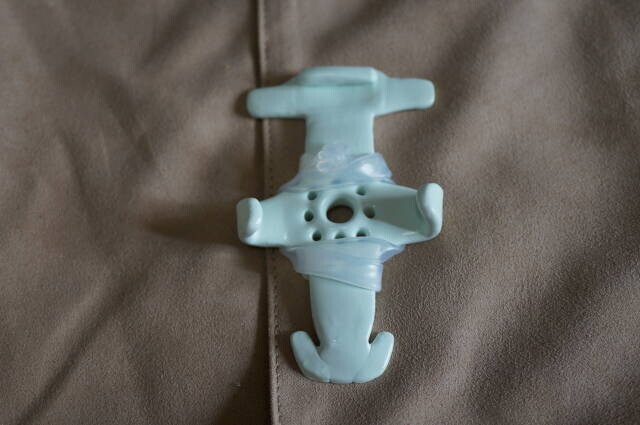
In an entry published in March 2023, Mr. Okada reported that the next application had been filed on March 15, 2023. The design included a perineal bar (a curved support beneath the scrotum) intended to stabilize the penis root. Its published claims described a separate lower support that could move vertically and be fixed in position.
Mr. Okada attributed improved stability to pressure from the front support and the perineal bar together. He cautioned that successful positioning still required familiarity and that inward fixation could not be guaranteed for every person. Mr. Okada favored the configuration without a urethral rod, but advised against omitting the perineal bar.
(Source: ok-lab's diary, published March 2023)
https://ok-lab.hatenablog.com/entry/2023/03/18/122146
The maker's answer to penile support device patents
Mr. Okada changed the designs, restricted disclosures during filing, and excluded the urethral rod from the later standard set.
A fitting complaint prompted an external alternative to the penile holder
In an entry published in August 2019, a customer reported that the vibrating chip's motor section was too large to fit. Mr. Okada returned a slimmer version, but the diary does not record whether it fitted. He reconsidered his earlier rectal-use suggestion after finding that movement during prolonged wear could make vibration stressful, and advised against prolonged use there.
His proposed double sleeve paired a 30-40mm penile sleeve with an approximately 7mm chip sleeve, provisionally priced at ¥1,500 (about $10 at ¥156 = $1, rate as of 2026-09-04) excluding tax. No matching product can be confirmed on the current list. Mr. Okada proposed this external fabric support as another approach for someone unable to accommodate the vibrating chip.
(Source: ok-lab's diary, published August 2019)
https://ok-lab.hatenablog.com/entry/2019/08/17/132641
Penile holder testing revealed slipping and serious symptoms after excessive tightening
In an entry published in April 2020, Mr. Okada warned that strong rearward tension could let the penis bend and the frame slip free. He also reported about 2 episodes he described as severe heart failure after overtightening the frame during testing. For the slipping problem, Mr. Okada proposed extra support at the frame's front loop.
(Source: ok-lab's diary, published April 2020)
https://ok-lab.hatenablog.com/entry/2020/04/11/151453
Attorney feedback narrowed penile fixation plans and restricted related photographs
In an entry published in December 2022, Mr. Okada described discussions that changed his planned application. According to his account, the attorney asked him to stop publishing even older gatekeeper photographs and supply printed copies of related posts. Mr. Okada explained that further blog coverage increased the attorney's preparation work.
The planned scope returned to inward fixation with a urethral rod, leaving the exposed-head, upright arrangement outside the application. Mr. Okada consequently withheld a more detailed development report he had considered publishing.
(Source: ok-lab's diary, published December 2022)
https://ok-lab.hatenablog.com/entry/2022/12/17/122643
The penile fixation launch excluded rods and limited weekly orders
In an entry published in March 2023, Mr. Okada announced plans to sell the 3-part external support set through the company's own online store. He excluded the urethral rod from this standard range because its use was substantially more difficult and carried different safety concerns. He warned that a rod extending from the penis head could place substantial strain on the urethra and cause injury.
Prices excluding tax were ¥10,000 (about $64 at ¥156 = $1, rate as of 2026-09-04) for the base plate, ¥3,000 (about $19 at ¥156 = $1, rate as of 2026-09-04) for the perineal bar, ¥2,000 (about $13 at ¥156 = $1, rate as of 2026-09-04) for the belt, and ¥15,000 (about $96 at ¥156 = $1, rate as of 2026-09-04) per set. He planned to pause sales at production capacity, complete outstanding manufacture, and reopen on Sunday evenings. Mr. Okada said he would continue reviewing the rod's safety and share further information when available.
(Source: ok-lab's diary, published March 2023)
https://ok-lab.hatenablog.com/entry/2023/03/25/122614
How penile support device patents changed over time
| Published | What the diary said then |
|---|---|
| Aug 2019 | The patented frame remained unproduced because Mr. Okada could not manufacture its bends. |
| Apr 2020 | A vibrating version became available through custom orders. |
| Oct 2022 | A tube garment discovery prompted patent consideration and reduced disclosures. |
| Dec 2022 | A flexible rod reached farther but needed repeated position checks. |
| Dec 2022 | A fixation device application was filed; a grant remained unconfirmed. |
| Feb 2023 | Staff confirmed that the older external frame project had been abandoned. |
| Mar 2023 | Successful testing without a rod broadened the requested protection and delayed filing. |
| Mar 2023 | The next application described a curved support reaching beneath the scrotum. |
| Mar 2023 | A standard set was announced, with rods excluded and sales subject to production capacity. |
The diary does not say what the current state is.
OK Prostate Chip products related to penile support device patents
No current product is directly tied to this topic.
Common worries about penile support device patents
OK Lab answered a reader's request by saying that the older frame project had been abandoned.
"What happened to the patented penile holder?"
In an entry published in February 2023, a reader requested more information about the older external vibrating frame. OK Lab staff replied that development had stopped and the project had been abandoned. Staff described the inward-fixation device under development as its intended replacement in purpose.
Mr. Okada added that he hoped to offer vibration as an extension of the newer design. The diary does not record a further response from that reader. He said more details would follow after the patent application.
(Source: ok-lab's diary, published February 2023)
https://ok-lab.hatenablog.com/entry/2023/02/18/122910
Buying from outside Japan

OK Lab ships internationally to countries covered by Japan Post's EMS courier service. Overseas orders are paid in advance by PayPal. Each order carries a ¥400 (about $3 at ¥156 = $1, rate as of 2026-09-04) handling fee, and EMS shipping is charged on top. These terms come from OK Lab's official sales-terms page (written here as plain text, not a link: ok-lab.net/docs/law), checked on September 7, 2026; confirm them on the official store before you order, because they can change.
Summary of this article
| What you wanted to know | The answer |
|---|---|
| In short: what is documented? | An older granted patent and later applications for changing fixation designs. |
| About this product: what is the chip? | A small urethral device made and sold by OK Lab in Japan. |
| Key terms: what are the supports? | Frames, front supports, rods, and perineal bars served different roles in the designs. |
| What happens: how did the designs develop? | Development moved from an external frame toward inward fixation, eventually without a urethral rod. |
| The maker's answer: what changed? | Mr. Okada revised designs and filing plans, then excluded rods from the standard set. |
| Changed over time: what is known today? | The diary does not say what the current state is. |
| Related products: what belongs in this patent discussion? | No current product is directly tied to this topic. |
| Common worries: what happened to the older frame? | Staff said the project had been abandoned in an entry published in February 2023. |
| Buying from outside Japan: what are the stated terms? | Advance PayPal payment, a ¥400 (about $3 at ¥156 = $1, rate as of 2026-09-04) handling fee, and additional EMS shipping charges. |
Source: ok-lab's diary (Okada Comfortable Life Laboratory). The original entries are in Japanese; quotations on this page are translated. Photos and videos are on the original entries.
This article is a summary of the maker's development diary. The product is not a medical device and no result is guaranteed. If anything feels wrong or worries you, see a doctor. Prices, specifications and cautions change, so confirm the latest information on the official blog and the official site. Questions about ordering and shipping go to the seller.