![Is the OK Prostate Chip patented? | The diary reports a 2022 decision to grant [OK Prostate Chip]](/img/a/T0667/eyecatch.svg)
This page is based on entries from "ok-lab's diary" (https://ok-lab.hatenablog.com/), the Japanese development diary written by Mr. Okada, founder of OK Lab, a small company in Japan (Okada Comfortable Life Laboratory). Only the entries about "patents for devices left in the urethra" are summarized here, in order of publication. Past prices and sizes are as written at the time. Current prices come from the official product list (retrieved September 4, 2026). Quotations are translated from Japanese.
Note: This page is a personal reading log by someone with no connection to the maker or the seller. It reflects the source entries as of their publication dates and makes no guarantee of accuracy or safety. The product is not a medical device; talk to a doctor about any health decision. Check the official site for current information. This page contains advertising.
In short
- The diary reports a March 2022 decision to grant the basic patent.
- Mr. Okada revised designs and sought further patents as testing exposed problems.
- The material does not establish today's patent status or whether later proposed designs reached sale.
If you see blood in your urine, even a small amount or for the first time, do not wait and see. See a urologist right away. If you suddenly cannot urinate, or the device cannot be removed, do not try to fix it yourself. Go to a medical facility, including emergency care, immediately.
About this product
The OK Prostate Chip is a small device that is placed in the urethra (the urine passage) so that it acts on the prostate; the maker sells it in several shapes, sizes and materials. It is made and sold by OK Lab (Okada Comfortable Life Laboratory), a small company in Japan, through its own online store, and prices are in Japanese yen (JPY).
The maker's development diary, "ok-lab's diary", is written in Japanese. This page is an English summary of it, and every quotation is translated.
OK Lab ships internationally, so readers outside Japan can order (see "Buying from outside Japan" below). Product names on this page are plain-English descriptions. The official Japanese product name is shown once in the product table so you can find the same item in the store.
Before you read: key terms
| Term | Plain-English meaning |
|---|---|
| Patent application | A filing seeking protection for an invention; the diary describes separate filings for different designs. |
| Patent claims | Statements identifying features for which protection is sought; these defined the designs discussed with the examiner. |
| Urethra | The urine passage; the chip is intended to remain inside it and act on the prostate. |
| Bulbar section | The part in the wider urethral area; it provides a location for a connected chip. |
| Sphincter | A muscle discussed as gripping the chip; the diary describes both positioning and pressure concerns. |
| Auxiliary chip | A second, connected chip intended to help position or retrieve the main chip. |
| Shape-memory wire | Wire intended to return to a preset curve; the maker used it to connect chip sections. |
| Nitinol | Nickel-titanium wire used for flexible connections and loops in the later designs. |
| Mesh stopper | An additional chip positioned between connected sections; the diary does not explain its stopping action. |
What happens: OK Prostate Chip patents
The OK Prostate Chip is a small device intended to remain in the urethra and stimulate the prostate. The diary's patent applications (filings seeking protection for inventions) concern the device's shape, linked parts, and later wire connections. Some proposed designs include a section extending into the bladder, while others connect sections around the prostate. Mr. Okada describes seeking protection for these different arrangements as development progresses.
An initial patent application preceded the finished product name and instructions
In an entry published in October 2017, Mr. Okada reported filing application 2017-193218 on October 3, 2017. His proposed system used a chip a few centimeters long, with linked parts intended to help positioning and retrieval. Mr. Okada said the hardware was ready for sale, but its instructions and product name were unfinished. He therefore postponed the launch while those details were prepared.
(Source: ok-lab's diary, published October 2017)
https://ok-lab.hatenablog.com/entry/20171003/1507036624
Objections prompted amendments, while patent protection remained an expectation
In an entry published in November 2021, Mr. Okada reported objections to the basic application and planned amendments. He expected roughly 95% of products then sold to fall within its eventual protection for 16 years. These were his expectations before the later decision.
He expected a cylindrical-motor design and a stainless-steel ring design to remain outside that application's protection. He also reported several related applications as a backup if the basic one failed.
(Source: ok-lab's diary, published November 2021)
https://ok-lab.hatenablog.com/entry/2021/11/27/124314
The basic patent application received a decision to grant
In an entry published in March 2022, Mr. Okada reported receiving a decision to grant a patent covering the device's basic shape. His patent adviser said the application had been narrowed to the patent claims (features for which protection was sought) accepted by the examiner. Mr. Okada thought the flattened structure might be the central feature. The material does not establish the exact protection in force today.
(Source: ok-lab's diary, published March 2022)
https://ok-lab.hatenablog.com/entry/2022/03/05/123200
A new patent plan reduced updates on the prostate prototype
In an entry published in February 2024, Mr. Okada said the prostate prototype (Prostate Alien) stayed in place better than he expected. He wanted to understand its structure before seeking a patent, so he planned fewer public updates. He separately described a related urethral prototype (Urethral Alien), with a jointed tail combining a cord, tubing, and resin.
Mr. Okada said he probably would not release that urethral prototype. He expected to offer its tail after further refinement. No matching product can be confirmed on the current list.
(Source: ok-lab's diary, published February 2024)
https://ok-lab.hatenablog.com/entry/2024/02/24/122947
Filing a curved-wire patent application ended the maker's sales delay
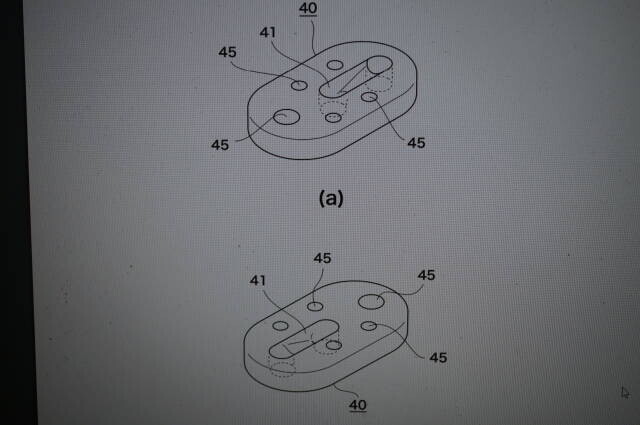
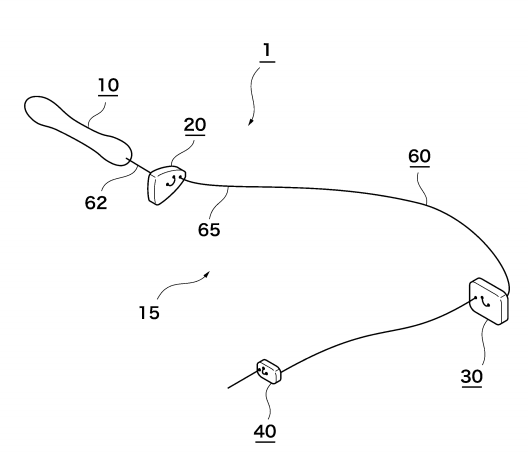
In an entry published in April 2024, Mr. Okada announced filings covering two arrangements connected by shape-memory wire (wire intended to regain a preset curve). One linked prostate and bulbar (wider urethral area) sections; the other added a bladder section.
He also sought protection for a mesh stopper (an additional chip connected to the wire). Mr. Okada said recording the key features in the application allowed sales of the shape-memory chip to begin. Prices and sales conditions for the separate three-chip model were still undecided. No matching product can be confirmed on the current list.
(Source: ok-lab's diary, published April 2024)
https://ok-lab.hatenablog.com/entry/2024/04/20/122856
Pricing followed the patent application for a three-chip wire-connected model
In an entry published in May 2024, Mr. Okada published standard pricing for the three-chip wire-connected model. The package included three chips, their shape-memory wire connection, and a tube cover for ¥13,000 (about $83 at ¥156 = $1, rate as of 2026-09-04) excluding tax. Adding a mesh stopper between the prostate and bulbar sections cost ¥2,000 (about $13 at ¥156 = $1, rate as of 2026-09-04).
The flat prostate-chip option reduced the price by ¥1,000 (about $6 at ¥156 = $1, rate as of 2026-09-04), while a screw-shaped bulbar chip added ¥1,000 (about $6 at ¥156 = $1, rate as of 2026-09-04). Each separate size change added ¥300 (about $2 at ¥156 = $1, rate as of 2026-09-04). No matching product can be confirmed on the current list.
(Source: ok-lab's diary, published May 2024)
https://ok-lab.hatenablog.com/entry/2024/05/18/122913
A bladder-loop prototype disclosed during patent work failed to stay stable
In an entry published in November 2024, Mr. Okada disclosed a bladder-loop prototype while withholding details of a separate patent application. The prototype used silicone-covered wire extending beyond the body, with a loop intended to stay in the bladder. He reported that movement and changes in penis length prevented stable positioning.
The historical option added ¥2,000 (about $13 at ¥156 = $1, rate as of 2026-09-04) excluding tax and was limited to 3 chip types supporting connections at both ends. No matching product can be confirmed on the current list. Mr. Okada cautioned that reliable prostate-chip positioning could not be expected from this design.
(Source: ok-lab's diary, published November 2024)
https://ok-lab.hatenablog.com/entry/2024/11/02/122858
Possible patent protection delayed sales information for the thinner loop
In an entry published in August 2025, Mr. Okada described his first bladder-loop prototype made with 0.2mm nitinol (nickel-titanium) wire. He said it felt gentler in his own testing and considered seeking protection for the design. Prices and specifications were withheld that week pending advice from a patent specialist.
He said a promising assessment would mean holding sales, while a negative assessment could allow pricing announcements the following week. The diary does not record that consultation's outcome. No matching product can be confirmed on the current list.
(Source: ok-lab's diary, published August 2025)
https://ok-lab.hatenablog.com/entry/2025/08/16/122934
The maker traced his patent ambitions to a relative's urinary difficulty
In an entry published in November 2025, Mr. Okada traced his interest in urethral devices to a relative who could not urinate. He also credited a doctor's patented device for widening blood vessels with inspiring his own work. He wrote that his aims included both help with urinary difficulties and pleasure.
Mr. Okada also discussed a jointed wire design as a possible new direction. He hoped it could retain springiness while reducing what he considered metal's unwanted effects on the body.
(Source: ok-lab's diary, published November 2025)
https://ok-lab.hatenablog.com/entry/2025/11/22/122910
The maker's answer to OK Prostate Chip patents
The diary describes safeguards and design revisions alongside patent work, while expressly denying any guarantee against infection.
The maker's patent discussion expressly rejected guaranteed protection against infection
In an entry published in October 2017, Mr. Okada distinguished concerns about physical injury from concerns about infection. He said the system could not guarantee that infection would never occur. His confidence in the device's mechanical design did not extend to an absolute infection guarantee. Mr. Okada emphasized cleanliness as his first precaution.
(Source: ok-lab's diary, published October 2017)
https://ok-lab.hatenablog.com/entry/20171010/1507618022
A reported injury prompted linked-chip changes and another patent application
In an entry published in December 2017, Mr. Okada reported an injury in a long-chip wear test. The tester reported damage to a sphincter (a muscle gripping the chip) after several days of 24-hour continuous wear. His own testing had included overnight breaks; the diary does not record the tester's recovery.
He responded with linked chips separated by about 10mm of thread, intended to reduce pressure at that muscle. That change also led to application 2017-250364, filed on December 27, 2017. Mr. Okada said the long chip would be sold only for short periods of use because he considered its muscle load substantial.
(Source: ok-lab's diary, published December 2017)
https://ok-lab.hatenablog.com/entry/20171231/1514712104
The three-hole patent application addressed problems with fixed chip positions
In an entry published in June 2018, Mr. Okada announced application 2018-125440 for a three-hole chip system. He said fixed chip positions had left some customers with thread that was too long or too short. The revised design allowed the positions of both the auxiliary chip (a linked supporting chip) and safety chip to vary.
The entry described thread up to 35cm long. Mr. Okada suggested the maximum length for people wanting adjustable chip positions.
(Source: ok-lab's diary, published June 2018)
https://ok-lab.hatenablog.com/entry/20180630/1530342059
Revisiting an original patent design did not remove the thread precaution
In an entry published in January 2021, Mr. Okada proposed the lead chip (Sea Slug, version 3, revision 1) for internal placement. No matching product can be confirmed on the current list.
He said customers' concerns had led him to sell versions with an external thread, despite the original patent design being fully internal. His tax-excluded estimates were ¥4,000 (about $26 at ¥156 = $1, rate as of 2026-09-04) for that lead chip, ¥1,500 (about $10 at ¥156 = $1, rate as of 2026-09-04) for a sphincter stopper, and ¥3,000 (about $19 at ¥156 = $1, rate as of 2026-09-04) for a ring-shaped auxiliary chip.
Loop-ended nylon extension thread and stainless-steel wire were each estimated at ¥500 (about $3 at ¥156 = $1, rate as of 2026-09-04) excluding tax. Mr. Okada considered the extension thread essential until users could prevent bladder migration and manage difficult retrieval.
(Source: ok-lab's diary, published January 2021)
https://ok-lab.hatenablog.com/entry/2021/01/16/124800
Despite a patent application, the maker still recommended covered wire
In an entry published in May 2024, Mr. Okada discussed the wire beside the bladder's sphincter. He considered that area sensitive and said bare wire could be uncomfortable. His suggestion that short use might be tolerable was tentative. Mr. Okada recommended a tube cover over the wire for the three-chip model.
(Source: ok-lab's diary, published May 2024)
https://ok-lab.hatenablog.com/entry/2024/05/18/122913
If you see blood in your urine, even a small amount or for the first time, do not wait and see. See a urologist right away. If you suddenly cannot urinate, or the device cannot be removed, do not try to fix it yourself. Go to a medical facility, including emergency care, immediately.
How OK Prostate Chip patents changed over time
| Published | What the diary said then |
|---|---|
| Oct 2017 | The first application preceded launch; instructions and naming were unfinished. |
| Dec 2017 | A tester's injury prompted a linked-chip redesign and another filing. |
| Jun 2018 | A three-hole design made previously fixed chip positions adjustable. |
| Jan 2019 | Mr. Okada reported a favorable international assessment of the vibrating design. |
| Nov 2021 | Objections led to planned amendments of the basic application. |
| Mar 2022 | The diary reported a decision to grant the basic patent. |
| Apr 2024 | Filing cleared the maker's delay on sales of the shape-memory chip. |
| Oct 2024 | Further patent plans slowed disclosure of selected new designs. |
| Nov 2024 | A silicone-covered bladder-loop prototype failed to provide stable positioning. |
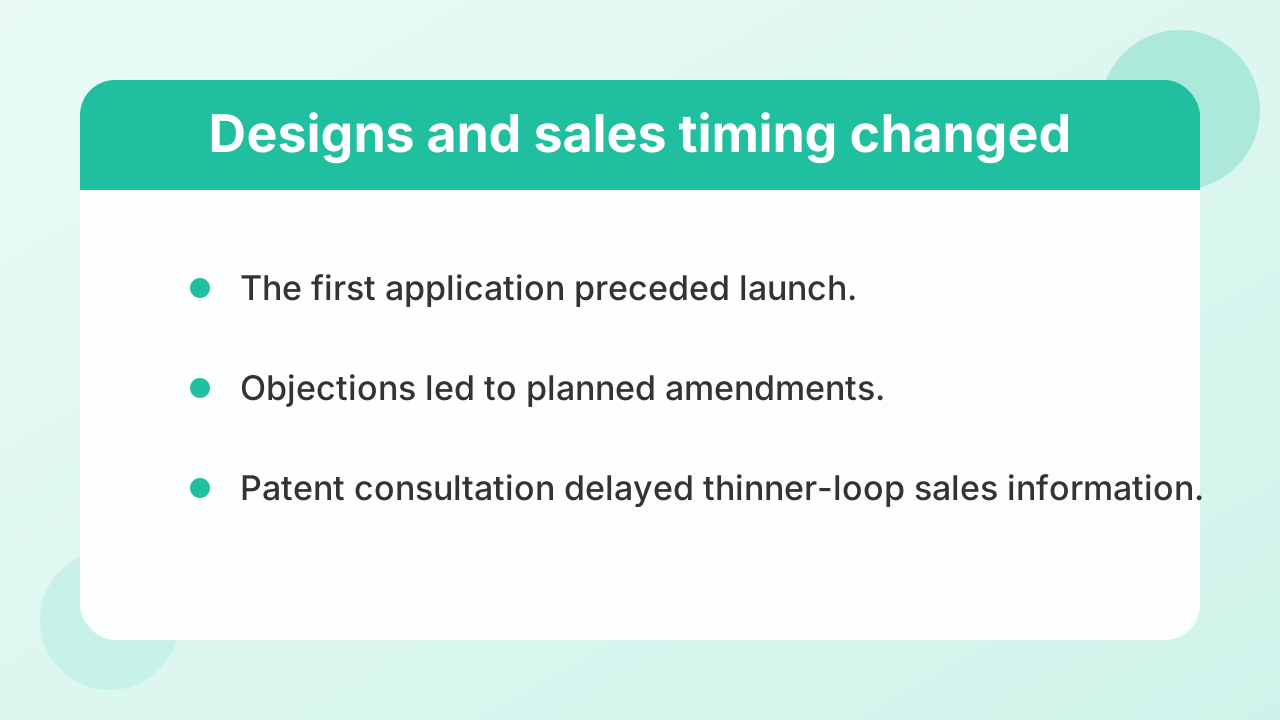
| Aug 2025 | Patent consultation delayed thinner-loop sales information; a longer hold depended on the advice. |
The diary does not say what the current state is.
OK Prostate Chip products related to OK Prostate Chip patents
No current product is directly tied to this topic.
Common worries about OK Prostate Chip patents
(The material contains no questions from readers about patents.)
Buying from outside Japan
OK Lab ships internationally to countries covered by Japan Post's EMS courier service. Overseas orders are paid in advance by PayPal. Each order carries a ¥400 (about $3 at ¥156 = $1, rate as of 2026-09-04) handling fee, and EMS shipping is charged on top. These terms come from OK Lab's official sales-terms page (written here as plain text, not a link: ok-lab.net/docs/law), checked on September 7, 2026; confirm them on the official store before you order, because they can change.
Summary of this article
| What you wanted to know | The answer |
|---|---|
| What is the short answer? | The diary reports a decision to grant the basic patent in March 2022. |
| What is the product? | A urethral device made and sold by OK Lab in Japan, priced in JPY. |
| What do the technical terms mean? | The entries discuss patent filings, connected chips, and wires intended to hold particular shapes. |
| What happened with the patents? | The basic application progressed; later designs led to separate filings and proposals. |
| How did the maker respond to problems? | He described design changes, thread precautions, cleanliness, and wire covers. |
| What changed over time? | Designs, applications, disclosure plans, and sales timing changed across the dated entries. |
| Which current product answers this patent question? | No current product is directly tied to this topic. |
| Were reader questions about patents recorded? | None appear in the supplied entries. |
| How does overseas buying work? | Advance PayPal payment, a ¥400 (about $3 at ¥156 = $1, rate as of 2026-09-04) handling fee, and additional EMS shipping charges. |
Source: ok-lab's diary (Okada Comfortable Life Laboratory). The original entries are in Japanese; quotations on this page are translated. Photos and videos are on the original entries.
This article is a summary of the maker's development diary. The product is not a medical device and no result is guaranteed. If anything feels wrong or worries you, see a doctor. Prices, specifications and cautions change, so confirm the latest information on the official blog and the official site. Questions about ordering and shipping go to the seller.