![Will deep grooves keep the chip in place? | A tighter grip can also pinch [OK Prostate Chip]](/img/a/T0535/eyecatch.svg)
This page is based on entries from "ok-lab's diary" (https://ok-lab.hatenablog.com/), the Japanese development diary written by Mr. Okada, founder of OK Lab, a small company in Japan (Okada Comfortable Life Laboratory). Only the entries about deep waists and pronounced ridges are summarized here, in order of publication. Past prices and sizes are as written at the time. Current prices come from the official product list (retrieved September 4, 2026). Quotations are translated from Japanese.
Note: This page is a personal reading log by someone with no connection to the maker or the seller. It reflects the source entries as of their publication dates and makes no guarantee of accuracy or safety. The product is not a medical device; talk to a doctor about any health decision. Check the official site for current information. This page contains advertising.
In short
A deeply narrowed chip can grip firmly, but the diary also records pinching, bleeding, and movement despite that shape.
Mr. Okada distinguishes comfortable retention from strong stimulation and warns against expecting a narrow waist to guarantee stability.
The current list includes ceramic twist and stainless-steel chips discussed here; historical custom dimensions are not confirmed current options.
If you see blood in your urine, even a small amount or for the first time, do not wait and see. See a urologist right away. If you suddenly cannot urinate, or the device cannot be removed, do not try to fix it yourself. Go to a medical facility, including emergency care, immediately.
About this product
The OK Prostate Chip is a small device that is placed in the urethra (the urine passage) so that it acts on the prostate; the maker sells it in several shapes, sizes and materials. It is made and sold by OK Lab (Okada Comfortable Life Laboratory), a small company in Japan, through its own online store, and prices are in Japanese yen (JPY).
The maker's development diary, "ok-lab's diary", is written in Japanese. This page is an English summary of it, and every quotation is translated. OK Lab ships internationally, so readers outside Japan can order (see "Buying from outside Japan" below).
Product names on this page are plain-English descriptions. The official Japanese product name is shown once in the product table so you can find the same item in the store.
Before you read: key terms
| Term | Plain-English meaning |
|---|---|
| Urethra | The urine passage; the chip occupies part of this passage to act on the prostate. |
| Sphincter | The muscle discussed as gripping the chip; these designs seek to hold their narrowed section at that muscle. |
| Waist or neck | A narrowed section between broader parts of the chip, intended to help it stay in place. |
| Groove opening | The opening of a recess in the chip; Mr. Okada varied it when comparing sensation and retention. |
| Stopper chip | An additional chip intended to limit unwanted inward movement. |
| Screw-shaped auxiliary chip | An additional part discussed for retention; the diary also describes discomfort associated with a tightly spaced arrangement. |
What happens: chip pinching and slipping
The OK Prostate Chip is a device placed in the urethra to act on the prostate. This topic concerns its waist or neck, the narrow section between broader bulges, and the pronounced ridges surrounding that section. The diary describes shapes intended to engage a sphincter, the muscle discussed as gripping the chip, near its rear end. Customers sought firmer retention, while Mr. Okada explored whether those shapes could also reduce unwanted movement.
A narrow-waist resin chip brought reports of pain and bleeding
In an entry published in March 2018, a customer reported more pain and bleeding with custom resin chips than glass during extended use. The customer wanted a curved tip and deeply narrowed rear section within a 4cm chip. Mr. Okada said those features could not physically fit that length.
The diary does not record whether the revised order was completed. Mr. Okada asked for a change to 5cm to accommodate the requested shape.
(Source: ok-lab's diary, published March 2018)
https://ok-lab.hatenablog.com/entry/20180331/1522485734
Deep grooves improved one glass prototype's comfort without preventing slipping
In an entry published in May 2018, Mr. Okada described glass prototypes made after a request for more pronounced bulges and grooves. One measured 41mm, with 11mm and 12mm bulges; another measured 44mm, with 10mm and 11mm bulges.
He also made a smaller example for his own trial. Mr. Okada found it much more comfortable than deeply recessed resin designs and considered developing the idea further. His caution was that this glass prototype still slipped downward during urination.
(Source: ok-lab's diary, published May 2018)
https://ok-lab.hatenablog.com/entry/20180505/1525509161
A tight grip accompanied slight bleeding in one custom-chip report
In an entry published in June 2018, a customer reported excellent stability from a custom medium-length chip. It measured 48mm, with a 9mm tip, 10mm central bulge, 4mm waist, and 10mm rear bulge. The customer found the stimulation too strong for extended use and noticed slight bleeding after removal at 30 minutes.
The customer suspected excessive squeezing, but that was their explanation of the experience. The diary does not record a specific reply from Mr. Okada about the bleeding.
(Source: ok-lab's diary, published June 2018)
https://ok-lab.hatenablog.com/entry/20180609/1528523953
A narrow waist did not stop another custom chip moving inward
In an entry published in June 2018, a customer sought better retention after a medium-length chip continued moving inward. That chip measured 42mm, with an 8mm central bulge, 6mm waist, and 11mm rear bulge. The customer described movement resembling a single-chip model despite the difference between its waist and rear bulge.
Mr. Okada responded with five prototypes, and the customer selected several. One selected piece broke during production, so he made a replacement. Mr. Okada asked whether that replacement would be acceptable; the diary does not record the customer's answer.
(Source: ok-lab's diary, published June 2018)
https://ok-lab.hatenablog.com/entry/20180616/1529136608
Pronounced ridges varied between batches of one custom ceramic design
In an entry published in December 2019, Mr. Okada classified a ridged ceramic chip (sea-slug version 3, revision 1) as medium-length. Its price was ¥4,400 (about $28 at ¥156 = $1, rate as of 2026-09-04), as published then.
He described remaining stock and a wait of approximately 2 weeks once that stock was gone. He also explained that the surface finish changed the prominence of the ridges, even with the same mold. Mr. Okada cautioned that successive pieces would not be identical.
(Source: ok-lab's diary, published December 2019)
https://ok-lab.hatenablog.com/entry/2019/12/14/151232
Narrow-waist prototypes made individual fit a specific design question
In an entry published in May 2021, Mr. Okada described 33 test chips made using digital designs. Neck length varied across 11 patterns in 0.5mm steps, with three thicknesses: 2mm, 2.75mm, and 3.5mm.
He planned to compare them himself; this paragraph does not record the completed comparison. Mr. Okada thought thinner necks favored retention, while suitable neck length depended on individual sphincter thickness.
(Source: ok-lab's diary, published May 2021)
https://ok-lab.hatenablog.com/entry/2021/05/08/125938
A titanium chip's tight grip impressed its customer more than Mr. Okada
In an entry published in September 2021, a customer praised the very narrow rear section of a short titanium chip. They reported less awareness of the device and less inward movement than with earlier chips.
Mr. Okada replied that the newer resin chips had almost the same narrow waist. However, he had not experienced the exceptionally secure hold described by this customer. He expressly cautioned against expecting that result from the narrow shape alone.
(Source: ok-lab's diary, published September 2021)
https://ok-lab.hatenablog.com/entry/2021/09/11/125735
Narrow-waist stainless-steel chips arrived as limited stock in September 2022
In an entry published in September 2022, Mr. Okada announced limited arrivals of contoured stainless-steel chips (Zoro) in S and L. The medium-length stainless-steel chip also arrived in S.
The diary attributed their slightly thinner waists to greater strength than the resin versions. Sales were expected to begin around the following week. Mr. Okada cautioned that exhausted stock would not receive an immediate replacement batch.
(Source: ok-lab's diary, published September 2022)
https://ok-lab.hatenablog.com/entry/2022/09/17/123057
The maker's answer to chip pinching and slipping
Mr. Okada's answers considered the stopper, material strength, groove dimensions, and intended retention method separately.
A stopper remained Mr. Okada's preferred answer to chip slipping
In an entry published in May 2018, Mr. Okada discussed inward movement after the whole chip had passed the sphincter. He thought pressure from the side could then move it toward the bladder.
A larger rear bulge with deeper grooves was another possibility he considered for preventing that passage. He presented this as a design idea, while favoring a stopper chip as the best answer to inward movement.
(Source: ok-lab's diary, published May 2018)
https://ok-lab.hatenablog.com/entry/20180505/1525509161
Narrow-waist designs depended on the strength of their material
In an entry published in June 2021, Mr. Okada compared the material limits on a narrow waist. He said ceramic and glass needed approximately 5mm there for strength, while the resin under development needed 3mm or more.
The titanium example he discussed had a 2mm recess width. His account treated material strength as a constraint on narrowing the chip, rather than a reason to copy one material's dimensions into another.
(Source: ok-lab's diary, published June 2021)
https://ok-lab.hatenablog.com/entry/2021/06/26/125926
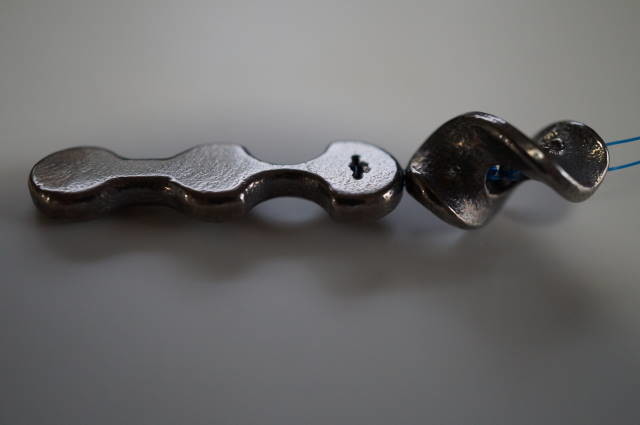
Deep grooves needed different openings for sensation and stable retention
In an entry published in June 2021, Mr. Okada distinguished neck thinness from the groove opening, meaning the opening of the recess. He believed a thinner section reduced strain and improved retention.
For the opening, his preferred sensation came at approximately 4mm, while 6–7mm seemed better for stable retention. Mr. Okada advised considering comfortable retention and stronger sensation as separate design goals.
(Source: ok-lab's diary, published June 2021)
https://ok-lab.hatenablog.com/entry/2021/06/26/125926
Narrow waists were unnecessary when a design used different retention
In an entry published in August 2021, Mr. Okada reviewed digital designs for several chip shapes. He welcomed the narrow waist on the long design.
For a separate design intended for stronger prostate stimulation, he said fixation at the sphincter was not its defining function. Mr. Okada therefore favored keeping that established shape instead of narrowing its waist further.
(Source: ok-lab's diary, published August 2021)
https://ok-lab.hatenablog.com/entry/2021/08/14/125815
If you see blood in your urine, even a small amount or for the first time, do not wait and see. See a urologist right away. If you suddenly cannot urinate, or the device cannot be removed, do not try to fix it yourself. Go to a medical facility, including emergency care, immediately.
How chip pinching and slipping changed over time
| Published | What the diary said then |
|---|---|
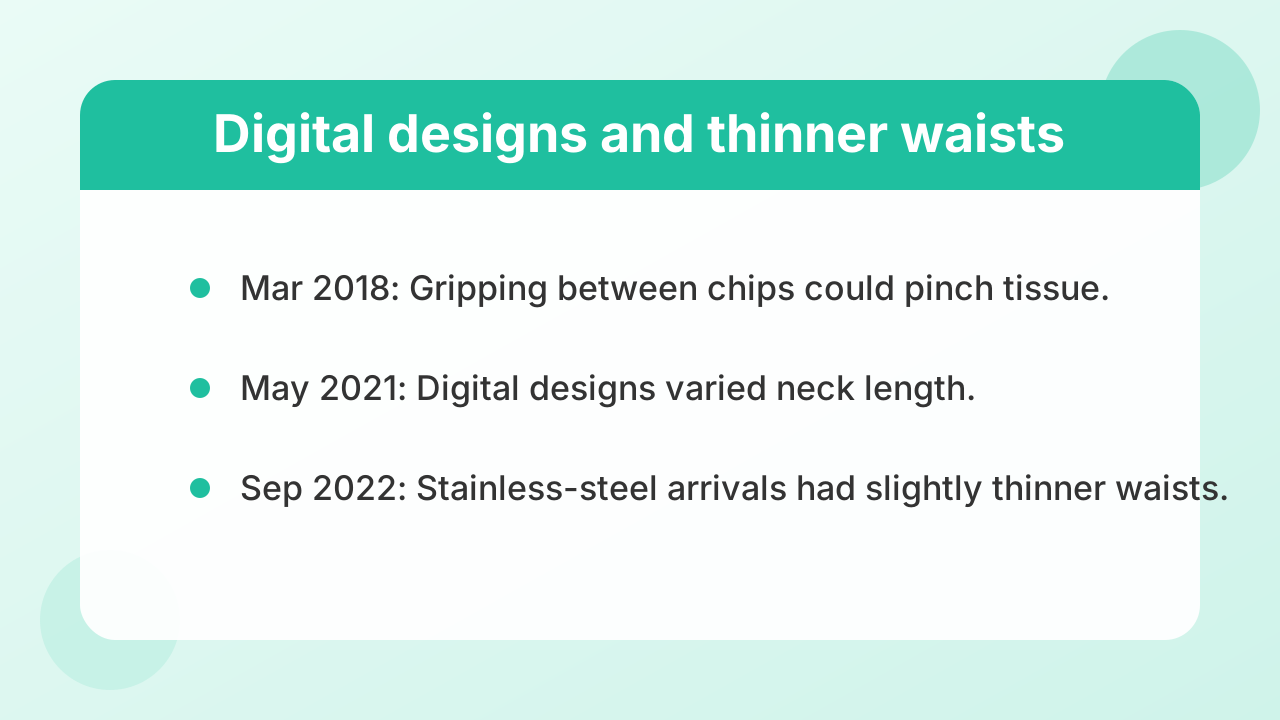
| Mar 2018 | Mr. Okada warned that gripping between two chips could pinch tissue painfully. |
| Mar 2018 | A requested curve and waist required a longer custom resin design. |
| May 2018 | A more comfortable glass prototype still slipped during urination. |
| Jun 2018 | A customer reported excellent stability alongside excessive stimulation and slight bleeding. |
| Dec 2019 | A ridged ceramic variant received medium-length pricing and a replenishment wait. |
| May 2021 | Digital designs enabled systematic variation of neck length and thickness. |
| Jun 2021 | Mr. Okada separated material strength, sensation, and retention requirements. |
| Sep 2021 | Mr. Okada tempered a customer's unusually positive titanium retention report. |
| Sep 2022 | Limited stainless-steel arrivals had slightly thinner waists than resin versions. |
OK Prostate Chip products related to chip pinching and slipping
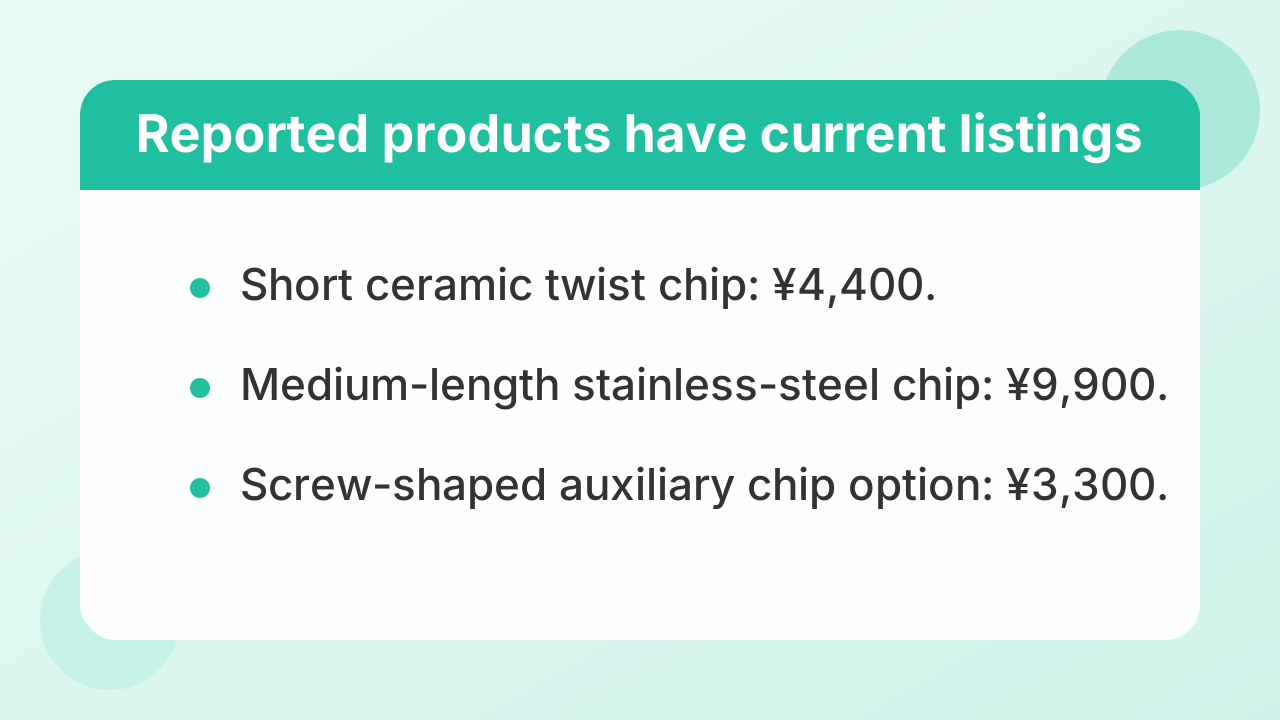
Current listings include products from both a discomfort question and a favorable retention report.
Products that appear in these entries
| Product (official name) | Price incl. tax | Relation to this topic |
|---|---|---|
| Short ceramic twist chip (OKプロステートチップ 陶器素材ショートタイプ ツイスト) | ¥4,400 (about $28 at ¥156 = $1, rate as of 2026-09-04) | A June 2021 customer reported discomfort with this chip and a zero-gap screw-shaped auxiliary chip. |
| Medium-length stainless-steel chip (OKプロステートチップ セミロングタイプ(サージカルステンレス)) | ¥9,900 (about $63 at ¥156 = $1, rate as of 2026-09-04) | An October 2022 customer reported that its narrow waist helped it act as a stopper. |
(Source: ok-lab's diary, published June 2021)
https://ok-lab.hatenablog.com/entry/2021/06/26/125926
(Source: ok-lab's diary, published October 2022)
https://ok-lab.hatenablog.com/entry/2022/10/01/122944
Products the diary mentioned as alternatives
| Product (official name) | Price incl. tax | Relation to this topic |
|---|---|---|
| Screw-shaped auxiliary chip option (スクリュー型補助チップ追加オプション) | ¥3,300 (about $21 at ¥156 = $1, rate as of 2026-09-04) | In December 2019, Mr. Okada suggested this accessory for slipping during urination, with his proposal also involving manual support. |
(Source: ok-lab's diary, published December 2019)
https://ok-lab.hatenablog.com/entry/2019/12/14/151232
Historical custom resin and glass builds, ridged ceramic variants, titanium chips, and early digital prototypes: No matching product can be confirmed on the current list.
Common worries about chip pinching and slipping
The reader questions distinguish gripping between separate parts, slipping outward, and discomfort during longer wear.
"Can separate chips provide the same tight grip?"
In an entry published in March 2018, a customer requested broader connected chips with more pronounced bulges to grip around the sphincter. Mr. Okada considered the idea useful against slipping, but described an important difference in the separate-type design.
Its parts contacted each other only temporarily during placement; afterward, they could not come together to pinch in the same way. His warning about the connected arrangement was that tissue could become trapped between the chips and hurt.
(Source: ok-lab's diary, published March 2018)
https://ok-lab.hatenablog.com/entry/20180317/1521275320
"What did Mr. Okada suggest for a chip slipping out?"
In an entry published in December 2019, a customer ordering a ridged ceramic variant asked about accessories or lubricant for unwanted expulsion. Mr. Okada said he lacked the knowledge to advise on lubricant.
He favored longer designs intended to catch at the bladder-side sphincter and thought pronounced projections could also resist outward movement. For slipping during urination, his preferred proposal involved a screw-shaped auxiliary chip and manual support. The diary does not record whether these suggestions resolved that customer's problem.
(Source: ok-lab's diary, published December 2019)
https://ok-lab.hatenablog.com/entry/2019/12/14/151232
"Could a tight grip explain discomfort after several hours?"
In an entry published in June 2021, a customer described muscle discomfort after approximately 3 hours with a short ceramic twist chip. Their screw-shaped auxiliary chip had a 0mm gap, and they asked about a shape suitable for longer wear.
Mr. Okada thought gripping between the accessory and chip end might become intolerable after a few hours. He considered retention at the main chip's final recess a gentler alternative to that tightly pinching arrangement. This was his explanation and proposed alternative; the diary does not record a subsequent result for the customer.
(Source: ok-lab's diary, published June 2021)
https://ok-lab.hatenablog.com/entry/2021/06/26/125926
Buying from outside Japan
OK Lab ships internationally to countries covered by Japan Post's EMS courier service. Overseas orders are paid in advance by PayPal. Each order carries a ¥400 (about $3 at ¥156 = $1, rate as of 2026-09-04) handling fee, and EMS shipping is charged on top. These terms come from OK Lab's official sales-terms page (written here as plain text, not a link: ok-lab.net/docs/law), checked on September 7, 2026; confirm them on the official store before you order, because they can change.
Summary of this article
| What you wanted to know | The answer |
|---|---|
| The short answer | Deep grooves brought reports of firmer grip, but also discomfort, bleeding, and continued slipping. |
| What the product is | A urethral device made by OK Lab in Japan. |
| What the shape terms mean | The waist is the narrowed section; surrounding bulges and groove openings affect the intended grip. |
| What happened in the cases | Custom shapes produced different experiences, including secure retention and inward movement. |
| What Mr. Okada proposed | Consider stoppers, material limits, and retention separately from stronger stimulation. |
| What changed over time | Hand-shaped experiments were followed by digital neck comparisons and thinner stainless-steel waists. |
| Which current products appear | The short ceramic twist chip and medium-length stainless-steel chip remain on the supplied list. |
| What customers asked | Whether separate parts grip alike, what counters slipping, and why extended wear became uncomfortable. |
| How overseas buying works | Advance PayPal payment, EMS shipping, and a ¥400 (about $3 at ¥156 = $1, rate as of 2026-09-04) handling fee under the stated terms. |
| What the accounts establish overall | Mr. Okada cautioned that a narrow waist alone did not guarantee the hold one customer described. |
Source: ok-lab's diary (Okada Comfortable Life Laboratory). The original entries are in Japanese; quotations on this page are translated. Photos and videos are on the original entries.
This article is a summary of the maker's development diary. The product is not a medical device and no result is guaranteed. If anything feels wrong or worries you, see a doctor. Prices, specifications and cautions change, so confirm the latest information on the official blog and the official site. Questions about ordering and shipping go to the seller.