![Will I have to pay if my chip breaks? | Repairs can cost extra, without guaranteed strength [OK Prostate Chip]](/img/a/T1037/eyecatch.svg)
This page is based on entries from "ok-lab's diary" (https://ok-lab.hatenablog.com/), the Japanese development diary written by Mr. Okada, founder of OK Lab, a small company in Japan (Okada Comfortable Life Laboratory). Only the entries about "repair costs and strength limits" are summarized here, in order of publication. Past prices and sizes are as written at the time. Current prices come from the official product list (retrieved September 4, 2026). Quotations are translated from Japanese.
Note: This page is a personal reading log by someone with no connection to the maker or the seller. It reflects the source entries as of their publication dates and makes no guarantee of accuracy or safety. The product is not a medical device; talk to a doctor about any health decision. Check the official site for current information. This page contains advertising.
In short
The diary describes paid repairs and reduced strength after some alterations or repairs.
Mr. Okada distinguished early defects from later failures and quoted repairs according to the damaged part.
The supplied current product list does not establish today's repair charges.
If you see blood in your urine, even a small amount or for the first time, do not wait and see. See a urologist right away.
If you suddenly cannot urinate, or the device cannot be removed, do not try to fix it yourself. Go to a medical facility, including emergency care, immediately.
About this product

The OK Prostate Chip is a small device that is placed in the urethra (the urine passage) so that it acts on the prostate; the maker sells it in several shapes, sizes and materials. It is made and sold by OK Lab (Okada Comfortable Life Laboratory), a small company in Japan, through its own online store, and prices are in Japanese yen (JPY). The maker's development diary, "ok-lab's diary", is written in Japanese. This page is an English summary of it, and every quotation is translated. OK Lab ships internationally, so readers outside Japan can order (see "Buying from outside Japan" below). Product names on this page are plain-English descriptions. The official Japanese product name is shown once in the product table so you can find the same item in the store.
Before you read: key terms
| Term | Plain-English meaning |
|---|---|
| Urethra | The urine passage; it is also where this device is placed. |
| Resin | Material used to cover components, secure attached thread, or reinforce broken ceramic. |
| Nylon thread | A line attached to the chip for retrieval; the diary discusses replacement when it breaks or detaches. |
| Motor | The component that produces vibration in a vibrating chip. |
| Flat motor | A flat version of the vibration-producing component, discussed in the motor-failure reports. |
| Controller | The electrical unit used to select vibration modes or supply power. |
| Rubber connection | A rubber-covered link between components, intended to provide a bend and some spring. |
| Waist | The narrow part of a chip's shape; a customer asked whether a deeper narrowing could help with fit. |
What happens: chip repair costs
The OK Prostate Chip is a device placed in the urethra, the urine passage, to act on the prostate. The repair questions concern its attached thread, vibrating components, electrical connections, and ceramic body. These parts secure the thread, provide vibration, or form the chip itself. The entries describe charges for restoring damaged parts and for making bulky sections smaller, alongside the maker's warnings about strength after that work.
Chip repair costs depended on where the electrical fault occurred
In an entry published in May 2019, a customer reported an electrical fault near the motor and asked about repair costs. Mr. Okada first asked whether the fault was inside the resin covering, the material surrounding the components. He offered free repair for a fault there, treating it as an initial defect.
For an identifiable cable fault, the quoted repair charge was ¥1,080 (about $7 at ¥156 = $1, rate as of 2026-09-04). Within 3 cm of the chip, motor-and-cable replacement cost ¥3,240 (about $21 at ¥156 = $1, rate as of 2026-09-04); the diary does not record whether this customer's repair was completed. Mr. Okada advised that faults in the cable or controller, the electrical control unit, would require paid repair.
(Source: ok-lab's diary, published May 2019)
https://ok-lab.hatenablog.com/entry/2019/05/18/150144
Thinner motor covers reduced size without guaranteeing long-term chip durability
In an entry published in August 2019, a customer wanted a thinner vibrating chip because its motor section would not fit. Mr. Okada said the 8 mm motor was about 4 mm thick before its protective covering. With resin, the thickness became about 6 mm, although he thought a thinner covering could bring it near 5 mm.
The customer requested the alteration, and Mr. Okada recorded a finished thickness of 5 mm. The diary does not record how the altered chip felt in use. Mr. Okada cautioned that he would test waterproofing before dispatch but could not guarantee long-term durability afterward.
(Source: ok-lab's diary, published August 2019)
https://ok-lab.hatenablog.com/entry/2019/08/10/125102
A smaller motor section carried chip repair costs without guaranteed durability
In an entry published in May 2020, a customer asked about a ceramic vibrating chip whose 10 mm motor section would not fit. The customer reported inflammation in the lower penile urethra for about 3 days after a forced attempt; it had since settled. Mr. Okada quoted ¥1,100 (about $7 at ¥156 = $1, rate as of 2026-09-04) for reducing the motor section to approximately 10.4 mm wide and 4.6 mm thick.
He also offered an 8 mm motor replacement for ¥3,300 (about $21 at ¥156 = $1, rate as of 2026-09-04) if a small reduction would not be enough. The diary does not record which option, if either, the customer chose. Mr. Okada warned that the reduced section would receive a waterproofing test, but its durability would not be guaranteed.
(Source: ok-lab's diary, published May 2020)
https://ok-lab.hatenablog.com/entry/2020/05/02/131505
A cracked rubber connection brought conditional chip repair costs
In an entry published in December 2020, a customer requested a stronger rubber connection, a flexible link between parts, for a custom chip. Its rubber covering had cracked after about 10 uses lasting roughly 1 hour each. Mr. Okada refused free repair: ¥1,100 (about $7 at ¥156 = $1, rate as of 2026-09-04) if the rubber came away cleanly, or ¥5,500 (about $35 at ¥156 = $1, rate as of 2026-09-04) for rebuilding, thread replacement, and bending.
The diary does not record whether the customer proceeded with either repair. No matching product can be confirmed on the current list. Mr. Okada proposed a connection no longer than 3 mm, which he believed would also provide more spring.
(Source: ok-lab's diary, published December 2020)
https://ok-lab.hatenablog.com/entry/2020/12/19/132929
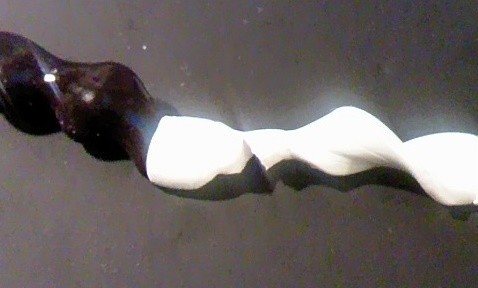
A mid-cable fault left chip repair costs undecided after inspection
In an entry published in July 2022, a customer reported that a custom vibrating chip stopped working during its second use. The customer asked whether the problem could be improved. After inspecting the returned item, Mr. Okada confirmed an electrical fault around the middle of its 20 cm cable.
He had not previously repaired that cable type, and the entry records neither a completed repair nor a final price. No matching product can be confirmed on the current list. Mr. Okada offered to consider a repair approach, while advising that the work would probably carry a charge.
(Source: ok-lab's diary, published July 2022)
https://ok-lab.hatenablog.com/entry/2022/07/30/122933
The maker's answer to chip repair costs
The maker offered several repair services, with conditions based on the fault, its timing, and the strength remaining afterward.
Early motor replacement established chip repair costs while testing continued
In an entry published in January 2019, Mr. Okada explained repair charges for an early long vibrating chip. If vibration stopped, replacement with a new motor and cable would cost ¥3,000, (about $19 at ¥156 = $1, rate as of 2026-09-04) tax excluded. He said testing the motor's durability still required at least several more months.
The temporary offer was therefore limited to long chips. No matching product can be confirmed on the current list. Mr. Okada welcomed reports of failures during this early period because they would help him assess durability.
(Source: ok-lab's diary, published January 2019)
https://ok-lab.hatenablog.com/entry/20190105/1546673405
An 8 mm motor reduction traded chip durability for less bulk
In an entry published in May 2020, a customer reported that an 8 mm motor section would not fit. Mr. Okada explained that the motor itself measured about 8 mm wide and 3.4 mm thick. Finished sections were usually 9–10 mm wide and 5–6 mm thick, which he attributed to the material needed for strength.
He offered a reduction to approximately 9 mm wide and 4.5 mm thick for ¥1,100 (about $7 at ¥156 = $1, rate as of 2026-09-04). The diary does not record whether this customer commissioned the alteration or whether it resolved the fit problem. Mr. Okada cautioned that waterproofing would be maintained, but durability could be lower.
(Source: ok-lab's diary, published May 2020)
https://ok-lab.hatenablog.com/entry/2020/05/02/131505
The repair warranty distinguished early motor faults from later failures
In an entry published in May 2022, a customer reported vibration stopping while changing controller modes on a newly received chip. Mr. Okada attributed intermittent stopping to variation among flat motors, the flat components producing vibration, measuring 8 mm or less. He said pre-dispatch checks could miss motors that stopped only occasionally.
He distinguished occasional stopping from repeated failures that made the product unusable. The diary does not record whether this customer's motor was replaced. Mr. Okada offered replacement for frequent stopping within 1 week of purchase; later failures after use would incur regular replacement fees.
(Source: ok-lab's diary, published May 2022)
https://ok-lab.hatenablog.com/entry/2022/05/21/124217
Ceramic chip repair could add bulk without restoring guaranteed strength
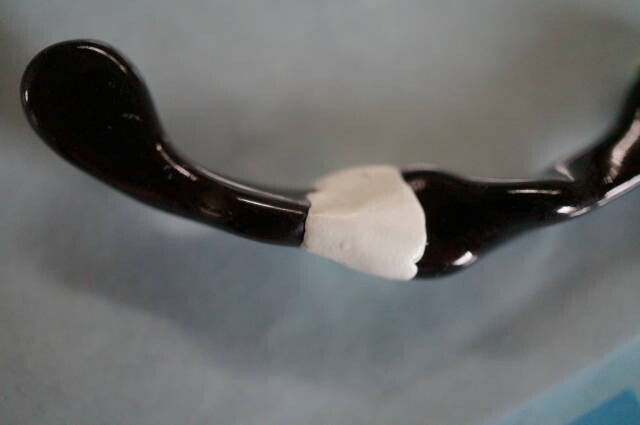
In an entry published in July 2024, a customer asked whether a long ceramic four-point twist chip broken in the Noto Peninsula earthquake was repairable. OK Lab's staff replied that repair depended on the break, normally involved a charge, and carried no guarantee of strength afterward. They also explained that reinforcement would make the chip thicker, wider, and less neat in appearance.
For this earthquake-damaged item, staff offered free repair if its condition allowed it. Mr. Okada subsequently described attempting the restoration, but the diary does not record the customer's experience with the repaired chip. Mr. Okada advised caution because the repair resin took time to become firm.
(Source: ok-lab's diary, published July 2024)
https://ok-lab.hatenablog.com/entry/2024/07/13/123018
If you see blood in your urine, even a small amount or for the first time, do not wait and see. See a urologist right away.
If you suddenly cannot urinate, or the device cannot be removed, do not try to fix it yourself. Go to a medical facility, including emergency care, immediately.
How chip repair costs changed over time
| Published | What the diary said then |
|---|---|
| Jan 2019 | Early motor offerings remained limited to long chips while durability testing continued. |
| May 2019 | Mr. Okada reported that even the 24-strand cable could break under repeated bending. |
| Aug 2019 | A completed thinning job reached 5 mm, without guaranteed long-term durability. |
| May 2020 | Four separate fit complaints prompted offers of paid alterations. |
| Dec 2020 | Mr. Okada suspected unequal rubber hardening times had weakened the connection. |
| May 2022 | Motor replacement costs mainly reflected labor, according to Mr. Okada. |
| Jul 2022 | Inspection confirmed an unusual fault within the cable, away from the motor. |
| Jul 2024 | Twisted ceramic shapes complicated restoration because the original alignment was difficult to identify. |
The diary does not say what the current state is.
OK Prostate Chip products related to chip repair costs
No current product is directly tied to this topic.
Common worries about chip repair costs
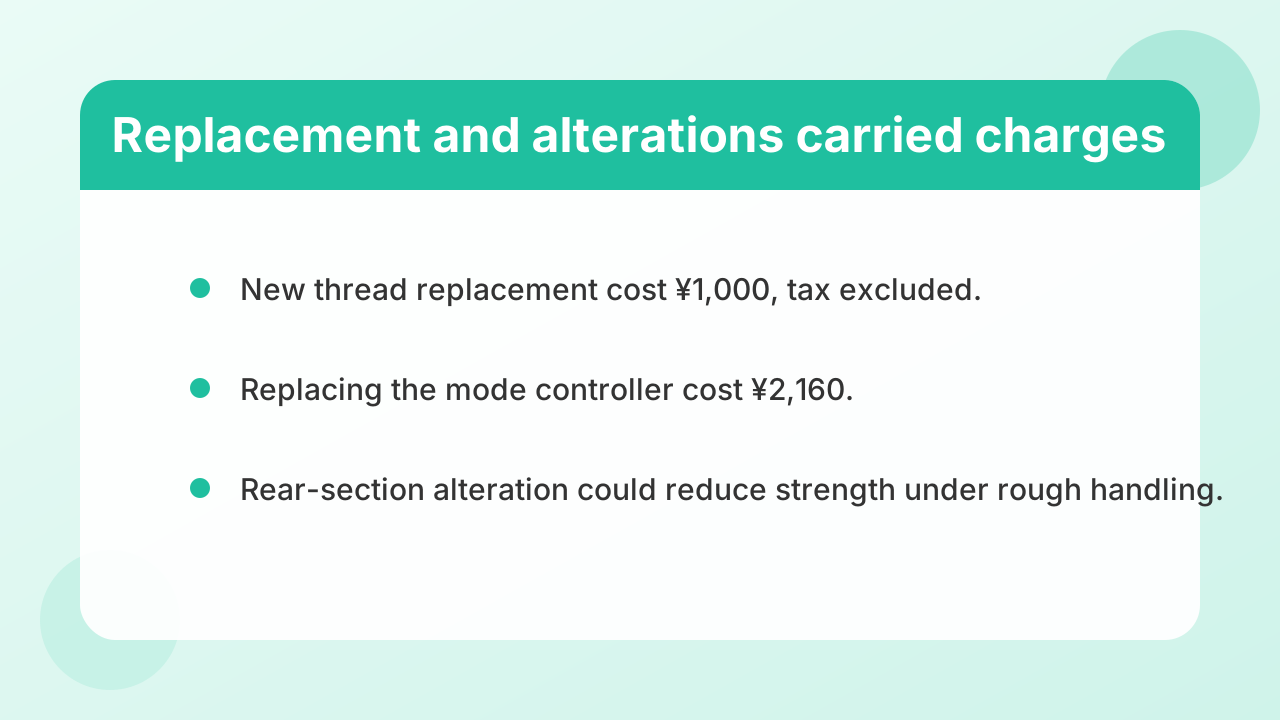
The replies distinguish thread replacement, controller replacement, and changes to ceramic shape.
"What were chip repair costs for a broken thread?"
The January 2019 entry addressed nylon thread, the line attached to a chip for retrieval, as well as vibrating components. Mr. Okada said replacement was available when the thread detached or broke. The charge for embedding a new thread was ¥1,000, (about $6 at ¥156 = $1, rate as of 2026-09-04) tax excluded, as published that month.
This was a service description rather than a customer case with a recorded repair outcome. Mr. Okada offered replacement of the damaged thread through that paid service.
(Source: ok-lab's diary, published January 2019)
https://ok-lab.hatenablog.com/entry/20190105/1546673405
"What were chip repair costs for the controller?"
The May 2019 customer's repair-price question also prompted Mr. Okada to explain controller replacement charges. Replacing the mode controller cost ¥2,160 (about $14 at ¥156 = $1, rate as of 2026-09-04), as published in that entry. A battery box without its electronic circuitry was ¥1,080 (about $7 at ¥156 = $1, rate as of 2026-09-04).
The reply set out options; it did not confirm that the customer's controller was the faulty component. Mr. Okada offered either replacement as paid work if the fault was in the controller.
(Source: ok-lab's diary, published May 2019)
https://ok-lab.hatenablog.com/entry/2019/05/18/150144
"Could chip repair reduce the ceramic rear section?"
In an entry published in May 2020, a customer requested smaller rear sections after difficulties with 3 ceramic chips. The smallest chip also became caught during removal, which the customer described as painful. Mr. Okada offered thread replacement for ¥1,100 (about $7 at ¥156 = $1, rate as of 2026-09-04) per chip, potentially reducing rear thickness and width by about 0.5 mm each.
The customer deferred sending the chips back and said further contact would depend on need. The diary does not record a completed alteration for that customer. Mr. Okada warned that these reductions could leave the rear section weaker under rough handling.
(Source: ok-lab's diary, published May 2020)
https://ok-lab.hatenablog.com/entry/2020/05/02/131505
"Could chip repair give ceramic a deeper waist?"
In a separate exchange published in May 2020, a customer asked about a deeper waist, the narrow part of the chip's shape. Their short ceramic chip would not fit, although they reported having used a single-chip resin model. Mr. Okada declined the requested shape because, he explained, ceramic needed sufficient thickness at its narrowest point for strength.
He instead offered a smaller rear section through paid thread replacement. The diary does not record whether this customer accepted that offer. Mr. Okada cautioned that the proposed rear-section alteration could reduce strength under rough handling.
(Source: ok-lab's diary, published May 2020)
https://ok-lab.hatenablog.com/entry/2020/05/02/131505
Buying from outside Japan

OK Lab ships internationally to countries covered by Japan Post's EMS courier service. Overseas orders are paid in advance by PayPal. Each order carries a ¥400 (about $3 at ¥156 = $1, rate as of 2026-09-04) handling fee, and EMS shipping is charged on top. These terms come from OK Lab's official sales-terms page (written here as plain text, not a link: ok-lab.net/docs/law), checked on September 7, 2026; confirm them on the official store before you order, because they can change.
Summary of this article
| What you wanted to know | The answer |
|---|---|
| The short answer | Repairs could carry charges, and some alterations or repairs came without guaranteed strength. |
| What the product is | A urethral device made by OK Lab, a small company in Japan. |
| What the repair terms mean | The entries distinguish thread, motors, controllers, protective coverings, and the ceramic body. |
| What problems were reported | Electrical faults, bulky motor sections, a cracked rubber connection, and broken ceramic. |
| What the maker offered | Paid replacement or alteration, with specific early-defect and earthquake-relief exceptions. |
| What changed over time | The diary added repair prices, size-reduction offers, defect limits, and ceramic-repair cautions. |
| Which current product addresses repair policy | No current product is directly tied to this topic. |
| What customers asked | Whether repairs were possible, what they cost, and whether altered parts could be smaller. |
| How overseas buying works | Advance PayPal payment, a ¥400 (about $3 at ¥156 = $1, rate as of 2026-09-04) handling fee, and additional EMS shipping. |
| What remains unknown today | The supplied list does not establish current repair charges or a current general repair warranty. |
Source: ok-lab's diary (Okada Comfortable Life Laboratory). The original entries are in Japanese; quotations on this page are translated. Photos and videos are on the original entries.
This article is a summary of the maker's development diary. The product is not a medical device and no result is guaranteed. If anything feels wrong or worries you, see a doctor. Prices, specifications and cautions change, so confirm the latest information on the official blog and the official site. Questions about ordering and shipping go to the seller.